

What if your industrial water strategy shifted from a multi-million dollar capital burden to a predictable monthly line item that scales with your production? With the global market projected to reach 4.53 billion USD in 2026, more facilities are abandoning traditional procurement for the flexibility of a mobile water treatment plant rental. It's no longer just a temporary fix for emergencies. It's a strategic logistical asset for data centers and semiconductor plants requiring immediate, high purity output.
You understand the pressure of the May 2026 EPA proposals regarding PFAS contaminants and the looming July 7 public hearing. Non-compliant discharge isn't an option. Unplanned downtime from equipment failure is too costly. This guide shows you how to master the technical and economic factors of mobile rentals to ensure rapid deployment and zero upfront CAPEX. We'll detail how utilizing containerized reverse osmosis plants with FilmTec membranes and Goulds Water Technology pumps provides the reliability your site demands. You'll learn to select systems that meet strict regulatory standards while maintaining operational continuity through precision-engineered filtration and pumping synergy.
Key Takeaways
- Identify critical deployment scenarios like maintenance bridging or equipment failure to maintain continuous site productivity and avoid regulatory fines.
- Evaluate high-performance membrane technologies from FilmTec and Hydranautics to achieve specific water purity requirements within containerized systems.
- Analyze the cost-benefit ratio of a mobile water treatment plant rental compared to permanent capital investment to optimize your operational budget and preserve CAPEX.
- Streamline site integration by coordinating high-efficiency Goulds Water Technology pumps with automated Walchem controllers for precise flow management and remote monitoring.
- Ensure long-term reliability by maintaining access to a specialized inventory of replacement filters and pressure gauges for rapid field repairs and system maintenance.
Why Mobile Water Treatment? Strategic Scenarios for Rental Fleet Deployment
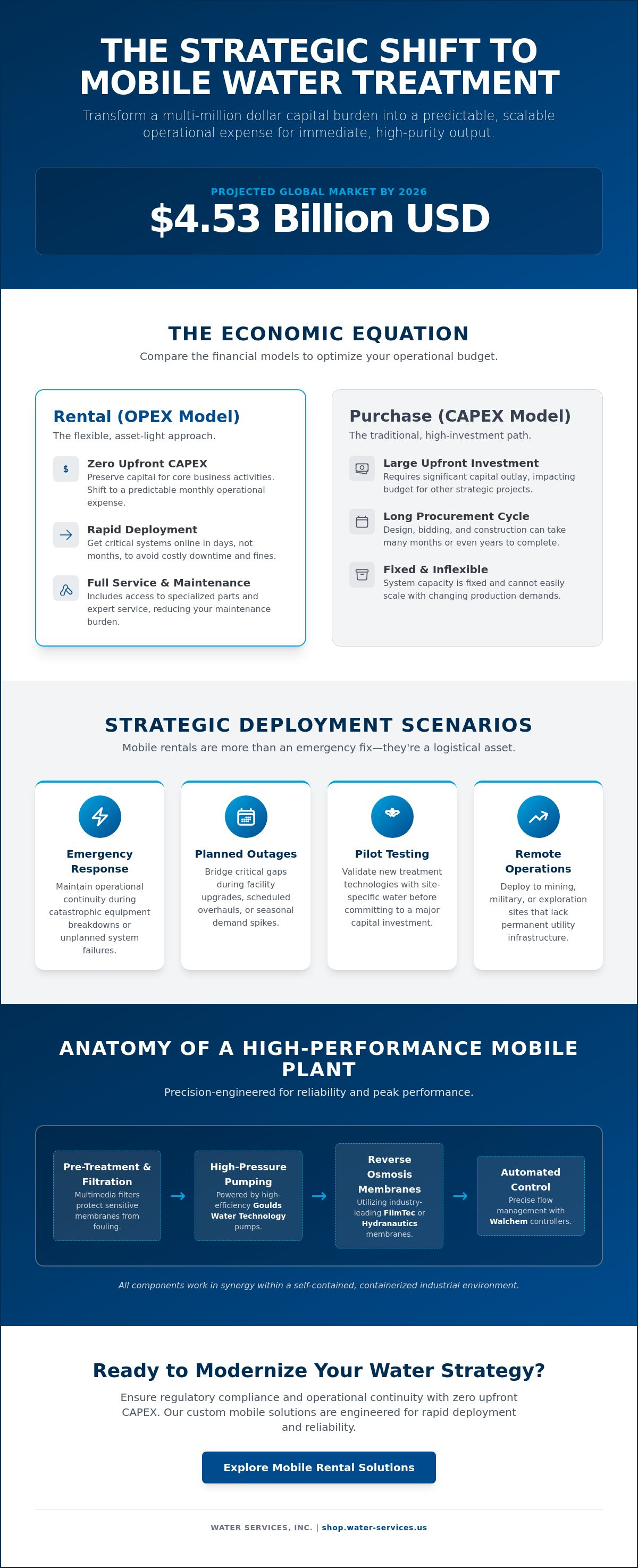
Industrial water management requires rapid logistical response. A mobile water treatment plant rental serves as more than an emergency backup. It's a strategic tool for maintaining operational continuity during catastrophic equipment breakdowns or unplanned system failures. These modular units bridge critical gaps when primary infrastructure undergoes large-scale facility upgrades or scheduled overhauls. Beyond maintenance, companies utilize mobile fleets to pilot test new treatment technologies. This allows for performance verification before committing to significant capital expenditures. It's a low-risk method to evaluate membrane performance or chemical efficacy on site-specific feed water before permanent installation.
Emergency Response vs. Planned Outages
The primary differentiator between emergency and planned deployment is the mobilization lead time. For unplanned outages, the cost of downtime often exceeds the premium for rapid equipment dispatch. Pre-approving rental vendors is a standard industrial practice to minimize these lead times. During these periods, a mobile water treatment plant rental provides the necessary redundancy to avoid regulatory fines from non-compliant discharge. Conversely, planned outages allow for capacity scaling to meet seasonal water demand fluctuations. This ensures production levels remain steady even when the main treatment train is offline for repair.
Remote Site Deployment: Mining and Military Needs
Remote mining exploration and military operations often lack permanent utility infrastructure. Containerized designs are engineered for transport to sites in Africa or South America via standard logistics channels. These units address specific challenges like brackish water and high-salinity intake in arid regions. Advancements in portable water purification technologies enable these mobile systems to produce high-purity water from diverse sources. These systems often integrate specialized filtration to handle high turbidity and suspended solids common in undeveloped areas. For industrial operators, implementing mining wastewater treatment solutions ensures regulatory compliance and facilitates resource recovery in water-scarce environments. This approach converts waste streams into reusable process water, reducing the environmental footprint and logistical burden of remote operations.
Core Technologies in Containerized Water Treatment Systems
Selecting a mobile water treatment plant rental requires a technical understanding of the hardware housed within the enclosure. These systems operate as self-contained industrial environments. They integrate advanced membrane separation, mechanical filtration, and chemical injection to meet specific effluent standards. Reliability depends on the synergy between high-performance components like FilmTec membranes and precise monitoring instruments. Every stage of the process must be engineered to handle variable influent quality without compromising the final product water.
Mobile Reverse Osmosis (RO) Units
Mobile RO units are configured for either brackish water or seawater desalination depending on the total dissolved solids (TDS) of the source. High-pressure configurations utilize Hydranautics or FilmTec membranes to achieve salt rejection rates exceeding 99%. These systems are critical for high-purity applications like boiler feed water or semiconductor rinsing. Efficiency in these units is measured by the recovery rate. Optimizing these rates is essential to minimize RO reject brine management costs, which can become a significant operational expense in zero liquid discharge (ZLD) strategies. Using high-flux membranes allows for higher throughput within the limited footprint of a standard shipping container.
Pre-Treatment and Filtration Modules
Protecting sensitive RO membranes from fouling is the primary function of pre-treatment modules. The use of multimedia filter tanks for industrial water treatment ensures that silt, sand, and other suspended solids are removed before they reach the high-pressure pumps. In specialized sectors like oil and gas, containerized units may include corrugated plate interceptor (CPI) technology to extract hydrocarbons. System integrity is monitored through a network of Ashcroft pressure gauges and Signet flow sensors. These instruments provide the real-time data necessary for Walchem controllers to adjust system parameters automatically. This level of automation reduces the need for constant on-site supervision while maintaining strict compliance.
Biological control and chemical stability are managed through integrated UV and dosing systems. Viqua UV water purification systems provide non-chemical disinfection for process water, neutralizing bacteria and viruses without altering the water's chemistry. For scale inhibition and pH adjustment, Pulsafeeder metering pumps deliver precise volumes of antiscalants. These pumps operate in tandem with Walchem controllers to ensure chemical delivery matches the real-time flow rate and water quality. If you're managing a complex site, accessing a broad range of water treatment components is vital for maintaining these high-precision systems during long-term deployments. This integrated approach ensures that a mobile water treatment plant rental delivers consistent results regardless of environmental challenges.
Evaluating the Economics: Rental vs. Capital Purchase
Financial flexibility defines the decision-making process for modern industrial water management. A mobile water treatment plant rental allows facilities to preserve capital for core business operations while addressing utility needs through operational expenditure (OPEX). This shift is reflected in the global mobile water treatment market, which is projected to reach 4.53 billion USD in 2026. For many organizations, the break-even point where rental costs meet the purchase price of a permanent installation typically occurs after 24 to 36 months of continuous operation. However, the immediate availability and lack of depreciation schedules make leasing a superior choice for projects with shorter timelines or uncertain durations.
Total Cost of Ownership (TCO) Analysis
Determining the true cost of water treatment requires looking beyond the monthly invoice. Owning a permanent system involves hidden expenses, including dedicated maintenance labor, specialized training, and the management of spare part inventories such as Harmsco filtration products or Ashcroft pressure gauges. A rental agreement typically bundles technical support and vendor-managed inventory into a single fee. This reduces the risk of unplanned downtime, as the provider is responsible for the technical integrity of the fleet. Mobilization and demobilization logistics are also critical factors. While these initial costs are higher for mobile units, they're offset by the elimination of permanent civil works and site preparation required for fixed infrastructure.
Feed Water Chemistry and System Sizing
Economic efficiency starts with precise engineering. Conducting a thorough water analysis prevents the common mistake of over-engineering rental units, which leads to paying for unused GPM capacity. The volume of water required dictates the number of containerized modules deployed to the site. For example, high-flow mining operations may require multiple units to handle heavy metal removal or high-salinity intake. Utilizing high-efficiency Goulds Water Technology pumps ensures that energy consumption remains optimized, directly impacting the daily operating cost. By matching the system size to the specific contaminants identified in the lab report, operators ensure they're only paying for the exact level of treatment required for regulatory compliance.
Tax advantages further strengthen the case for a mobile water treatment plant rental. Rental payments are often fully deductible as business expenses in the year they're paid, whereas capital equipment must be depreciated over several years. This improves immediate cash flow and liquidity. When combined with the ability to scale capacity up or down as production needs change, the rental model provides a level of financial agility that permanent installations cannot match. For global sites, this model also simplifies logistics, as the burden of equipment disposal and decommissioning at the end of a project rests with the equipment provider rather than the site operator.
Logistics and Integration: Deploying Your Mobile Plant
Successful deployment of a mobile water treatment plant rental depends on the seamless integration of mechanical and electrical subsystems. It isn't merely about positioning a container on site. It involves establishing reliable raw water intake and ensuring the electrical control architecture aligns with existing facility power. Precision at this stage prevents hydraulic imbalances that could lead to membrane fouling or system bypass. Every connection must be verified to maintain the technical integrity of the temporary utility.
Pumping and Flow Control Logistics
Selecting the correct intake pump is the first technical hurdle. Centrifugal pumps are standard for surface water, while submersible units are required for deep-well or sump applications. Integrating Goulds Water Technology Pumps ensures the system handles the specific head pressure and flow rate required by the primary treatment modules. Goulds pumps are essential in high-head mining applications where they must overcome significant vertical lift to deliver raw water to the treatment train.
Flow automation is managed through electric power controls and Walchem controllers. These systems prevent tank overflows and dry-run conditions by modulating pump speed based on real-time sensor data. Properly configured controls ensure the treatment plant operates within its design envelope, even during influent surges. This level of automation is critical for maintaining consistent output quality without constant manual intervention.
On-Site Commissioning and Training
Modern mobile units utilize standardized "Plug-and-Play" connections to minimize installation time. These cam-lock or flanged interfaces allow for rapid connection to existing pipework. Once mechanical connections are secure, commissioning involves verifying the calibration of Signet flow sensors and Ashcroft pressure gauges. These instruments provide the feedback loop necessary for the Walchem controllers to maintain system stability.
Training on-site personnel is the final step in deployment. Local operators must understand how to perform daily monitoring and replace consumables like replacement sediment and carbon filters. Establishing remote monitoring protocols allows for off-site performance tracking. This ensures the system maintains compliance with local discharge permits and the evolving 2026 EPA standards regarding PFAS and other contaminants.
Personnel safety during commissioning and operation is paramount. All staff must be equipped with appropriate personal protective equipment (PPE) to handle chemical dosing and high-pressure maintenance tasks. For sites requiring immediate hardware support or replacement parts, you can purchase industrial water treatment components directly to ensure your mobile plant remains operational without delay. This proactive approach to logistics ensures that your mobile water treatment plant rental delivers reliable performance from the first hour of mobilization.
Custom Mobile Solutions from Water Services, Inc.
Engineering a mobile water treatment plant rental requires a focus on logistical durability and technical precision. Water Services, Inc. designs modular systems that function as standalone industrial utilities, capable of rapid deployment to high-demand environments. These plants aren't generic assemblies; they're curated configurations utilizing industry-standard components like FilmTec membranes and Goulds pumps. By prioritizing a modular architecture, we ensure that every system remains adaptable to the specific project lifecycles of mining, manufacturing, and municipal sectors.
Modular Design for Global Reach
Standardized shipping container footprints are the foundation of our global distribution strategy. Whether shipping a 20-foot or 40-foot unit, these systems are designed for seamless international ocean freight and rail transport. This logistical compatibility allows us to support remote projects across Africa, the Middle East, and the Americas without the delays associated with oversized cargo. Our engineering team, headquartered in Provo, Utah, develops these units to withstand extreme climates, from sub-zero temperatures to high-heat desert mining environments.
Technical integrity is maintained by ensuring all internal components meet international electrical and safety standards. This includes the integration of Walchem controllers and Signet sensors that are globally recognized for reliability. By adhering to these rigorous specifications, our mobile units provide a stable platform for high-purity water production regardless of the site's geographic or environmental constraints.
Full-Lifecycle Technical Support
Operational continuity depends on the immediate availability of replacement parts and consumables. We maintain a comprehensive inventory of water treatment components to facilitate rapid field repairs. This inventory includes everything from replacement sediment filters to high-pressure Ashcroft gauges. Our global distribution network ensures that sites in remote regions receive critical hardware, such as replacement membranes or Pulsafeeder metering pumps, without extended lead times.
Maintaining regulatory compliance requires consistent chemical management. As a specialized water treatment chemicals distributor, we provide the antiscalants and cleaning agents necessary to protect your RO membranes from fouling. Direct access to our engineering teams allows for custom system modifications if feed water chemistry shifts during the project lifecycle. This full-spectrum support model ensures that your mobile water treatment plant rental remains an asset rather than a liability, providing the technical reliability required for 2026 industrial standards.
Flexible rental and leasing options are tailored to match the specific duration of your project. This allows for precise budget management, converting what would be a large capital hurdle into a manageable operational expense. Our track record in delivering high-purity water solutions to the world's most demanding sites makes us a dependable partner for your next temporary or long-term water management challenge.
Optimizing Industrial Water Strategy for 2026 and Beyond
Industrial water management in 2026 requires balancing immediate regulatory compliance with long-term financial stability. Transitioning to a mobile water treatment plant rental model allows facilities to bypass high CAPEX hurdles while maintaining the technical integrity of their discharge streams. By integrating authorized components from Goulds, Viqua, and FilmTec, operators ensure their temporary systems meet the same rigorous standards as permanent infrastructure. This approach effectively mitigates the risk of unplanned downtime and ensures adherence to evolving EPA standards for PFAS and salinity.
Water Services, Inc. brings over 30 years of industrial expertise to every deployment. Founded in 1994, we serve as an authorized distributor for world-class manufacturers, ensuring your site receives only verified, high-performance hardware. Our proven track record includes global installations across Africa, South America, and the Middle East, proving our capability in the most demanding environments. It's time to shift your water strategy from a capital burden to a flexible, high-performance asset. Request a Custom Mobile Treatment Rental Quote today to secure your facility's operational continuity. Your site's compliance and efficiency are achievable through our precision-engineered modular solutions.
Frequently Asked Questions
How fast can a mobile water treatment plant be deployed to a remote site?
Mobilization speed for a mobile water treatment plant rental typically ranges from 48 hours for emergency domestic dispatch to several weeks for international ocean freight. Logistics depend on the proximity of the fleet to the site and the complexity of the required pre-treatment. Pre-approving vendors and establishing site-specific connection points like cam-lock fittings significantly reduces the time required for on-site commissioning.
What industries benefit most from mobile water treatment rentals?
Data centers, semiconductor manufacturing, and mining operations are the primary beneficiaries of mobile treatment fleets. These sectors require consistent, high-purity water to protect sensitive equipment and maintain production schedules. Construction sites also utilize these systems to manage groundwater discharge and meet strict environmental compliance standards during large-scale facility upgrades or unplanned system failures.
Can mobile units handle high-salinity or brackish water sources?
Mobile units are specifically engineered to treat high-salinity and brackish water sources using high-rejection RO membranes. Configuration depends on the Feed Water Total Dissolved Solids (TDS) levels. Utilizing Hydranautics or FilmTec seawater membranes allows these containerized systems to produce potable or process water from sources that would otherwise be unusable in arid mining or coastal regions.
What are the typical power requirements for a containerized RO system?
Typical containerized RO systems require 460V, 3-phase, 60Hz electrical service for industrial operation. The specific amperage depends on the GPM flow rate and the pressure requirements of the integrated high-efficiency Goulds Water Technology pumps. Small units might operate on lower power, but industrial-scale containerized plants often require a dedicated transformer or a high-capacity generator for remote site operation.
Is technical support included in the mobile water treatment rental fee?
Technical support is generally integrated into the rental agreement to ensure system reliability and continuous performance. This includes access to engineering teams for remote troubleshooting and the provision of replacement parts like Pulsafeeder metering pumps or Signet sensors. Operators should verify whether the fee covers on-site technician visits or if support is limited to remote guidance and component replacement logistics.
Are mobile water treatment systems compliant with EPA and local discharge regulations?
Mobile systems are designed to meet or exceed EPA and local discharge regulations, including the 2026 PFAS standards. Compliance is achieved through a combination of ultrafiltration, reverse osmosis, and precise chemical dosing. Utilizing Walchem controllers ensures real-time monitoring of effluent quality, providing the data logs necessary to prove regulatory adherence and avoid costly environmental fines at your site.
What is the difference between a skid-mounted and a containerized rental unit?
Skid-mounted units are designed for installation within an existing building, while containerized units are self-contained for outdoor or remote use. Containerized systems provide integrated environmental protection, HVAC, and lighting, making them suitable for extreme climates. Skid-mounted rentals are typically more compact and easier to maneuver through standard industrial doorways for indoor facility upgrades or temporary pilot testing.
How long can a mobile water treatment plant be rented for?
Rental durations are highly flexible, ranging from short-term emergency needs of two weeks to multi-year bridge contracts. Many industrial projects utilize a mobile water treatment plant rental for 12 to 24 months during permanent facility construction. This flexibility allows organizations to adjust their water treatment capacity based on fluctuating production demands without committing to long-term capital ownership or depreciation.
0 comentarios