

With the EPA’s 2026 Multi-Sector General Permit now requiring quarterly monitoring for 40 different PFAS compounds across 23 industrial sectors, your pretreatment strategy is now a matter of regulatory compliance. You already know that even a minor increase in Total Suspended Solids (TSS) leads to irreversible RO membrane fouling and costly system pressure drops. High-performance multimedia filter tanks for industrial water treatment provide the essential depth-loading capacity required to manage industrial-scale turbidity. These systems are critical for removing particles down to the 15-20 micron range before they reach your sensitive downstream components.
We understand that achieving consistent results in harsh environments is difficult when media replacement and system complexity interfere with production. This article will show you how to master technical specifications and media layering to maintain turbidity levels below 1 NTU. You'll learn to optimize service flow rates between 3 and 7 gpm/sq ft and select the right tank configurations to protect your FilmTec or Hydranautics membranes. We provide a technical breakdown of the engineering standards needed to ensure your water treatment infrastructure remains reliable and efficient throughout 2026.
Key Takeaways
- Evaluate the physics of media layering and specific gravity to maintain depth filtration efficiency through repeated backwash cycles.
- Identify how multimedia filter tanks for industrial water treatment function as a robust front line to prevent premature fouling of FilmTec and Hydranautics membranes.
- Analyze the CAPEX and OPEX trade-offs between multimedia systems and cartridge filtration to optimize long-term filtration costs.
- Calculate critical flux rates and select heavy-duty materials like epoxy-lined carbon steel to ensure tank durability in harsh industrial applications.
- Discover the engineering requirements for integrating high-capacity filtration into containerized and mobile systems for remote site deployment.
Understanding Multimedia Filter Tanks in Industrial Water Treatment
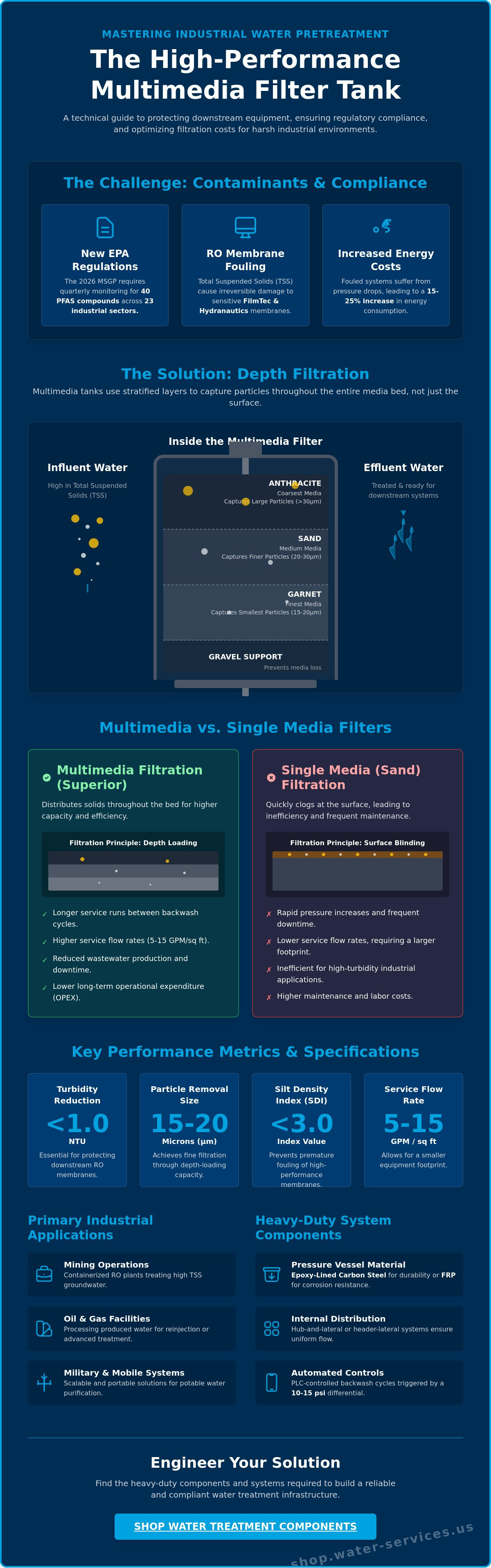
Multimedia filter tanks for industrial water treatment are pressure-driven vessels engineered to remove suspended solids through depth filtration. These systems utilize stratified layers of media, typically consisting of anthracite, sand, and garnet, to capture contaminants throughout the entire bed. This design follows established multimedia filtration principles where the coarsest media sits at the top and the finest at the bottom. This arrangement allows larger particles to be trapped in the upper layers while smaller particles are caught deeper in the bed, significantly increasing the solids-loading capacity compared to single-media systems.
Industrial operators rely on these tanks as the essential front line for protecting sensitive downstream equipment. High-performance FilmTec and Hydranautics RO membranes require feed water with low particulate counts to prevent irreversible fouling. A well-engineered multimedia system consistently reduces the Silt Density Index (SDI) to levels below 3.0 and maintains turbidity under 1.0 NTU. By removing these solids early, facilities prevent the 15% to 25% increase in energy costs often associated with fouled reverse osmosis systems. You can find specialized components for these setups in our water treatment collection.
Efficiency drives the preference for multimedia over traditional sand filters. Single-media filters often suffer from surface blinding, where a thin layer of sediment blocks the entire flow. Multimedia tanks support higher service flow rates, typically ranging from 5 to 15 GPM per square foot. This allows for a smaller equipment footprint while handling the high-volume requirements of industrial sites. The stratified layers also ensure longer run times between backwash cycles, which reduces overall wastewater production.
The Core Components of an Industrial Filter Tank
The structural integrity of the system depends on the pressure vessel material. Epoxy-lined carbon steel is the standard for heavy-duty industrial environments due to its durability and pressure ratings. FRP (Fiber Reinforced Plastic) vessels are utilized where corrosion resistance and weight are primary concerns. Internal distribution is managed through hub-and-lateral or header-lateral systems to ensure uniform water flow and prevent media migration. Modern systems utilize automatic PLC-controlled valves to trigger backwash cycles based on a differential pressure of 10 to 15 psi, ensuring consistent performance without manual intervention.
Primary Applications: From Mining to Military
In remote mining operations, multimedia tanks are integrated into containerized RO plants to treat groundwater with high Total Suspended Solids (TSS). Oil and gas facilities use these tanks to process produced water before reinjection or advanced treatment. For military applications, the technology provides a scalable and portable solution for drinking water purification. These units must survive harsh environments while delivering reliable turbidity reduction to meet strict potable water standards. Whether deployed in a fixed factory or a mobile unit, the engineering remains focused on high-capacity sediment removal and system reliability.
The Mechanical Principles of Depth Filtration and Media Layering
Depth filtration in multimedia filter tanks for industrial water treatment works by utilizing the entire volume of the media bed rather than just the top surface. In a standard sand filter, particles accumulate on the surface, causing rapid pressure increases and frequent downtime. Multimedia tanks distribute the solids load by placing coarse media at the top and finer media at the bottom. Large particles, often 100 microns or larger, are trapped in the upper anthracite layer. Finer particles down to 15 or 20 microns penetrate deeper into the sand and garnet. This hierarchical capture ensures the bed remains porous for longer durations, extending service cycles and reducing backwash frequency.
The careful selection of media ensures that smaller grain sizes fill the void spaces created by larger grains, effectively reducing the overall pore size without sacrificing hydraulic capacity. Density governs the position of each layer. Re-stratification after a backwash cycle is governed by the specific gravity of each material. Anthracite has the lowest specific gravity, typically 1.4 to 1.6, allowing it to settle on top. Silica sand follows with a specific gravity of 2.65. Garnet is the densest material at 3.8 to 4.2, ensuring it settled at the bottom. This density gradient ensures that even after a high-velocity backwash of 12 to 15 GPM/sq ft, the media layers return to their engineered positions.
Media Profiles: Anthracite, Sand, and Garnet
- Anthracite: This carbonaceous material provides the primary dirt-holding capacity. Its angular shape creates large interstitial spaces for heavy sediment capture.
- Silica Sand: Positioned as the intermediate layer, sand removes the bulk of turbidity and fine sediment that bypasses the anthracite.
- Garnet: Using both fine and coarse grades provides a final polishing step. The heavy garnet layer also acts as a stable support for the lighter media above it.
Stream Liner Technology in High-Flow Filtration
Maintaining laminar flow is critical for preventing "mud balling" and media loss. Internal stream liners or distribution baffles ensure water enters the tank without creating localized high-velocity zones. If flow is not uniform, channeling occurs. This allows raw water to bypass the media entirely, leading to high SDI values and potential damage to downstream RO membrane systems. Proper flow distribution is especially vital when designing modular and containerized systems where space constraints can amplify hydraulic turbulence. For high-temperature or corrosive applications, these internal components must be fabricated from 316L stainless steel or specialized chemical-resistant polymers to ensure long-term mechanical integrity.
Comparing Multimedia Filtration to Alternative Pre-treatment Technologies
Selecting the right pretreatment technology requires a balance between initial capital expenditure (CAPEX) and long-term operational costs (OPEX). Multimedia filter tanks for industrial water treatment offer a distinct advantage over single-media sand filters in terms of hydraulic efficiency and physical footprint. While a standard sand filter typically operates at 2 to 3 GPM per square foot, a multimedia system handles 5 to 15 GPM per square foot. This higher flux rate allows engineers to specify smaller vessels to achieve the same throughput, reducing the required floor space by up to 50% in high-flow industrial applications.
The choice between multimedia tanks and cartridge filtration often comes down to the "break-even" point of consumable costs. Cartridge housings have a lower CAPEX but require frequent purchases of replacement filters. In systems with Total Suspended Solids (TSS) exceeding 5 to 10 ppm, cartridge filters foul rapidly, leading to excessive labor and disposal costs. Multimedia systems represent a higher initial investment but utilize permanent media that lasts for years. For continuous industrial processes, the transition to multimedia filtration typically pays for itself within 12 to 18 months through reduced consumable spending and minimized system downtime.
Ultrafiltration (UF) has emerged as a high-purity alternative for facilities with low-TSS feed water. UF membranes provide a physical barrier against sub-micron particles and pathogens that multimedia cannot capture. However, UF systems are more sensitive to high turbidity spikes and require complex chemical cleaning regimes. When evaluating multimedia filter tanks for industrial water treatment against alternative technologies, the primary driver is the ability to handle high solids loading without constant manual intervention.
Operational Costs and Maintenance Logistics
Maintenance for multimedia systems is predictable and utilitarian. The filter media typically requires a full bed replacement every 3 to 5 years, depending on the abrasive nature of the raw water. Backwash water consumption is a critical metric for operational efficiency. In most industrial settings, the backwash process consumes between 2% and 5% of the total treated water volume. Operators must account for this waste stream when sizing feed pumps and storage tanks to ensure continuous supply to downstream processes.
Performance Benchmarks: Micron Ratings and SDI
Multimedia systems effectively target the 5 to 15 micron range. This performance is vital for protecting downstream Reverse Osmosis systems from particulate fouling. By maintaining a Silt Density Index (SDI) below 3.0, these tanks extend the life of FilmTec and Hydranautics membranes. While multimedia filtration is highly effective for bulk sediment removal, it cannot remove dissolved solids or sub-micron colloidal silica. If your process requires sub-micron clarity, multimedia should be followed by polishing filters or ultrafiltration units.
Engineering Specifications: Sizing and Material Selection
Engineering multimedia filter tanks for industrial water treatment requires precise hydraulic calculations to prevent bed compaction and media migration. The primary metric for sizing is flux, expressed in GPM per square foot of filter area. For high-turbidity feeds common in mining or municipal runoff, flux rates should be limited to 3 to 5 GPM/sq ft to maximize solids retention. In contrast, polished water applications can handle up to 15 GPM/sq ft. Exceeding these limits forces particles through the bed, leading to breakthrough and downstream fouling of RO membranes.
Material selection depends on the chemical composition of the influent and the site environment. Epoxy-lined carbon steel is the preferred choice for mining wastewater and heavy industrial applications due to its superior structural rigidity and abrasion resistance. While FRP vessels are suitable for smaller commercial loads, they lack the durability required for the high-vibration and high-pressure environments found in oil and gas operations. Standard vessels are rated for 100 PSI, but custom high-pressure tanks are necessary for deep-well injection or long-distance pipeline transport where pressures can exceed 150 PSI.
Backwash flow requirements often exceed service flow rates by 50% to 100%. Selecting high-capacity industrial pumps ensures the bed expands sufficiently to release trapped sediment during the cleaning cycle. Without adequate backwash velocity, typically 12 to 15 GPM/sq ft, the media bed will eventually solidify into "mud balls," rendering the system ineffective.
Sizing the Filter for Your Flow Rate
Designing for system redundancy is standard practice. Facilities with continuous operations utilize Lead/Lag or Parallel configurations. This allows one tank to backwash while the others maintain the required system flow. Tank diameter is calculated by dividing the peak flow rate by the target flux. For example, a 100 GPM system operating at 5 GPM/sq ft requires 20 square feet of filter area, necessitating a 60-inch diameter vessel. Automated backwash sequences are managed via electric power controls and PLC systems that monitor differential pressure or time-based triggers.
Material Durability and Chemical Compatibility
In oil and gas sectors, produced water contains hydrocarbons and corrosive salts that demand specialized internal liners like vinyl ester or phenolic epoxies. Site safety protocols often dictate the use of ASME Section VIII Code-stamped vessels, particularly in high-occupancy industrial zones or high-pressure applications. For desert or tropical deployments, external coatings must include UV-resistant polyurethane finishes to prevent structural degradation from solar radiation. These specifications ensure that multimedia filter tanks for industrial water treatment survive the 20 to 25 year service life expected in heavy industry.
Build your infrastructure with high-performance industrial-grade water treatment equipment designed for global logistics and extreme environments.
Integrating Multimedia Filtration into Modular and Containerized Systems
Modular designs represent the final evolution of water treatment infrastructure for decentralized applications. Integrating multimedia filter tanks for industrial water treatment into containerized systems allows for rapid deployment at remote mining or military installations. These "plug-and-play" units arrive at the site pre-plumbed and pre-tested, reducing installation time by up to 70% compared to traditional stick-built plants. Space optimization is a critical engineering requirement. A standard 40ft shipping container can house a complete treatment train, including multiple filter vessels, chemical dosing stations, and reverse osmosis membranes.
Water Services, Inc. utilizes these integrated designs to provide efficient mining wastewater treatment solutions. By mounting multimedia filter tanks for industrial water treatment on heavy-duty steel skids, the equipment remains protected during transit and operational use in harsh environments. Global logistics play a major role in system specification. For domestic projects, we often ship vessels pre-loaded with media to simplify startup. For international sites, we ship media in separate 50lb bags or 2000lb super-sacks to reduce shipping weight and prevent internal damage during ocean transit.
Modular System Design Principles
Skid-mounting enables rapid deployment and simplified site relocation. Integrated piping manifolds allow for multi-tank parallel operation, ensuring that system flow remains uninterrupted during backwash cycles. These systems feature pre-wired Walchem controllers that integrate directly with existing SCADA networks. This connectivity allows engineers to monitor pressure drops and flow rates in real-time for systems located thousands of miles from our home base. The use of standardized components across the skid ensures that maintenance remains predictable and parts are easily sourced.
Maintenance and Training for Remote Operations
Remote sites often lack specialized water treatment technicians. We design operator interfaces to be intuitive and utilitarian, focusing on essential data points like differential pressure and turbidity levels. Every modular system includes a comprehensive spare parts kit containing essential gaskets, valves, and O-rings. Safety is prioritized by including necessary personal protective equipment for handling media and maintenance chemicals. Remote troubleshooting via IoT sensors allows our technical team to optimize backwash sequences and extend media life without requiring an on-site visit. This logistical competence ensures that your water treatment infrastructure remains operational regardless of geographical challenges.
Optimizing Industrial Water Treatment Infrastructure
The transition toward more stringent industrial effluent standards requires a shift from surface-level filtration to engineered depth-loading systems. You've seen how multimedia filter tanks for industrial water treatment provide the necessary 15-20 micron removal efficiency to protect high-value reverse osmosis membranes. By prioritizing heavy-duty materials and automated controls, facilities in the mining and oil sectors maintain consistent turbidity reduction even in harsh environments.
Water Services, Inc. has provided global engineering expertise since 1994, delivering specialized water solutions for military and industrial applications. Our logistics team coordinates worldwide shipping from our Provo, Utah headquarters to ensure your equipment arrives ready for field deployment. Whether you require a standalone vessel or a fully containerized plant, our technical integrity remains the standard for the industry.
Shop Multimedia Filter Tanks and Components at Water Services, Inc. to secure the hardware your facility needs for long-term operational success. We're ready to support your next project with reliable equipment you can trust and rely on.
Frequently Asked Questions
What is the typical micron rating for an industrial multimedia filter?
Industrial multimedia filters typically achieve a micron rating of 15 to 20 microns. While some specialized configurations claim filtration down to 10 microns, the standard depth-filtration bed captures the bulk of sediment within this 15-20 micron range. This performance ensures that downstream cartridge filters or RO membranes aren't overloaded with large particulates.
How often should the media in a multimedia filter tank be replaced?
The media in a multimedia filter tank should be replaced every 3 to 5 years under normal operating conditions. Highly abrasive influent or frequent chemical shocks can shorten this lifespan to 2 years. Operators should monitor the bed for "mud balling" or media loss during backwash cycles to determine if a full bed refresh is necessary for continued performance.
Can multimedia filters remove dissolved chemicals or heavy metals?
Multimedia filters don't remove dissolved chemicals, dissolved heavy metals, or salts. Their primary function is the removal of suspended solids and turbidity through physical entrapment. If your application requires the removal of dissolved contaminants, you must integrate secondary stages like activated carbon, ion exchange, or Hydranautics RO membranes into your treatment train.
What is the difference between a sand filter and a multimedia filter?
The primary difference is that multimedia filters utilize depth filtration while sand filters rely on surface filtration. Multimedia systems use multiple layers of varying density and grain size, allowing for service flow rates of 5 to 15 GPM per square foot. This is significantly higher than the 2 to 3 GPM per square foot typical of single-media sand filters, allowing for a smaller equipment footprint.
How much pressure drop is normal across a clean multimedia filter bed?
A clean multimedia filter bed typically exhibits a pressure drop between 3 and 5 psi at rated flow. As the bed captures sediment, this differential pressure will increase. Most automated systems are programmed to trigger a backwash cycle once the pressure drop reaches a threshold of 10 to 12 psi to prevent bed compaction and channeling.
What flow rate (GPM per square foot) is recommended for industrial multimedia tanks?
For effective multimedia filter tanks for industrial water treatment, the service flow rate should be maintained between 3 and 7 GPM per square foot. While some systems can handle higher flux, lower rates improve turbidity reduction and extend run times. Backwash rates are much higher, requiring 12 to 15 GPM per square foot to ensure the bed expands and releases trapped solids.
Is backwashing a multimedia filter mandatory, and how long does it take?
Backwashing is mandatory to prevent the filter bed from blinding and becoming a solid mass. A typical backwash sequence takes 10 to 15 minutes, followed by a 5-minute rinse cycle to re-settle the media layers. Failure to backwash results in high pressure drops and breakthrough, where contaminants are forced through the media into the treated water stream.
Can multimedia filter tanks be used for seawater desalination pre-treatment?
Multimedia filter tanks are a standard pre-treatment requirement for seawater desalination systems to protect RO membranes from organic and inorganic particulates. In these applications, the vessels must be constructed from corrosion-resistant materials like FRP or high-grade stainless steel. They effectively reduce the Silt Density Index (SDI) of seawater to levels acceptable for high-pressure desalination pumps.
0 comments