

An RO membrane can reject dissolved salts, but particles in the feed can still contribute to fouling. UF as a pretreatment for reverse osmosis removes suspended material before the water reaches the RO stage, helping reduce particulate loading on the membrane. It does not remove dissolved salts, so it complements rather than replaces RO treatment.
That distinction matters when assessing pretreatment: clearer feed can help, but it does not eliminate every cause of fouling. Dissolved organics, biological growth, and mineral scaling can still affect RO performance and cleaning needs.
This article explains how UF pore size affects contaminant removal, what UF can and cannot remove, and how those effects influence RO fouling and chemical cleaning. It also shows how the treatment stages fit together and why feed-water characteristics matter when assessing a UF-RO system.
Key Takeaways
- Compare UF pore size with the particles you need to remove; this helps clarify what the membrane can intercept before water reaches RO.
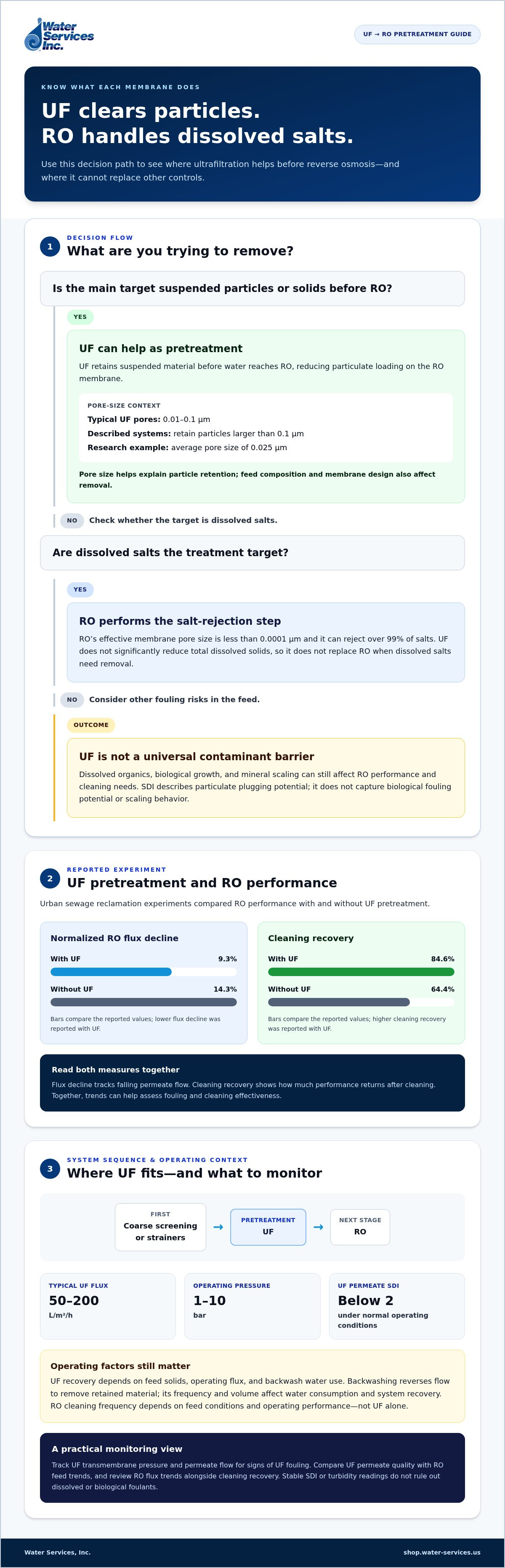
- In urban sewage reclamation experiments, RO flux decline was 9.3% with UF pretreatment versus 14.3% without it, while cleaning recovery was 84.6% versus 64.4%.
- Use SDI as one feed-water indicator, not a complete fouling prediction; it does not capture biological fouling potential or scaling behavior.
- Assess the full pretreatment train and feed-water conditions together to understand where UF can reduce RO fouling and chemical-cleaning demands.
Effects on RO fouling and chemical cleaning
UF pretreatment reduces particulate loading on the RO membrane, which can affect flux decline, cleaning recovery, and cleaning frequency.
RO Flux Decline and Cleaning Recovery
Flux decline measures falling permeate flow, while cleaning recovery shows how much performance returns after cleaning. Both help operators assess fouling and the effectiveness of a chemical-cleaning cycle. In urban sewage reclamation experiments, normalized RO flux decline was 9.3% with UF pretreatment, compared with 14.3% without it. Cleaning recovery was 84.6% with UF and 64.4% without UF. These results show how pretreatment can reduce fouling pressure and support better recovery after cleaning.
UF pretreatment can reduce particulates, but dissolved substances may remain in the feed to RO. Dissolved compounds, scaling precursors, and bacteria can still contribute to fouling. Track normalized flux and cleaning recovery together: changes in both can help distinguish worsening feed-related fouling from cleaning that restores less membrane performance.
UF and Conventional Media Filtration
UF uses a membrane barrier, while conventional media filtration captures particles as water passes through filter media. The distinction matters because suspended-solids removal affects RO feed quality and subsequent cleaning demand. In seawater RO pretreatment research, both coagulation-integrated sand filtration and UF maintained turbidity below 0.1 NTU and SDI under 2. Those results show that performance depends on the treatment design, not simply the filtration category.
For drinking-water RO in the United States, projects must address applicable finished-water quality and monitoring requirements. UF pretreatment is designed around feed quality and RO inlet targets. There is no single regulatory number for UF pore size or pretreatment that applies to every system.
Typical UF flux is 50-200 L/m2/h. UF recovery depends on feed solids, operating flux, and the water used for backwashing. Backwash reverses flow to remove retained material; its frequency and volume influence water consumption and system recovery. RO cleaning frequency likewise depends on feed conditions and operating performance, rather than UF alone.
By reducing suspended solids, UF can reduce particulate fouling and the associated need for chemical cleaning. It does not set a fixed RO membrane lifespan: scaling, biological growth, operating conditions, and cleaning effectiveness also matter. Review flux trends and cleaning recovery to spot changes before they cause persistent performance losses.
UF membrane pore size and contaminant removal
UF as a pretreatment for reverse osmosis uses a physical membrane barrier to retain suspended particles before RO treatment. A UF membrane used in pretreatment research had an average pore size of 0.025 μm. That example helps illustrate how pore dimensions relate to particle retention, but feed composition and membrane design also shape removal performance. UF is a filtration step, not a universal barrier to every contaminant.
Typical UF membrane pores range from 0.01 to 0.1 micrometers, with operating pressures of 1 to 10 bar. Pores retain particles larger than 0.1 micron in the described membrane systems. This makes UF useful for intercepting suspended solids that can reach downstream equipment. It does not mean every organic compound is removed: dissolved or smaller molecules may pass through, depending on their properties and the treatment configuration.
RO handles a different separation task. Its effective membrane pore size is less than 0.0001 micrometers, allowing it to reject over 99% of salts. UF does not significantly reduce total dissolved solids, so it cannot replace RO when dissolved salts need removal. In practice, evaluate particle removal and dissolved-contaminant treatment as separate design requirements rather than expecting one membrane stage to perform both jobs.
For system setup, place UF after coarse screening or strainers and before RO. This protects the UF stage from larger debris and directs its permeate to the RO feed. Using UF as a pretreatment for reverse osmosis also means accounting for feed variability, backwash demand, and membrane condition in lifecycle planning. These operating factors affect system performance and the timing of membrane maintenance or replacement.
UF pretreatment and RO membrane fouling
UF removes particulate material before RO, but it cannot control every cause of fouling. This distinction matters because solids, biological growth, and mineral scaling require different controls.
UF Pretreatment for Reducing RO Fouling
UF pretreatment reduces the particulate load reaching RO, helping limit deposits on the RO membrane. Lower turbidity and fewer suspended solids can reduce one pathway to fouling, especially when feed quality varies. UF output can provide SDI below 2 under normal operating conditions. However, those readings describe particulate plugging potential, not biological activity or scale formation.
In an industrial filtration system, compare UF permeate quality with RO feed trends. Rising turbidity or SDI can signal changes in upstream solids removal. Stable readings help with diagnosis, but do not rule out dissolved or biological foulants.
Causes and Control of UF Fouling
UF fouling occurs when retained solids, organic material, or biological matter builds up on or within the membrane. Control it by managing the feed and restoring filtration performance through backwashing and membrane cleaning. Track transmembrane pressure and permeate flow: rising pressure or declining flow can indicate deposits are restricting passage.
SDI alone cannot identify every risk. An SDI of 1.5 entering RO does not establish whether biofouling will occur within six months, or whether calcium carbonate will precipitate under prevailing recovery and pH conditions. Use feed characteristics and operating trends together.
Fouling, Scaling, and RO Lifespan
Particulate fouling and mineral scaling are separate mechanisms, so UF is not a complete scale-control barrier. UF removes particulates, but dissolved scale-forming ions can pass through and precipitate later as operating conditions change. Recovery and pH affect calcium carbonate precipitation, making feed chemistry important alongside filtration performance.
RO membrane lifespan reflects cumulative fouling, scaling, operating conditions, and cleaning effectiveness. UF can reduce particulate exposure, but it does not set a fixed service life or remove the need to monitor RO performance. Review normalized flow, pressure trends, feed turbidity, and scaling indicators together to identify changes in the filtration train.
UF membrane pore size and contaminant removal
UF as a pretreatment for reverse osmosis provides a membrane barrier that retains suspended particles before RO treatment. One UF membrane used in pretreatment research had an average pore size of 0.025 μm. That example shows how pore dimensions relate to particle retention, while feed composition and membrane design also affect removal. UF is a filtration stage, not a universal barrier to every contaminant.
Typical UF membrane pores range from 0.01 to 0.1 micrometers, with operating pressures of 1 to 10 bar. Described UF membranes retain particles larger than 0.1 micron. Smaller dissolved molecules may pass through, so pore size alone cannot define removal of organic matter. In one MBR effluent study, UF reduced proteins by 66.2% and UV254 by 15.8%, illustrating that removal varies by contaminant type and treatment conditions.
RO handles dissolved salts, which UF does not significantly reduce. RO membranes have effective pore sizes less than 0.0001 micrometers and reject over 99% of salts. The role of UF as a pretreatment for reverse osmosis is therefore to address particulate loading, while RO provides dissolved-salt separation. Treat those functions as distinct design requirements when assessing feed contaminants.
For system layout, place UF after coarse screening or strainers and before the RO stage. This gives the UF membrane a defined role in the treatment train. Planning UF as a pretreatment for reverse osmosis also involves accounting for feed variability, backwash demand, and membrane condition. These factors inform operation and maintenance planning alongside pore size, rather than relying on a single membrane specification to determine system performance.
Water Services: Goulds Water Technology Pumps
Water Services, Inc. can help match RO equipment to a treatment train where UF reduces particulate loading but dissolved salts still require reverse osmosis. Its offerings include Goulds Water Technology Pumps, FilmTec Reverse Osmosis Membranes, and Hydranautics RO Membranes. These components are relevant when planning or updating an RO system based on UF permeate quality, feed conditions, and fouling-control needs.
Consider the available membrane and pumping equipment when selecting the RO stage that follows pretreatment. For RO equipment options, visit Water Services, Inc.’s water treatment equipment shop, or contact Water Services, Inc. to discuss your application.
Plan the Next Step for Your Treatment Train
Using UF as a pretreatment for reverse osmosis starts with matching the filtration stages to the feed water and process requirements. Assess how UF permeate will serve the RO system, then select compatible equipment for the complete treatment train. This keeps the design focused on the contaminants each stage is intended to handle.
Water Services offers Goulds Water Technology Pumps, Viqua UV Water Purification Systems, and FilmTec Reverse Osmosis Membranes for water-treatment applications. These equipment options can support planning for pumping, disinfection, and the RO stage without treating UF as a substitute for dissolved-solids removal.
To discuss equipment for your application, contact Water Services. A clear view of feed conditions and treatment goals is a practical starting point for the next design decision.
Frequently Asked Questions
How does ultrafiltration (UF) work as pretreatment for reverse osmosis?
UF separates suspended material from feed water before it enters the RO stage. In hollow-fiber systems, outside-to-inside flow is usually preferred because particles collect on the fiber’s outer surface. Backwashing helps clear the retained material. This configuration makes UF useful as a particulate barrier, while RO remains responsible for separating dissolved substances from water.
What water contaminants does UF remove before reverse osmosis?
UF primarily retains suspended solids and particles, including material that contributes to turbidity. It can also reduce some organic compounds, but removal varies with the compounds’ characteristics and the treatment configuration. Dissolved salts pass through UF and require a separate treatment stage, such as RO. For example, feed water containing both sediment and dissolved salts needs filtration for particles and RO for salt separation.
What UF membrane pore size and operating pressure are typical for RO pretreatment?
UF membranes typically have pore sizes from 0.01 to 0.1 micrometers and operate at 1 to 10 bar. These ranges provide a starting point for evaluating pretreatment, not a complete membrane specification. Feed solids, required permeate quality, membrane configuration, and flow conditions affect selection. Compare these operating needs with the RO system’s feed requirements before settling on a design.
What are the capital and operating costs of UF pretreatment for RO systems?
UF pretreatment costs depend on system capacity, feed-water quality, membrane area, and the equipment needed for operation. Operating expenses are shaped by pumping energy, backwash water, cleaning chemicals, membrane replacement, and waste handling. A solids-heavy feed may require more frequent cleaning or backwashing. Evaluate these factors over the planned operating period instead of comparing equipment purchase cost alone.
How should a UF system be designed and operated ahead of reverse osmosis?
Place UF after coarse screening or strainers and before RO, removing larger debris upstream. Set the design around source-water variability and RO feed targets. During operation, monitor permeate turbidity, SDI, flow, and pressure trends to identify performance changes. Establish backwashing and cleaning controls based on the membrane and feed conditions, then review RO inlet data separately.
What are typical UF recovery rates, flux rates, and backwash requirements?
Typical UF flux is 50–200 L/m²/h. UF recovery depends on feed solids, operating flux, and water used for backwashing; backwash reverses flow to remove retained material, and its frequency and volume affect water use and recovery.
0 comments