

The highest-flow-rated UV system isn’t automatically the right fit for a commercial facility. Sizing a UV disinfection system for commercial use starts with the required dose, then accounts for peak flow, bathroom demand, and feedwater UV transmittance. A dose of 30 mJ/cm2 is one example minimum standard, but the appropriate design basis depends on the treatment requirement and water quality.
Flow estimates can miss the demand created when multiple bathrooms and other water uses operate at the same time. A sound sizing decision considers that peak demand alongside UVT measured at 254 nm, because water quality affects the dose the system can deliver. This article explains how a professional evaluates those inputs, applies operating capacity and redundancy considerations, and determines when pretreatment may affect the design. You’ll see what information shapes the specification and why choosing by flow rate alone can leave a commercial system poorly matched to its duty.
Key Takeaways
- Match the design dose to the treatment objective and the microorganisms the system must address, rather than choosing a dose by habit.
- Base capacity on simultaneous facility demand, including bathroom use, and account for operating patterns that can affect peak flow.
- Use feedwater UV transmittance results to assess how effectively UV can pass through the water and whether pretreatment should be part of the design.
- Bring dose, flow, water quality, and operating requirements together in the final specification so the selected system fits the facility’s actual duty.
Selecting a UV dose based on standards or pathogens
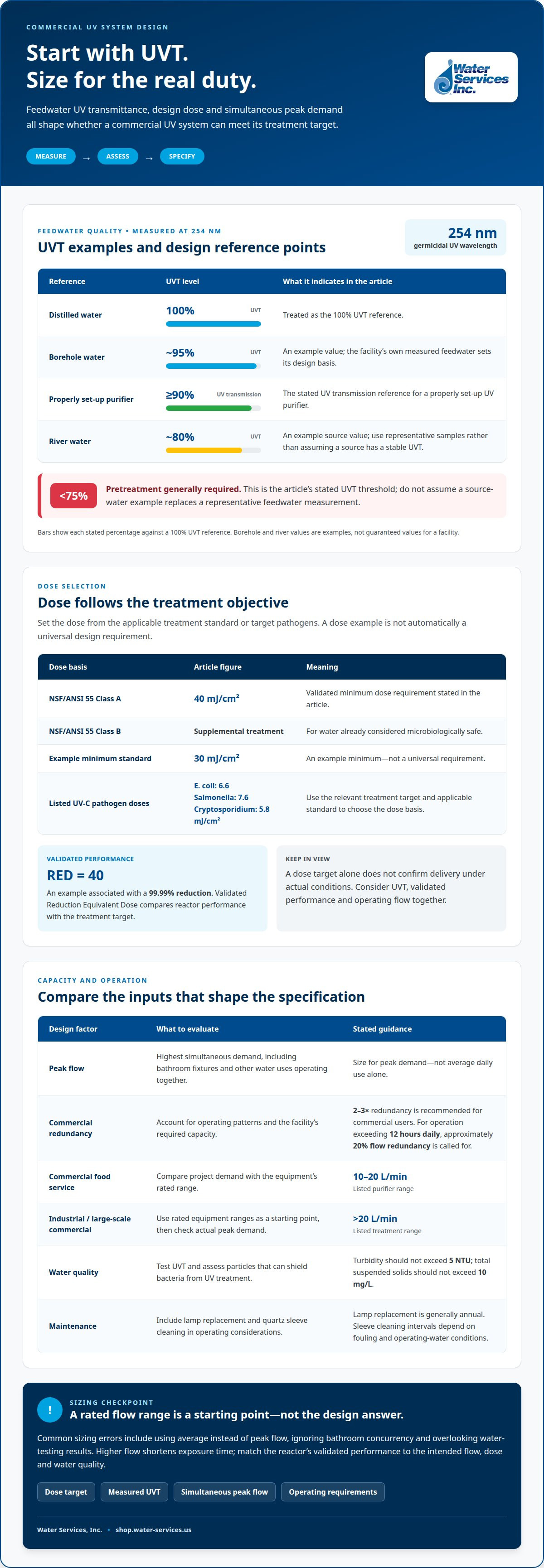
Set the dose from the applicable treatment standard or target pathogens. NSF/ANSI 55 Class A requires a validated minimum dose of 40 mJ/cm²; Class B systems provide supplemental treatment for water already considered microbiologically safe.
-
How a Professional Chooses a Dose Basis
Identify the treatment objective before selecting equipment. A professional checks whether the design must meet an applicable standard or address named pathogens, then avoids treating example doses as universal requirements. For example, the listed UV-C doses are 6.6 mJ/cm² for E. coli, 7.6 mJ/cm² for Salmonella, and 5.8 mJ/cm² for Cryptosporidium. A 30 mJ/cm² dose is an example minimum standard, while 40 mJ/cm² is the stated NSF/ANSI 55 Class A minimum with validated performance.
-
How a Professional Accounts for UV Transmission
Include feedwater UV transmittance (UVT) when selecting a dose. UVT describes how much UV light passes through water; lower UVT means less light reaches microorganisms. A dose target alone does not show whether the system can deliver treatment under actual water conditions. Evaluate UVT alongside the manufacturer’s performance data and operating flow. Do not select a unit solely by its nominal dose if its performance basis does not match the feedwater.
-
How a Professional Uses Validated Reduction Equivalent Dose
Use validated Reduction Equivalent Dose (RED) to compare delivered performance with the treatment target. RED expresses a reactor’s validated disinfection performance, rather than relying only on theoretical exposure. UV dose is theoretically calculated by multiplying UV intensity by exposure time. As flow increases, water spends less time in the reactor, which can reduce delivered dose unless the system is sized for that flow. A system with a validated RED of 40 is an example associated with a 99.99% reduction.
-
How a Professional Specifies UV Intensity and Dose Monitoring
Specify monitoring that indicates whether operating conditions support the required dose. UV intensity measures the light available for disinfection, while delivered dose also depends on exposure time and flow. Evaluate intensity readings against the reactor’s validated operating range, and use monitoring devices to flag when performance falls outside that range. Connect readings to the treatment target, feedwater UVT, and design flow. This helps prevent an intensity reading from being mistaken for proof of delivered dose.
Sizing by maximum flow rate and facility bathrooms
Set design capacity from simultaneous demand, not average daily use. Account for bathroom fixtures, process loads, and water quality.
-
How a Professional Establishes Design Flow and Evaluates Water Quality
Establish design flow from the facility’s operating pattern and peak-use periods. Include bathrooms and other water demands that may run together, then evaluate wastewater quality because particles can shield bacteria from UV treatment. Turbidity should not exceed 5 NTU, and total suspended solids should not exceed 10 mg/L. Use water testing to inform pretreatment and avoid basing selection on flow alone.
-
How a Professional Assesses Peak Flow and Capacity
Calculate capacity from the highest simultaneous flow, then select a reactor rated for that flow and treatment dose. For commercial users, a 2-3 times redundancy factor is recommended; operation exceeding 12 hours daily calls for approximately 20% flow redundancy. Bathroom count helps identify simultaneous demand, but actual fixture use and other loads determine the design peak. Undersizing risks inadequate treatment when demand rises.
-
How a Professional Matches Modules and Chamber Design to Flow
Match module power and chamber configuration to design flow, dose, and water quality. Higher flow shortens exposure time, so validated system performance must cover the intended operating conditions. Commercial UV costs vary with reactor capacity, installation scope, power demand, and maintenance; a single price cannot represent every configuration. Lamp replacement is generally annual. Quartz sleeve cleaning intervals depend on fouling and operating-water conditions.
-
How a Professional Checks Commercial System Flow-Rate Ranges
Compare project demand with the equipment’s rated range. Commercial food-service purifiers are listed at 10-20 L/min, while industrial or large-scale commercial treatment exceeds 20 L/min. These ranges are starting points, not substitutes for peak-flow assessment. Common sizing errors include using average instead of peak flow, ignoring bathroom concurrency, and overlooking testing results. Each can leave capacity or treatment performance mismatched to actual duty.
Measuring feedwater UV transmittance at 254 nm
Use feedwater UV transmittance to assess how much UV light reaches the treatment zone. Measure it at 254 nm, the wavelength used for germicidal UV output.
-
How a Professional Tests Feedwater UV Transmittance
Measure a representative feedwater sample in a quartz cuvette at 254 nm. The result, expressed as a percentage, shows how much UV light passes through the sample. Distilled water is treated as 100% UVT; borehole water is an example near 95%, while river water is around 80%. These examples help frame results, but the facility’s measured water determines the design basis.
Compare the result with the operating target. A properly set-up UV purifier should have UV transmission of 90% or greater. Below 75%, water generally requires pretreatment. UVT can vary with source and water conditions, so use representative feedwater rather than assuming a stable value from its source alone. For industrial water treatment, include seasonal or process changes when they affect the sample’s representativeness.
-
How a Professional Relates UV Transmittance to Lamp Requirements
Use measured UVT, design flow, and required dose to establish lamp requirements. Lower UVT means less UV light penetrates the water, so the system may need greater intensity or pretreatment to meet its target. Even a small drop in UVT can substantially increase the intensity required for disinfection. Do not select lamp capacity based on flow alone.
Assess turbidity and other water-quality factors alongside UVT. Turbidity above 5 NTU can interfere with UV treatment; filtration may reduce particles that shield microorganisms. Dissolved chemical constituents can also absorb UV light, so a clear appearance doesn’t establish suitable transmittance. The professional uses test results to determine whether filtration or other pretreatment belongs ahead of the UV chamber, then matches lamp output to the measured feedwater and operating conditions.
Commercial system sizing
Commercial UV design combines hydraulic demand, validated dose, feedwater quality, and operating conditions. Specify these together rather than choosing equipment by flow rating alone.
- Define the operating case. For sizing a UV disinfection system for commercial use, record peak flow, required dose, and measured water conditions together. A design example uses 150 m3/hr and 90% UVT as specification inputs. These values illustrate how a project basis can be documented, not universal requirements. A flow figure without its UVT basis does not describe the full treatment duty.
- Account for temperature and pressure. Water temperatures above 40℃ can degrade UV intensity; the stated design approach recommends increasing power by 5%-10%. Include operating temperature in equipment selection instead of assuming ambient conditions represent the process. Pressure also matters to system integration, so evaluate it alongside flow, reactor requirements, and site operating conditions.
- Include lamp aging and sleeve fouling. Select a site-specific lamp fouling and aging factor from 0.5 to 0.9. This accounts for reduced UV output during operation, rather than sizing only for a new lamp and clean sleeve. Relate lamp output and energy demand to the required dose at design flow. For sizing a UV disinfection system for commercial use, documenting this factor makes the equipment basis clearer.
- Plan standby capacity for the duty. Drinking-water UV system designs should provide standby equipment equivalent to at least 20% of the UV disinfection equipment needed at peak flows, or at least two reactors. Keep standby capacity aligned with the peak-flow case, not average operation. The final specification should show both normal and standby configurations.
For commercial projects, review UV treatment equipment as part of a specification that accounts for flow, water conditions, and operating needs.
Water Services
Water Services, Inc. is a practical next step when your flow, dose, and feedwater assessment is ready to guide equipment selection. Its offerings include Viqua UV Water Purification Systems, Goulds Water Technology Pumps, FilmTec Reverse Osmosis Membranes, and Hydranautics RO Membranes. The operating conditions established during sizing help determine which treatment equipment fits the facility’s water requirements.
Bring the design basis to the equipment discussion: required dose, peak flow, measured UV transmittance, and identified pretreatment needs. These details connect sizing work to the treatment components under consideration. Contact Water Services, Inc. to discuss your commercial water-treatment requirements.
Move from design basis to equipment selection
Turn the sizing criteria into a clear project specification. For sizing a UV disinfection system for commercial use, connect the treatment objective to the facility’s operating conditions so equipment selection reflects the intended duty, not an isolated rating. Keep water-quality and demand assumptions visible in the design discussion. This gives the equipment decision a practical reference as the project moves forward.
Water Services, Inc. offers equipment for water treatment applications, including Viqua UV Water Purification Systems, Goulds Water Technology Pumps, and FilmTec Reverse Osmosis Membranes. If you’re ready to discuss how your project requirements relate to equipment selection, contact Water Services, Inc. for sizing help. A clear design basis is a solid starting point for the next decision.
Frequently Asked Questions
What Else Should Influence Your Decision?
Consider maintenance access, standby configuration, operating temperature, and equipment integration when selecting a system. A reactor may meet its treatment target but still be a poor fit if lamp replacement or sleeve cleaning is difficult within the facility layout. Also consider how the UV unit connects to existing pumps and controls. These practical factors shape how the system can be operated and maintained over time.
What UV dose is required for commercial water disinfection and different target pathogens?
The required dose depends on the treatment objective and target organisms. Example UV-C doses listed for individual pathogens are 6.6 mJ/cm² for E. coli, 7.6 mJ/cm² for Salmonella, and 5.8 mJ/cm² for Cryptosporidium. These figures are not interchangeable with a project design target. For commercial specification, connect the selected dose to applicable performance requirements and validated reactor operation.
How do UV transmittance, turbidity, and water quality affect UV system sizing?
Lower UV transmittance and higher turbidity can reduce the UV light available to microorganisms, affecting the system’s delivered treatment. Evaluate these as separate water-quality inputs: UVT measures light transmission, while turbidity reflects suspended particles. For example, suspended solids can shield microorganisms even when the lamp produces UV light. Water testing helps determine whether pretreatment is needed before final equipment selection.
How do reactor design, lamp power, and contact time determine UV system performance?
Performance depends on reactor geometry, which distributes water around the UV source, the lamp’s output, and the time water remains in the chamber. Higher flow shortens exposure, so validated reactor performance must cover the intended operating conditions. Lamp power alone does not establish delivered dose. Review the system’s validated dose at the design flow, including the water-quality basis for that validation.
What commercial UV disinfection system sizes and flow rates are available?
Commercial flow ranges vary by application and equipment design. Food-service commercial purifier examples fall within 10-20 L/min, while industrial or large-scale commercial systems may exceed 20 L/min. These ranges describe broad application categories, not a final selection for a facility. Specify capacity against its actual peak demand, treatment target, and feedwater conditions, then account for the redundancy required by the operating plan.
What regulations and certification standards apply to commercial UV disinfection systems in the United States?
NSF/ANSI 55 provides a relevant certification framework for UV water treatment devices. Class A requires a minimum dose of 40 mJ/cm² with validated performance; Class B is intended for supplemental treatment of microbiologically safe water. The applicable design basis depends on the water source and intended use. Confirm the project’s regulatory and certification requirements with its governing specifications before final equipment selection.
0 comments