

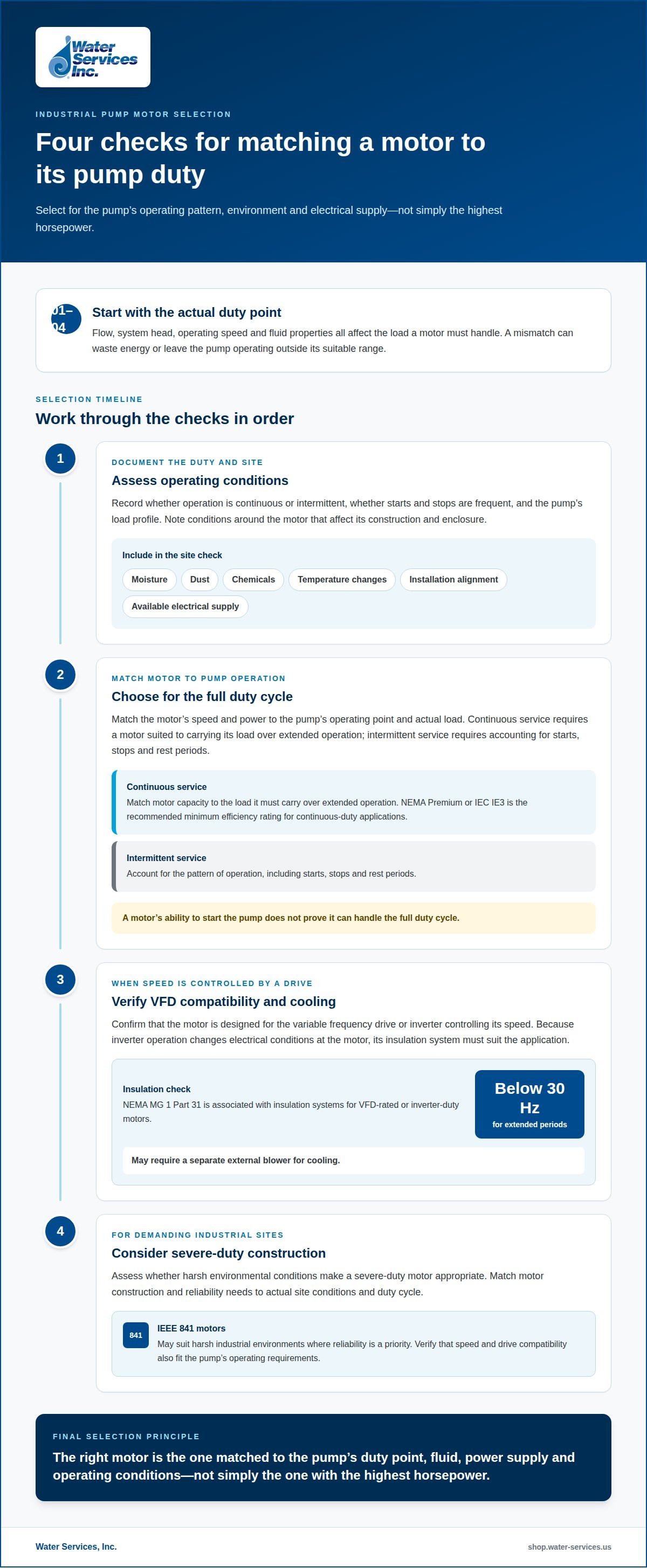
The right motor is the one matched to the pump’s duty point, fluid, power supply, and operating conditions, not simply the one with the highest horsepower. For continuous-duty applications, industrial pump motor selection should include an efficiency rating of at least NEMA Premium or IEC IE3, alongside checks for power factor and the fluid’s specific gravity.
It’s easy to focus on horsepower, but flow, system head, operating speed, and fluid properties also affect the load a motor must handle. A mismatch can waste energy or leave the pump operating outside its suitable range.
This guide walks through industrial pump motor selection, from defining flow and head requirements to matching voltage, phase, frequency, and motor speed. It also explains how efficiency, power factor, and specific gravity affect the choice.
Key Takeaways
- Start with the pump’s required flow and head, then match motor speed and power to the actual operating duty.
- Account for variable frequency drive operation and select an inverter-duty motor suited to the intended speed range.
- Compare efficiency ratings and power factor to assess motor performance under the application’s expected load.
- Factor in fluid specific gravity and installation conditions, since both affect power demand and motor suitability.
How to Select the Right Industrial Pump for Your Application?
Match the motor to the pump’s duty cycle, operating environment, and electrical supply. For variable-speed operation, confirm drive compatibility and cooling requirements before specifying an inverter-duty motor.
-
Assess Duty Cycles and Operating Conditions
First, document whether operation is continuous or intermittent, and whether the motor will start and stop frequently. Record the pump’s load profile and conditions around the motor, including exposure to moisture, dust, chemicals, and temperature changes. These details help determine the required enclosure and motor construction. Include installation alignment and the available electrical supply rather than choosing by horsepower alone.
-
Match Motor Types to Duty Cycles
Choose a motor rated for the centrifugal pump’s actual operating pattern. For continuous service, match the motor to the load it must carry over extended operation. For intermittent service, account for starts, stops, and rest periods. Compare the pump’s operating point with the motor’s speed and power requirements. A motor’s ability to start the pump does not show that it can handle the full duty cycle.
-
Check Variable Frequency Drive Compatibility
Confirm that the motor is designed for the variable frequency drive or inverter controlling its speed. Inverter operation changes the electrical conditions at the motor, so the insulation system must suit that application. NEMA MG 1 Part 31 is associated with insulation systems for VFD-rated or inverter-duty motors. If the motor will run below 30 Hz for extended periods, it may need a separate external blower for cooling.
-
Select Severe-Duty Motor Options
Assess whether harsh environmental conditions make a severe-duty motor appropriate. Exposure to demanding industrial conditions can make motor construction and reliability important selection factors. IEEE 841 motors may suit harsh industrial environments where reliability is a priority. Match the motor option to the actual site conditions and duty cycle, then verify that its speed and drive compatibility fit the pump’s operating requirements.
Energy efficiency ratings and power factor
Common pump motor selection mistakes include oversizing, overlooking power factor, and treating service factor as a continuous rating. These can increase current demand, reduce efficiency, or contribute to overload.
-
Compare Motor Efficiency Ratings
Compare efficiency ratings at the motor’s expected load, and identify the applicable standard for its market. According to the European Union, EU rules required three-phase motors from 0.75 kW to 1000 kW to meet IE3 efficiency requirements by July 2021. NEMA Premium and IEC IE3 are recommended minimum ratings for continuous-duty applications. Even small loads can use a premium efficiency motor. Compare rated efficiency at the intended output, not only at the nameplate maximum.
-
Consider Power Factor and Service Factor
Review power factor alongside efficiency because it describes how effectively the motor uses electrical power. A lower power factor can mean higher current for the same useful output, affecting the electrical supply. Treat service factor as an operating allowance, not a replacement for correct sizing. For example, a 1.15 service factor can allow a 10 HP motor to run at 11.5 HP in the stated example, but that capacity shouldn’t be assumed as its continuous design load.
-
Evaluate Oversizing and Operating Efficiency
Size the motor for the pump’s calculated load instead of adding capacity without a duty-based reason. For most industrial motors, efficiency peaks around 75 to 90 percent of load. An oversized motor may operate below that range, particularly under variable-speed or reduced-load conditions. Check the expected operating profile, including changes in flow and output, and avoid relying on service factor to correct a persistent mismatch. Where frequent starts are expected, a pump starter with surge protection can reduce inrush stress.
-
Weigh Efficiency Against Lifecycle Costs
Compare energy use across the expected operating schedule, not just the motor’s purchase decision. Pump efficiency affects input power: an 80%-efficient pump requires more than 1 HP of input power to deliver 0.8 HP of hydraulic power. Include operating hours, load variation, cooling needs, and temperature in the assessment. For variable-speed systems, review compatible electric power controls alongside the motor rating.
What are pump motors?
A pump motor converts electrical input into the mechanical power that drives the pump. Select it for the fluid, site conditions, installation, and electrical supply.
- Assess the fluid alongside the pump construction. Record its chemical composition, viscosity, temperature, solids content, toxicity, and volatility, as these affect pump compatibility and motor exposure. A centrifugal pump handling process water has different requirements from one transferring corrosive chemicals. Acids, caustics, salts, and organic solvents may call for corrosion-resistant materials in the pump system. Also consider the motor’s exposure to chemical vapors, residue, moisture, and temperature changes.
- Match the enclosure and motor design to installation conditions. ODP motors may suit clean, dry indoor locations with good ventilation. TEFC motors are often selected for dusty, dirty, outdoor, or more demanding industrial environments. Hazardous locations may require explosion-proof or Class 1 Division 2 motors. NEMA motors have a standard ambient temperature of 40 C; higher temperatures require derating or higher-class insulation. Installations above 3300 feet require derating because thinner cooling air reduces heat removal.
- Confirm mechanical fit before finalizing horsepower and sizing. Check the motor frame, mounting configuration, shaft dimensions, coupling details, and horizontal or vertical orientation against the pump. For example, IEC frame designation 132M indicates a shaft height of 132 mm; NEMA 184T is another typical frame designation. A mismatch can prevent proper alignment or coupling, even when the motor’s output suits the pumping duty.
- Match voltage, phase, frequency, and drive requirements to the available supply. Common North American three-phase voltages include 208V, 230V, 460V, and 575V; a 460 V motor may be used on a 480 V supply as an example. Check the nameplate and wiring configuration rather than relying on voltage labels alone. For variable-speed operation, confirm VFD compatibility and that the motor’s insulation suits inverter operation. These checks link electrical compatibility with reliable operation.
How specific gravity affects power requirements
Specific gravity affects the power required to move a fluid. Include fluid properties and actual process conditions when sizing the motor.
-
Account for Specific Gravity in Power Requirements
Use the fluid’s specific gravity relative to water when calculating pump power. A value greater than 1 increases horsepower demand; a value below 1 decreases it. For example, at 430 gallons per minute and 54 feet of head, the water duty-point requirement is 7.49 horsepower. With a 50% ethylene glycol solution, it is 7.99 horsepower, and the non-overloading requirement for the 8-inch impeller is 9.3 horsepower. Include fluid concentration in the calculation.
-
Determine Horsepower and Torque Needs
Size horsepower and torque according to pump type, fluid, flow, and system head. A centrifugal pump’s power demand changes with its operating point. A positive-displacement pump must provide torque to move fluid against process pressure and viscosity. No single horsepower or torque value suits every pump. Thick, syrupy fluids are often handled by positive-displacement pumps.
- Calculate required flow and total system head before selecting motor output. Include elevation and friction losses through pipes, valves, bends, and equipment. Then use the pump curve and fluid properties to determine the load. Consider peak and average flow, operating frequency, and whether the pump is horizontal or vertical. This connects process requirements to motor sizing instead of relying on flow alone.
- For a motor quote or replacement, gather the existing nameplate, electrical supply, speed, frame size, enclosure, mounting style, shaft dimensions, and pump information. Cost varies with horsepower, motor type, efficiency, voltage, and construction, so these details shape the specification. A close-coupled pump motor, for example, must match the pump’s frame and shaft exactly. For industrial plants, also record the duty cycle and process-fluid conditions to avoid mismatching the motor and load.
Water Services
Water Services, Inc. supports pump-system selection with Goulds Water Technology Pumps and offers Water Treatment Antiscalants and Chemicals for process-water treatment needs. For applications involving purification, its product range also includes Viqua UV Water Purification Systems and Hydranautics RO Membranes.
Bring your flow, head, fluid, and operating conditions to the discussion. These details connect application requirements with relevant pump or water-treatment equipment. Contact Water Services, Inc. to discuss your industrial pumping requirements.
Put Your Motor Specification Into Action
Turn operating requirements into a specification that supports maintenance and process changes. Keep the pump’s duty, fluid conditions, electrical supply, mounting arrangement, and control method in one equipment file. This gives engineering and maintenance teams a shared reference for replacement planning, troubleshooting, and system changes. A clear industrial pump motor selection process also helps keep the motor matched to the application as operating needs evolve.
Water Services offers Goulds Water Technology Pumps, Viqua UV Water Purification Systems, and FilmTec Reverse Osmosis Membranes for related pumping and water-treatment needs. For a motor specification that calls for an AC metric three-phase option, explore AC metric three-phase motors.
Contact Water Services to discuss pump selection for your application. A well-defined specification is a practical starting point for your next equipment decision.
Frequently Asked Questions
Overloading or Non-Overloading Motor?
Choose a non-overloading motor when pump demand can rise beyond its normal duty point. In one example, a 7.5-horsepower motor can overload if flow exceeds 430 gallons per minute; a 10-horsepower motor is recommended when non-overloading operation is needed. The selection depends on the pump curve and operating range. Don’t use service factor as a substitute for sizing against the pump’s maximum power requirement.
Step 2: Identify Fluid Characteristics: Why Does Fluid Matter?
Fluid characteristics matter because they affect pump load and the materials needed to withstand the process. Viscosity affects how readily fluid moves, while suspended solids can influence equipment handling and wear. Chemical composition matters too: a fluid that attacks wetted components can compromise the pump system. For an accurate selection, describe the fluid under actual operating conditions, including changes in concentration or temperature.
How do pump efficiency, power factor, and service factor affect motor selection?
Use these ratings to assess different aspects of motor performance: efficiency indicates how much electrical input becomes useful output, power factor describes electrical utilization, and service factor indicates an allowable load above the motor rating. Compare efficiency at the expected operating load, then assess power factor against the facility’s electrical capacity. Treat service factor as an operating allowance, not a normal sizing target. Running above rated load can cause excess heat and increase overload risk.
How do voltage, phase, frequency, and power supply affect industrial pump motor selection in the United States?
Match the motor nameplate to the facility supply for voltage, phase, and frequency. A dual-rated example provides 10 HP at 60 Hz and 8.3 HP at 50 Hz, so frequency can affect available output. Three-phase supply is common in industrial applications, while the motor connection must match the available phase. Confirm supply compatibility before choosing a replacement, especially when equipment moves between plants or regions.
Which NEMA motor enclosure, insulation class, and protection rating suit different pump environments?
Select enclosure, insulation, and protection ratings as separate checks. ODP construction may suit clean, dry indoor locations with ventilation; TEFC is often used in dusty, dirty, outdoor, or demanding environments. Insulation class relates to thermal capability, while an IP rating describes enclosure protection. NEMA motors have a standard ambient temperature of 40 C; higher ambient temperatures require derating or higher-class insulation.
When should you choose a TEFC, ODP, explosion-proof, or inverter-duty pump motor?
Choose ODP for a clean, dry, well-ventilated indoor location, and TEFC for dusty or outdoor service. A classified hazardous area may require an explosion-proof or Class 1 Division 2 motor. Select inverter-duty construction when a variable frequency drive controls motor speed, and match its insulation system to drive operation. These categories address different conditions, so base the choice on both site exposure and control method.
0 comments