

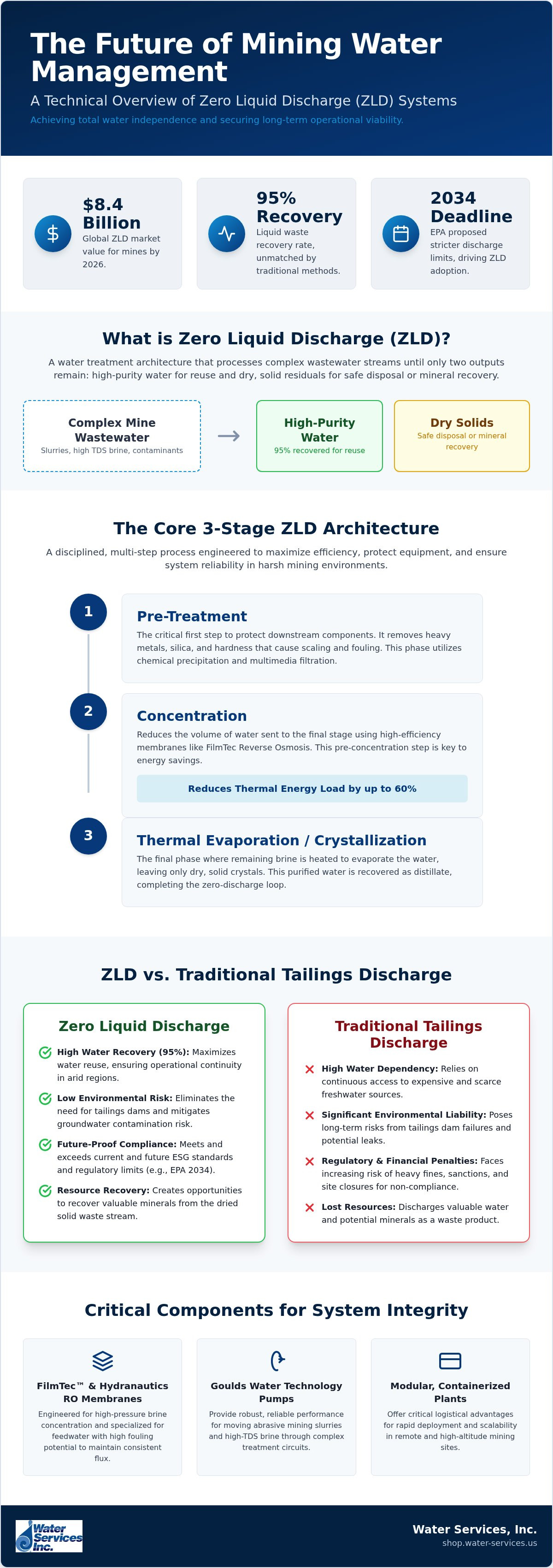
By 2026, the global market for zero liquid discharge systems for mines is valued at $8.4 billion, driven by a 95% liquid waste recovery rate that traditional methods cannot match. You recognize that relying on tailings dams or expensive continental water transport creates significant environmental risks and operational bottlenecks. With the EPA proposing stricter discharge limits for 2034, the pressure to achieve total water independence is a technical reality that requires immediate engineering attention.
This guide explains how to implement advanced zero liquid discharge systems for mines to eliminate liquid waste, maximize recovery, and secure your site's operational future. We analyze the integration of FilmTec reverse osmosis membranes, the reliability of Goulds Water Technology Pumps, and the logistical advantages of modular, containerized treatment plants for remote mining environments. You'll discover how hybrid systems combining membrane-based pre-concentration with thermal evaporation reduce energy consumption while recovering valuable minerals from brine. This technical overview provides the specifications needed to maintain compliance and ensure long term site viability in water scarce regions.
Key Takeaways
- Understand how zero liquid discharge systems for mines convert complex wastewater streams into high-purity water for reuse and dry solids for safe disposal.
- Learn why the three-stage architecture of pre-treatment, concentration, and thermal evaporation is essential for maximizing the operational lifespan of industrial hardware.
- Compare the total cost of ownership between traditional tailings discharge and ZLD to mitigate long-term environmental risks and regulatory penalties.
- Discover the logistical advantages of containerized reverse osmosis plants as a modular pre-concentration step for remote and high-altitude mining sites.
- Identify the critical role of high-performance components like Goulds pumps and FilmTec membranes in maintaining system integrity within harsh mining environments.
What is Zero Liquid Discharge (ZLD) in Mining Operations?
Zero Liquid Discharge (ZLD) is a specialized water treatment architecture designed to remove all liquid effluent from an industrial process. In mining, this technology processes wastewater until only high-purity permeate and dry solids remain. These solid residuals are either disposed of safely or processed to recover valuable minerals. Implementing zero liquid discharge systems for mines allows operators to achieve near-total water independence. This is critical for sites where environmental permits are tied to strict discharge limits or where freshwater access is physically constrained.
Modern ZLD configurations use a multi-step approach to maximize efficiency. This typically starts with chemical pre-treatment and membrane concentration using industrial water treatment components, followed by thermal evaporation. By 2026, the adoption of these systems has moved beyond simple compliance. It's now a strategic tool for reducing environmental liability and mitigating the long-term risks of tailings dam failures. Recovering 95% of liquid waste for reuse significantly lowers the site's overall water footprint.
The Mining Water Balance Challenge
Managing the water balance at remote sites is a complex engineering task. Declining ore grades mean mines must process larger volumes of material, which directly increases water demand. In arid regions like Chile or parts of the Middle East, this scarcity creates operational bottlenecks. ZLD systems address this by recycling process effluent, reducing the need for expensive continental water transport. It's a technical solution for maintaining production capacity in water-stressed zones where traditional discharge isn't an option.
Regulatory Drivers for ZLD Adoption
Stricter environmental mandates are accelerating the global use of zero liquid discharge systems for mines. The U.S. EPA recently proposed zero-discharge limits for specific industrial pollutants, with a compliance deadline set for 2034. Similar mandates in emerging markets are forcing a shift away from traditional tailings discharge. Fines for groundwater contamination or illegal discharge can lead to immediate site closures. Transitioning to circular water management ensures long-term site viability while meeting increasingly rigid ESG standards and local discharge permits.
Core Technologies in a Mining ZLD Recovery System
Engineering zero liquid discharge systems for mines requires a disciplined three-stage architecture: pre-treatment, membrane concentration, and thermal evaporation. Each stage must be optimized to handle specific feedwater chemistries. Failure in the pre-treatment phase often leads to irreversible scaling or fouling in expensive downstream equipment. Robust pumping is equally critical for system uptime. We recommend utilizing Goulds Water Technology Pumps for moving abrasive mining slurries and high-TDS (Total Dissolved Solids) brine through these complex circuits.
Advanced Membrane Pre-concentration
The concentration stage is designed to reduce the volume of water sent to the thermal evaporator. By utilizing FilmTec Reverse Osmosis Membranes, operators can achieve high-efficiency brine concentration. These membranes are engineered for high-pressure applications, allowing for maximum water recovery before the brine reaches the energy-intensive evaporation stage. For complex feedwater with high organic or biological fouling potential, Hydranautics RO Membranes provide specialized surface chemistries to maintain consistent flux. Using RO as a pre-concentration step can reduce the thermal energy load by up to 60% compared to direct thermal treatment.
Chemical Precipitation and Media Filtration
Effective pre-treatment determines the total operational lifespan of zero liquid discharge systems for mines. This stage removes heavy metals, silica, and hardness that cause rapid scaling in heat exchangers. We utilize Multimedia Filter Tanks to capture suspended solids and particulates before they reach the membranes. Precision chemical dosing is achieved using Pulsafeeder Metering Pumps. These pumps ensure exact reagent delivery for optimal precipitation reactions. This prevents mineral buildup, maintaining the hydraulic efficiency of the entire plant while protecting high-value membrane assets.
Thermal Evaporation and Crystallization
The final stage converts the concentrated brine into high-purity distillate and dry solids. Thermal evaporators typically use Mechanical Vapor Recompression (MVR) or Multi-Effect Distillation (MED) to separate water from dissolved salts. MVR is often preferred for its lower electricity consumption per cubic meter treated. The resulting dry solids can then be processed to recover valuable industrial byproducts like sodium sulfate or calcium carbonate. This turns a waste stream into a potential revenue source while ensuring zero liquid effluent. Operators seeking high-performance components for these stages can browse our industrial water treatment catalog for site-ready solutions.
ZLD vs. Traditional Tailings Discharge: A Comparative Analysis
Evaluating zero liquid discharge systems for mines requires a technical shift from initial capital expenditure (CAPEX) to total cost of ownership (TCO). Traditional tailings management often appears cost effective on paper, yet it carries massive long term liabilities. Tailings dams are prone to stability risks and groundwater seepage, necessitating decades of monitoring and environmental bonding. ZLD eliminates these risks by converting liquid waste into dry solids. It transforms an unpredictable environmental liability into a controlled industrial process. This shift provides water security, ensuring a consistent internal supply regardless of regional drought or climate fluctuations.
Resource recovery is another critical differentiator. Traditional discharge locks valuable minerals in a wet slurry, making them inaccessible. ZLD systems allow for the extraction of industrial byproducts from the brine, such as sodium sulfate or calcium carbonate. This adds a potential revenue stream that offsets operational costs. By selecting reliable Goulds Water Technology Pumps to handle high-TDS fluids, operators ensure that the increased complexity of a ZLD circuit doesn't translate to excessive downtime.
Water Recovery Efficiency: 50% vs. 98%
Traditional tailings recovery for copper mining typically ranges from 54% to 72%. This leaves a significant volume of water trapped in the tailings pond, where it's lost to evaporation or entrainment. This 'lost water' problem forces mines to source expensive fresh make-up water from continental or desalinated sources. Advanced zero liquid discharge systems for mines achieve approximately 95% water recovery. This near-total circularity significantly reduces the mine's impact on the local water table, which is vital for maintaining positive community relations and securing social licenses to operate in arid zones.
Infrastructure and Operational Footprint
The land use requirements for ZLD are a fraction of those needed for massive tailings ponds. While a tailings dam occupies hundreds of hectares and alters the local topography, a ZLD plant is a compact industrial installation. Maintenance protocols also differ. Instead of dam wall integrity inspections, the focus moves to managing scaling and fouling within industrial filtration systems. Although ZLD is energy intensive, the power draw is justified by the elimination of water transport costs. In remote sites, the ability to recycle 95% of process water often makes the difference between a viable project and a stranded asset.
Designing and Implementing Modular ZLD for Remote Mines
Implementing zero liquid discharge systems for mines requires a precise four-step engineering workflow. First, engineers must conduct comprehensive feedwater characterization and pilot testing. This identifies specific scaling ions and organic loads that dictate membrane selection. Second, operators must choose between site-built infrastructure and modular units. For remote sites, modularity is often the only viable path. Third, the system must be integrated into the existing mine power and water grids. This includes managing the high electrical load of thermal stages and ensuring stable voltage for sensitive electronics. Finally, commissioning involves rigorous staff training to handle specialized evaporation and crystallization hardware.
The Logistical Advantage of Containerized Systems
Remote mining operations face extreme logistical constraints. Traditional site-built plants require months of on-site construction and specialized labor. Containerized Reverse Osmosis Plants arrive as pre-tested, plug-and-play modules. These units reduce on-site civil work and simplify transport over difficult terrain. Scalability is a core benefit; you can add modules as mine production increases. This phased approach manages CAPEX while maintaining near-total water recovery in hostile environments.
Feedwater Chemistry and Scale Inhibition
Mining effluent contains high Total Dissolved Solids (TDS) that threaten thermal efficiency. Using high-performance Water Treatment Antiscalants prevents mineral precipitation on heat exchanger surfaces. Real-time process monitoring is handled by Walchem Controllers, which adjust chemical dosing based on sensor feedback. This automation reduces human error in demanding environments where manual monitoring is impractical. Ensuring the integrity of these chemical reactions protects the ZLD investment from premature failure.
To secure the components needed for zero liquid discharge systems for mines, you can browse our industrial water treatment inventory for immediate global distribution.
Mining ZLD Solutions from Water Services, Inc.
Water Services, Inc. specializes in the engineering and supply of modular pre-concentration stages for zero liquid discharge systems for mines. Since 1994, we've provided technical solutions for the world's most demanding industrial environments. From our headquarters in Provo, Utah, we maintain a global logistical network that supports mining operations across Africa, the Middle East, and the Americas. Our expertise lies in integrating high-performance components into custom mine water balances, ensuring each system meets site-specific chemical and hydraulic requirements. We provide detailed process design and charge custom engineering fees for the integration of ZLD equipment into existing mining infrastructure.
High-Performance Pumping for ZLD Loops
The reliability of a ZLD circuit depends on the integrity of its fluid transport systems. We utilize Goulds Water Technology Pumps to manage high-pressure reverse osmosis and brine recirculation. These pumps are selected with specific metallurgy to withstand corrosive mine wastewater and high-TDS fluids. To ensure maximum uptime, we integrate Ashcroft Pressure Gauges for precise real-time monitoring of system pressure differentials. This allows operators to identify potential scaling or pump cavitation before it causes a mechanical failure, maintaining the stability of the zero liquid discharge systems for mines.
Containerized RO and Mobile Filtration
Modular deployment is the most efficient way to manage water recovery at remote sites. We provide Mobile Ultrafiltration Systems that serve as an essential pre-treatment step, removing suspended solids and protecting downstream membranes. Our custom-designed Containerized Reverse Osmosis Plants are built for rapid deployment and can be scaled as production demands fluctuate. These units are available for purchase, and we also offer rental and leasing options for temporary site needs or pilot testing. This flexibility allows mining companies to validate ZLD performance before committing to full-scale capital investments.
Global Technical Support and Maintenance
Long-term regulatory compliance requires consistent system performance and a reliable supply of consumables. Our technical team provides on-site commissioning and long-term maintenance contracts to ensure your plant operates at peak efficiency. We stock and distribute high-performance FilmTec RO Membranes for rapid replacement, minimizing downtime in remote locations. Our logistical competence ensures that critical components reach your site regardless of geographic complexity. For a technical review of your site's water management needs, contact Water Services, Inc. for a custom mining ZLD consultation.
Securing Operational Resilience with Advanced ZLD
Transitioning to zero liquid discharge systems for mines is no longer just a compliance measure; it's a strategic move toward total water independence. By implementing a disciplined multi-stage recovery process, operators can achieve 95% water recovery and eliminate the long-term environmental risks associated with traditional tailings management. Modular and containerized configurations provide the technical flexibility needed to deploy these systems in the world's most remote environments without the logistical delays of extensive on-site civil works. These systems turn wastewater into a reliable internal asset while recovering industrial byproducts from the brine reject.
Water Services, Inc. brings over 30 years of industrial engineering experience to every project. Our global installation footprint across Africa, the Middle East, and the Americas proves our ability to deliver reliable results in harsh mining sectors. We specialize in modular and containerized engineering that integrates high-performance components into your site-specific water balance. We invite you to Request a Custom ZLD System Design Quote to begin optimizing your site's recovery goals. Securing your water supply today ensures the long-term viability of your mining operations tomorrow.
Frequently Asked Questions
What are the primary benefits of ZLD for mining companies?
Primary benefits include total water circularity and the elimination of environmental discharge permits. By implementing zero liquid discharge systems for mines, companies mitigate the legal risks associated with groundwater contamination and upcoming EPA mandates. This technology also secures a consistent water supply in arid regions, reducing reliance on expensive external sources. It transforms a waste stream into a managed industrial process, significantly improving a site's long-term environmental, social, and governance (ESG) profile.
How much water can a mining ZLD system actually recover?
Most advanced systems achieve a liquid recovery rate between 95% and 98%. This is a substantial improvement over traditional tailings management, which typically recovers only 54% to 72% of process water. The remaining 2% to 5% of waste is converted into dry solids for disposal or mineral recovery. This high efficiency is achieved through a combination of high-pressure membrane pre-concentration and thermal evaporation, ensuring that almost every gallon is returned to the mine's process loop.
Is ZLD cost-effective for smaller mining operations?
Modular and containerized zero liquid discharge systems for mines have made this technology more accessible for smaller sites. While the operational energy costs are higher than traditional treatment, the reduction in water transport fees and the elimination of tailings dam monitoring often justify the investment. Smaller operators benefit from pre-tested, plug-and-play modules that reduce on-site construction costs. This approach allows for phased implementation, matching water treatment capacity with the mine's actual production scale and revenue.
What are the main challenges in implementing ZLD at remote mine sites?
The primary challenges involve logistical complexity and high energy requirements for the thermal evaporation stage. Remote sites often lack the robust power infrastructure needed for Mechanical Vapor Recompression (MVR) systems. Transporting specialized chemicals and replacement parts to isolated geographic regions also requires a sophisticated supply chain. To address this, we focus on modular designs that simplify transport and utilize automated controllers to minimize the need for specialized on-site engineering staff during daily operations.
How does ZLD impact the management of mine tailings?
ZLD fundamentally changes tailings management by removing the liquid component from the waste stream. This allows mines to transition to dry stack tailings, which are more stable and have a significantly smaller land footprint than traditional wet ponds. Eliminating liquid effluent removes the primary driver of tailings dam failures and groundwater seepage. This shift reduces the site's long-term environmental liability and can simplify the process of obtaining new mining permits in ecologically sensitive zones.
What role does Reverse Osmosis play in a Zero Liquid Discharge system?
Reverse Osmosis (RO) serves as the critical pre-concentration step that reduces the volume of water sent to the thermal evaporator. By using high-rejection membranes like FilmTec or Hydranautics, the system can concentrate brine to a point where the thermal stage's energy load is reduced by up to 60%. This makes the entire ZLD process more energy-efficient. RO effectively separates the bulk of the high-purity water for immediate reuse, leaving only a small, concentrated stream for final treatment.
Can ZLD systems recover valuable minerals from mining wastewater?
Crystallization stages within a ZLD system are specifically designed to recover dissolved solids as dry, marketable minerals. Common byproducts recovered from mining wastewater include sodium sulfate, calcium carbonate, and magnesium salts. In some cases, these minerals can be sold to industrial markets, providing a revenue stream that helps offset the system's operational expenses. This turns a traditional waste management cost center into a resource recovery opportunity, aligning with modern circular economy principles in the mining sector.
What maintenance is required for a modular ZLD plant?
Maintenance focuses on protecting high-value components from scaling and mechanical wear. This includes regular chemical cleaning of RO membranes and the monitoring of pump seals on Goulds Water Technology units. Operators must also calibrate Signet flow sensors and Walchem controllers to ensure precise chemical dosing. Consumables like sediment filters and antiscalants require scheduled replacement to maintain hydraulic efficiency. We recommend long-term maintenance contracts to ensure that specialized thermal equipment remains in compliance with environmental discharge standards.
0 comentarios