

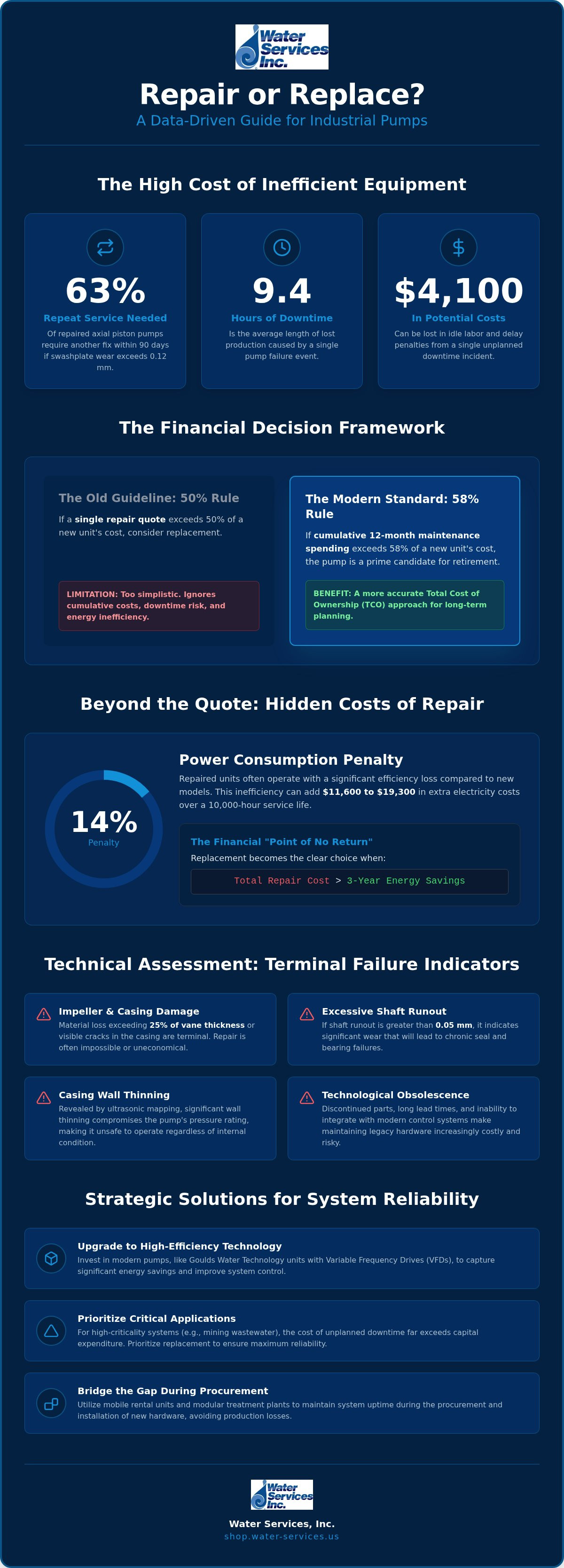
Did you know that 63% of repaired axial piston pumps require repeat service within just 90 days when swashplate wear exceeds 0.12 mm? This data point underscores why the decision of when to repair vs replace an industrial pump is no longer a simple matter of comparing two quotes. In an environment where a single failure results in an average of 9.4 hours of unplanned downtime, the financial impact can reach $4,100 in idle labor and penalties for a single event.
It's a challenge to balance tight capital budgets against the rising energy costs of inefficient older equipment. You need to ensure system reliability for your Goulds or Pulsafeeder units while meeting 2026 energy efficiency standards. This guide provides the technical and financial framework to help you decide between repair and replacement by focusing on the total cost of ownership. We'll preview the 58% rule for maintenance spending, analyze the 14% power consumption penalty of aging units, and explain how to use ISO 4406:2022 standards to assess the remaining useful life of your hardware.
Key Takeaways
- Apply the 58% rule to cumulative 12-month maintenance costs to determine the financial threshold for equipment retirement.
- Identify terminal failure indicators in shafts and impellers to understand when to repair vs replace an industrial pump for maximum reliability.
- Analyze the ROI of upgrading to Goulds Water Technology pumps equipped with VFDs to capture significant energy efficiency gains.
- Prioritize replacement for high-criticality applications, such as mining wastewater treatment, where unplanned downtime costs exceed capital expenditure.
- Utilize mobile rental units and modular treatment plants to maintain system uptime during the procurement and installation of new hardware.
The 50% Rule and Beyond: Establishing a Decision Framework
The 50% rule has long served as a baseline for maintenance managers. It dictates that if a repair quote exceeds half the price of a new unit, you should opt for replacement. However, current market data suggests this approach is often insufficient for 2026 operations. The industry has shifted toward a more precise 58% rule. This metric tracks cumulative maintenance spending over a 12-month period. If those costs exceed 58% of a new pump's list price, the unit is a candidate for retirement. Determining when to repair vs replace an industrial pump requires this rigorous financial scrutiny.
This framework often fails when applied to critical infrastructure. For high-priority systems, the cost of unplanned downtime dwarfs the equipment's purchase price. A single failure typically results in 9.4 hours of lost production. This generates costs between $2,800 and $4,100 in idle labor and delay penalties. Decision-makers must use a Total Cost of Ownership (TCO) model. This model integrates energy efficiency, downtime risk, and lead times. It helps balance immediate O&M budget constraints with long-term CapEx optimization to ensure system reliability.
Calculating the Financial "Point of No Return"
Precise repair estimates must include labor, specialized machining, and OEM-certified parts. Many facilities overlook hidden costs like reduced equipment lifespan and restricted warranty coverage. Repaired units often operate with a 14% power consumption penalty compared to new, high-efficiency models. This inefficiency can add $11,600 to $19,300 in electricity costs over a 10,000-hour service life. The financial "Point of No Return" occurs at the intersection where the total repair cost equals the projected 3-year energy savings of a high-efficiency replacement.
The Role of Equipment Age and Design Life
Design life expectations differ based on the Types of Industrial Pumps in use. Standard centrifugal pumps may offer a 15-year service life, whereas submersible pumps in corrosive mining environments often fail much sooner. Technological obsolescence makes maintaining legacy hardware difficult. Parts for older industrial pumps are frequently discontinued or subject to long lead times. Engineers must also evaluate the fatigue life of non-serviceable components like pump casings. If ultrasonic thickness mapping reveals significant wall thinning, the casing reaches its terminal limit regardless of internal component condition. Knowing when to repair vs replace an industrial pump requires assessing these structural realities alongside mechanical wear.
Technical Assessment: Diagnosing Critical Component Failure
A visual inspection is rarely enough to determine the remaining service life of a high-pressure system. A comprehensive technical assessment of pump performance involves analyzing vibration spectra and thermal signatures to identify subsurface wear. While a pump might still move fluid, internal tolerances may have degraded beyond the point of economical recovery. Determining when to repair vs replace an industrial pump requires comparing these diagnostic results against Original Equipment Manufacturer (OEM) specifications.
- Vibration Analysis: Use accelerometers to detect bearing frequencies, misalignment, or impeller imbalance.
- Infrared Thermography: Identify localized heat signatures in bearing housings or motor windings that indicate friction or electrical resistance.
- Flow and Pressure Testing: Compare current performance data against the factory pump curve to calculate efficiency loss.
- Precision Measurement: Use micrometers to check for shaft runout and wear ring clearances.
Impeller and Casing Integrity
Cavitation damage often ruins the hydraulic profile of an impeller, making repair impossible if the material loss exceeds 25% of the vane thickness. In mining wastewater applications, abrasive solids cause distinct erosion patterns that compromise the volute casing. Cracks in the casing are a terminal failure indicator because they compromise the structural pressure rating. If you observe deep pitting or "honeycombing" on the impeller, it's usually more cost-effective to source a new Goulds Water Technology pump than to attempt a resurfacing that won't restore original efficiency.
Seals, Bearings, and Shaft Alignment
Chronic seal failure is frequently a symptom of a larger system-level issue, such as pipe strain or shaft deflection. If a shaft shows runout greater than 0.05 mm, the vibration will continue to destroy new seals regardless of the repair quality. Bearing housing wear is another critical checkpoint. When the pump "eats itself" from the inside, the housing bore becomes oversized, preventing proper bearing seating. If you're experiencing repeated failures, it's time to evaluate if the current hardware is suited for the application. You can consult with technical experts to determine if a more robust Pulsafeeder or Goulds model is required for your specific operational demands.
Finally, evaluate the motor separately. While rewinding is an option for older motors, 2026 standards prioritize high-efficiency units. A motor rewind typically results in a 1% to 2% efficiency drop, which compounds over thousands of operating hours. Upgrading to a modern, VFD-ready motor during a pump replacement often provides the fastest path to a lower total cost of ownership.
The ROI of Efficiency: Energy and Technology Upgrades
Pumps operating below 85% efficiency consume up to 14% more power. Over a 10,000-hour service life, this inefficiency adds between $11,600 and $19,300 in electricity costs based on current 2026 utility rates. Determining when to repair vs replace an industrial pump requires a shift from looking at upfront costs to analyzing lifecycle energy consumption. Research indicates that energy inefficiency can account for 44% to 52% of the total three-year expense for repaired units. If the "Efficiency Payback Period" for a new unit is under 24 months, continuing to repair legacy hardware is a financial liability.
Integrating a Variable Frequency Drive (VFD) fundamentally alters the replacement calculation. Older pumps often operate at a fixed speed regardless of system demand, wasting energy through throttling valves. Modern systems utilize electric power controls to match motor speed to actual hydraulic requirements. This reduces mechanical stress on seals and bearings while significantly lowering the carbon footprint of industrial water treatment operations. It's a pragmatic approach to optimizing the total cost of ownership.
Modern Pump Hydraulics and IE4/IE5 Motors
Legacy hardware from a decade ago cannot match 2026 hydraulic standards. Advancements in computational fluid dynamics have allowed manufacturers like Goulds Water Technology Pumps to minimize internal friction and turbulence. These units often feature ultra-premium efficiency IE4 or IE5 motors. These motors maintain peak efficiency even during partial load conditions, unlike older designs that see performance drops. Shifting to these standards ensures compliance with 2026 energy mandates while maximizing the durability of your pumping system.
Smart Monitoring and Predictive Maintenance
The decision of when to repair vs replace an industrial pump is more accurate when supported by real-time telemetry. 78% of Tier-1 pump models now include CAN bus outputs for remote diagnostics. Modern pumps use embedded IoT sensors to monitor vibration, temperature, and pressure. These sensors integrate with electric power controls to provide a continuous stream of performance data. This data-driven evidence allows operators to justify a full system upgrade before a catastrophic failure occurs. Key factors for calculating ROI include:
- Energy Savings: The delta between current power draw and the rated efficiency of a new IE5 motor.
- Maintenance Reduction: The elimination of repeat repairs on worn swashplates or eroded casings.
- Downtime Prevention: Avoiding the $4,100 average cost of a single unplanned failure event.
- Regulatory Compliance: Meeting ESG reporting requirements for energy use per ton of processed material.
Operational Criticality and Application-Specific Risks
Assigning a "Criticality Rank" to each unit is a prerequisite for any maintenance strategy. A Rank 1 pump is a single point of failure where a shutdown halts the entire production line. For these assets, the decision of when to repair vs replace an industrial pump is driven by risk mitigation rather than just the 58% cost rule. In remote military installations or offshore platforms, the logistical cost of sourcing specialized parts for obsolete hardware often exceeds the price of a new unit. Lead times for remanufactured components currently average 11 to 17 business days; however, a new Tier-1 unit can often be sourced in 3 to 5 days. When downtime costs average $436 per hour, a two-week delay for a repair is rarely justifiable.
This risk is amplified in specialized sectors like mining. Effective mining wastewater treatment solutions require equipment that can handle extreme pH levels and high solids content. If a pump in this environment requires frequent intervention, it's a sign that the original material selection was inadequate for the application. In these scenarios, a "repair" only resets the clock on an inevitable failure, whereas a replacement allows for a strategic upgrade to more resilient hardware.
Harsh Environments and Material Selection
Standard cast iron components often fail prematurely when exposed to abrasive slurries or corrosive chemicals. If your technical assessment reveals consistent pitting or wall thinning, you should consider upgrading to exotic alloys or specialized coatings. Repairing a degraded hydraulic profile with inferior materials leads to a 37% to 61% increase in re-failure probability if verification protocols are skipped. For precision applications, such as chemical injection, Pulsafeeder metering pumps offer the reliability needed to maintain process integrity without the frequent maintenance cycles associated with lower-tier hardware.
Downtime Impact Analysis
A thorough downtime analysis must account for idle labor, rental substitution, and potential penalties for project delays. In a high-capacity RO plant, the "Cost per Hour" of a failure can quickly erode annual O&M budgets. Managing these risks requires a balance between a robust "Critical Spares" inventory and planned equipment retirement. For a deeper look at integrating these decisions into a broader facility strategy, consult our Industrial Water Treatment Systems pillar. Understanding when to repair vs replace an industrial pump ensures that your capital is invested in uptime rather than reactive fixes.
If your current pumping system is nearing its "Point of No Return," you can browse our Goulds and Pulsafeeder inventory to find a high-efficiency replacement that meets 2026 reliability standards.
Strategic Solutions: Bridging the Gap with Water Services, Inc.
Deciding when to repair vs replace an industrial pump is only the first step in maintaining operational continuity. The execution phase often presents logistical hurdles, particularly regarding the lead times for specialized hardware. Water Services, Inc. operates as a curated authority, providing the engineering consulting and technical hardware necessary to bridge these gaps. We specialize in integrating modern Goulds Water Technology and Pulsafeeder units into existing legacy systems. This ensures that new, high-efficiency hardware performs reliably within your established hydraulic parameters without requiring a total system redesign.
The Rental Bridge Strategy
Emergency failures don't wait for procurement cycles or budget approvals. Our rental bridge strategy utilizes mobile ultrafiltration and reverse osmosis units to maintain water flow during major overhauls or unexpected breakdowns. These mobile systems provide immediate relief, ensuring production doesn't halt while you wait for a new unit's 3 to 5 day delivery window. An advantage of this approach is financial flexibility. Rental and leasing fees are typically categorized as O&M expenses. This allows facility managers to maintain uptime by bypassing the lengthy approval delays often associated with capital expenditure (CapEx) requests. For rapid deployment in remote or demanding sites, modular and containerized treatment units offer a pre-packaged solution that minimizes on-site construction and engineering time.
Expert Commissioning and Maintenance
Achieving the maximum design life of a new pump requires precise installation and commissioning. Our technical support services address critical factors like shaft alignment, foundation integrity, and suction piping geometry from day one. This proactive approach prevents the vibration and seal issues that lead to premature "repair vs replace" dilemmas later. During on-site maintenance or replacement procedures, strict adherence to PPE and safety protocols is mandatory to protect personnel and maintain equipment integrity. By choosing a partner with global logistical reach, you gain access to a stable supply of OEM parts and expert guidance. This comprehensive support simplifies the process of determining when to repair vs replace an industrial pump, shifting your facility's focus from reactive maintenance to strategic asset management.
Browse our full catalog of Goulds Pumps and Industrial Solutions to find the reliable hardware your 2026 operations require.
Optimizing Your 2026 Pumping Infrastructure
Decisions regarding aging assets must prioritize total cost of ownership over immediate line-item savings. Applying the 58% maintenance cost threshold and calculating the 14% energy penalty of legacy hardware provides a clear financial roadmap for your facility. By assessing the terminal wear of impellers and casings early, you can avoid the high re-failure risks associated with incomplete repairs. Mastering the criteria for when to repair vs replace an industrial pump is essential for maintaining a resilient, high-uptime operation.
As an Authorized Goulds Water Technology Distributor with over 30 years of global water infrastructure experience, Water Services, Inc. provides the technical expertise and hardware to secure your system. We offer rapid deployment of mobile and containerized rental units to eliminate downtime during major upgrades. Consult with a Water Services specialist for a pump condition assessment to ensure your operations remain efficient and compliant. It's time to transition from reactive maintenance to a strategy built on industrial reliability and long-term performance. We're ready to support your next equipment milestone.
Frequently Asked Questions
What is the 50% rule for industrial pump repair?
The 50% rule is a legacy benchmark suggesting replacement if repair quotes exceed half the cost of a new unit. In 2026, many operators use a more precise 58% rule based on cumulative 12-month maintenance spending. If repair expenses reach this threshold, the investment is rarely recovered through extended service life. This modern framework helps managers prioritize capital for high-efficiency hardware that offers better long-term reliability.
How long do industrial centrifugal pumps typically last before replacement?
Standard centrifugal pumps typically offer a design life of approximately 15 years under normal operating conditions. However, this lifespan varies significantly by application. Submersible pumps in corrosive mining wastewater or abrasive slurry environments often require replacement much sooner. Factors like fluid cleanliness, cavitation history, and adherence to ISO 4406:2022 standards for fluid sampling directly influence the actual service life of your specific hardware.
Can a repaired pump ever reach its original energy efficiency rating?
It's technically difficult for a repaired pump to match its factory efficiency rating. A standard motor rewind typically results in a 1% to 2% efficiency drop. Wear on internal hydraulic profiles and swashplate contact surfaces often remains even after parts replacement. These cumulative inefficiencies can lead to a 14% increase in power consumption compared to a new, high-efficiency Goulds Water Technology pump, increasing your total cost of ownership.
What are the most common signs that an industrial pump is beyond repair?
Terminal failure indicators include structural cracks in the pump casing or wall thinning that compromises pressure ratings. If an impeller shows material loss exceeding 25% of its vane thickness, the hydraulic profile is likely ruined. Other signs include repeated seal failures caused by shaft runout greater than 0.05 mm and bearing housing bores that have become oversized. These conditions prevent the proper seating of new components, making repair unfeasible.
How do energy efficiency standards in 2026 affect the repair vs. replace decision?
Current 2026 standards place a high priority on ultra-premium efficiency IE4 and IE5 motors. When deciding when to repair vs replace an industrial pump, you must account for the power savings of modern hardware. New units equipped with VFD-ready motors and optimized hydraulics often provide an efficiency payback period of under 24 months. This makes replacement the more compliant and cost-effective choice for meeting modern ESG reporting requirements.
Does it make sense to repair a pump if parts are obsolete or have long lead times?
Repairing obsolete equipment is often a high-risk strategy. Sourcing remanufactured parts for legacy hardware currently takes between 11 and 17 business days. In contrast, new Tier-1 units can often be sourced in just 3 to 5 days. For critical systems where downtime costs are high, waiting for obsolete components is rarely justifiable. Upgrading to a currently supported model ensures better long-term parts availability and faster emergency response.
How can I calculate the cost of downtime when deciding on a pump replacement?
To calculate downtime impact, sum the costs of idle labor, lost production revenue, and potential penalties for project delays. Industry data shows that a single unplanned failure results in an average of 9.4 hours of downtime, costing between $2,800 and $4,100 per event. If your repair lead time is significantly longer than the procurement time for a new unit, you must add the "cost of waiting" to the repair quote.
Are there tax advantages to replacing rather than repairing industrial equipment?
Tax regulations often distinguish between maintenance expenses and capital investments. While repairs are typically categorized as immediate operating expenses, a new pump is a capital expenditure that may be eligible for depreciation over several years. Some jurisdictions offer specific incentives for upgrading to energy-efficient industrial motors. We recommend consulting with your financial department to evaluate how these accounting classifications affect your specific decision when to repair vs replace an industrial pump.
0 comentarios