

Over 65% of industrial water treatment plants now integrate RO modules to achieve high-purity output. This isn't just about filtration; it's about engineering a specific process fluid. Many operators ask what is ro water in the context of high-scale production. It's a precision-engineered fluid where Total Dissolved Solids (TDS) are reduced through semi-permeable membranes under high pressure. According to April 2026 industry data, the global RO market has reached $7.95 billion as facilities struggle with rising TDS levels and stricter EPA regulations regarding PFAS and microplastics.
You've likely seen high TDS levels shorten the lifespan of your Goulds pumps or foul your membranes in remote, harsh environments. It's frustrating when high waste ratios impact your bottom line or when maintenance schedules become unpredictable. We understand that industrial reliability depends on the technical integrity of your equipment and its ability to withstand rigorous commercial demands.
This guide provides a professional-grade understanding of RO properties and the industrial mechanisms required for reliable, high-scale operations. We'll examine the hardware requirements, including FilmTec membranes and containerized solutions, to help you determine if this technology fits your specific site.
Key Takeaways
- Understand the precise technical definition of what is ro water and how hydraulic pressure overcomes osmotic pressure to produce high-purity permeate.
- Differentiate between low-pressure residential units and industrial systems that utilize multi-stage centrifugal pumps for high-volume daily output.
- Identify the specific contaminants industrial RO effectively removes, including heavy metals and Total Dissolved Solids (TDS) like sodium and magnesium.
- Evaluate the operational advantages of containerized RO plants and mobile ultrafiltration systems for rapid deployment in remote or harsh environments.
- Learn to drive procurement using technical specifications for heavy-duty hardware like FilmTec membranes and Walchem controllers to ensure system reliability.
Defining RO Water: The Science of Reverse Osmosis
Industrial operators must understand that RO water is the product of molecular separation under high-pressure conditions. When engineers define what is ro water, they refer to the permeate stream produced when applied hydraulic pressure exceeds the natural osmotic pressure of the feed source. This process utilizes a semi-permeable membrane, such as those manufactured by FilmTec or Hydranautics, with pores as small as 0.0001 microns. This scale is small enough to stop nearly all dissolved solids and organic molecules while allowing water molecules to pass through.
Unlike standard mechanical filtration that relies on a physical barrier to trap suspended particles, The Science of Reverse Osmosis involves a diffusive mechanism. It targets contaminants at the ionic and molecular level. This level of purification is necessary for high-scale operations where even minor mineral scaling can destroy heavy-duty equipment or contaminate sensitive industrial processes. According to 2026 industry standards, this technology is the primary method for achieving high-purity water in over 65% of global industrial treatment facilities.
Permeate vs. Concentrate: Understanding the Stream Split
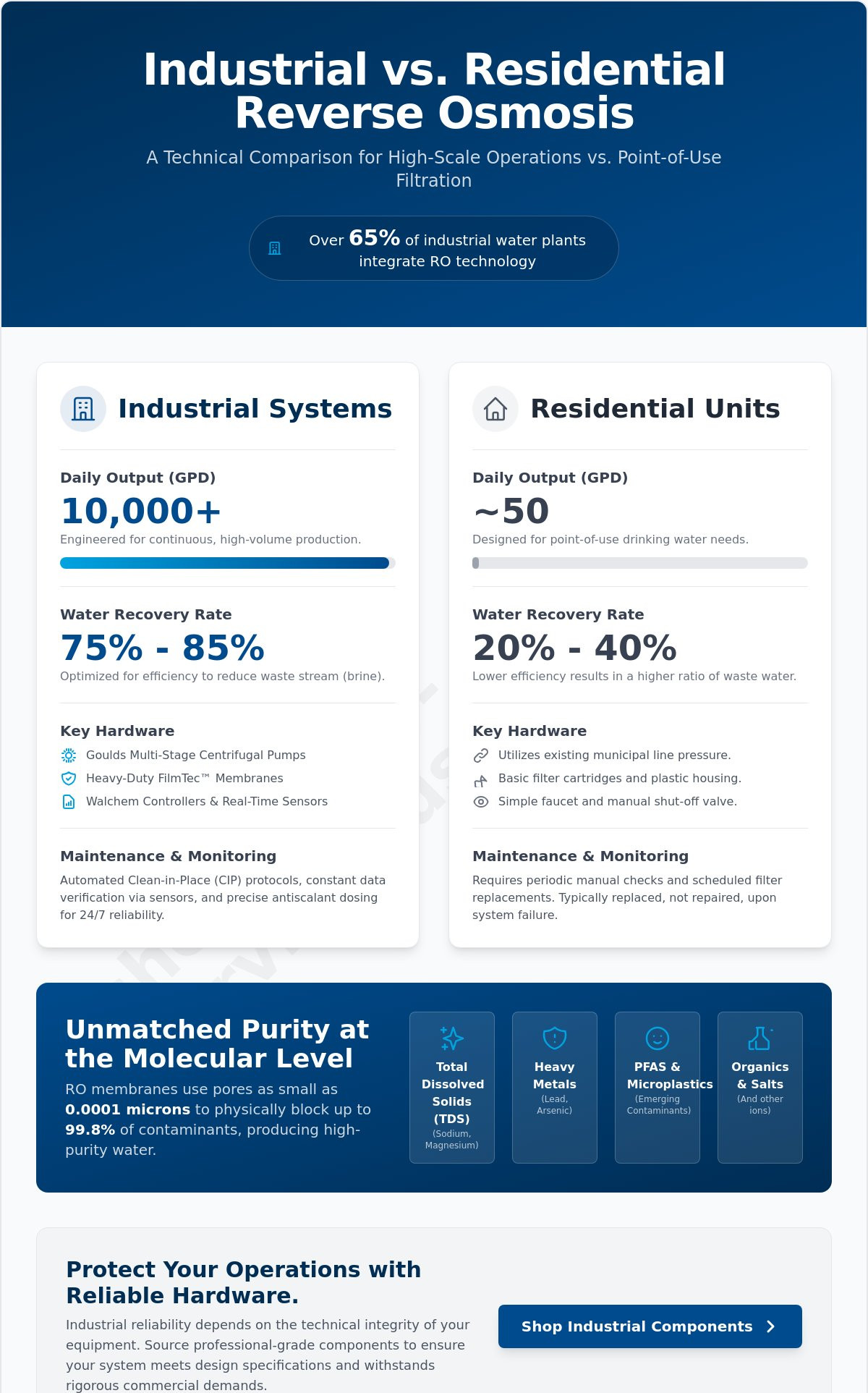
The reverse osmosis process splits the incoming feed water into two distinct streams. The permeate is the purified water intended for industrial use or consumption. It's been stripped of up to 99.8% of its dissolved salts. Conversely, the concentrate, or brine, is the reject stream that carries away the concentrated minerals and contaminants. Industrial systems are engineered to target higher recovery rates than residential units, often reaching between 75% and 85%. Achieving these rates requires precise chemical management using antiscalants to prevent membrane fouling in the concentrate stream.
The Role of Osmotic Pressure in Industrial Scaling
Total Dissolved Solids (TDS) levels in the source water dictate the mechanical requirements of the system. High salt concentrations increase the natural osmotic pressure; this means the system must apply significantly more hydraulic pressure to reverse the flow. This creates a direct mathematical relationship between salt concentration and energy consumption. For high-TDS brackish water, specialized high-pressure pump configurations, such as Goulds multi-stage centrifugal pumps, are required. Without the correct horsepower and head capacity, the system cannot overcome the osmotic barrier, leading to a total failure in permeate production.
Industrial vs. Residential RO Systems: Key Differences
Understanding what is ro water requires a clear distinction between point-of-use residential filters and high-scale industrial systems. While a standard home unit might produce 50 gallons per day (GPD) using simple municipal line pressure, industrial configurations are engineered to generate thousands of GPD. These systems aren't just larger versions of home filters; they're complex process plants utilizing heavy-duty components designed for 24/7 operation. Industrial racks prioritize efficiency and durability, often achieving recovery rates between 75% and 85%, far exceeding the low efficiency of residential units.
While industrial systems are the focus here, understanding the broader landscape of filtration—including common misconceptions—is valuable; for more insights, visit PrímaVíz to explore an expert interview on water treatment facts and myths.
System monitoring and maintenance also differ significantly. Determining what is ro water at an industrial scale involves constant data verification. Industrial units feature comprehensive instrumentation, including Signet flow sensors and Ashcroft pressure gauges, to track real-time performance. Unlike residential systems that are often replaced when they fail, industrial RO plants utilize Clean-in-Place (CIP) protocols. These protocols, combined with precise antiscalant dosing via Pulsafeeder metering pumps, extend the life of expensive membranes in harsh environments.
High-Pressure Pumping: The Heart of the System
Industrial reverse osmosis cannot function without dedicated multi-stage centrifugal pumps. Goulds Water Technology pumps are the industry standard for this application because they provide the consistent head pressure required to overcome osmotic resistance. It's critical to match the pump horsepower (HP) to the specific flux requirements of the membrane array. In brackish or corrosive environments, stainless steel construction is mandatory to prevent premature equipment failure. You can find these high-performance industrial pumps and components to ensure your system meets its design specifications.
Membrane Selection: FilmTec and Hydranautics
The choice of membrane defines the system's rejection capabilities. Industrial systems typically use 4-inch or 8-inch Thin-Film Composite (TFC) elements from leaders like FilmTec and Hydranautics. These membranes are engineered for specific feed water profiles, such as high-rejection seawater elements or low-energy brackish water elements. Professionals must interpret membrane data sheets to ensure the hardware can handle the specific Contaminants Removed by Reverse Osmosis at the required flow rate. For example, an 8-inch element offers significantly more surface area than a 4-inch element, allowing for much higher permeate volumes within a compact footprint. This selection is a technical decision based on the chemistry of your source water.
What Contaminants Does Industrial RO Water Remove?
Industrial reverse osmosis provides a critical barrier against a wide array of chemical and biological impurities. When evaluating what is ro water, the primary focus is on the rejection of Total Dissolved Solids (TDS). High-performance membranes effectively strip sodium, chloride, and magnesium from the feed stream; this protects downstream equipment from scale and corrosion. In April 2026, updated EPA guidance highlighted the role of RO in managing emerging contaminants, specifically focusing on the destruction and disposal of per- and polyfluoroalkyl substances (PFAS).
Heavy metals like lead, arsenic, and chromium are also removed with high efficiency. This is vital for treating industrial runoff or groundwater in regions with high natural mineral content. The FDA technical guide on reverse osmosis details how these systems achieve the chemical purity required for sensitive manufacturing environments. Beyond chemicals, RO membranes act as a physical barrier to pathogens. They provide high rejection rates for bacteria, viruses, and cysts like Cryptosporidium. It ensures the permeate meets strict microbiological standards. Understanding what is ro water also requires acknowledging its role in removing industrial solvents and volatile organic compounds (VOCs) that standard carbon filtration might miss.
RO Water Purity Standards for Mining and Military
Remote mining sites and military deployments face unique challenges with source water quality. High TDS levels in these environments can quickly degrade boiler tubes and sensitive process machinery. RO technology allows these operations to meet potable water standards while ensuring environmental compliance for wastewater discharge. By 2026, wastewater reuse projects incorporating RO have grown by 45% across industrial sectors. This growth is driven by the need for sustainable water management in water-scarce regions. High-recovery systems are now essential for maintaining operational longevity in these harsh environments.
The Limitations: What RO Cannot Remove Alone
While RO is highly effective, it isn't a universal solution for every contaminant. Dissolved gases, such as carbon dioxide and oxygen, pass through membranes easily. These often require specialized degasification steps to prevent corrosion in high-pressure steam systems. Additionally, low molecular weight organic compounds may bypass the membrane barrier. To ensure absolute sterilization, many industrial racks pair RO with Viqua UV purification systems. This multi-stage approach addresses both the dissolved solids and any potential biological breakthrough. It provides a comprehensive treatment solution for high-scale operations.
Maximizing Efficiency in Remote and Mobile RO Operations
Operating in remote mining sites or military outposts requires more than just high-purity output; it requires logistical reliability. When discussing what is ro water in these contexts, we focus on the ability to produce high-quality permeate in environments where traditional infrastructure is non-existent. Containerized RO plants provide a plug-and-play solution that integrates the entire treatment train into a single, weather-hardened shipping container. These systems are essential for sites facing high water waste ratios or harsh environmental conditions that would foul standard equipment. By 2026, the adoption of smart RO systems with digital monitoring has grown by 58%, allowing remote operators to track performance via Walchem controllers without constant on-site supervision.
Energy efficiency is another critical factor for remote operations where power is limited. Modern large-scale desalination and brackish water units now utilize energy recovery devices (ERDs). These components capture hydraulic energy from the concentrate stream and recycle it into the feed stream, reducing power consumption by up to 30%. This advancement is particularly vital for the 70% of newly commissioned desalination plants that rely on RO technology as of 2026. If you're planning a remote deployment, you can browse our containerized RO and mobile treatment systems designed for rapid field integration.
Containerized vs. Skid-Mounted Systems
Logistical speed defines the choice between containerized and skid-mounted systems. Containerized plants are ideal for international shipping to regions like the Middle East or Africa because the container serves as both the shipping crate and the permanent housing. This provides built-in climate control and weatherproofing for sensitive electronics and Signet flow sensors. In contrast, skid-mounted systems are better suited for indoor facilities where space is at a premium. A modular containerized unit can move from arrival to first permeate production in a fraction of the time required for site-built racks.
Reject Water Management and Antiscalants
Managing the "brine footprint" is a primary challenge in remote sites where wastewater disposal is restricted. High-recovery systems now achieve rates above 85% by optimizing chemical dosing. Selecting the correct antiscalant based on specific feed water chemistry prevents mineral scaling on Hydranautics or FilmTec membranes. This optimization is typically handled by Pulsafeeder metering pumps, which deliver precise chemical volumes to maintain membrane flux. As environmental regulations tighten in 2026, many industrial users are moving toward Zero Liquid Discharge (ZLD) to eliminate liquid waste entirely and maximize water reuse.
Sourcing Quality Industrial RO Equipment
Industrial procurement for water treatment requires a focus on technical specifications rather than initial capital expenditure. When purchasing managers ask what is ro water in the context of their facility, they must consider the Total Cost of Ownership (TCO). This calculation includes power consumption, chemical dosing, and membrane replacement intervals. As of May 2026, mid-sized industrial systems producing 50,000 to 100,000 GPD typically range from $100,000 to $300,000. Sourcing through a specialized distributor like Water Services, Inc. ensures that the hardware matches the specific chemical profile of your feed source.
Maintaining system integrity requires genuine replacement parts. Using generic filters in Pentair filter housings or non-compliant membranes can lead to unexpected pressure drops and increased energy costs. We provide heavy-duty components, including Harmsco filtration products and replacement sediment filters, to ensure your system continues to meet its design permeate flow. High-scale operations shouldn't compromise on the technical integrity of their equipment to save on short-term costs.
Custom Engineering for Specific Site Requirements
Off-the-shelf RO systems often fail in harsh industrial or mining environments. These sites require custom-engineered racks that account for fluctuating TDS levels and extreme temperature ranges. Our engineering process starts with a comprehensive water analysis and ends with system commissioning. This ensures the high-pressure pumps and Walchem controllers are calibrated for your specific site conditions. We provide global technical support and maintenance contracts for installations worldwide, leveraging our logistical expertise and Provo, Utah headquarters to ship equipment to any remote site.
Procuring Components and Consumables Online
Operational uptime depends on the immediate availability of consumables and precision instrumentation. Streamlining your maintenance schedule is easier with a reliable online source for membranes and filters. High-quality Ashcroft pressure gauges and Signet flow sensors are essential for identifying fouled membranes before they cause system downtime. Monitoring these data points is the only way to verify what is ro water quality in real-time. Accuracy in your sensors prevents the costly replacement of an entire membrane array due to undetected scaling.
Browse our industrial RO components and systems at shop.water-services.us
Optimizing Your Industrial Water Infrastructure
Maintaining a professional-grade understanding of what is ro water ensures your facility remains compliant with shifting 2026 EPA standards regarding PFAS and microplastics. High-scale operations require a transition from basic mechanical filtration to precision-engineered molecular separation. This process involves matching heavy-duty multi-stage centrifugal pumps to specific membrane flux requirements to maintain recovery rates between 75% and 85%. Reliability in harsh environments depends on the technical integrity of your hardware and the precision of your instrumentation.
Water Services, Inc. has specialized in containerized and mobile water treatment since 1994. We're an authorized distributor for Goulds, FilmTec, and Viqua; we provide the global logistical expertise required to support installations across Africa, South America, and the Middle East. Our team understands the rigors of industrial environments and the necessity of dependable hardware for 24/7 production cycles. We're ready to assist you in selecting the exact specifications for your site.
Explore Industrial RO Systems and Components at Water Services, Inc.
We look forward to helping you secure a dependable and efficient water supply for your upcoming project.
Frequently Asked Questions
How is RO water different from distilled water?
RO water is produced through molecular separation under pressure, while distilled water is created through evaporation and condensation. Distillation is energy-intensive because it requires phase changes. Industrial RO systems are more cost-effective for large-scale production because they only require electrical energy for high-pressure Goulds pumps to produce high-purity permeate.
What is the typical lifespan of an industrial RO membrane?
The typical lifespan of an industrial RO membrane ranges from 3 to 5 years. This duration depends heavily on the consistency of your pretreatment and the use of antiscalants via Pulsafeeder metering pumps. Proper maintenance prevents irreversible fouling and maintains the 99.8% rejection rates expected from high-quality FilmTec elements.
Can RO water be used for boiler feed in industrial plants?
Yes, RO water is a standard choice for boiler feed because it removes the scale-forming ions that cause tube failure. Reducing Total Dissolved Solids (TDS) minimizes the need for frequent boiler blowdowns. This efficiency saves energy and reduces chemical costs in high-pressure steam systems where what is ro water purity directly impacts equipment longevity.
How much pressure is required for brackish water reverse osmosis?
Brackish water systems generally require operating pressures between 200 and 400 PSI. The exact pressure depends on the feed water TDS; higher salt concentrations increase the osmotic pressure that must be overcome. Accurate monitoring with Ashcroft pressure gauges is essential to maintain the design flux without damaging the membranes.
What is a good recovery rate for an industrial RO system?
A target recovery rate for industrial systems is between 75% and 85%. This means 75% of the feed water becomes purified permeate. Achieving these rates requires careful management of the concentrate stream to prevent mineral precipitation on the membrane surface, often monitored by Walchem controllers.
Is RO water corrosive to industrial piping?
RO water is naturally aggressive and can be corrosive to standard carbon steel or copper piping. Because the permeate has very low mineral content, it tends to leach metals from its surroundings. Industrial facilities use 316L stainless steel, PVC, or high-density polyethylene (HDPE) to transport this fluid safely.
Do RO systems remove PFAS and other "forever chemicals"?
Reverse osmosis is one of the most effective technologies for removing PFAS. According to April 2026 EPA guidance, RO membranes achieve rejection rates exceeding 95% for these compounds. This makes the technology a primary choice for environmental remediation and municipal compliance in modern what is ro water applications.
How do I know when to replace my RO membrane?
You should replace your membrane when you observe a 10% to 15% drop in normalized permeate flow. Monitoring salt passage is also critical; an increase of 15% in permeate TDS indicates membrane degradation. Use Signet flow sensors to track these technical data points and prevent total system failure.
0 comentarios