

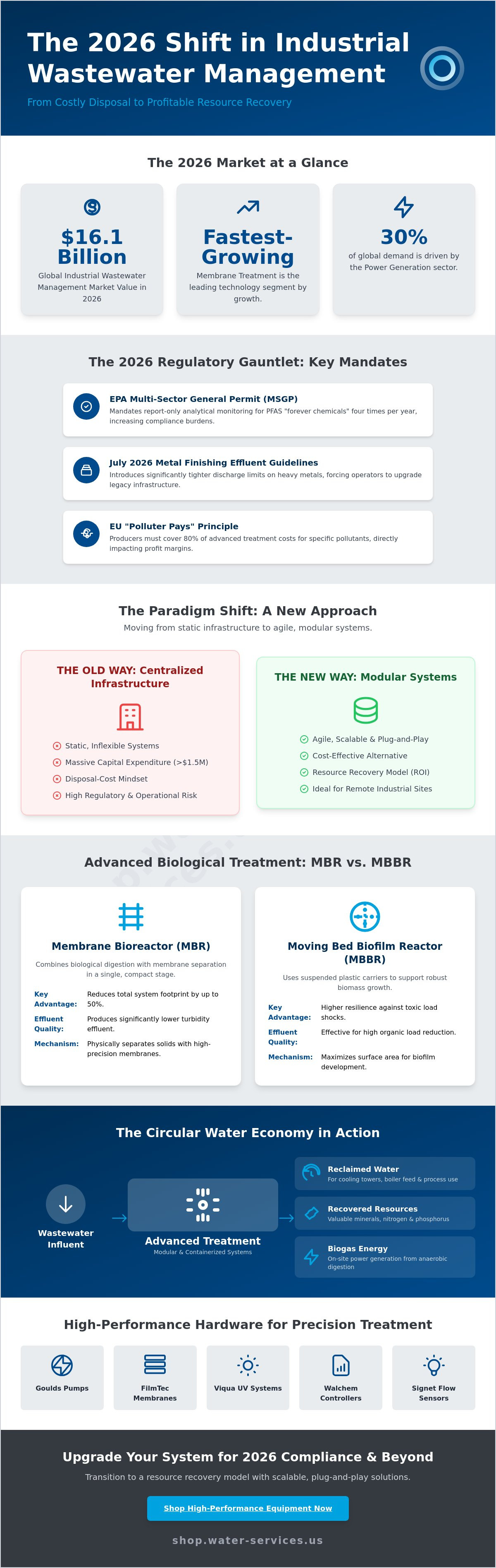
The global industrial wastewater management market is valued at $16.1 billion in 2026, with membrane treatment now the fastest-growing technology segment. You are likely managing the immediate pressure of the 2026 EPA Multi-Sector General Permit, which mandates report-only analytical monitoring for PFAS four times per year. Meeting these strict environmental discharge regulations often feels like a choice between massive capital expenditures or regulatory risk. We focus on wastewater treatment technologies that solve this dilemma by replacing static, centralized infrastructure with agile, modular systems.
Industrial operators in the power generation sector, representing 30% of global demand this year, require reliable hardware that ensures both compliance and resource recovery. You will discover how containerized reverse osmosis plants and mobile ultrafiltration systems provide a cost-effective alternative to complex traditional builds that can exceed $1.5 million. This article details specific 2026 trends, including the July 2026 Metal Finishing Effluent Guidelines and the industry-wide shift toward energy-neutral treatment. We provide a technical overview of how modularity and high-performance components like FilmTec membranes and Goulds pumps streamline your water reuse operations and improve site efficiency.
Key Takeaways
- Learn how to transition from a disposal-cost mindset to a resource recovery model that maximizes your operational ROI.
- Compare the technical advantages of Membrane Bioreactor (MBR) and Moving Bed Biofilm Reactor (MBBR) systems for biological processing.
- Discover how modular wastewater treatment technologies provide scalable, plug-and-play solutions for remote industrial sites.
- Identify the specific hardware configurations, from Goulds pumps to Viqua UV systems, required for high-stakes industrial applications.
The Evolution of Industrial Wastewater Treatment in 2026
Industrial wastewater management in 2026 has moved past the era of simple disposal. It's now a strategic operation focused on resource reclamation. Modern wastewater treatment technologies consist of integrated systems engineered for precise contaminant removal and high-purity water recovery. The Wastewater treatment process now incorporates real-time digital monitoring and automated chemical dosing to ensure operational uptime. Stricter EPA mandates and the rising cost of raw water intake drive this transition. The global industrial wastewater management market is valued at $16.1 billion in 2026, reflecting this shift toward high-efficiency systems. Companies view treated effluent as an asset rather than a liability. Digital twins and IoT sensors allow for predictive maintenance, which reduces the risk of unplanned system failures and extends the life of expensive hardware.
Regulatory Pressures and Global Compliance Standards
The 2026 regulatory environment is defined by aggressive oversight of "forever chemicals." The EPA now requires quarterly monitoring for PFAS under the Multi-Sector General Permit. By April 2026, the final rule listing specific PFAS as hazardous constituents went into effect. By July 2026, the Metal Finishing Effluent Guidelines will introduce even tighter limits on heavy metal discharges. These mandates force operators to upgrade legacy infrastructure immediately. High-performance wastewater treatment technologies are necessary to maintain a reliable purified water system for secondary industrial processes. Global mining and military operations must also navigate the EU "polluter pays" principle. This principle mandates that producers cover 80% of advanced treatment costs for specific pollutants, making compliance a direct factor in profit margins.
From Waste to Resource: The Circular Water Economy
The circular economy is a functional reality for industrial sectors in 2026. Facilities now recover valuable minerals, nitrogen, and phosphorus from effluent streams. Biogas generated during anaerobic digestion provides on-site energy, which reduces reliance on external power grids. Reclaimed water serves as the primary source for industrial cooling towers and boiler feed. This reduces the demand for expensive municipal water and lowers overall operational costs. Integrated systems using Walchem controllers and Signet flow sensors provide the precision needed for these recovery processes. The energy neutrality goal for wastewater treatment in the EU is set for 2045, but leading 2026 facilities are already hitting these benchmarks. The economic value of water reuse in 2026 industrial sectors is defined by the direct reduction of procurement costs and the elimination of non-compliance fines.
Advanced Biological and Physical-Chemical Treatment Methods
Industrial operators in 2026 select biological or physical-chemical processes based on influent chemistry and footprint constraints. Biological systems are the standard for organic load reduction, while physical-chemical methods handle heavy metals and non-biodegradable toxins. Advanced Oxidation Processes (AOP) are now a primary tool for destroying persistent industrial pollutants that bypass traditional secondary treatment. Dissolved Air Flotation (DAF) remains essential for separating fats, oils, and greases from process streams. These wastewater treatment technologies provide the foundational reliability needed to meet the strict 2026 EPA discharge limits. You can source the necessary industrial water treatment equipment to support these advanced systems through our catalog.
Membrane Bioreactors (MBR) and Ultrafiltration
Membrane Bioreactors (MBR) combine biological digestion with high-precision membrane separation in a single stage. This technology replaces secondary clarifiers, which reduces the total system footprint by up to 50%. In contrast, Moving Bed Biofilm Reactors (MBBR) use suspended plastic carriers to support biomass growth, offering higher resilience against toxic shocks. Data from the Industrial Wastewater Treatment Technology Database (IWTT) confirms that MBR systems produce effluent with significantly lower turbidity than conventional activated sludge. For remote mining or oil sites, mobile ultrafiltration systems provide a rapid, skid-mounted solution for generating high-quality process water. Membrane maintenance is a critical factor; systems require automated backpulsing and periodic chemical cleaning to prevent organic fouling in high-strength industrial applications.
Physical-chemical separation continues to evolve through the use of specialized media and resins. In the mining sector, ion-exchange resins target specific dissolved metals like copper and nickel to meet the July 2026 effluent standards. DAF systems use micro-bubbles to float light solids to the surface for mechanical skimming. This is often the first step in treating produced water in the oil and gas sector before it moves to membrane polishing.
Zero Liquid Discharge (ZLD) as a Compliance Gold Standard
Zero Liquid Discharge (ZLD) is the definitive solution for facilities in water-stressed regions or those facing "zero discharge" permit requirements. The ZLD mechanism utilizes brine concentrators and crystallizers to convert liquid waste into high-purity distillate and solid salt cakes. This process allows for 95% to 99% water recovery, which provides a closed-loop supply for industrial boilers and cooling towers. While ZLD was once considered cost-prohibitive, 2026 innovations in mechanical vapor recompression have improved energy efficiency. The most effective way to reduce ZLD expenses is implementing high-recovery reverse osmosis as a pre-concentration step to minimize the thermal evaporation load. This strategy ensures your facility remains compliant while insulating the operation from rising raw water costs.
Modular and Containerized Treatment: The 2026 Shift to Decentralization
In 2026, industrial operators prioritize mobility over permanent civil works. Static, centralized plants often fail to meet the rapid deployment needs of remote mining sites or oil fields. Modular wastewater treatment technologies offer a pre-engineered solution that reduces site preparation time by up to 60%. These systems arrive as skid-mounted or containerized units, ready for immediate plug-and-play integration. This shift allows for decentralized management, where water is treated closer to the source of generation. It eliminates the high cost of piping wastewater to a central hub and reduces the overall infrastructure footprint.
Scalability is a core advantage of the modular model. Instead of expanding a permanent concrete structure, you can daisy-chain additional units to increase capacity as production grows. This approach lowers the Total Cost of Ownership (TCO) by avoiding massive upfront capital expenditures. It also minimizes long-term risks, as individual modules can be relocated or sold if site requirements change. Rapid deployment is essential in 2026, especially as industries scramble to meet new EPA PFAS monitoring requirements that went into effect earlier this year.
Containerized RO and UF Systems
Climate-controlled containers house sensitive industrial reverse osmosis systems to ensure consistent performance in extreme environments. These units protect membranes and high-pressure pumps from the high temperatures of the Middle East or the humidity of South American mining regions. Each container typically includes onboard PLC controllers for automated operation and integrated chemical dosing stations. This self-contained design ensures that precision wastewater treatment technologies, such as FilmTec membranes and Goulds pumps, operate within optimal technical specifications regardless of external site conditions.
Rental vs. Purchase: Financial Flexibility in 2026
Industrial water management in 2026 utilizes flexible financing to balance Operating Expense (OpEx) and Capital Expenditure (CapEx). A mobile water treatment plant rental is often the superior choice for short-term remediation or exploratory mining projects. Rental agreements typically include technical support and scheduled maintenance, which reduces the burden on your internal engineering staff. If the project duration exceeds 36 months, purchasing a permanent modular unit usually provides a better long-term return on investment. This financial agility allows companies to maintain regulatory compliance without committing to heavy-duty infrastructure before a site's viability is confirmed.
Selecting Technology for High-Stakes Industrial Applications
Choosing the right wastewater treatment technologies requires a technical match between influent chemistry and discharge requirements. In 2026, the power generation sector accounts for 30% of global industrial wastewater demand. These facilities prioritize systems that handle high-volume cooling tower blowdown and heavy metal removal. In contrast, the food and beverage industry manages high Biochemical Oxygen Demand (BOD) levels, which often exceed 2,000 mg/L. This necessitates robust biological treatment or advanced oxidation to prevent high surcharges from municipal utilities. Military and remote camps focus on potable water production and sanitary waste management using containerized systems that operate independently of local infrastructure.
Oil and gas operators face the challenge of treating produced water containing complex hydrocarbons and high total dissolved solids (TDS). Effective management in 2026 involves multi-stage separation using corrugated plate interceptors followed by ultrafiltration polishing. This allows for the reuse of water in hydraulic fracturing or secondary recovery, which reduces the need for freshwater intake. Each industry presents unique chemical profiles that dictate the selection of specific filtration media and membrane types. You must ensure that your system is engineered to handle these specific contaminant loads without frequent membrane replacement or hardware failure.
Mining Wastewater: Compliance and Resource Recovery
Mining operations deal with high turbidity, heavy metals, and acidic mine drainage. Implementing mining wastewater treatment solutions is essential for recovering process chemicals and meeting the July 2026 effluent guidelines. Corrugated plate interceptors and multimedia filter tanks provide the first line of defense against heavy sediment loads. Advanced filtration systems address tailings pond management by reducing the volume of liquid waste and allowing for the reclamation of dissolved metals like copper and nickel. This circular approach turns a waste stream into a potential revenue source while maintaining compliance with the EU 80% removal rate standard for quaternary treatment.
Critical Factors in Technology Selection
A detailed water analysis is the mandatory first step in engineering any industrial system. You must define the influent characteristics, including pH, temperature, and specific ion concentrations. The desired effluent quality determines whether the system is designed for environmental discharge or high-purity process reuse. Geographic constraints also play a major role in 2026. Footprint limitations on offshore platforms or in remote mountain mines require compact, skid-mounted units. Power availability and local climate factors dictate the need for energy-efficient components or climate-controlled enclosures. To ensure your system meets these rigorous technical requirements, browse our professional-grade water treatment equipment for your specific industry application.
Integrating Precision Hardware for High-Performance Treatment
Successful execution of modern wastewater treatment technologies depends on the technical integrity of the physical hardware. While process design provides the framework, industrial-grade components ensure the system meets the rigorous demands of the 2026 market, which is currently valued at $16.1 billion. High-purity requirements for water reuse in the pharmaceutical and power sectors necessitate the use of FilmTec or Hydranautics reverse osmosis membranes. These membranes provide the salt rejection rates needed for high-pressure boiler feed or cooling tower makeup. For chemical-free pathogen control, integrating Viqua UV systems provides a reliable sterilization method that avoids the logistics of hazardous chemical storage. Every component must be selected for its ability to withstand the continuous operational cycles of a heavy-duty industrial environment.
The Engine of the System: Industrial Pumps
The movement of fluid through filtration and membrane stages requires consistent hydraulic pressure. Goulds Water Technology Pumps serve as the industry standard for high-volume wastewater movement. These centrifugal pumps are engineered with specialized impellers and materials, such as 316 stainless steel or CD4MCu, to handle the abrasive or corrosive fluids common in mining and oil production. Selecting the correct pump head and horsepower ensures the system maintains the required GPH without cavitation or premature seal failure. High-efficiency pump selection is a primary factor in maintaining system uptime in harsh environments. Optimizing pump efficiency reduces the energy consumption of high-pressure membrane systems, which significantly lowers the long-term operational cost and accelerates the return on investment for the facility.
Monitoring and Control Infrastructure
Precision control is managed through electric power controls and Variable Frequency Drives (VFDs). These components allow the system to adjust flow rates based on real-time demand, which protects sensitive membranes from pressure spikes. Walchem controllers and Signet flow sensors provide the digital data points necessary for automated operation and process optimization. Accurate chemical dosing is achieved through Pulsafeeder metering pumps, which ensure antiscalants and pH adjusters are delivered at exact intervals to prevent mineral scaling on RO membranes. Ashcroft pressure gauges provide the final layer of system health monitoring, allowing operators to identify filter fouling or pump wear before it impacts effluent quality. This integrated hardware stack ensures that your wastewater treatment technologies remain compliant with the 2026 EPA monitoring standards.
From our headquarters in Provo, Utah, we supply the hardware required to transform complex wastewater into a reusable resource. We ship worldwide to ensure that mining, oil, and power facilities have access to the heavy-duty components they need for 2026 compliance. Quality water equipment you can trust and rely on is the foundation of every high-performance industrial water system.
Optimizing Industrial Compliance and Operational ROI for 2026
Industrial water management in 2026 requires a technical balance between regulatory compliance and resource recovery. You've seen how modular systems and containerized RO plants provide the scalability needed to handle the EPA's April 2026 PFAS hazardous constituent listing. Decentralization is no longer a niche concept; it's the primary strategy for reducing infrastructure costs in high-stakes sectors like mining and power generation. Implementing these wastewater treatment technologies ensures your facility meets the 80% removal rate standard for quaternary pollutants while protecting your operational bottom line.
Success in these environments depends on the technical integrity of your hardware. Water Services, Inc. provides the industrial expertise and logistical reach required for global deployment across Africa, the Middle East, and the Americas. As an authorized distributor for Goulds, Viqua, and FilmTec, we offer custom engineering and design services for the most complex industrial sites. We provide the equipment you can trust for continuous, heavy-duty performance.
Explore our full catalog of industrial water treatment hardware and modular systems to secure your facility's future. Our team is ready to support your 2026 compliance goals with precision-engineered solutions.
Frequently Asked Questions
What are the most common wastewater treatment technologies for industrial use in 2026?
The most common wastewater treatment technologies for industrial use in 2026 include membrane filtration, advanced biological reactors, and physical-chemical separation. Membrane treatment is currently the fastest-growing segment, driven by the need for high-purity process water. Facilities utilize reverse osmosis and ultrafiltration to remove dissolved solids and pathogens. Advanced Oxidation Processes (AOP) are also standard for destroying persistent organic pollutants like PFAS to meet the 2026 EPA discharge requirements.
How does Zero Liquid Discharge (ZLD) work in a mining context?
Zero Liquid Discharge (ZLD) in mining utilizes thermal evaporation and crystallization to eliminate all liquid waste. The process converts brine into high-purity distillate for reuse and solid salt cakes for disposal or mineral recovery. This allows mining sites to recover 95% to 99% of their process water. It's an essential strategy for sites in water-stressed regions where environmental permits prohibit any liquid discharge into local aquifers.
Can I rent a mobile wastewater treatment plant for a temporary site?
You can rent mobile wastewater treatment plants for temporary projects, exploratory mining, or emergency remediation. These systems are typically skid-mounted or housed in 20-foot or 40-foot containers for rapid deployment. Rental models allow operators to treat water as an Operating Expense (OpEx) rather than a large Capital Expenditure (CapEx). This flexibility is ideal for sites that only require advanced filtration for a duration of 6 to 24 months.
What is the difference between MBR and MBBR technologies?
Membrane Bioreactors (MBR) combine biological digestion with membrane filtration, while Moving Bed Biofilm Reactors (MBBR) use suspended plastic carriers to grow biomass. MBR provides superior effluent quality by replacing secondary clarifiers with high-precision membranes. MBBR is more resilient to toxic shocks and fluctuations in organic load. MBR is the preferred choice when space is limited and high-purity water reclamation is the primary goal for the facility.
How do I choose between a centralized plant and a containerized modular system?
Centralized plants are designed for permanent, high-volume municipal or large industrial hubs, whereas containerized modular systems offer rapid deployment and scalability. Modular units are pre-engineered and factory-tested, which reduces site preparation time by 60%. You should choose modular systems for remote mining sites, oil fields, or facilities where production capacity might change. Centralized infrastructure is better suited for decades-long operations with stable, massive flow requirements.
What role do UV sterilizers play in industrial wastewater treatment?
UV sterilizers provide chemical-free disinfection by using specific light wavelengths to deactivate the DNA of bacteria, viruses, and protozoa. In industrial wastewater treatment technologies, Viqua UV systems are integrated as a final polishing step before discharge or reuse. This technology eliminates the need for hazardous chlorine storage and prevents the formation of harmful disinfection byproducts. It's a critical component for meeting the 80% removal rate standards for quaternary treatment in 2026.
Is it possible to recover minerals from mining wastewater?
It is possible to recover minerals like copper, nickel, and phosphorus from mining wastewater using ion-exchange resins and selective precipitation. The 2026 shift toward a circular water economy treats effluent as a resource rather than a waste product. Advanced filtration and Zero Liquid Discharge (ZLD) systems concentrate these minerals into a manageable form for reclamation. This process helps offset treatment costs while ensuring compliance with the July 2026 Metal Finishing Effluent Guidelines.
How often do membranes in RO systems need to be replaced in industrial settings?
Reverse osmosis membranes in industrial settings typically last between 2 and 5 years. This duration depends heavily on the effectiveness of your pretreatment and the chemical dosing of antiscalants. High-fouling environments, such as produced water treatment in oil and gas, may require more frequent cleaning or replacement. Utilizing Walchem controllers for precise monitoring helps extend membrane life by preventing mineral scaling and organic fouling through automated maintenance cycles.
0 comentarios