

Selecting the wrong motor control method can lead to excessive peak demand charges and premature mechanical failure. While many operators view the VFD vs soft starter for industrial pumps debate as a simple choice of price versus performance, the reality in 2026 is far more complex. You're likely managing high inrush currents and the destructive impact of water hammer on your Goulds Water Technology pumps or other critical assets. These operational hurdles directly erode your bottom line and threaten compliance with tightening industrial energy efficiency regulations.
This guide provides the technical and economic clarity required to make an informed investment decision. You'll discover how to differentiate between these technologies based on duty cycles, variable demand requirements, and total cost of ownership. We'll examine the specific scenarios where a soft starter provides sufficient protection and where the precision of a VFD is mandatory for system longevity. By the end of this analysis, you'll have a clear roadmap to reduce your OPEX and extend the life cycle of your industrial pumping infrastructure through precise control logic.
Key Takeaways
- Reduce mechanical stress and eliminate water hammer by integrating the correct ramp-up logic for your pumping assets.
- Evaluate the VFD vs soft starter for industrial pumps by calculating the return on investment through both capital expenditure and operational savings.
- Maximize energy efficiency in variable-flow systems by utilizing affinity laws to meet 2026 NEMA and IEC motor standards.
- Match control hardware to specific applications, such as membrane flux management in RO plants or high-torque starts in mining slurry operations.
- Optimize system performance by choosing between discrete startup protection and continuous speed modulation based on your specific process flow requirements.
Understanding the Mechanism: How VFDs and Soft Starters Control Industrial Pumps
Industrial pumping systems rely on precise motor control to maintain operational uptime. The fundamental difference in the VFD vs soft starter for industrial pumps debate lies in how each device manages electrical energy and mechanical torque. Modern 2026 industrial standards move beyond simple motor activation. They prioritize long-term protection for high-value assets like Goulds Water Technology Pumps. Proper integration of electric power controls prevents the mechanical shock and thermal stress that lead to pump failure.
The Variable Frequency Drive (VFD) Workflow
A Variable-frequency drive functions as a comprehensive power converter. It rectifies incoming AC power into DC; it then uses an inverter to switch that DC back into a simulated AC wave with adjustable frequency and voltage. This allows the pump to maintain full torque even when running at sub-nominal speeds. Operators can adjust flow rates in real time based on sensor feedback without relying on restrictive throttling valves. This capability eliminates the energy waste associated with mechanical flow restriction. It provides a level of process precision that simpler starters cannot match.
The Soft Starter Workflow
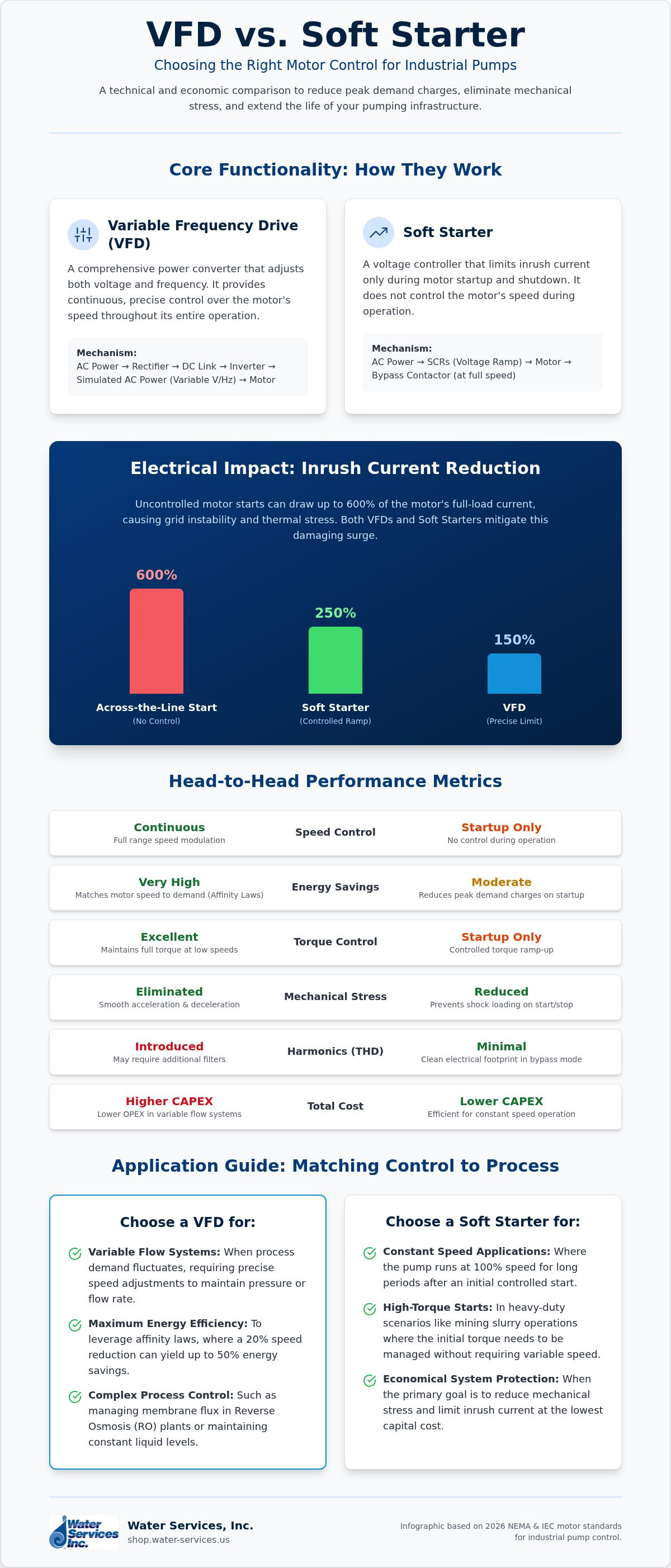
Soft starters utilize silicon-controlled rectifiers (SCRs) to manage the voltage ramp-up during the initial motor start phase. Unlike a VFD, a soft starter does not change the frequency of the power. It reduces the initial voltage to limit inrush current, which can reach 600% of full-load current in across-the-line starts. This prevents grid voltage dips and protects internal pump components from sudden torque spikes. Once the motor reaches full operational speed, most units engage a bypass mode. This sends line power directly to the motor, making the soft starter highly efficient for applications that run at a constant 100% speed.
Current NEMA and IEC efficiency standards emphasize the need for controlled acceleration to preserve winding insulation and bearing integrity. While a VFD provides continuous speed modulation, a soft starter serves as a specialized protection tool for constant-speed loads. Both technologies are critical for reducing the high peak demand charges associated with industrial pumping operations. Choosing the correct mechanism is the first step in optimizing your infrastructure's total cost of ownership.
Technical Comparison: Performance Metrics for Heavy-Duty Pumping
The evaluation of VFD vs soft starter for industrial pumps requires a deep dive into electrical and mechanical performance metrics. Standard across-the-line starts subject motors to an inrush current that often reaches 600% of the full-load rating. This spike causes grid instability and thermal stress. Both VFDs and soft starters mitigate this by providing controlled ramping, but their methods of execution differ significantly across the pump's operational range. Choosing between them depends on whether your process requires fixed-speed protection or dynamic flow modulation. For organizations seeking specialized expertise in this selection process, Ana-Digi Systems provides decades of industrial automation experience to help optimize motor control and energy usage.
VFDs provide precise torque control throughout the entire pump curve. This is vital for maintaining efficiency in systems where demand fluctuates. By adjusting speed, the VFD ensures the pump operates at its Best Efficiency Point (BEP). Soft starters are optimized specifically for the transition from zero to full speed. They lack the ability to modulate speed once the motor is running. For centrifugal pumps, the controlled acceleration provided by either device significantly reduces the wear on mechanical seals and bearings. This prevents the shock loading that often leads to seal failure in high-pressure environments.
Electrical Footprint and Harmonics
The electrical impact of these devices varies, particularly in remote mining or oil sites. VFDs utilize high-speed switching that can introduce harmonic distortion into the power grid. This often necessitates the installation of additional harmonic filters to protect sensitive downstream electronics. A technical comparison from Sprecher + Schuh notes that while VFDs offer superior control, soft starters maintain a much cleaner electrical footprint with minimal noise. Soft starters are often the preferred choice for simple, constant-speed applications where space for filtering equipment is limited. You can find robust options for these environments in our Electric Power Controls collection.
Eliminating water hammer is another critical metric. Rapid valve closures or pump shutdowns create pressure surges that can rupture long industrial pipelines. Both technologies allow for controlled deceleration. This gradually reduces fluid velocity and protects the structural integrity of the piping network. Choosing the correct control strategy ensures that your hardware meets 2026 reliability standards while minimizing unnecessary electrical complexity. If you're looking to optimize your site's power distribution, exploring the hardware at Water Services is a practical next step for technical procurement.
Economic Analysis: ROI and Total Cost of Ownership (TCO)
Determining the total cost of ownership (TCO) requires balancing initial capital expenditure (CAPEX) against long-term operational costs (OPEX). While a soft starter typically offers a lower purchase price, the potential for energy savings often makes the VFD a more strategic investment for complex systems. Both technologies contribute to lower utility demand charges by eliminating high inrush currents during startup. This prevents the peak demand penalties that utilities often levy against industrial facilities with large motor loads.
When the VFD Pays for Itself
Applications with fluctuating flow requirements, such as municipal water distribution or variable-load industrial processes, see the fastest ROI with a VFD. The primary driver for this is found in the Affinity Laws. These laws dictate that the power consumed by a centrifugal pump is proportional to the cube of its speed; therefore, a 20% reduction in motor speed can result in approximately a 50% reduction in energy consumption. This exponential relationship allows for rapid recovery of the initial hardware cost in high-demand environments.
Beyond energy, VFDs reduce maintenance costs by eliminating the need for mechanical throttling valves. This decreases vibration and wear on pipe hangers and reduces the frequency of seal replacements in Goulds Water Technology Pumps. When evaluating the VFD vs soft starter for industrial pumps, consider that the VFD's ability to match pump output to process demand directly lowers OPEX in any variable-speed application.
The Cost-Efficiency of Soft Starters
A soft starter remains the most cost-efficient choice for applications where the pump operates at a constant speed for long durations. The initial CAPEX is significantly lower than a VFD of the same horsepower rating. Additionally, soft starters have a smaller physical footprint. This makes them ideal for space-constrained sites or modular, containerized water treatment plants where every square inch of panel space is valuable.
Troubleshooting is often simpler for on-site maintenance teams because the circuitry is less complex than that of a VFD. There's no need for expensive harmonic filters or specialized shielded cables in most installations. For constant-load systems, the soft starter provides the necessary protection against mechanical shock without the added cost of speed control hardware. You can compare various electric power controls to determine which configuration fits your facility's budget and technical requirements.
Application Guide: Mining, Reverse Osmosis, and Wastewater
The decision in the VFD vs soft starter for industrial pumps debate often hinges on the specific fluid dynamics of the application. In heavy industry, the material being moved and the environment of the site dictate the necessary level of control. High-solids slurry in mining requires different torque management than high-purity water in a desalination plant. Reliability in remote, off-grid locations often favors simplicity; however, process precision in chemical treatment demands sophisticated modulation to maintain system integrity.
Pumping in Mining and Heavy Industry
Deep-well mining operations face significant challenges with varying head pressure. Moving high-solids slurry requires high starting torque to overcome the inertia of settled particles. Robust soft starters are often the preferred choice for these heavy-duty cycles. They provide the necessary current limiting without the complexity of a drive. When integrating Goulds Water Technology Pumps into these environments, engineers must account for the abrasive nature of the media. For more on managing these systems, see our guide on Mining Wastewater Treatment Solutions. The goal is to protect the pump impeller and motor windings from the mechanical shock of sudden starts.
Control Logic for Reverse Osmosis Systems
Variable frequency drives are essential for the performance of industrial Reverse Osmosis (RO) plants. Maintaining a constant flux across FilmTec and Hydranautics membranes requires precise pressure control. A VFD allows the system to compensate for temperature changes and membrane age by adjusting pump speed rather than using energy-wasting bypass valves. This precision prevents membrane fouling and extends the service life of expensive filtration components. Our Commercial Reverse Osmosis Water Filtration Guide provides further detail on optimizing these high-pressure configurations. Without precise speed control, membrane systems often suffer from flux imbalances that lead to premature scaling.
Modular, containerized water treatment systems often have limited space for electrical hardware. In these scenarios, the compact nature of a soft starter is a distinct advantage. If the site relies on limited generator power, the ability of a VFD to limit starting current to 100% of the motor rating can be the deciding factor. Site engineers must weigh the need for speed modulation against the desire for simplified maintenance in remote settings. For professional assistance in selecting the right electric power controls, you can browse our full inventory of industrial pumping hardware to find a solution that matches your site's technical requirements.
Final Selection: How to Choose the Right Control Strategy
Selecting the optimal control strategy requires a systematic audit of your operational parameters. The VFD vs soft starter for industrial pumps decision isn't just a hardware choice; it's a long-term commitment to a specific maintenance and energy profile. By following a structured selection process, you ensure that your Goulds Water Technology Pumps operate within their designed performance envelopes while meeting 2026 efficiency mandates. You should evaluate your system through four critical steps.
Step 1 involves defining your flow requirements. If your process requires constant flow at a fixed head pressure, a soft starter provides the necessary mechanical protection without unnecessary complexity. Step 2 requires an assessment of your electrical grid capacity. Facilities with limited transformer headroom or aggressive utility peak demand charges benefit from the VFD's ability to limit starting current to 100% of the motor rating. Step 3 addresses environmental conditions. VFDs generate heat and require filtered cooling air or climate-controlled enclosures, whereas soft starters are more resilient in dusty or humid environments. Finally, Step 4 evaluates your internal technical capability. VFDs require sophisticated parameter tuning and specialized diagnostic tools, while soft starters are generally more accessible to standard electrical maintenance teams.
The Decision Matrix
A concise decision matrix helps categorize the primary benefits of each technology. VFDs offer continuous speed control and significant energy savings but introduce higher complexity and harmonic considerations. Soft starters focus on startup protection and cost savings with low technical complexity. For specialized applications, such as remote mining or military water supply, consulting with Water Services for custom containerized solutions ensures that your electric power controls are pre-integrated and tested for your specific environment. This approach reduces on-site installation time and guarantees component compatibility.
Implementation and Support
Successful deployment depends on proper commissioning. Parameter tuning is essential to align the drive or starter with the specific inertia and torque requirements of the pump. Improperly configured ramp times can still lead to water hammer or motor overheating. Water Services provides global engineering support to ensure that installations in remote oil sites or industrial plants achieve their projected ROI. Our team understands that uptime is your primary metric. You can contact Water Services for a custom pump control evaluation to determine the most reliable and cost-effective configuration for your infrastructure.
Optimizing Your Industrial Pumping Infrastructure for 2026
The decision between a VFD vs soft starter for industrial pumps determines your facility's long-term energy profile and maintenance schedule. Systems requiring precise pressure modulation or membrane flux management necessitate the advanced control logic of a VFD. Conversely, constant-speed applications benefit from the reliability and lower capital expenditure of a soft starter. Both technologies provide essential motor protection that extends the life cycle of your pumping assets and ensures compliance with global efficiency standards.
Water Services, Inc. has provided specialized industrial water treatment systems and global engineering support since 1994. As an authorized Goulds Water Technology distributor, we integrate high-performance hardware with the correct control logic for remote mining, oil, and military sites. Our technical experts ensure your site reaches its projected ROI through precise commissioning and ongoing support. Shop Industrial Pumps and Electric Power Controls today to enhance your operational reliability and reduce total cost of ownership. Your infrastructure's efficiency is a strategic asset; we help you protect it.
Frequently Asked Questions
Can I use a VFD on any industrial pump?
You can use a VFD on most centrifugal and positive displacement pumps, provided the motor is inverter-rated. The motor must feature NEMA MG1 Part 31 compliant insulation to withstand the high-frequency voltage spikes generated by the drive. If you're retrofitting older Goulds Water Technology pumps, verify the insulation class first. Non-rated motors often suffer from premature winding failure due to corona discharge when paired with modern high-speed switching drives.
Do soft starters save energy compared to across-the-line starting?
Soft starters primarily reduce peak demand charges rather than operational energy consumption. They limit the initial inrush current during the startup phase, which prevents the utility penalties associated with high-current spikes. Unlike a VFD, a soft starter doesn't modulate motor speed once the system reaches full velocity. If your process requires constant-speed operation, the soft starter provides the necessary mechanical protection without the higher energy-saving capabilities of a drive.
How much more does a VFD cost than a soft starter in 2026?
A VFD typically requires a higher initial investment than a soft starter of the same horsepower rating. This price gap accounts for the complex power electronics and cooling requirements inherent in variable speed technology. When evaluating the VFD vs soft starter for industrial pumps, you must also factor in the cost of harmonic filters and shielded cabling. The higher CAPEX of a VFD is usually justified by long-term OPEX savings in variable-flow applications.
What is the lifespan of a VFD in a mining environment?
In demanding mining environments, a VFD typically lasts between 7 and 10 years with professional maintenance. Harsh conditions like high ambient heat, vibration, and conductive dust can reduce this lifespan if the unit isn't housed in a NEMA 4 or 4X enclosure. Regular replacement of cooling fans and DC bus capacitors is essential to reach the upper end of this range. Reliability often depends on the quality of the initial site commissioning and environmental protection.
Can a soft starter prevent water hammer in high-pressure systems?
Yes, soft starters effectively prevent water hammer by utilizing a soft stop feature. This function gradually ramps down the motor voltage, allowing the fluid velocity in the pipeline to decrease slowly. This controlled deceleration eliminates the sudden pressure surges that occur when a pump stops abruptly. It's a critical feature for protecting the structural integrity of long pipelines and high-pressure Reverse Osmosis systems from mechanical shock and potential pipe bursts.
Do VFDs require special motors or can they run on standard Goulds pumps?
VFDs require motors specifically designed for inverter duty to handle the thermal and electrical stress of variable frequencies. While many modern Goulds pumps come equipped with compatible motors, older units may need an upgrade. Standard motors lack the reinforced insulation needed to prevent pitting in the bearings and insulation breakdown. Always consult the motor nameplate for an Inverter Duty or Inverter Rated designation before connecting a new variable frequency drive to your system.
What maintenance is required for a soft starter vs. a VFD?
Soft starters require minimal maintenance, focusing on periodic terminal tightening and heat sink cleaning. VFDs are more technical and require an annual schedule that includes inspecting cooling fans, testing electrolytic capacitors, and cleaning air filters. Because VFDs contain more sensitive electronic components, they are more susceptible to failure from environmental contaminants. Choosing a soft starter simplifies the maintenance routine for remote sites with limited technical staff or specialized diagnostic hardware.
How do harmonics from a VFD affect other equipment on my site?
Harmonics from a VFD create electrical noise that can cause overheating in transformers and interference with sensitive instrumentation like Walchem controllers or Signet flow sensors. This distortion can also lead to nuisance tripping of circuit breakers and reduced efficiency in other motors sharing the same power bus. To mitigate these effects, engineers often install line reactors or active harmonic filters; additionally, incorporating power quality solutions from ecsintl.com helps protect against damaging electrical transients. This ensures site-wide electrical stability and protects the integrity of your industrial control logic.
0 comentarios