

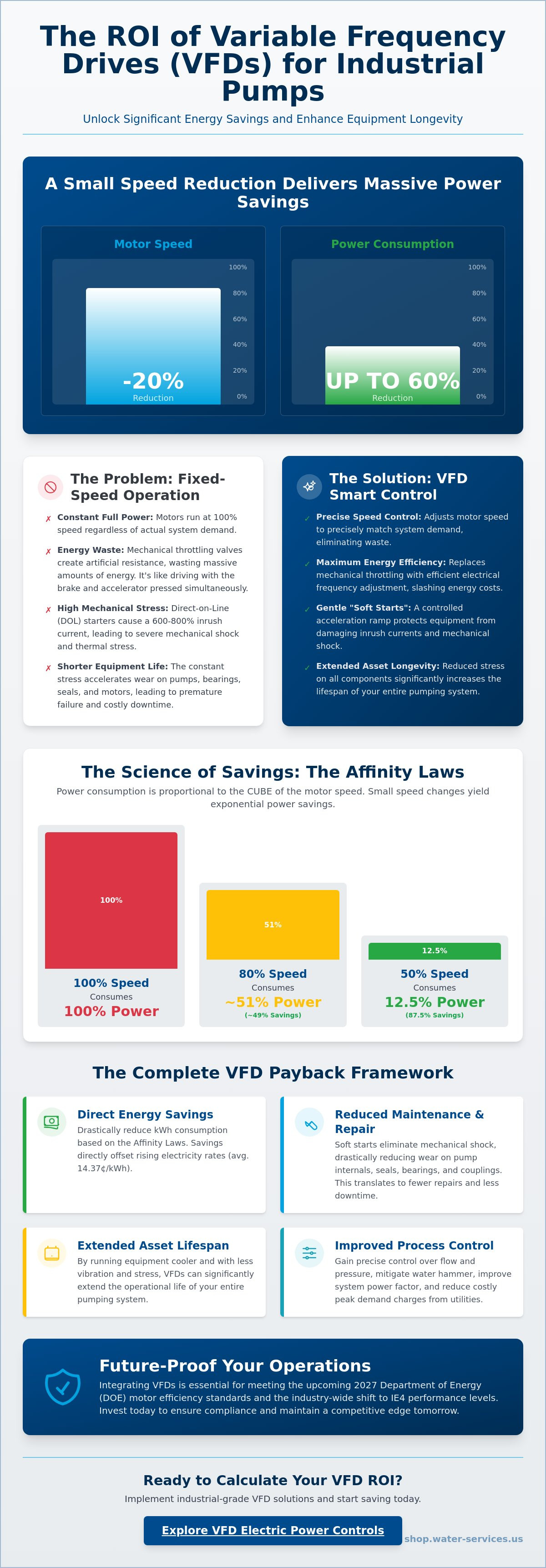
Did you know that a modest 20% reduction in motor speed can slash your pump's power consumption by up to 60%? With the average U.S. commercial electricity rate reaching 14.37¢ per kilowatt-hour in June 2026, operating centrifugal pumps at full fixed speeds via direct-on-line starters is a costly technical oversight. You likely recognize that inefficient flow control drives up utility bills and induces mechanical stress, yet quantifying the variable frequency drive (VFD) for pumps ROI requires more than a basic energy audit. This guide provides a professional framework to calculate true industrial payback by integrating energy data, maintenance savings, and asset longevity.
You will discover how to justify VFD integration within high-flow water treatment environments where reliability is paramount. We explain the financial implications of the upcoming 2027 DOE motor efficiency standards and the industry shift toward IE4 performance levels. This analysis previews the impact of localized utility rebates, the mitigation of water hammer through controlled deceleration, and the specific metrics needed to secure capital approval for your 2026 infrastructure projects. Our focus remains on technical integrity and the precise calculation of total cost of ownership for your pumping systems.
Key Takeaways
- Replace mechanical throttling with precise electrical frequency adjustment to eliminate system-wide energy waste and improve process control.
- Leverage the Affinity Laws to optimize flow rates and significantly reduce power consumption in centrifugal pumping systems.
- Quantify the variable frequency drive (VFD) for pumps ROI by integrating maintenance savings, reduced mechanical stress, and extended asset longevity.
- Apply a comprehensive financial framework that factors in localized utility rebates and the specific requirements of NEMA-rated electrical power controls.
- Streamline implementation by integrating custom VFD panels within containerized reverse osmosis plants for immediate industrial-grade efficiency.
Understanding VFD for Pumps: The Foundation of Industrial ROI
A Variable-frequency drive is an electronic power conversion device that regulates the rotational speed of an AC motor by varying the frequency and voltage of the power supplied to it. In industrial pumping, this technology replaces inefficient mechanical control methods like throttling valves or bypass lines. Traditional systems often run pumps at a constant speed, using valves to restrict flow to meet process requirements. This practice wastes significant energy as the motor continues to draw full power against artificial resistance. By contrast, a VFD adjusts the motor speed to match the exact demand of the application. Transitioning to this level of control is a primary factor in calculating a favorable variable frequency drive (VFD) for pumps ROI, especially as electricity rates continue to climb.
Moving away from Direct-on-Line (DOL) starting is another critical shift for modern facilities. DOL starters subject the motor and pump to 600% to 800% of their rated current during startup. This "across the line" method causes thermal stress and mechanical shock that shortens equipment life. Implementing electric power controls with VFD capabilities allows for a controlled acceleration ramp. This soft-start functionality protects internal pump components and reduces the peak demand charges levied by utility providers. By 2026, these standards have become the baseline for high-horsepower industrial operations seeking to minimize downtime.
The Core Mechanism: Frequency vs. Flow
The relationship between electrical frequency, measured in Hertz (Hz), and motor RPM is direct and linear. Most industrial motors in North America are designed for 60 Hz operation at full speed. When a VFD reduces the output to 30 Hz, the motor speed drops by 50%. This precision is vital for high-flow water treatment where process variables change frequently. The Affinity Laws dictate that the power required by a centrifugal pump is proportional to the cube of its speed, meaning even a minor reduction in frequency results in massive energy savings.
VFD vs. Soft Starters: Which Delivers Better ROI?
Soft starters are effective for reducing inrush current during the initial startup phase, but they offer no control once the motor reaches full speed. They're often chosen for their lower initial capital cost. However, a VFD provides continuous speed modulation throughout the entire operating cycle. While the upfront investment for a VFD is higher, the long-term operational flexibility usually leads to a superior variable frequency drive (VFD) for pumps ROI. In complex water treatment scenarios requiring constant pressure or variable flow, a VFD is the only viable technical solution.
Energy Efficiency and the Affinity Laws: Quantifying Power Savings
The primary driver for a variable frequency drive (VFD) for pumps ROI is the exponential relationship between pump speed and power consumption. While many industrial operators assume energy savings are linear, centrifugal pumps follow the "Law of Cubes." This principle, detailed in The Affinity Laws for Pumps, states that the power required by the pump is proportional to the cube of the shaft speed. If you reduce the motor speed by just 20%, the power draw drops by nearly 50%. In high-flow reverse osmosis systems, where high-pressure pumps operate continuously, these savings directly offset the average U.S. commercial electricity rate of 14.37¢ per kilowatt-hour recorded in June 2026.
Industrial systems frequently suffer from "energy waste" caused by oversized pumps. Engineers often specify pumps with a safety margin, leading to units that run at 100% speed while a throttling valve restricts the actual flow to 70% or 80%. This is equivalent to driving a vehicle with the accelerator floored while using the brake to control speed. A VFD eliminates this mechanical resistance. Beyond simple kWh reduction, VFDs improve the system's Power Factor. By maintaining a Power Factor near unity, you reduce the "demand charges" that utilities levy on industrial facilities for reactive power usage. This secondary financial benefit often accelerates the payback period by several months.
Calculating Theoretical Energy Savings
To estimate your specific savings, you must analyze the pump's performance curve against your system's head requirements. Static head, the vertical distance the fluid must be lifted, remains constant regardless of flow. Friction head, however, decreases as flow slows down. VFDs are most effective in systems dominated by friction head. You can reference specific performance data for Goulds Water Technology Pumps to determine how much speed can be safely reduced without falling below the minimum required head for your process. Precise mapping of these curves is the first step in a reliable ROI calculation.
Power Factor Correction and Utility Incentives
In 2026, utility providers have expanded rebate programs to encourage the adoption of high-efficiency electric power controls. For instance, Con Edison currently offers custom incentives at a rate of $0.35/kWh saved for VFD installations. Similarly, the Energy Trust of Oregon provides specific 2026 incentives for retrofitting industrial pumps up to 100 horsepower. These efficiency credits can significantly lower the net purchase price of the hardware. When you factor in these localized rebates alongside the 30% to 50% energy reduction typically seen in motor-driven systems, the variable frequency drive (VFD) for pumps ROI often becomes undeniable within the first 18 to 24 months of operation.
Maintenance Reduction: The Hidden Driver of VFD ROI
Calculating a comprehensive variable frequency drive (VFD) for pumps ROI requires looking beyond the monthly utility bill to the Total Cost of Ownership (TCO). While energy savings are immediate, the reduction in mechanical wear often provides the most significant long-term financial gain. Direct-on-line starting and abrupt stops create hydraulic shock, commonly known as water hammer. This phenomenon sends pressure surges through the system that can rupture pipe joints and damage valve seats. By utilizing a VFD to manage controlled acceleration and deceleration ramps, you eliminate these spikes. This protective measure is essential for maintaining system integrity in high-pressure industrial environments.
Thermal management is another critical factor in asset preservation. Motors running at full speed via traditional starters generate higher internal temperatures, which can degrade winding insulation over time. Operating at reduced speeds lowers these temperatures. According to U.S. Department of Energy data on VFD Maintenance and Reliability, even a small decrease in operating temperature can effectively double the life of motor insulation. In sectors like mining or oil and gas, where the cost of unplanned downtime often exceeds the cost of the equipment itself, this increased reliability is a vital metric for ROI.
Protecting High-Value Assets
Precision control is particularly beneficial for Goulds centrifugal pumps operating in abrasive or corrosive environments. A VFD allows the pump to stay within its Preferred Operating Region (POR), which minimizes shaft deflection and vibration. This stability directly reduces the frequency of mechanical seal replacements and bearing overhauls. By preventing cavitation through precise pressure management, the VFD also protects the impeller from the pitting and erosion that typically occur during erratic flow conditions.
System-Wide Longevity
The benefits of VFD integration extend to downstream instrumentation and filtration components. Constant, steady flow reduces the mechanical fatigue on Ashcroft pressure gauges and sensitive flow sensors, ensuring they remain in calibration for longer intervals. Furthermore, steady-state operation prevents the pressure fluctuations that can lead to premature fouling or structural failure in RO membranes and multimedia filter tanks. Extending the interval for a major system overhaul from three years to five or more years dramatically shifts the financial profile of the installation, securing a much higher variable frequency drive (VFD) for pumps ROI.
The 2026 ROI Calculation Framework for Industrial Pumps
To secure a precise variable frequency drive (VFD) for pumps ROI, industrial managers must move beyond anecdotal estimates and utilize a standardized calculation framework. The total ROI formula for 2026 integration is: (Annual Energy Savings + Annual Maintenance Savings + One-time Rebates) divided by (Total Equipment Cost + Installation Labor). This calculation must account for the specific hardware requirements of your electric power controls, including NEMA-rated enclosures. Using NEMA 4X enclosures for corrosive environments or NEMA 3R for outdoor installations protects the drive's internal semiconductors from environmental degradation, ensuring the asset reaches its full depreciable life.
Installation costs vary significantly based on site accessibility. Remote mining operations or specialized military installations often face higher labor rates and logistical surcharges that must be amortized over the life of the asset. Duty cycles also dictate the speed of payback. A pump running 24/7 at 75% load will typically achieve full cost recovery in less than 14 months. Conversely, intermittent systems with fewer annual run hours require a longer horizon. Accurate modeling ensures that capital is allocated to the pump stations where it will generate the highest yield.
Gathering Your Data Points
You need several specific metrics to populate the ROI model: motor horsepower, average flow rate, annual operating hours, and the local electricity rate. As of June 2026, the average U.S. commercial electricity rate is 14.37¢ per kilowatt-hour. You should also analyze historical maintenance logs to estimate the average annual cost of seal failures and bearing wear. To value 'avoided downtime', assign a specific dollar amount to each hour of lost production caused by pump failure to quantify the financial benefit of improved system reliability.
Sensitivity Analysis: What if Energy Prices Rise?
A robust variable frequency drive (VFD) for pumps ROI model includes sensitivity analysis for energy price volatility. With electricity costs rising 7.4% year-over-year as of February 2026, VFDs serve as a critical hedge against operational inflation. In regions with carbon tax mandates or strict efficiency regulations, the "business as usual" approach of fixed-speed pumping carries an increasing financial penalty. Future-proofing your facility today ensures long-term margin protection against surging utility demand from the electrification of industrial fleets.
Explore our full range of industrial pumps and electric power controls to start your efficiency upgrade today.
Implementing VFD Solutions with Water Services, Inc.
Water Services, Inc. engineers technical solutions for high-stakes industrial water treatment. We specialize in custom VFD panels designed for harsh environments where standard commercial drives often fail. Our integration of containerized reverse osmosis plants provides a plug-and-play solution that maximizes variable frequency drive (VFD) for pumps ROI through pre-configured efficiency. Based in Provo, Utah, our team manages international distribution and commissioning. We provide on-site technical support from domestic facilities to remote sites in Central America. We curate hardware from industry leaders like Goulds Water Technology, Walchem, and Signet to ensure every component meets rigorous performance standards.
Mobile and Modular VFD Integration
Modular systems require ruggedized power controls to withstand the vibrations of transport and the instability of remote power grids. VFDs are central to optimizing mining wastewater treatment solutions and mobile rental units. In remote mining operations, these drives provide the precise flow control needed for complex filtration while protecting the motor from voltage fluctuations. For diesel-powered pump skids, implementing speed control can significantly reduce fuel consumption. This reduction in fuel logistics is a critical factor for sites where delivery costs are high. Reliability remains our primary focus, ensuring that mobile ultrafiltration systems and multimedia filter tanks operate without interruption in the field. Our panels are built to withstand the rigors of these demanding commercial and industrial environments.
Expert Consulting and System Design
Off-the-shelf VFDs frequently lack the specific programming and enclosure ratings required for specialized water treatment. Water Services, Inc. utilizes a matched-component design philosophy. We align the specific hydraulic characteristics of the pump with the electronic parameters of the drive and the precision of Walchem controllers or Signet flow sensors. This holistic approach ensures the system operates at its peak efficiency point, securing the fastest possible variable frequency drive (VFD) for pumps ROI. Our technical team evaluates your specific head requirements and flow demand to program the drive for optimal performance.
Our logistical competence allows us to deliver complete, curated equipment packages that include everything from Goulds pumps to Ashcroft pressure gauges. This level of technical integrity ensures that your water treatment plant isn't just a collection of parts, but a stable, high-performance asset. We understand that precise control is the foundation of industrial reliability. Whether you're managing a local municipal facility or a remote industrial site, our solutions prioritize technical integrity over flashy presentation.
Contact Water Services for a custom ROI analysis and VFD system quote to optimize your industrial pumping infrastructure.
Securing Long-Term Efficiency in Industrial Pumping
Implementing a precise speed control strategy is the most effective method for mitigating rising utility costs and extending the service life of your infrastructure. By applying the 2026 calculation framework, you can accurately quantify the variable frequency drive (VFD) for pumps ROI through combined energy savings, maintenance reduction, and localized utility rebates. These technical upgrades transform your pumping systems from high-maintenance liabilities into stable, efficient assets capable of meeting rigorous industrial demands. Precision control ensures your facility remains compliant with evolving motor efficiency standards while protecting downstream components from hydraulic shock.
Water Services, Inc. has been engineering custom water treatment solutions since 1994. As an authorized Goulds Water Technology distributor, we provide the technical expertise and logistical competence necessary for global deployment in the mining and military sectors. Our team ensures that every VFD integration is precisely matched to your specific hydraulic requirements to achieve maximum reliability in harsh environments. We understand the complexities of high-flow water treatment and the necessity of dependable, curated hardware. Don't let inefficient fixed-speed operation erode your operational margins. Take the next step toward system optimization by visiting our catalog today.
Shop Industrial VFDs and Power Controls
Frequently Asked Questions
What is the typical payback period for a VFD in an industrial water plant?
Payback periods for high-horsepower industrial pumps typically range from 12 to 24 months. This timeline depends on the annual run hours and the local utility rates. With the June 2026 commercial electricity rate at 14.37¢ per kilowatt-hour, energy-intensive processes see faster cost recovery. Maintenance savings and utility rebates further accelerate the variable frequency drive (VFD) for pumps ROI, often reaching full payback within the first 18 months.
Can I install a VFD on an existing older pump motor?
You can install a VFD on older motors, but they must be inverter-duty rated to withstand high-frequency voltage spikes. Standard motors manufactured before the mid-1990s often lack the specialized insulation required to handle the electrical stress of a drive. If you retrofit an older motor, you should use dV/dt filters or shaft grounding rings to prevent premature winding failure and bearing pitting.
How much energy can a VFD actually save on a centrifugal pump?
Variable frequency drives can reduce energy consumption by 30% to 50% in most centrifugal pumping applications. Because of the Affinity Laws, power consumption is proportional to the cube of the motor speed. Reducing the speed by just 20% can cut the required power by approximately 50%. This exponential relationship makes VFDs significantly more efficient than using throttling valves for flow control.
Do VFDs require special maintenance or environmental controls?
VFDs require specific environmental controls to protect sensitive power electronics from heat and contaminants. Most industrial drives need clean air and effective heat dissipation to prevent semiconductor failure. In harsh water treatment environments, we recommend using NEMA 4X or NEMA 3R enclosures. Regular maintenance includes inspecting cooling fans and cleaning heat sinks to ensure the drive operates within its specified thermal limits.
Is a VFD better than a soft starter for reducing ROI-draining downtime?
A VFD provides a superior variable frequency drive (VFD) for pumps ROI compared to a soft starter in applications with variable flow demands. Soft starters only manage the initial inrush current during the startup phase. VFDs provide continuous speed modulation and prevent mechanical stress throughout the entire operating cycle. This reduces downtime caused by pipe fatigue, valve wear, and seal failures that soft starters cannot prevent.
What are the most common reasons a VFD ROI might be lower than expected?
A low ROI often occurs in systems with high static head requirements. If a pump must overcome significant vertical lift, the motor speed cannot be reduced below a certain threshold without stopping the flow entirely. Other factors include incorrect drive sizing or failing to account for the increased cooling needs of the motor at low speeds. Accurate system mapping is required to ensure projected savings are realized.
Are there specific 2026 government grants for industrial VFD upgrades?
While universal federal grants are limited, many localized utility programs offer significant financial incentives in 2026. For example, Con Edison provides custom rebates at $0.35 per kWh saved. The Energy Trust of Oregon also has a 2026 program for VFD retrofits on pumps up to 100 horsepower. You should consult your local utility provider to identify specific prescriptive or custom efficiency credits available in your region.
Does a VFD affect the warranty of my Goulds Water Technology pump?
Installing a VFD does not void the warranty of a Goulds Water Technology pump when the installation follows manufacturer guidelines. Using a drive actually protects the pump by ensuring it operates within its Preferred Operating Region (POR). This reduces vibration and shaft deflection, which are common causes of mechanical failure. Correct VFD programming ensures the pump remains within its safe mechanical and thermal limits.
0 comentarios