

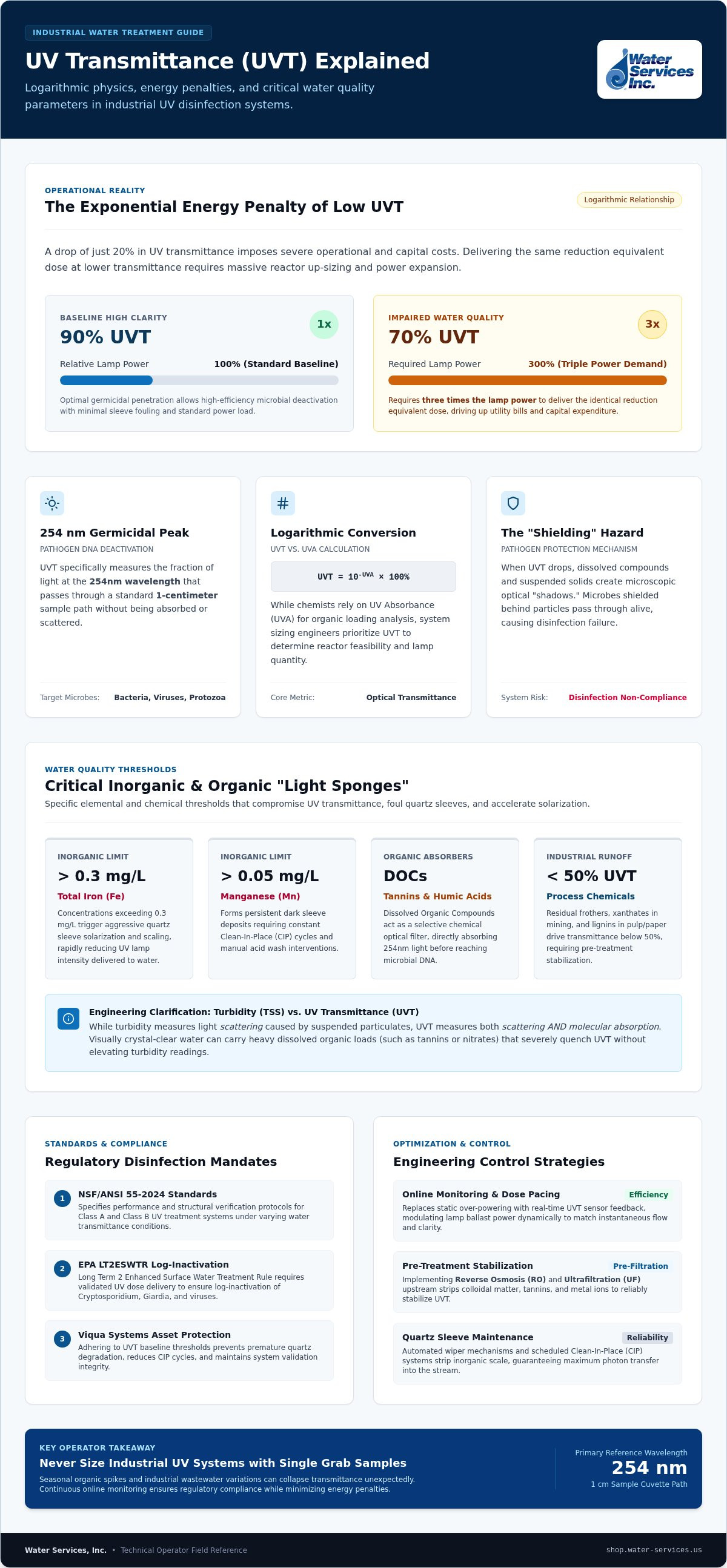
Sizing a UV system for water with 70% UVT compared to 90% UVT often requires three times the lamp power to deliver the same reduction equivalent dose. This exponential energy penalty is why UV transmittance (UVT) in water treatment explained is a vital topic for any facility manager. It's frustrating when unpredictable disinfection results lead to regulatory risks or when over-specified lamps drive up utility costs. You likely know that water clarity matters; however, the logarithmic relationship between UV absorbance and germicidal efficiency is what determines if your industrial system remains reliable or becomes a liability.
This operator guide provides the technical framework to master UVT science and optimize your treatment plant. We'll show you how to ensure compliance with the latest NSF/ANSI 55-2024 standards and EPA LT2ESWTR requirements for log-inactivation. You'll gain a clear understanding of UV system design parameters, from managing quartz sleeve fouling to implementing real-time dose pacing. We'll examine specific thresholds for iron, hardness, and turbidity that protect your Viqua systems and other high-value assets while significantly lowering your long-term maintenance intervals.
Key Takeaways
- Gain a clear understanding of UV transmittance (UVT) in water treatment explained through the logarithmic relationship between light absorbance and germicidal energy.
- Identify critical inorganic and organic "light sponges," such as iron and manganese, that cause quartz sleeve fouling and unpredictable disinfection results.
- Master the UV dose equation to calculate how fluctuating UVT levels dictate the required lamp intensity and contact time for regulatory compliance.
- Evaluate the benefits of online monitoring versus benchtop testing to implement automated dose pacing and reduce industrial energy costs.
- Learn how pre-treatment technologies, including reverse osmosis and ultrafiltration, stabilize UVT to ensure consistent microbial inactivation in demanding environments.
What is UV Transmittance (UVT) and Why Does it Matter?
UV transmittance (UVT) in water treatment explained starts with a fundamental measurement of light penetration. UVT identifies the percentage of ultraviolet light at the 254nm wavelength that travels through a one-centimeter water sample without being absorbed or scattered. This specific wavelength is critical because it powers ultraviolet germicidal irradiation, the process that deactivates the DNA of bacteria, viruses, and protozoa. There's a strict inverse relationship at play here. High UVT values indicate clear water where light travels freely. Low UVT values signal the presence of light-absorbing contaminants that compromise disinfection.
When UVT is low, pathogens can effectively hide. Suspended solids and dissolved molecules act as shields, creating "shadows" where microorganisms remain protected from the UV rays. This shielding makes it impossible to guarantee consistent microbial inactivation regardless of the lamp's raw power. If the light can't reach the target, the disinfection cycle fails.
UVT vs. UVA: Understanding the Terminology
Technical specifications often reference UV Absorbance (UVA) alongside UVT. UVA is a logarithmic measurement of the light energy trapped by the water sample. Operators use the formula UVT = 10^-UVA * 100% to convert these values. While chemists use absorbance for detailed organic loading analysis, engineers prioritize UVT. It's the primary indicator of UV disinfection feasibility because it translates directly into reactor performance and sizing requirements.
The Economic Importance of High UVT
Maintaining high UVT is a matter of operational solvency. Low UVT levels force facilities to install larger reactors with more lamps to compensate for poor light penetration. This leads to higher initial capital costs and increased ongoing energy consumption. For industrial operators using Viqua UV Water Purification Systems, low UVT often correlates with higher concentrations of iron or hardness. These minerals foul quartz sleeves rapidly. Frequent fouling requires more clean-in-place (CIP) cycles and manual maintenance. High UVT ensures that the system delivers its design dose efficiently, protecting high-value industrial assets and reducing the total cost of ownership. It's the difference between a system that runs autonomously and one that requires constant technical intervention.
Factors That Impact UV Transmittance in Industrial Water
Industrial water quality is rarely static. When looking at UV transmittance (UVT) in water treatment explained, we must categorize the specific contaminants that quench UV energy. Dissolved Organic Compounds (DOCs), such as tannins and humic acids, are the most common absorbers in natural source water. These molecules act as a chemical filter, soaking up 254nm light before it can reach the target microbes. In many process environments, these organics are the primary reason for UV system inefficiency.
Inorganic elements serve as light sponges that drastically reduce disinfection efficacy. Iron and manganese are particularly problematic; concentrations exceeding 0.3 mg/L of iron or 0.05 mg/L of manganese cause rapid sleeve solarization and scaling. Nitrates also absorb UV light, though often to a lesser degree than metal ions. It's also vital to distinguish between Total Suspended Solids (TSS) and UVT. While turbidity measures light scattering from particles, UVT accounts for both scattering and molecular absorption. High turbidity water often has low UVT, but clear water containing dissolved absorbers can also have dangerously low transmittance, making pre-filtration essential.
Chemical Interference in Mining and Energy Sectors
Remote operations face unique hurdles. In mining wastewater treatment solutions, residual process chemicals like xanthates or frothers can cause UVT to plummet below 50%. These industrial-specific absorbers require specialized pre-treatment to ensure the UV system remains effective. Lignins from pulp and paper processing or runoff from oil and gas sites introduce similar challenges, often requiring advanced oxidation or specialized filtration before UV disinfection.
Seasonal and Process Fluctuations
Relying on a single grab sample for system design is a high-risk strategy. Source water UVT often shifts following heavy rainfall or spring runoff, which washes organic matter into the intake. Industrial batch processing also creates spikes in wastewater discharge contaminants. The EPA Ultraviolet Disinfection Guidance Manual emphasizes the need for continuous monitoring or conservative design baselines to handle these fluctuations. If your process water quality varies, reviewing specialized industrial filtration components can help stabilize your UVT levels before they reach the reactor.
The Critical Link: How UVT Dictates UV Disinfection Dose
The core of UV transmittance (UVT) in water treatment explained lies in the UV dose equation: Dose = Intensity × Time. While flow rate determines the contact time pathogens spend in the reactor, UVT dictates the light intensity they actually receive. As UVT decreases, the light intensity at the furthest point from the lamp drops exponentially. This creates a "wall of water" effect where UV-C energy cannot penetrate the outer layers of the fluid stream. Pathogens passing near the reactor wall in low-UVT water enter a "dead zone" where they receive a sublethal dose. This leads to microbial breakthrough and regulatory non-compliance even if the lamps are operating at full power.
System designers must account for these physics by specifying equipment based on the worst-case UVT scenario rather than the average. If a system is validated to deliver 40 mJ/cm² at 95% UVT, it will fail to meet that same standard if the water clarity drops to 85% without a corresponding increase in lamp power or a reduction in flow. This is why World Health Organization guidance on water treatment and pathogen control emphasizes the operational factors of fluid penetration as a primary barrier to reliable disinfection. Without sufficient transmittance, the UV reactor cannot function as a reliable microbial barrier.
UVT Design Thresholds for Industrial Equipment
Industrial reactors are categorized by their design setpoints to ensure they match the source water profile. Standard benchmarks include 95% UVT for ultrapure or RO permeate applications, 85% for potable groundwater, and 75% for high-quality wastewater effluent. When UVT drops below 50%, standard mercury-vapor reactors often reach their physical limits. For example, treating a 100 GPM stream at 95% UVT requires minimal energy. However, treating that same 100 GPM stream at 75% UVT can require three times the lamp power or multiple reactors in series to achieve the same reduction equivalent dose (RED). This design gap highlights why accurate UVT data is essential during the engineering phase.
Optimizing Dose with Real-Time Monitoring
Modern facilities avoid the high costs of over-specification by using automated dose pacing. Integrating Walchem Controllers allows the system to modulate lamp output in real time based on continuous UVT and flow sensor inputs. This ensures the system only consumes the energy required to meet the target dose. Implementing these controls in commercial water purification systems prevents quartz sleeve solarization from excessive lamp heat and significantly extends the service life of amalgams and ballasts. It's a precise approach that balances microbial safety with operational efficiency.
Monitoring and Managing UVT for System Compliance
Selecting the correct monitoring hardware is the first step in maintaining industrial oversight. Benchtop spectrophotometers are the standard for periodic validation and laboratory audits, providing a precise snapshot of water quality. However, for UV transmittance (UVT) in water treatment explained within an operational context, online monitors are indispensable. These instruments provide the continuous data stream required for automated dose pacing. Without online monitoring, operators must rely on conservative, high-power settings that lead to excessive energy expenditure and accelerated lamp degradation.
Pre-treatment strategies are the primary lever for increasing UVT before the disinfection stage. Coagulation and flocculation processes effectively remove large organic molecules that act as primary light absorbers. For high-purity requirements, reverse osmosis and ultrafiltration serve as the ultimate UVT boosters. These membrane technologies remove the dissolved and suspended solids that standard filters miss, often stabilizing UVT levels above 95% regardless of source water fluctuations.
Steps to Improve UVT Performance
System optimization requires a methodical approach to identifying and removing interference. Follow these steps to stabilize your process water:
- Step 1: Conduct a full chemical analysis to identify specific UV absorbers like dissolved iron, manganese, or tannins.
- Step 2: Implement activated carbon or specialized resin filtration to target dissolved organic compounds (DOCs) that bypass mechanical filters.
- Step 3: Use industrial water filtration systems for sediment removal to eliminate particulate scattering.
Maintenance of UVT Sensors and Quartz Sleeves
Monitoring accuracy depends entirely on the cleanliness of the optical surfaces. In high-fouling environments, automated wiping systems are essential to prevent mineral scaling from skewing UVT readings. If a sensor window becomes fouled, the system may report a false-low UVT, causing the controller to ramp up lamp power unnecessarily. Calibration protocols must include periodic verification against a calibrated benchtop unit to ensure the online instrument hasn't drifted. Sudden UVT drops in a closed-loop industrial process typically indicate a failure in upstream filtration or an unexpected chemical spike, requiring immediate inspection of the pre-treatment stage. Maintaining these sensors ensures that your safety data remains reliable and your energy costs stay controlled.
To optimize your facility's disinfection efficiency and ensure long-term reliability, browse industrial UV and filtration hardware designed for demanding commercial environments.
Implementing UV Solutions in Demanding Industrial Environments
Field operations in remote mining, oilfields, and military camps require hardware that performs under extreme conditions. When UV transmittance (UVT) in water treatment explained is applied to these environments, the focus shifts from laboratory theory to field-ready durability. Standard UV reactors often fail in these settings because they aren't sized for the high organic loads or mineral interference common in untreated groundwater. Customizing a reactor involves more than just increasing lamp count; it requires a integrated approach to fluid management. Stabilizing water quality before it reaches the UV chamber is the most effective way to ensure consistent microbial inactivation. Utilizing modular and containerized reverse osmosis plants allows operators to control UVT levels precisely, even when source water clarity fluctuates due to seasonal runoff or process changes.
Mission-critical sites cannot afford downtime caused by component failure or lack of technical support. Reliability in these sectors depends on a stable supply chain and equipment that integrates seamlessly with existing infrastructure. For example, pairing Viqua UV systems with high-performance Goulds pumps ensures that flow rates remain within the validated envelope of the UV reactor. This coordination prevents the "dead zones" discussed in previous sections by maintaining the hydraulic turbulence necessary for uniform dose delivery. Global technical support ensures that replacement parts and engineering expertise are available for remote installations, protecting high-value industrial assets from biological fouling and regulatory non-compliance.
Case Study: UVT in Remote Mining Operations
Remote mine sites in Africa and South America frequently contend with groundwater containing iron levels far exceeding the 0.3 mg/L threshold. This leads to rapid quartz sleeve fouling and a catastrophic drop in delivered UV dose. In these off-grid installations, energy efficiency is paramount. Operators must balance the power demand of the UV lamps with the limited output of local microgrids. The implementation of Goulds Water Technology Pumps equipped with variable frequency drives allows for precise flow control, which, when paired with real-time UVT monitoring, reduces energy consumption by up to 30%. This systematic approach ensures that the disinfection process remains effective without overtaxing the site's power resources.
Selecting the Right Industrial UV Partner
Engineering expertise grounded in Provo, Utah, translates to global reliability for industrial users. A dependable partner understands that UVT-driven design is the only way to guarantee performance in commercial environments. When specifying a system, use this final checklist:
- Verify that the reactor is validated for your specific "worst-case" UVT percentage.
- Ensure the controller supports real-time dose pacing based on flow and transmittance inputs.
- Confirm the availability of automated mechanical wiping for high-fouling water.
- Audit the vendor's ability to provide global logistical support for replacement amalgams and sleeves.
Optimizing Industrial Disinfection Through Precise UVT Management
Mastering the variables of UV transmittance (UVT) in water treatment explained throughout this guide is the first step toward reducing operational overhead. As established, UVT isn't just a metric; it's the physical limit that dictates whether your disinfection system succeeds or fails. By addressing dissolved organic absorbers and implementing automated dose pacing, facilities can ensure consistent microbial inactivation while extending the service life of quartz sleeves and amalgam lamps. This technical precision is essential for remote mining, oilfield, and military sites where downtime isn't an option.
Water Services, Inc. brings over 30 years of global water engineering expertise to every project. As a strategic distributor for Viqua and Goulds Water Technology, we specialize in high-durability solutions for the most demanding industrial environments. Our team understands the rigors of mission-critical sites and provides the logistical support necessary to maintain compliance. Contact Water Services, Inc. for a Professional UVT Analysis and System Design to stabilize your water quality and protect your high-value assets. Achieving reliable, cost-effective disinfection starts with a system engineered for your specific water profile.
Frequently Asked Questions
What is a good UVT percentage for drinking water?
High-quality potable groundwater typically maintains a UVT between 85% and 95%. If your source water is treated via reverse osmosis, the UVT often exceeds 98%. For most municipal and industrial drinking water applications, a design setpoint of 85% UVT is considered the standard baseline for ensuring reliable microbial inactivation. Maintaining these levels prevents the need for excessive lamp power and reduces the risk of regulatory non-compliance.
Can high turbidity cause low UV transmittance?
Turbidity and UVT are distinct metrics, though high turbidity often leads to lower transmittance. Turbidity measures the scattering of light by suspended solids, whereas UV transmittance (UVT) in water treatment explained accounts for both scattering and molecular absorption. Water may appear clear with low turbidity yet still possess a low UVT due to dissolved organic compounds or minerals that act as light sponges, absorbing UV energy without being visible.
How often should I test UVT in an industrial wastewater system?
Industrial wastewater systems require continuous online monitoring to account for rapid process fluctuations and batch discharge variations. While municipal systems might rely on daily grab samples, industrial environments in mining or oil sectors benefit from real-time spectrophotometric sensors. This data allows Walchem controllers to implement dose pacing, ensuring the UV system delivers the required fluence even when influent quality shifts unexpectedly between shifts or production cycles.
Does temperature affect UV transmittance readings?
Water temperature doesn't significantly alter the transmittance of the fluid itself, but it does impact the operational efficiency of the UV lamps and sensors. Extreme cold can reduce lamp intensity, while excessive heat during clean-in-place (CIP) cycles can affect the quartz sleeve and sensor electronics. Most industrial monitors include temperature compensation to ensure that the reported UVT remains accurate across the 5°C to 40°C operating range.
What is the difference between UVT and UV dose?
UVT is a measure of the water's clarity and its ability to allow 254nm light to pass through a one-centimeter path. In contrast, UV dose is the total germicidal energy delivered to the microorganisms, calculated as Intensity multiplied by Time. While UVT is an inherent property of the water quality, the UV dose is the result of the system's design, lamp power, and flow rate interacting with that transmittance level.
Can I use UV disinfection if my water UVT is below 50%?
Disinfecting water with a UVT below 50% is technically challenging and often economically unfeasible with standard reactors. Most commercial systems are validated for a minimum UVT of 50% to 70%. When transmittance falls below this threshold, pre-treatment technologies such as ultrafiltration or reverse osmosis are required to remove dissolved absorbers. These boosters stabilize the water quality before it enters the UV disinfection stage to ensure consistent performance.
How do tannins affect the performance of my Viqua UV system?
Tannins are dissolved organic compounds that act as powerful UV absorbers, significantly reducing the effective dose of a Viqua UV Water Purification System. Even low concentrations of tannins can drop UVT levels to a point where pathogens are shadowed from the germicidal light. To maintain system performance, operators often install activated carbon filters or specialized resin tanks upstream to remove these organics before the water reaches the UV reactor.
Why does my UV system alarm even when the water looks clear?
UV systems often alarm in clear water because the sensors detect low UV transmittance that's invisible to the human eye. Dissolved substances like iron, manganese, and nitrates don't always cause visible turbidity, but they absorb 254nm light aggressively. This UV transmittance (UVT) in water treatment explained highlights why a UV sensor alarm usually indicates a chemical shift in the water or mineral fouling on the quartz sleeve rather than a lamp failure.
0 comentarios