

Reliable water treatment requires clear support arrangements as well as suitable equipment. A technical support contract for water systems can define how operators access emergency assistance, schedule preventive maintenance, and address performance issues. Its value is clarity: the scope, responsibilities, and covered technology are agreed before a problem occurs.
Support needs vary by system: pumps, filtration, ultraviolet treatment, and reverse osmosis each have distinct operating requirements. A well-defined agreement sets expectations for response, routine service, optimisation, and specialist expertise. This article explains common service agreement terms, how emergency response and maintenance are structured, and what affects contract costs. It also considers technology-specific support and how Water Services, Inc.’s water treatment equipment fits industrial and commercial systems.
Key Takeaways
- Define the agreement’s scope, covered equipment, responsibilities, and support process before service is needed.
- Set clear emergency reporting and escalation steps so operators know what information to provide when a disruption occurs.
- Use maintenance and performance records to identify service needs and guide system optimisation.
- Match technical support to the treatment technologies in use, since pumps, UV systems, and reverse osmosis components have different requirements.
Why Choose a Service Agreement?
A service agreement sets the support scope before an equipment fault disrupts water treatment or distribution. Compare its covered tasks, reporting process, and service area with the system’s operating needs.
Service Reports and Compliance Records
Specify what each service report records: equipment inspected, work completed, observed faults, and recommended follow-up. A pump inspection report, for example, can document its condition and any action required. Define who receives the report, how it is delivered, and how maintenance records are retained. These details help operators track work and assemble documentation for applicable compliance processes.
Maintenance Scheduling and Service Frequency
Build a scheduled maintenance plan around the equipment, operating demands, and agreed tasks. Identify routine inspections and how operators should report faults between visits. Unlike time-and-materials service, an agreement defines recurring support in advance; time-and-materials work is arranged and charged for each service call. Before negotiating, list critical assets, required tasks, service frequency, exclusions, and how the scope can change.
Technical Support and On-Call Coverage
Define what 24/7 technical support means in practice: how operators report an incident, which assistance is available remotely, and how an on-call request is escalated. State response expectations and the process for prioritizing faults by their effect on operations. Inadequate coverage can leave staff without clear escalation steps, delay fault diagnosis, and extend disruption. U.S. federal law requires covered, nonexempt employees to receive at least time-and-a-half for hours worked over 40 in a workweek, which can affect labor costs for support coverage, according to the U.S. Department of Labor.
Agreement Services and Inspections
List included services precisely, such as equipment inspections, operating checks, troubleshooting, and written recommendations. Separate included work from repairs, replacement parts, and tasks requiring separate authorisation. Name the covered sites and assets, then explain how future sites or equipment can be added. For example, agree on an inspection scope and reporting process before adding a new treatment unit to the support schedule.
Emergency support and response times
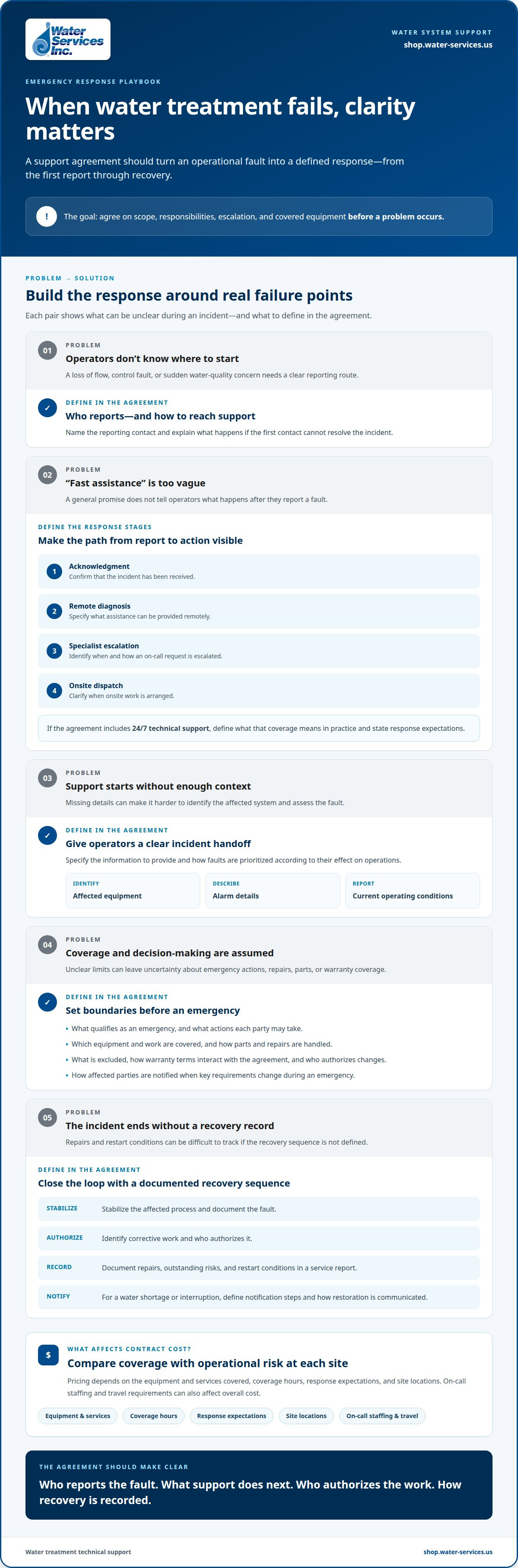
An emergency clause should turn an operational fault into a defined response process. Identify who reports an incident, how to reach support, and what happens if the first contact cannot resolve it. Operators of industrial treatment systems should know how to report a loss of flow, a control fault, or a sudden water-quality concern.
Support contract pricing depends on the equipment and services covered, coverage hours, response expectations, and site locations. On-call staffing and travel requirements can also affect overall cost. Compare these factors with the operational risks at each site.
Define response stages instead of relying on a general promise of fast assistance. The agreement can distinguish acknowledgment, remote diagnosis, specialist escalation, and dispatch for onsite work. Name the contact roles and the information operators must provide, such as affected equipment, alarm details, and current operating conditions. This gives support staff a practical starting point during a disruption.
Review response commitments alongside warranties and exclusions. Clarify which equipment and work are covered, how parts and repairs are handled, and which events fall outside the agreement. A warranty, for example, may cover a component defect but exclude damage caused by an external event. The contract should explain how these terms interact.
Emergency terms should define what qualifies as an emergency and what actions each party may take. Explain how key requirements can change during an emergency, who authorises changes, and how affected parties are notified. Clear limits help prevent improvised decisions from creating operational or contractual problems.
Define a separate recovery sequence. First, stabilise the affected process and document the fault. Next, identify corrective work and who authorises it. Then record repairs, outstanding risks, and restart conditions in a service report. For a water shortage or interruption, specify notification steps and how restoration of service will be communicated.
Preventive maintenance and system optimisation
A useful maintenance plan links each task to a specific asset and operating objective. Start with an equipment register, then identify inspection points, required records, and the person responsible for each action. During scheduled reviews, an operator might log pump condition, filter pressure readings, and treatment alarms. Explain how these observations lead to follow-up work, rather than treating each visit as a standalone inspection.
Set maintenance intervals according to equipment instructions, operating conditions, and service history. Continuously operated systems may need a different schedule from equipment used intermittently. Define included activities, such as checking connections, reviewing control settings, or inspecting filtration components. Record what triggers an additional visit, such as a recurring alarm or a change in source-water quality. This makes service frequency responsive to the system instead of relying on the calendar alone.
Optimisation starts with a baseline. Record relevant operating data, such as flow, pressure, water-quality readings, and chemical consumption, then compare later results with that starting point. Investigate the cause of a performance shift before changing settings. For example, increasing antiscalant use may affect operating costs and treatment performance, so any change should follow process requirements and be documented. The agreement can specify how recommendations are assessed and who approves adjustments.
Use maintenance reports to identify recurring issues and practical improvements. Repeated filter changes, control adjustments, or alarms may point to an operating condition that needs attention. Ask that recommendations describe the observed issue, proposed action, and expected operational effect. For ultraviolet treatment or mobile ultrafiltration, base the review on the actual equipment configuration and available operating records. Track changes and results so operators can compare performance and maintain a clear service history.
Supported water treatment technologies
A support agreement should identify each treatment technology by its process role, equipment, and operating requirements. Reverse osmosis, ultraviolet disinfection, filtration, and pumping involve different components and failure points. An RO system review might focus on membrane performance and feed conditions, while UV support centres on lamp status and treatment controls. A generic equipment list can overlook these engineering differences.
When preparing a technical support contract for water systems, build a technology register before defining coverage. Record each system’s main components, control interfaces, process inputs, and operating records. Then match the support scope to those assets, including troubleshooting, inspections, performance reviews, or specialist engineering escalation. This makes exclusions visible and shows where technology-specific expertise matters.
Provider qualifications should match the equipment and work covered. Look for relevant treatment-process experience, familiarity with equipment documentation and control systems, and technicians whose training suits their assigned tasks. Ask how comparable systems are supported, including how faults are diagnosed, recommendations made, and service records kept. Site credentials may depend on the work and location, so define them in the project scope.
Contract cost depends on the technologies covered, service frequency, coverage hours, site access, and the balance between remote assistance and onsite work. A single filtration train with scheduled reviews has a different scope from a multi-process plant requiring broader coverage. Align support with system complexity, operational criticality, and agreed tasks instead of comparing contract totals alone.
Use a practical review sequence: list process stages, map assets to each stage, identify operating data available for diagnosis, then assign responsibilities and exclusions. For example, distinguish membrane troubleshooting from replacement supply, or UV system inspection from process changes. To compare relevant water treatment equipment, match each technology to the treatment stage and support requirements it creates.
Water Services, Inc.: Goulds Water Technology Pumps
Water Services, Inc. offers Goulds Water Technology Pumps for operators evaluating pump equipment in a water treatment system. When reviewing a support agreement, match covered assets to the equipment installed and identify how replacement components or treatment products fit the system’s requirements.
Water Services, Inc. also offers Viqua UV Water Purification Systems, Hydranautics RO Membranes, and Water Treatment Antiscalants and Chemicals. These products relate to distinct treatment stages, so consider them in light of system configuration, process needs, and equipment records. Pumps move water, while UV systems and RO membranes serve different treatment processes. Antiscalants and chemicals are selected according to treatment conditions.
For operators planning equipment needs alongside their support-contract review, explore the water treatment products available through Water Services, Inc.
Set the Scope for Your Next Support Decision
Use your next contract review to connect equipment needs with the support operators will rely on. A concise asset register, clear operating priorities, and defined responsibilities provide a practical starting point. They also distinguish equipment selection from maintenance and emergency coverage, so each requirement is addressed in the right part of the agreement.
Water Services, Inc. offers Goulds Water Technology Pumps, Viqua UV Water Purification Systems, and FilmTec Reverse Osmosis Membranes. Each serves a different system function. Identifying the relevant process and equipment helps operators focus technical discussions and plan the next step for their water system.
A technical support contract for water systems should reflect the actual technologies and operating requirements at each site. Bring those priorities together before deciding how equipment support fits the wider agreement. Contact Water Services, Inc. to discuss equipment options for your application, and move forward with a clearer basis for planning.
Frequently Asked Questions
What is a technical support contract for water systems?
It is a written agreement defining how technical assistance applies to specified water equipment and operating needs. It can clarify whether support includes diagnosis, guidance on corrective work, or equipment-related recommendations. If an RO system’s performance changes, for example, the contract should establish whether troubleshooting is included and how proposed replacement work is handled separately.
What services are typically included in water system technical support contracts?
Common tasks include equipment reviews, fault diagnosis, maintenance guidance, and technical recommendations. The exact scope depends on the assets and work named in the agreement. Specify whether support includes remote analysis of operating records, help interpreting alarms, or recommendations for process adjustments. Also define how parts, major repairs, and system design changes are authorised and documented.
What response times and service-level guarantees should a water system support contract include?
Set separate commitments for acknowledging a service request, beginning diagnosis, escalating unresolved faults, and dispatching onsite assistance. Define how each stage is measured, which contact channels qualify, and how operators receive updates. If the contract includes service-level guarantees, state the remedy for missed commitments and any exclusions. Distinguishing response from resolution prevents mismatched expectations during an incident.
Do state or local regulations affect water system maintenance and support contracts?
Applicable requirements can vary by jurisdiction, system type, and the work performed. Translate relevant obligations into contract tasks by identifying who arranges inspections, maintains records, submits required reports, and addresses findings. For a facility serving multiple locations, map applicable requirements for each site separately. This helps prevent a general service scope from overlooking local reporting or maintenance responsibilities.
0 comentarios