

The most advanced treatment train isn’t automatically the right one for a mine site. Tailings pond water recycling systems perform reliably when treatment is matched to the water chemistry and intended reuse, rather than selected by technology alone. Variable pond conditions can affect process selection, while an unclear reuse target makes it harder to set treatment requirements and system capacity.
Fouling, scaling, and changing feedwater quality can also affect system performance over time. Before comparing equipment, define what the recycled water must support and which water-quality limits apply to that use.
This guide explains how to assess tailings water, establish a realistic reuse target, and compare treatment approaches using site-specific data. It also covers practical scoping details for evaluating filtration, ultrafiltration, and reverse osmosis, including feedwater variability, pretreatment needs, and operating conditions. The goal is a dependable basis for system selection, not a one-size-fits-all design.
Key Takeaways
- Set a specific reuse goal before selecting treatment. Process water, dust control, and other uses can require different water-quality criteria.
- Assess tailings pond water recycling systems against representative water analyses and changing feedwater conditions, not assumptions about typical pond water.
- Compare clarification, filtration, ultrafiltration, and reverse osmosis by treatment function, feedwater suitability, limitations, and monitoring needs.
- Scope a system using the site’s flow profile, operating schedule, utilities, footprint, and water-quality data.
- When evaluating a partner, clarify whether the proposed scope covers equipment supply, custom design, integration, rental, commissioning, and ongoing support.
Why Tailings Pond Water Recycling Systems Start with a Reuse Goal
Tailings pond water recycling means treating water recovered from a tailings facility and returning it to a defined use at the site. This differs from discharge treatment, which prepares water for release to the environment subject to applicable requirements. The two objectives can require different treatment criteria, so establish the intended destination before selecting equipment.
Tailings contain finely ground material and water, and their composition depends on the mining and processing context. For background on what tailings are, consider the wider material as well as the water being recovered. A reuse project should answer a practical question first: what must the treated water do on this site?
Which mine-water reuse goal should the project serve?
Potential destinations include process makeup, dust suppression, or another site-specific application. These are options to assess, not assumed end uses. Each has distinct quality requirements. Confirm the relevant limits and operating needs with the teams responsible for the receiving process, equipment, and water management.
Connect the target to actual demand. Review the site water balance, expected operating schedule, and seasonal changes in water availability and reuse needs. For example, fluctuating demand may mean a use cannot provide a consistent outlet for recovered water throughout the year. A realistic target defines both the required water quality and the volume the operation can use, rather than simply maximizing recovery.
What makes tailings pond water different from a standard feedwater source?
Pond water can contain suspended solids and dissolved constituents that vary with mine operations and changing pond conditions. Inflows, process changes, solids settling, and seasonal conditions may all affect the water entering treatment. A process suited to one feedwater condition may need different pretreatment or operating controls when conditions shift.
One sample is only a snapshot. Build a representative water-quality profile by sampling across relevant operating and seasonal conditions, and record where and when each sample was collected. Coordinate the sampling plan with site operators so it captures meaningful changes in pond conditions and process inputs.
Use the results to define a fit-for-purpose reuse target. The recovery objective should reflect site demand, water-balance constraints, and the range of feedwater conditions the system may encounter. This gives the next design step a sound basis: comparing treatment approaches against measured water quality and a clearly stated use.
How Tailings Pond Water Recycling Treatment Trains Work
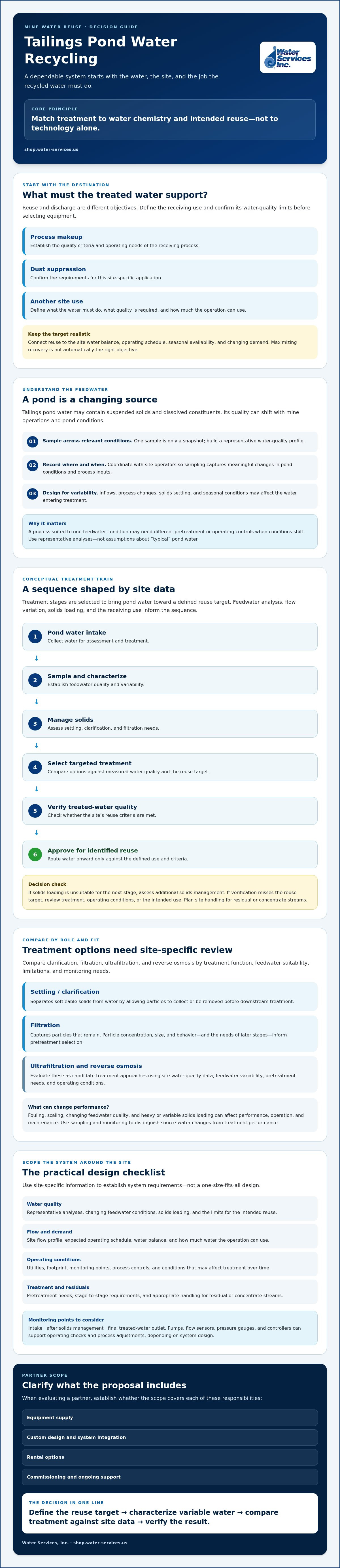
A treatment train is a sequence of operations selected to bring pond water toward a defined reuse target. The sequence depends on feedwater analysis, flow variation, suspended-solids loading, and the receiving use. Those factors determine which stages are needed and where monitoring should occur. Reclaim ponds and decant systems can also affect water collection and supply to treatment. See this overview of water management in tailings facilities.
Conceptual process flow: Pond water intake → sample and characterize → manage solids → sample → select targeted treatment → verify treated-water quality → approve for identified reuse.
Decision points: If solids loading is unsuitable for the next stage, assess additional solids management. If verification shows the reuse target isn’t met, review treatment, operating conditions, or the intended use before routing water onward. Plan appropriate site handling for any residual or concentrate stream.
Sampling points at the intake, after solids management, and at the final treated-water outlet help distinguish source-water changes from treatment performance. They also help confirm whether water meets the site’s reuse criteria. Pumps move water between stages, while flow sensors, pressure gauges, and controllers can support operating checks and process adjustments. Their selection and configuration depend on the system design.
How do solids removal and filtration fit into the process?
Settling or clarification separates settleable solids from water by allowing particles to collect or be removed before downstream treatment. Filtration captures particles that remain. The right pretreatment depends on particle concentration, size, and behavior, as well as the requirements of later stages. A changing or heavy solids load can affect filter operation and maintenance needs.
Review industrial water-treatment equipment when evaluating filtration and treatment components for a site-specific train. Don’t assume a standard equipment sequence will suit every pond.
When might membrane treatment be evaluated?
Ultrafiltration may be considered when reducing fine suspended material is part of the treatment objective. Reverse osmosis may be evaluated when dissolved constituents must be addressed for the intended reuse. Neither process is a default choice. Let feedwater characteristics and the reuse target guide the assessment.
Membrane design also requires attention to pretreatment, fouling, scaling, operating controls, and concentrate handling. Recovery and treated-water quality depend on project conditions, so establish them through site data and appropriate evaluation rather than assumption. For qualified project teams, sharing water analyses and reuse requirements with an equipment and engineering provider can help identify which tailings pond water recycling systems options merit further review.
Comparing Tailings Pond Water Recycling Technologies and Their Trade-Offs
No single process suits every pond. Tailings pond water recycling systems must account for suspended material and dissolved constituents, which can vary with mine operations and pond conditions. A change in feedwater can affect separation, filter loading, membrane fouling, scaling risk, and maintenance needs. Compare technologies against representative water analyses and the receiving use, not just a preferred equipment type.
| Process | Main function | Feedwater considerations | Limitations and monitoring |
|---|---|---|---|
| Clarification | Separates settleable suspended solids. | Assess solids concentration, particle characteristics, and settling behavior. | Requires a plan for separated solids and monitoring of solids carryover and process conditions. |
| Filtration | Captures particles that remain after upstream solids management. | Review particle loading and the characteristics of water entering the filter. | Loading changes can affect operating intervals. Track pressure and filtration performance, and plan for cleaning or media replacement as applicable. |
| Ultrafiltration | Provides membrane separation for suspended material and fine particles. | Evaluate feedwater variability and the effectiveness of upstream pretreatment. | Fouling and cleaning requirements need review. Monitor operating indicators and treated-water quality against the intended use. |
| Reverse osmosis | Separates dissolved constituents when required by the reuse specification. | Analyze dissolved constituents and assess pretreatment needs and scaling potential. | Consider membrane fouling, concentrate management, monitoring, and site-specific operating conditions. |
How do clarification, filtration, and ultrafiltration differ?
These processes address suspended material at different stages. Clarification targets particles that can settle, filtration captures remaining particles, and ultrafiltration uses a membrane barrier to separate fine suspended material. Actual performance depends on feed characteristics and system design. Include residuals handling, cleaning needs, and operating checks in the engineering review. For broader context on industrial water filtration technologies, review how filtration categories serve different treatment functions.
What should teams assess before considering reverse osmosis?
Start with dissolved-constituent analyses and the reuse specification. Then assess pretreatment, scaling potential, fouling controls, and how the concentrate stream will be managed. Membrane selection and operating conditions require qualified design review using site-specific data. Don’t assume a particular recovery rate or permeate quality without project validation.
Selection takeaway: Match each process to the water analyses and reuse specification, then verify its operating and residuals-management requirements. Variable chemistry makes monitoring and maintenance planning part of process selection, not an afterthought.
How to Scope a Tailings Pond Water Recycling System
Scope the system from the operating need outward. Start with the reuse specification and site data, then evaluate treatment stages, equipment, and operating constraints. A clear design basis helps teams compare options and identify uncertainties before committing to a full-scale configuration.
- 1. Define the reuse target. Document the receiving use, required water quality, expected daily demand, and acceptable variation in supply.
- 2. Build a representative feedwater profile. Compile water analyses and flow data across relevant operating and seasonal conditions. Include suspended solids, dissolved constituents, and observed changes that may affect treatment.
- 3. Map site operating conditions. Record the operating schedule, expected flow range, available power and utilities, access constraints, footprint, and existing infrastructure. Identify how residuals or concentrate streams can be managed.
- 4. Select and evaluate a treatment concept. Compare process stages against the reuse specification and feedwater profile. Consider pilot testing if variability or process uncertainty makes full-scale performance difficult to assess from existing data.
- 5. Verify local requirements. Confirm applicable reuse, discharge, and permitting requirements with the relevant authorities for the project location. Don’t assume rules from another jurisdiction apply.
- 6. Validate operation after commissioning. Check actual flow, treatment performance, and final water quality against the design basis. Review results under operating conditions that reflect the site’s expected variability.
What site data should be collected before design?
Bring together representative water analyses, flow profiles, operating conditions, and seasonal context. Specify desired treated-water quality, daily demand, and the variability the operation can accommodate. Also document power, access, available space, residuals handling, and tie-in points to existing infrastructure. Record missing information as an open design question rather than replacing it with an assumption.
How should pumps, controls, and chemical dosing be considered?
Match pump selection to required flow and head, fluid characteristics, and duty requirements. Identify monitoring points for flow, pressure, and treatment performance so operators can recognize changing conditions. If chemical dosing is part of the proposed process, define its purpose and the controls needed for consistent operation. Review industrial pump options as one equipment input during system scoping.
For tailings pond water recycling systems, modular or mobile equipment may be worth evaluating when project requirements call for flexibility, but neither is a universal fit. Assess equipment options against the project’s flow, water analyses, and site constraints, and include industrial pump options in that scoping process.
Selecting a Tailings Pond Water Recycling Partner and Next Steps
A suitable project partner should connect the proposed treatment sequence to site data, defined reuse requirements, and operating constraints. Evaluate the scope as carefully as the equipment. Confirm what is included, who owns each delivery task, and how the system will be monitored once it is operating. Tailings pond water recycling systems depend on a fit between process design and day-to-day mine operations.
What should a mining team ask a treatment-system supplier?
Ask which water analyses, flow conditions, and reuse requirements inform the proposal. Request a clear explanation of design assumptions and any conditions that could change equipment selection or operating needs. Confirm whether the scope covers equipment supply, custom design, integration, rental, commissioning, maintenance, and performance monitoring, or only specific items. Ask for documented evidence before relying on site-specific performance claims.
Define responsibilities in writing. Clarify who coordinates installation, provides operating guidance, checks treatment performance, and responds to maintenance requirements. These details help the project team compare proposals based on scope and operational fit, not equipment lists alone.
When might modular or mobile treatment be appropriate?
Modular or mobile equipment may merit evaluation when project duration, deployment needs, or site constraints favor a flexible arrangement. Assess transport and access, power and other utilities, operator requirements, footprint, and connections to existing infrastructure. The format still needs to match feedwater conditions and the required reuse. Mobility alone doesn’t establish process suitability.
Water Services, Inc. supplies industrial water-treatment equipment and provides custom engineering, integration, rental, commissioning, and maintenance support. Its capabilities include mobile ultrafiltration systems and containerized reverse osmosis plants, which can be considered as options in a site-specific scope. These capabilities aren’t a claim of a proven tailings-specific installation or a standard turnkey package. Water Services, Inc. is headquartered in Provo, Utah, and supports projects with a global footprint.
Before contacting a supplier, assemble the reuse specification, representative water analyses, flow profile, operating schedule, and site constraints. These inputs make it easier to discuss process assumptions and identify what additional information is needed. Learn more about Water Services, Inc. at the online store.
Build Your Recycling Plan Around Site Conditions
Effective tailings pond water recycling systems start with a defined reuse goal, representative water-quality data, and a clear picture of site demand. Treatment choices should follow those inputs. Clarification, filtration, ultrafiltration, and reverse osmosis each serve different functions, and variable feedwater can change their operating and maintenance needs.
A sound scope also accounts for flow, utilities, footprint, residuals handling, and local reuse or discharge requirements. Use these details to compare process options, define project responsibilities, and identify what must be verified during commissioning and operation.
Water Services, Inc. provides industrial water-treatment capabilities that include custom engineering, modular systems, equipment supply, and project support. Assess these options against your site requirements rather than assuming a preset tailings-pond package.
Start with your reuse target, water analyses, and operating constraints. Discuss your mining water-treatment requirements with Water Services, Inc. A clear project basis is a practical first step toward a treatment approach that fits your operation.
Frequently Asked Questions
What is a tailings pond water recycling system?
A tailings pond water recycling system treats water recovered from a tailings facility so it can be returned to a defined use at the mine. Treatment requirements depend on the receiving process and the water’s characteristics. This differs from treating water for environmental discharge, which has separate requirements that must be verified for the project location. The reuse goal guides process selection, monitoring, and the quality criteria used to assess treated water.
How is water from a tailings pond treated for reuse?
Treatment starts with characterizing the source water and identifying the intended reuse. Depending on suspended solids and dissolved constituents, a treatment train may include settling or clarification, filtration, ultrafiltration, or reverse osmosis. Sampling before and after key stages helps teams track feedwater changes and assess performance. The exact sequence isn’t universal. Select it using representative water analyses, operating conditions, and the quality requirements of the receiving use.
Can tailings pond water be reused in mine operations?
Yes, tailings pond water may be reused in mine operations if its quality is suitable for the intended application and the operation can use the recovered volume. Potential destinations include process makeup or dust suppression, subject to site-specific requirements. Operators should confirm water-quality criteria with the teams responsible for the receiving use and verify local reuse requirements. Reuse should not be confused with environmental release, which may involve distinct regulatory and stakeholder considerations.
Which treatment technologies are used for tailings water recycling?
Options can include clarification, media or cartridge filtration, ultrafiltration, and reverse osmosis. Clarification targets settleable solids, while filtration and ultrafiltration can reduce suspended material at later treatment stages. Reverse osmosis may be assessed when dissolved constituents need to be addressed for a particular reuse target. Selection depends on feedwater quality, operating variability, and treatment objectives. Include residuals, cleaning needs, concentrate handling, and monitoring requirements in the evaluation.
How do suspended solids affect tailings pond water treatment?
Suspended solids can increase loading on downstream filters and membranes, affect operating stability, and add cleaning or residuals-handling requirements. Their concentration and particle characteristics help determine whether settling, clarification, filtration, or additional pretreatment should be evaluated. Pond conditions and mine operations can change solids levels, so one sample may not capture the range the system will encounter. Representative sampling supports a more realistic assessment of pretreatment needs and equipment operation.
When should a mine consider reverse osmosis for tailings water?
Consider reverse osmosis when water analyses indicate that dissolved constituents must be reduced to meet a defined reuse specification. Before selecting it, assess pretreatment requirements, scaling potential, membrane fouling risks, operating conditions, and how the concentrate stream will be managed. Reverse osmosis isn’t a default step for every recycling project. A qualified design review should use site-specific water data to evaluate suitability, expected operating needs, and treated-water quality.
What information is needed to design a tailings water recycling system?
Provide the intended reuse, required treated-water quality, expected demand, and representative water analyses. Include flow data, operating schedules, seasonal conditions, and known changes in pond-water chemistry or solids loading. Site details matter too: available power and utilities, footprint, access, existing infrastructure, and plans for residuals or concentrate handling. These inputs help engineering teams assess treatment options and identify uncertainties. For tailings pond water recycling systems, check local reuse and discharge requirements as well.
0 comentarios