

Improper lubrication can reduce a slurry pump's lifespan by as much as 30 percent, yet many industrial operators still struggle with premature component failure. You've likely experienced the high cost of replacement parts and the operational strain of frequent, unplanned downtime. Achieving consistent slurry pump wear life optimization requires a precise balance of metallurgy and hydraulic design to prevent energy waste and early wet-end degradation. It's a common challenge to match pump materials to the increasingly complex chemical slurries found in modern mining and industrial environments.
This guide provides the technical strategies and material science required to extend the life of wet-end parts to 12 months, significantly reducing your total cost of ownership. You'll learn how to utilize high-chromium alloys like ASTM A532 Class III Type A and how computational fluid dynamics can improve hydraulic efficiency by up to 10 percent. We also cover the impact of 2026 regulations, including the EN ISO 9906:2012 performance standards and federal mandates affecting motor sourcing. This analysis prepares you to implement a durable, reliable pumping system that prioritizes technical integrity and operational safety over short-term savings.
Key Takeaways
- Identify the specific mechanisms of impingement, sliding abrasion, and corrosion to establish a precise baseline for your component maintenance strategy.
- Select between ASTM A532 High-Chrome White Iron and specialized elastomer liners based on particle size and chemical composition to achieve 6 to 12 month service intervals.
- Integrate antiscalants and flocculants into your process to prevent abrasive scale buildup and manage solids concentration before the pump inlet.
- Implement operational strategies like Best Efficiency Point tracking and VFD integration to achieve comprehensive slurry pump wear life optimization.
- Leverage custom-engineered containerized systems and genuine Goulds Water Technology parts to ensure maximum durability in remote or harsh industrial sites.
Understanding the Mechanics of Slurry Pump Erosion and Abrasion
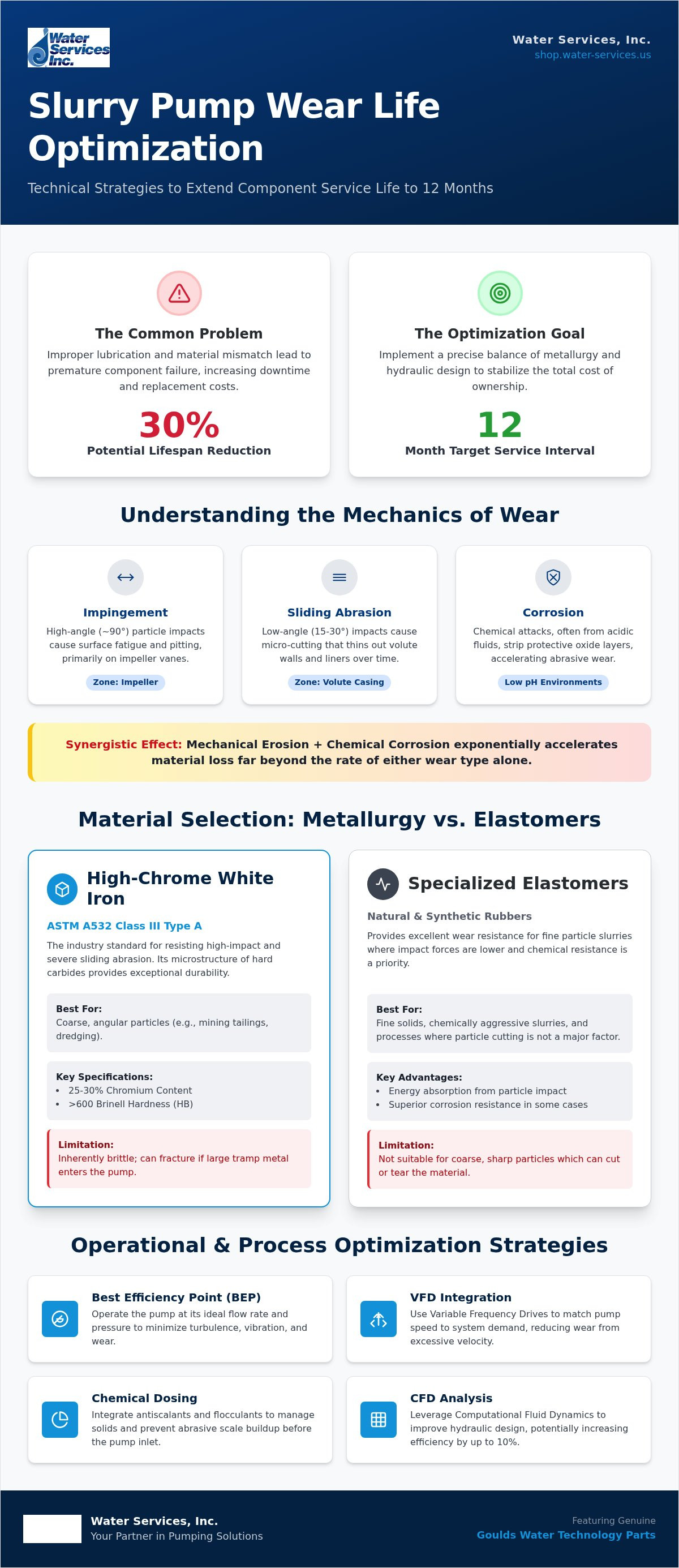
Industrial slurry handling involves extreme mechanical stress. Wear isn't a single event but a cumulative degradation caused by impingement, sliding abrasion, and chemical corrosion. For operators, the primary objective is slurry pump wear life optimization, which targets a service interval of 6 to 12 months for wet-end components. Extending the life of these parts reduces the frequency of intrusive maintenance and stabilizes the total cost of ownership. Successful slurry pump wear life optimization relies on understanding these interactions at the molecular and mechanical levels.
Most material loss occurs in three critical zones: the impeller vanes, suction liners, and volute casings. The impeller faces the highest velocity and turbulence, making it susceptible to leading-edge erosion. Suction liners often fail due to the direct impact of solids entering the eye of the pump. The rate of this loss depends heavily on the slurry's physical properties. Hardness, measured on the Mohs scale, determines if a particle can penetrate the pump's metal or elastomer surfaces. Large, angular particles cause severe impingement damage, while fine solids contribute to high-velocity sliding abrasion that thins out volute walls.
Particle Dynamics and Impingement Angles
Impact angle determines the type of material failure. Low-angle impingement, typically between 15 and 30 degrees, causes micro-cutting and sliding abrasion, which is common in the volute. High-angle impacts, closer to 90 degrees, lead to surface fatigue and pitting on the impeller vanes. Because wear rates are often proportional to the cube of the slurry velocity, even a minor increase in pump RPM can exponentially accelerate component failure. Critical velocity is the minimum flow rate required to maintain solids in a fully suspended state to prevent localized scouring and pipe blockages.
The Synergy of Erosion and Corrosion
In heavy industrial environments, mechanical erosion rarely acts alone. Acidic mine water often strips the protective oxide layers from metal components, exposing fresh surface area to immediate abrasive attack. This cycle accelerates material loss far beyond the rates of simple erosion or corrosion in isolation. While high-chrome alloys offer superior hardness, stainless steel or specialized coatings may be necessary in low-pH environments to maintain integrity. Integrating comprehensive Mining Wastewater Treatment Solutions helps manage these chemical variables, protecting the pump from accelerated degradation. Monitoring pH levels and solids concentration is essential for maintaining the structural stability of the wet-end hardware over its intended service life.
Material Selection: Metallurgy vs. Elastomers for Harsh Sites
Material selection is the primary lever for slurry pump wear life optimization. Operators must match component hardness to the specific abrasive characteristics of the process fluid. While hardness provides resistance to micro-cutting, the wrong material choice can lead to premature brittle failure or chemical degradation. In 2026, the industry standard for high-abrasion environments remains High-Chrome White Iron, though elastomers and ceramic-epoxy coatings provide critical utility in specific fine-particle and refurbishment scenarios. Successful engineering requires a data-driven approach to metallurgy that accounts for both particle size and chemical pH.
High-Chrome Alloys: When Hardness is Mandatory
ASTM A532 Class III Type A is the definitive metallurgical standard for handling coarse particles and high-impact slurries. This alloy typically contains 25 percent to 30 percent chromium, resulting in a microstructure of hard eutectic carbides. These components often achieve Brinell hardness (HB) levels exceeding 600. This hardness is essential for resisting the sliding abrasion found in mining tailings and dredging. However, high-chrome components are inherently brittle. Large impellers may fracture if tramp metal or large rocks enter the pump chamber. Utilizing genuine Goulds Water Technology Pumps ensures metallurgical consistency and adherence to these strict ASTM specifications, providing the predictable wear rates required for 12-month maintenance cycles.
Elastomers and Rubber Linings: The Fine Particle Solution
Rubber liners and impellers often outperform metal when the particle size threshold is below 6mm. Elastomers utilize a "rebound effect" to mitigate low-angle impingement. Instead of the material being cut by the particle, the rubber deforms and then recovers its original shape. This elasticity absorbs the kinetic energy of fine, abrasive solids. Natural rubber provides excellent wear resistance in neutral industrial water, but it has distinct limitations. It typically fails if temperatures exceed 70°C or if the slurry contains oils and solvents. In these cases, synthetic elastomers like nitrile or neoprene are required. For operators managing fine-particle slurries, slurry pump wear life optimization depends on selecting an elastomer that balances mechanical rebound with chemical compatibility. Ceramic-epoxy coatings further support this by allowing for the cost-effective refurbishment of worn casings during scheduled downtime.
If you're unsure which material fits your specific abrasive application, consider requesting technical consulting for material selection to ensure maximum component durability.
Chemical and Process Optimization to Reduce Wear Rates
While metallurgy provides the physical defense against abrasion, chemical optimization addresses the fluid environment itself. Scaling and corrosive oxidation are major contributors to wet-end degradation that mechanical design alone cannot solve. Antiscalants prevent the buildup of abrasive mineral scales on impellers and volutes, ensuring smooth flow paths and reducing localized turbulence. Additionally, adjusting the pH of the process fluid neutralizes acidic compounds that strip away protective oxide layers from metal parts. This chemical stabilization is a cornerstone of slurry pump wear life optimization, as it prevents the accelerated corrosion-erosion synergy that leads to premature component failure.
The concept of lubricated transport involves using chemical additives to modify the boundary layer between the slurry and the pump internals. These additives reduce the friction coefficient of the fluid, allowing solids to glide over surfaces rather than cutting into them. This approach is particularly effective in high-concentration mining applications where sliding abrasion is the primary wear mechanism. By managing the chemical characteristics of the slurry, operators can maintain the structural integrity of high-chrome and elastomer parts for longer durations.
Precision Dosing for Pump Protection
Effective chemical intervention requires exact control over dosing rates to avoid waste and ensure consistent protection. Walchem Controllers automate this process by integrating with flow sensors to adjust chemical delivery in real time based on fluctuating process metrics. When paired with high-accuracy Pulsafeeder metering pumps, these systems maintain optimal chemical concentrations without the risk of manual error. The implementation of targeted antiscalant programs can extend the operational life of wet-end components by up to 20 percent by maintaining hydraulic surface integrity. This automated approach ensures that the pump remains protected even during variable flow conditions or sudden changes in slurry chemistry.
Managing Slurry Viscosity and Concentration
Slurry concentration directly impacts the rate of material loss within the pump casing. Reducing the solids concentration by even 5 percent can potentially double the wear life of suction liners and impellers. High-viscosity slurries increase internal friction and power consumption, leading to excessive heat and accelerated fatigue. Flocculants are used to manage these solids before they reach the pump inlet, while suction-side dilution water can optimize flow consistency. For heavy industrial sites, sourcing reliable chemicals is critical; referring to a Water Treatment Chemicals Distributor ensures that the additives used are compatible with both the pump metallurgy and the downstream process. Implementing these process adjustments facilitates slurry pump wear life optimization through improved fluid dynamics and reduced mechanical stress.
Operational Strategies for Minimizing Component Fatigue
Operational discipline is as critical as metallurgy for achieving slurry pump wear life optimization. Even the most advanced high-chrome alloys fail prematurely if the pump operates outside its intended hydraulic limits. Maintaining the system within its designed parameters prevents unnecessary mechanical fatigue and localized erosion. By prioritizing hydraulic stability and leveraging modern monitoring hardware, operators can shift from reactive repairs to a predictable maintenance cycle that aligns with the 6 to 12 month service targets discussed earlier.
Implementing Variable Frequency Drives (VFDs) is a primary strategy for speed control. Because wear rates typically increase by the cube of the impeller velocity, even a 10 percent reduction in RPM can significantly extend the life of wet-end parts. VFDs allow the pump to match actual process demand, preventing the excessive velocities that occur when a pump is oversized for the application. Furthermore, maintaining proper gland seal water pressure is vital. This pressurized barrier prevents abrasive particles from migrating into the stuffing box, protecting the shaft sleeve and packing from immediate destruction.
BEP Operation and Hydraulic Stability
Operating a pump at its Best Efficiency Point (BEP) ensures that the slurry enters and exits the impeller vanes with minimal turbulence. When a pump operates too far to the left or right of its BEP, it creates recirculating flows and internal vortices. These turbulent zones trap abrasive solids, causing them to strike the internal surfaces repeatedly and accelerate material loss. Utilizing Signet Flow Sensors provides the real-time data required to monitor performance and adjust flow rates accordingly. You can identify hydraulic instability by monitoring for these specific indicators:
- Cavitational noise that sounds like pumping gravel or marbles.
- High-frequency vibration detected at the bearing housing or casing.
- Unexplained temperature increases in the process fluid or pump housing.
Predictive Maintenance Protocols
The 2026 industrial standard for slurry pump wear life optimization relies on sensor-based monitoring rather than manual inspections. Predictive maintenance uses vibration analysis and pressure differentials to identify wear before a catastrophic failure occurs. Ashcroft Pressure Gauges are essential for detecting internal degradation through head loss. A measurable drop in discharge pressure at a constant speed often indicates that impeller clearances have increased due to erosion. Transitioning to a scheduled replacement strategy prevents the secondary damage to shafts and motors that occurs during a run-to-fail event. This proactive approach ensures that replacements happen during planned outages, maximizing overall site reliability.
To enhance your system's operational reliability, browse our selection of industrial control sensors and pressure gauges today.
Maximizing ROI with Goulds Water Technology and Water Services, Inc.
Achieving successful slurry pump wear life optimization requires a shift from viewing pumps as individual components to seeing them as part of a managed industrial system. The total cost of ownership (TCO) in mining and heavy industry is dominated by energy consumption and maintenance labor rather than the initial purchase price. By integrating the metallurgical, chemical, and operational strategies discussed in previous sections, operators can realize a significant return on investment. Selecting the right hardware partner ensures these strategies are backed by engineering precision and logistical reliability.
Goulds Water Technology is the industry leader in heavy-duty slurry management. Their equipment is engineered specifically for severe-duty applications where standard pumps fail. For remote mining sites, the value of custom-engineered containerized systems is significant. These modular units provide a "plug-and-play" solution that includes the pump, dosing controllers, and filtration hardware in a single, protected environment. This approach minimizes site construction time and ensures that every component is optimized for the local slurry characteristics from day one.
The Advantage of Genuine Goulds Components
The use of "will-fit" or third-party replacement parts introduces significant risk into high-pressure slurry applications. While these parts may have lower upfront costs, they often lack the exact metallurgical consistency of genuine components. A slight deviation in the chromium content or heat treatment of an impeller can lead to uneven wear and premature hydraulic instability. Genuine Goulds impellers are designed using advanced computational fluid dynamics to ensure flow paths remain stable throughout the part's service life. You can source these high-performance components directly through our Pumps Collection to maintain the technical integrity of your system.
Global Engineering Support from Water Services, Inc.
Water Services, Inc. provides more than just hardware; we offer the technical expertise required to solve complex fluid handling challenges. Based in Provo, Utah, our engineering team supports global mining projects with custom-designed treatment and transport solutions. This includes the deployment of mobile ultrafiltration and RO systems to manage process water quality, which directly impacts pump longevity. During any high-pressure maintenance or component replacement, it's mandatory to utilize appropriate Personal Protective Equipment (PPE) to ensure technician safety. our holistic approach combines specialized hardware with expert consulting to ensure your facility meets its 2026 production and safety targets.
For a comprehensive evaluation of your current system, consult with our engineers for a custom pump optimization audit to identify potential durability improvements and cost savings.
Engineering a Sustainable Pumping Strategy for 2026
Achieving successful slurry pump wear life optimization requires a disciplined synergy between metallurgical selection and process chemistry. By matching ASTM A532 high-chrome alloys to coarse particle streams and utilizing precision dosing for chemical antiscalants, you can effectively double the service life of wet-end components. Maintaining hydraulic stability at the Best Efficiency Point further prevents the internal turbulence that leads to premature fatigue. These technical adjustments shift your maintenance model from reactive repair to a predictable, high-performance cycle that protects your hardware and your budget.
Water Services, Inc. has provided global technical support for specialized mining and industrial projects since 1994. As an authorized Goulds distributor, we ensure your operations are supported by genuine hardware and specialized industrial expertise. It's time to transition to a proactive strategy that reduces your total cost of ownership while stabilizing production in the most demanding environments. Your path to maximum durability and operational reliability starts with the right engineering partner and a commitment to technical integrity.
Shop Genuine Goulds Water Technology Pumps and Parts
Frequently Asked Questions
What is the average wear life of a slurry pump impeller?
Average wear life for wet-end components typically targets 6 to 12 month intervals in heavy industrial environments. This duration varies significantly based on the abrasive nature of the medium and the material hardness of the impeller. For severe-duty applications, using high-chrome alloys like ASTM A532 is essential to meet these targets. Factors such as pump speed and particle impingement angles will ultimately dictate the frequency of your scheduled maintenance cycles.
How does slurry concentration affect pump wear?
Increasing solids concentration exponentially accelerates material loss within the pump casing. Higher concentrations lead to more frequent particle impacts and increased sliding abrasion against internal surfaces. Research indicates that reducing the solids concentration by even 5 percent can potentially double the wear life of suction liners. Managing this variable through suction-side dilution or flocculants is a critical component of a comprehensive slurry pump wear life optimization strategy.
Should I use a metal or rubber-lined pump for abrasive sand?
High-chrome metal is the standard for coarse sand and large particles that cause high-impact damage. Conversely, rubber-lined pumps are superior for fine, abrasive sands where the particle size is typically under 6mm. The elastomer's ability to deform and rebound absorbs kinetic energy from fine particles, preventing the micro-cutting seen in metal. Matching the material to your specific particle size distribution is vital for maximizing component durability.
Can VFDs really extend the life of my slurry pump?
VFDs are highly effective because wear rates are proportional to the cube of the impeller's velocity. Reducing the pump speed to match actual demand significantly lowers the kinetic energy of particle impacts. This reduction in RPM prevents the excessive turbulence and recirculating flows that occur when a pump is oversized. By operating at lower speeds, you drastically decrease the rate of material thinning in the volute and impeller vanes.
What are the signs that a slurry pump liner needs replacement?
A measurable drop in discharge pressure or total head is often the first indicator of internal liner wear. As clearances between the impeller and the liner increase due to erosion, the pump loses hydraulic efficiency. You should also monitor for increased vibration levels and a distinct rattling noise that suggests internal instability. Ashcroft pressure gauges are useful tools for detecting these performance deviations before a catastrophic component failure occurs.
How does pH level impact the wear rate of high-chrome pumps?
Low pH levels introduce corrosive wear that strips the protective oxide layers from high-chrome metal parts. This chemical attack exposes fresh metal to immediate mechanical erosion, creating a destructive cycle that accelerates material loss. While high-chrome is exceptionally hard, it's susceptible to acidic environments found in many mining tailings. Adjusting the slurry pH or using specialized coatings is necessary to maintain the structural integrity of the pump.
Is it worth using chemical antiscalants in mining slurry?
Chemical antiscalants are a cost-effective investment that can extend the life of wet-end parts by up to 20 percent. These additives prevent the formation of abrasive mineral scales on internal hydraulic surfaces, ensuring smooth flow paths and reducing friction. By preventing scale buildup, you maintain the original design geometry of the impeller and volute. This chemical intervention is a key differentiator in slurry pump wear life optimization for complex mining fluids.
Why are genuine Goulds parts better than third-party replacements?
Genuine Goulds parts provide the metallurgical consistency and precision required for high-pressure industrial applications. Third-party or "will-fit" parts often lack the specific chromium content and heat treatment necessary to resist severe abrasion. Goulds impellers are designed using computational fluid dynamics to ensure stable flow paths and minimal internal turbulence. Using authorized components protects your broader system from the vibration and shaft damage caused by poorly balanced replacements.
0 comentarios