

A single unpredicted storm event can stall production for weeks and cost millions in lost revenue if your pumping infrastructure isn't designed for peak surge. Sizing a dewatering pump for an open pit mine is no longer just about moving steady-state groundwater; it's a critical risk-mitigation exercise against catastrophic flooding and rising operational costs. With the global dewatering pump market projected to reach USD 8.2 billion in 2026, the pressure to maintain stable pit drawdown while managing abrasive slurries is at an all-time high.
You likely understand that inefficiently sized motors and frequent pump failures due to high-chrome wear are more than just maintenance headaches; they're threats to your bottom line. This guide provides the technical framework to master complex calculations like Total Dynamic Head (TDH) and Net Positive Suction Head (NPSH) while accounting for new 2026 MSHA and EPA regulations. We'll examine how to specify high-performance systems, such as Goulds Water Technology Pumps, to ensure regulatory compliance and reduce energy consumption. You'll learn to balance hydrogeological data with IE5 motor efficiency standards to build a reliable, high-durability dewatering strategy.
Key Takeaways
- Learn to calculate Base Inflow Rate and Peak Storm Runoff using the Rational Method to ensure your system handles both groundwater seepage and catastrophic weather events.
- Master the technical variables for sizing a dewatering pump for an open pit mine, including precise Total Dynamic Head calculations and NPSH requirements for high-altitude sites.
- Identify the optimal metallurgy for your application, comparing high-chrome white iron for abrasive slurries against duplex stainless steel for corrosive, low-pH environments.
- Stay compliant with 2026 MSHA and EPA standards by integrating IE5 ultra-premium motors and advanced electromagnetic compatibility testing for imported equipment.
- Explore the shift toward modular, containerized pump stations that integrate with automated control systems for improved reliability and reduced maintenance intervals.
The Fundamentals of Open Pit Mine Dewatering Sizing
Open pit dewatering involves the strategic management of surface runoff and groundwater to ensure safe, dry operational conditions. This process is a continuous engineering requirement that addresses three primary water sources: groundwater seepage through pit walls, direct precipitation from storm events, and process water from mining activities. Understanding The Fundamentals of Open Pit Mine Dewatering is essential for maintaining bench stability and preventing production delays. Reliability in these systems directly correlates to the structural integrity of the mine's haul roads and working faces.
Accurate specification is the difference between a stable pit and a flooded operation. Many site managers fall into the trap of "oversizing" equipment to create a perceived safety margin. This approach is counterproductive. An oversized pump often operates outside its Best Efficiency Point (BEP), causing internal turbulence and cavitation. These conditions lead to premature motor failure and high vibration levels that destroy seals and bearings. Properly sizing a dewatering pump for an open pit mine ensures the equipment operates within its designed hydraulic range, maximizing Mean Time Between Failures (MTBF).
The Consequences of Incorrect Pump Specification
Incorrectly specified pumps lead to immediate production downtime. The cost of a stalled shovel or haul truck fleet far exceeds the initial investment in high-quality hardware like Goulds Water Technology Pumps. Safety is a primary concern. Uncontrolled water levels lead to bench saturation, which increases the risk of catastrophic slope failure. 2026 EPA discharge permits mandate precise management of peak water surges. A system that cannot handle the volume or the sediment load risks regulatory non-compliance and heavy fines for discharging sediment-heavy water into local watersheds.
Initial Site Assessment Checklist
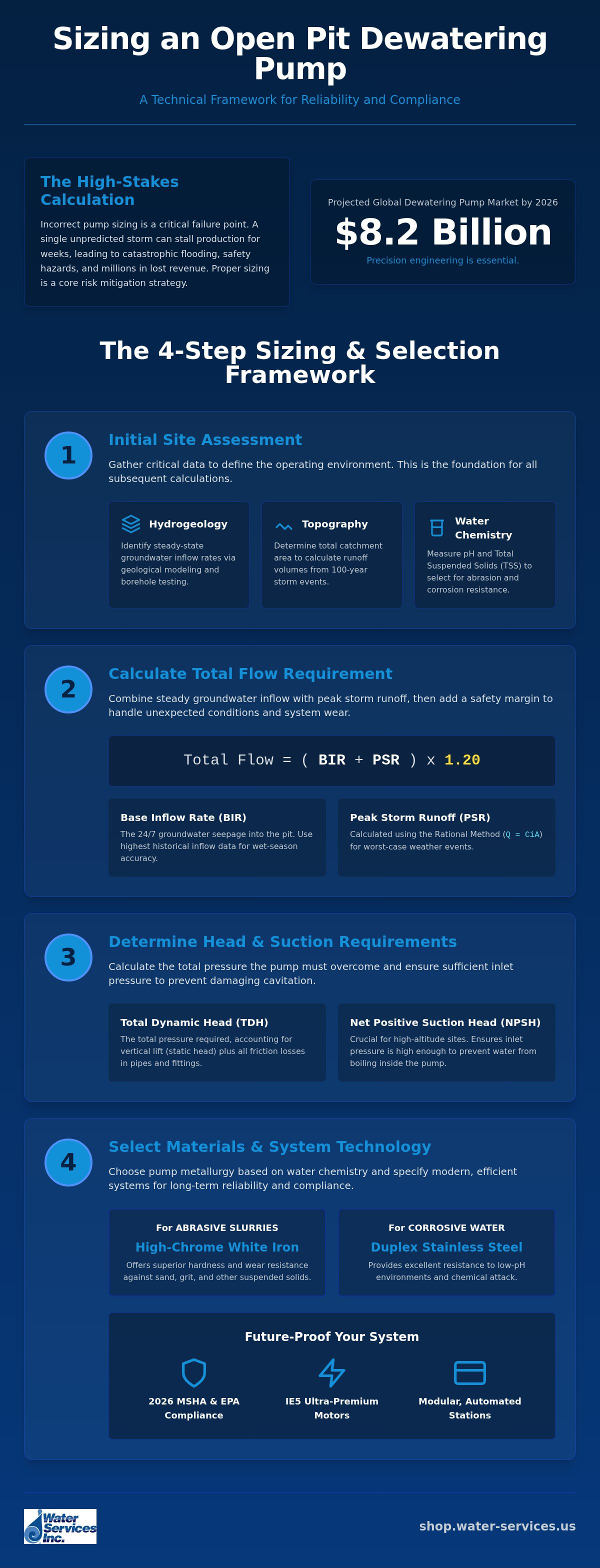
Before selecting hardware, a comprehensive site assessment is required to define the operating environment. This data allows for the selection of a system that balances daily seepage with the capacity for rapid drawdown after storm events.
- Hydrogeological data: You must identify steady-state groundwater inflow rates through geological modeling and borehole testing.
- Topographical analysis: Determine the total catchment area to calculate potential storm runoff volumes during 100-year rain events.
- Water chemistry testing: Measure pH levels and Total Suspended Solids (TSS) to select appropriate materials for abrasive or corrosive fluids.
Calculating Flow Requirements: Inflow vs. Storm Runoff
Calculating total flow capacity is the most volatile step in sizing a dewatering pump for an open pit mine. You must establish the Base Inflow Rate (BIR) first. This represents the steady-state groundwater seepage that occurs 24/7 through the pit walls and floor. Groundwater levels fluctuate seasonally, so your BIR should reflect the highest recorded historical inflow to prevent saturation during wet months. This base rate forms the foundation of your daily pumping operations, but it rarely accounts for the most dangerous variable: the storm event.
To account for weather events, we use the Rational Method to calculate Peak Storm Runoff (PSR). The formula is Q = CiA. Within this calculation, C represents the runoff coefficient. For the hard, compacted, or rocky surfaces typical of an open pit, this coefficient usually ranges from 0.70 to 0.95. The i variable is the rainfall intensity, which should be based on local 10-year or 50-year storm data. Finally, A is the catchment area, which includes the total footprint of the pit, the walls, and any surrounding haul roads that drain into the basin.
Once you have the sum of BIR and PSR, apply a 20% safety margin. This contingency accounts for inevitable pump wear, pipe scaling, and unexpected hydrogeological shifts that occur as the mine deepens. You also need to determine the required drawdown time. If a storm floods the pit floor, how fast must the water be cleared to resume operations? Industry standards often target a 48 to 72-hour window. Achieving this requires pump discharge piping optimization to ensure the calculated flow reaches the surface without excessive friction losses. If the piping is undersized, even the most powerful pump will fail to meet the drawdown deadline.
The Rational Method for Mining Catchments
Applying the Rational Method requires precise data for each variable. When selecting the rainfall intensity (i), 2026 climate models suggest using more conservative 50-year storm data to account for increasing weather volatility. Measuring the catchment area (A) requires including the entire pit perimeter and haul road drainage. Even a small miscalculation in acreage can lead to thousands of gallons of unexpected inflow during a peak event, overwhelming your primary pump stations and risking bench instability.
Balancing Duty and Standby Capacity
Relying on a single massive pump creates a single point of failure. A more reliable configuration utilizes multiple smaller units, such as Goulds Water Technology Pumps, arranged in a duty/assist or duty/standby setup. This allows the system to scale its output based on real-time inflow conditions. During dry periods, only the lead pump runs at its Best Efficiency Point. As water levels rise during a storm, the assist pumps activate sequentially to handle the surge. Integrating Signet flow sensors and Walchem controllers allows for remote monitoring of GPM performance, ensuring the system meets its 2026 EPA discharge requirements. If you're currently dealing with frequent pit flooding, reviewing your pump's duty logic is a logical first step.
Determining Total Dynamic Head (TDH) and NPSH
Total Dynamic Head (TDH) represents the total equivalent height that a fluid must be pumped, accounting for all resistance in the system. When sizing a dewatering pump for an open pit mine, calculating TDH accurately is mandatory to prevent motor overload or insufficient flow. Static Head is the primary component; it's the vertical distance from the lowest sump level to the final discharge point. However, friction loss often accounts for a significant portion of the total pressure requirements. This resistance occurs as fluid moves against pipe walls and is influenced by pipe diameter, length, and internal roughness. Unlike standard water applications, mine water often contains suspended solids that increase viscosity and friction. You must also account for minor losses, which include the resistance created by bends, valves, and check valves. In deep pits with complex piping, these variables significantly impact the pump's operating point on its performance curve.
A 5-Step Formula for Mining TDH
Precision in TDH calculation prevents the common mistake of selecting a pump that cannot reach the discharge point. Follow this structured approach:
- Step 1: Measure the vertical lift from the lowest anticipated sump level to the highest point in the discharge line.
- Step 2: Calculate pipe friction using the Hazen-Williams equation, using a conservative C-factor to account for internal scaling over time.
- Step 3: Factor in the specific gravity of the fluid. Sediment-laden mine water is denser than clean water, requiring more power to move the same volume.
- Step 4: Add a reserve head of 10% to 15% to account for future pit deepening as the mine progresses.
- Step 5: Verify the calculated TDH against pump manufacturer performance curves to ensure the duty point remains within the Best Efficiency Point (BEP).
Avoiding Cavitation in High-Lift Scenarios
Net Positive Suction Head (NPSH) is the margin of safety against cavitation. You must ensure that the NPSH Available (NPSHa) at the site is always greater than the NPSH Required (NPSHr) by the pump. If the pressure at the pump inlet drops too low, the fluid vaporizes, creating bubbles that collapse and erode the impeller. Altitude is a critical factor here. In mountain-region mines, atmospheric pressure is lower, which reduces the NPSHa and limits suction lift capacity. 2026 technical standards recommend using Ashcroft pressure gauges to monitor suction and discharge health in real-time. These instruments provide the data necessary to detect early signs of suction loss before catastrophic internal damage occurs.
Selecting Materials for Abrasive and Corrosive Mine Water
Mining water is rarely clean. Unlike municipal applications, sizing a dewatering pump for an open pit mine requires a rigorous evaluation of solids handling capabilities. You aren't just moving water; you're moving a suspension of drill cuttings, rock fragments, and abrasive silt. If your metallurgy is too soft, the internal components will erode in weeks. This erosion increases internal clearances, leading to a rapid drop in hydraulic efficiency and eventual pump failure.
High-chrome white iron, typically containing 25 to 30 percent chromium, is the industry standard for purely abrasive slurries. It provides the extreme hardness, often exceeding 600 BHN, needed to resist scouring from sharp particles. However, if your site assessment identifies Acid Mine Drainage (AMD), high-chrome iron will fail due to chemical corrosion. In these environments, CD4MCu duplex stainless steel is the superior choice. This material offers excellent resistance to pitting and stress corrosion cracking while maintaining the mechanical strength required for high-head dewatering. Selecting the right metallurgy ensures your pump survives the chemistry of the pit.
Impeller design also dictates slurry performance. Open impellers are generally preferred for mine dewatering because they handle larger solids and are easier to clear if a blockage occurs. Enclosed impellers offer higher efficiency but are prone to clogging in high-sediment environments. Mechanical seals are another critical failure point. Abrasive particles can migrate into the seal faces, causing immediate leaks. Using hard-faced tungsten carbide or silicon carbide seals is a prerequisite for industrial reliability. These materials resist the grinding action of silt, extending the Mean Time Between Failures (MTBF).
Goulds Water Technology Solutions for Mining
Goulds Water Technology Pumps are the industry standard for durability in these demanding environments. Specific models are engineered with oversized shafts and heavy-duty bearings to handle the mechanical stresses of mine dewatering. A major advantage of using these standardized industrial components is the global availability of replacement parts. This reduces your Mean Time to Repair (MTTR) and ensures that a single component failure doesn't lead to a multi-day production halt. If you need a high-head solution that doesn't compromise on wear life, Goulds remains the most reliable specification for 2026 operations.
Chemical Resistance and pH Management
Acid Mine Drainage presents a unique challenge where low pH levels accelerate equipment degradation. Material selection must be paired with active water treatment chemicals to neutralize acidity before discharge. Managing these chemicals requires strict adherence to safety protocols. Personnel should always use appropriate PPE, including chemical-resistant gloves and face shields, when handling antiscalants or neutralizing agents. Properly sizing a dewatering pump for an open pit mine includes planning for these auxiliary treatment stages to meet 2026 EPA effluent standards. If you're ready to upgrade your site's hardware, consult our pump specialists for a technical specification.
Implementation: From Sizing to Modular System Integration
Implementation marks the transition from hydraulic modeling to operational deployment. Once you complete the process of sizing a dewatering pump for an open pit mine, the focus shifts to hardware integration and system protection. The modern mining environment favors modular, containerized dewatering units over traditional permanent installations. These units house the pumps, motors, and sophisticated filtration hardware in a secure, climate-controlled environment. This approach allows for rapid deployment and provides a scalable framework that can be relocated as the pit floor deepens or the catchment area expands. Modular systems allow for the incremental addition of pump skids as the Total Dynamic Head (TDH) increases with pit depth.
Automation is a core requirement for 2026 operations. Integrating Variable Frequency Drives (VFDs) with automated control systems allows for remote monitoring and dynamic flow adjustment. This integration ensures that the system responds to real-time inflow fluctuations without manual intervention, reducing energy costs and mechanical stress. New regulations effective October 1, 2026, mandate enhanced Electromagnetic Compatibility (EMC) immunity testing for imported VFDs, making local technical support a critical factor in equipment selection. These systems allow operators to adjust GPM output from a central control room, ensuring the pit remains dry while minimizing motor wear.
The Benefits of Containerized Systems
Containerized systems provide a centralized hub for all hydraulic and electrical components. This configuration protects sensitive electric power controls from the dust, vibration, and temperature extremes typical of open-pit environments. In remote regions, modular units simplify logistics by arriving pre-tested and ready for immediate connection to the discharge manifold. This plug-and-play capability is essential for emergency dewatering or rapid site startups where production delays carry significant financial penalties. It also ensures that IE5 Super Premium motors are housed in an environment that prevents premature insulation breakdown from external contaminants.
Next Steps: Engineering Your Dewatering Strategy
Moving from a sizing calculation to a finalized procurement specification requires technical oversight. A robust spec must account for 2026 MSHA motor ratings and tightened EPA discharge limits. Leveraging Mining Wastewater Treatment Solutions allows you to integrate dewatering with resource recovery and compliance-driven filtration. This holistic view ensures that the water pumped from the pit is treated to the required standard before it leaves the site.
Effective sizing a dewatering pump for an open pit mine is the first step in a larger water management cycle. Water Services, Inc. provides the engineering expertise and high-durability hardware, including Goulds Water Technology Pumps, to support these complex installations. Contact our technical team to convert your site data into a reliable, high-performance dewatering system designed for long-term industrial utility and regulatory compliance.
Optimizing Your 2026 Dewatering Infrastructure
Sizing a dewatering pump for an open pit mine is a technical necessity that directly impacts pit floor safety and production uptime. By integrating precise TDH calculations with the Rational Method for storm surge, you protect your operation from catastrophic flooding and inefficient energy consumption. Selecting the correct metallurgy, such as high-chrome iron or duplex stainless steel, ensures your equipment survives the abrasive and corrosive realities of the mining environment. These steps are essential to maintaining bench stability and meeting 2026 EPA discharge standards.
As an authorized distributor with global industrial engineering expertise, Water Services, Inc. provides the technical support needed to specify high-performance hardware. We're specialists in high-head slurry management and understand the rigors of modern regulatory compliance. You can Shop Goulds Water Technology Pumps for Mining to find durable solutions that minimize maintenance intervals and maximize hydraulic efficiency. Implementing a modular, automated system today will provide the scalability required as your pit expands and deepens. Proper specification ensures your site remains dry, compliant, and operational through every seasonal shift.
Frequently Asked Questions
What is the difference between static head and total dynamic head in a mine?
Static head is the absolute vertical lift from the pit sump to the highest discharge point. Total Dynamic Head (TDH) is a more complex metric that includes this static lift plus friction losses from piping and minor losses from valves and fittings. When sizing a dewatering pump for an open pit mine, TDH is the critical calculation because it accounts for the actual resistance the pump must overcome. Friction increases with pipe length and fluid velocity, making TDH significantly higher than static head in deep pit operations.
How do I calculate the runoff coefficient for an open pit mine?
The runoff coefficient (C) is determined by the permeability of the catchment surface. In open pit environments, surfaces are typically compacted rock or clay with low infiltration rates. For these hard surfaces, a coefficient between 0.70 and 0.95 is the industry standard. You must weigh the area of haul roads, pit benches, and walls to determine a weighted average. This value represents the percentage of rainfall that becomes surface runoff rather than soaking into the ground during a storm.
Why does my dewatering pump keep cavitating at high altitudes?
Cavitation at high altitudes occurs because atmospheric pressure decreases as elevation increases, which directly reduces the Net Positive Suction Head Available (NPSHa). Lower air pressure provides less force to push water into the pump suction, causing the fluid to vaporize at the impeller eye. To prevent this, you must derate the pump or select a model with a lower NPSH Required (NPSHr). Installing Ashcroft pressure gauges helps monitor suction pressure to detect these conditions before internal damage occurs.
Can I use a standard centrifugal pump for water with high sediment content?
Standard centrifugal pumps aren't designed for the abrasive nature of mine water. High sediment content, including drill cuttings and silt, will erode standard cast iron or bronze impellers rapidly. For these applications, you require specialized hardware like Goulds Water Technology Pumps with high-chrome white iron or duplex stainless steel components. These materials resist scouring and maintain hydraulic efficiency over longer intervals. Additionally, an open impeller design is necessary to pass larger solids without clogging the pump casing.
How often should I check the NPSH available for my pit sump pump?
You should verify NPSH available whenever the pit depth increases or the sump location changes. In dynamic mining environments, the vertical suction lift often increases as the pit floor is lowered, which reduces NPSHa. A monthly audit of suction conditions is recommended for stable operations. If you notice increased vibration or noise, immediate testing is required. Using Walchem controllers and Signet flow sensors allows for continuous monitoring of these hydraulic parameters to prevent catastrophic failure.
What are the most durable materials for pumps handling acid mine drainage?
CD4MCu duplex stainless steel is the most durable material for handling acid mine drainage (AMD) with low pH levels. While high-chrome iron handles abrasion well, it lacks the chemical resistance needed for acidic fluids. Duplex stainless steel provides a balance of high mechanical strength and superior resistance to pitting and stress corrosion. This metallurgy ensures the pump casing and impeller survive the corrosive environment without the rapid degradation seen in standard industrial alloys or carbon steel components.
Should I use a single large pump or a series of staged pumps for a deep pit?
A series of staged pumps is generally more efficient and reliable for deep pits exceeding the head capacity of a single unit. Staging allows you to distribute the pressure load across multiple pump stations, reducing the risk of pipe bursts and seal failures. This configuration also provides redundancy; if one pump requires maintenance, others can often continue operating at reduced flow. Staged systems are easier to scale as the pit deepens compared to replacing a single massive unit.
How does rainfall intensity affect my pump sizing for a 10-year storm event?
Rainfall intensity (i) determines the peak volume of water your system must clear within a specific timeframe. In the Rational Method, a higher intensity value directly increases the required GPM capacity of the pump station. For a 10-year storm event, you must size the system to handle the peak surge to prevent pit flooding. Sizing a dewatering pump for an open pit mine based on these intensity peaks ensures you have enough capacity for rapid drawdown after heavy precipitation events.
0 comentarios