

The pump with the highest rated capacity may be the wrong choice for your process. When selecting a chemical metering pump, match its operating range to your required feed rate, discharge pressure, chemical, and control method. A maximum flow figure alone cannot tell you whether a pump will suit the actual duty.
Flow rate and dosing accuracy are useful starting points, but they do not tell the whole story. Wetted materials must suit the exact chemical and operating conditions, and the pump’s control options must fit the way your process changes. A mismatch can leave you with equipment that meets a headline specification but cannot perform the required duty.
This 2026 buying guide explains how to define measurable requirements before comparing models. It covers flow, pressure, accuracy, chemical compatibility, and controls, along with a practical way to build a shortlist. You’ll also find what to verify in current manufacturer documentation when reviewing Pulsafeeder metering pumps or related process-control equipment.
Key Takeaways
- Start with the dosing duty. Define the required feed-rate range and system pressure before comparing pump capacity.
- When selecting a chemical metering pump, verify wetted-material compatibility for the chemical’s exact concentration, temperature, and operating conditions.
- Compare control methods with the way the process operates, then confirm each candidate’s control options in manufacturer documentation.
- Use a specification checklist to compare requirements with confirmed pump data, including maintenance access and the proposed configuration.
- Water Services, Inc. offers Pulsafeeder metering pumps, Walchem Controllers, and water-treatment chemicals.
What a Chemical Metering Pump Does, and What Your Dosing Application Requires
A chemical metering pump delivers controlled quantities of a chemical into a process. Its purpose is dosing, not simply moving liquid from one location to another. A transfer pump may circulate or move liquid without controlling the dose the process requires. Judge equipment by the duty it must perform, not by its label alone. For a foundational overview of operating principles, see Metering pump.
Water treatment, process dosing, and laboratory preparation can all involve measured chemical delivery, but their requirements differ. A pump dosing a chemical into a flowing water line, for example, may need to adjust as process flow changes. A laboratory preparation task may have a different operating schedule and delivery requirement. In each case, define the required dose and operating conditions before comparing equipment.
Definition: A pump’s setpoint or rated capacity describes a specified setting or maximum under stated conditions. Verified performance is what the selected configuration can deliver at your actual pressure, chemical, and operating range.
Which process details should you gather before comparing pumps?
Start by documenting the duty. Record the target dose, expected process-flow range, required chemical feed-rate range, operating schedule, and pressure at the injection point. Note whether demand is steady, intermittent, or changes with a measured process condition. This helps determine whether a fixed setting may be sufficient or whether the dosing rate needs to respond to changing demand.
Map the injection location and identify available measurement or control signals, such as a process-flow measurement or analyzer output. Record how each signal is generated and which equipment is expected to use it. A signal alone does not confirm that a candidate pump or controller can act on it. Verify the required control method and compatibility in the relevant manufacturer documentation.
What does metering-pump capacity tell you, and what does it not?
A maximum rated flow is a starting point, not proof of fit. The pump must deliver the required dose at the system’s actual operating pressure and across the needed range. A model that appears suitable by maximum capacity may not meet the duty at the intended setting or under the actual operating conditions.
Separate your required operating range from the pump’s stated maximum capacity. Then compare the duty with model-specific performance curves and limits. Check current manufacturer documentation and note the conditions under which published performance applies. This is central to selecting a chemical metering pump: shortlist by verified operating performance, not headline capacity alone.
Match Pump Capacity, Pressure, and Materials to the Chemical
A suitable pump must cover the required dosing rate at the system’s operating pressure and handle the chemical under actual process conditions. Flow, pressure, and dosing range are linked. A pump’s published maximum flow does not show what it can deliver at your required pressure or across the full operating range. Compare candidate models using manufacturer data for the specific configuration, and review a comprehensive selection guide alongside the manufacturer’s documentation.
How should you estimate the required dosing rate?
Begin with process demand and the target concentration. If the process flow and target dose are expressed on compatible bases, a preliminary relationship is: chemical feed rate = process flow rate × required chemical dose per unit of process flow. For example, a volumetric process flow requires a dose expressed per matching volume. Do not combine mass-based and volume-based values without the correct conversion data.
No site values are provided here, so a numerical example would be misleading. Gather the process-flow range, target concentration, and units, then have the system engineer or supplier confirm the calculation, including any required dilution or product-strength adjustment. Use the resulting minimum and maximum feed rates to define the duty the pump must cover.
Build a comparison table with one row per candidate and columns for required minimum, normal, and maximum feed rates; operating pressure; and the corresponding confirmed manufacturer specifications. Record the source document and conditions for each specification. Diaphragm and peristaltic designs are options to evaluate against the duty, chemical, maintenance access, and verified operating envelope, not universal answers.
How do chemical properties affect material selection?
Compatibility depends on more than the chemical name. Give the manufacturer the exact chemical identity, concentration, temperature range, and relevant operating conditions. Ask for confirmation covering every wetted component, including the pump head, diaphragm or tubing, valves, seals, and connections. Approval for one component or a different concentration does not establish compatibility for the full assembly.
Sodium hypochlorite and hydrochloric acid are examples that require application-specific material checks. Do not assume materials suitable for one chemical, concentration, or temperature will suit another. Confirm the candidate’s wetted-material configuration and any model-specific limits directly with the manufacturer before purchase.
Record the calculation inputs and compatibility confirmation with your shortlist. For separate bench workflows involving measured liquids, see laboratory glassware and equipment. Laboratory equipment supports bench work and is not a pump component.
Compare Metering Pump Designs and Controls Without Guessing at Fit
Design and control choices should follow the process requirements, not assumptions about a pump category. Compare candidates by their verified operating envelope, chemical compatibility, maintenance requirements, and the space available for access. A design that appears suitable on paper still needs confirmation for the exact duty and configuration.
When might diaphragm or peristaltic designs be considered?
Diaphragm and peristaltic pumps are design categories to evaluate, not automatic recommendations. Review manufacturer documentation for how each candidate handles the required flow and pressure, which materials contact the chemical, and what inspection or replacement tasks maintenance may involve. Consider installation constraints too, including access to service points and space for routine work.
Before narrowing the design choice, provide the manufacturer with the exact chemical, concentration, temperature, and operating duty. Confirm the operating limits and wetted components for the specific configuration. If the process has unusual constraints, such as intermittent operation or limited maintenance access, include them in the comparison instead of assuming a design will accommodate them.
Which control method fits a changing dosing demand?
A fixed setpoint holds dosing at a selected rate. Timer-based control runs dosing on a defined schedule. Flow-paced control adjusts dosing in relation to a process-flow measurement, while feedback-based control responds to a measured process condition, such as an analyzer value. The right approach depends on whether demand is steady or changes with the process, and on what the control system must measure and do.
Before specifying controls, identify the required sensor inputs, controller outputs, operating logic, and response to signal loss or out-of-range measurements. Confirm that the pump and control components support the required arrangement. Water Services, Inc. offers Walchem Controllers, but specific compatibility, signals, protocols, and integrations must be verified against current manufacturer documentation.
- Manual: An operator sets or changes the dosing rate.
- Timer-based: Dosing follows a defined schedule.
- Flow-paced: The rate responds to a process-flow measurement.
- Feedback-based: The rate responds to a measured process condition and configured control logic.
Use a chemical dosing and process-control guide for broader system context, then verify each candidate against its documentation. For your shortlist, record the control method, required signals, maintenance needs, chemical-contact materials, and confirmed operating limits. This keeps pump selection grounded in the actual process rather than assumed design advantages.
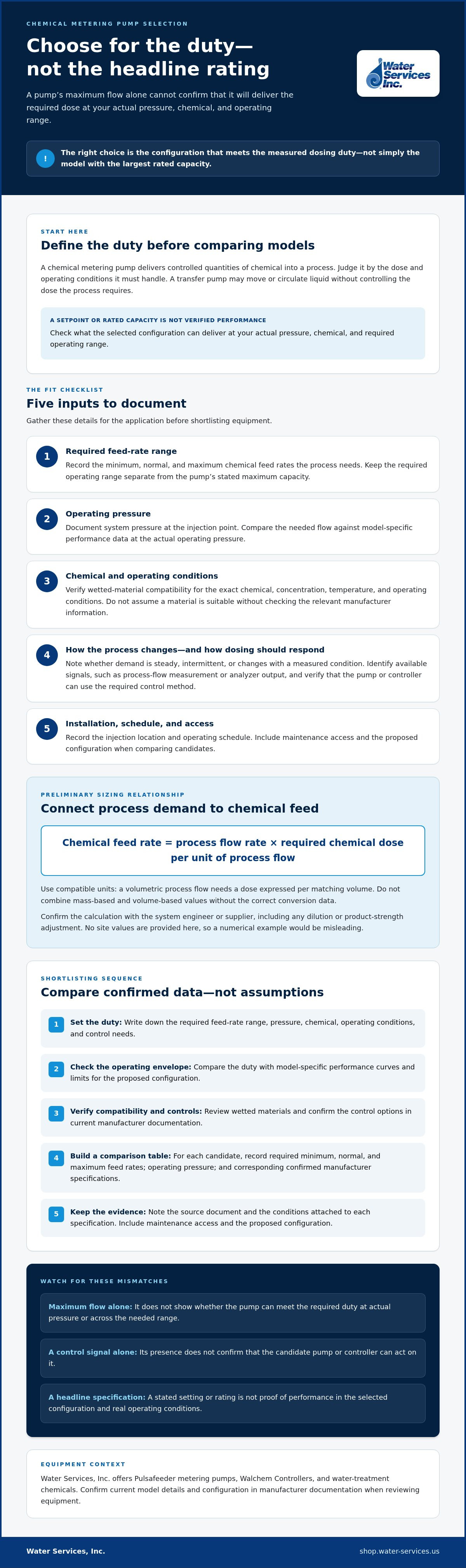
Use This Checklist When Selecting a Chemical Metering Pump
A clear datasheet turns process requirements into questions a supplier or manufacturer can answer. Use this sequence when selecting a chemical metering pump, and mark missing information as “to confirm” rather than filling gaps with assumptions.
- Define the dosing duty. Record the target dose, required minimum and maximum feed rates, normal operating rate, process demand, and operating schedule.
- Document pressure and injection conditions. Note the pressure at the injection point and describe where the chemical enters the process. Include process changes that may affect dosing demand.
- Identify the chemical precisely. Provide its name, concentration, temperature range, and other relevant operating conditions. Do not substitute a similar chemical or a general material description.
- Specify materials and design requirements. Ask the manufacturer to confirm compatibility for every wetted component in the proposed configuration. Record maintenance-access and installation constraints.
- Define control and site requirements. State whether control is manual, timer-based, flow-paced, or feedback-based. List available signals, required operating logic, available power, and maintenance requirements.
- Verify the candidate and final configuration. Request current documentation for the specific model and configuration, including applicable flow and pressure performance, operating limits, wetted materials, and control options. Resolve unknowns before purchase.
What information belongs on a pump-selection datasheet?
Keep process values and units, chemical details, operating schedule, power availability, control signals, installation constraints, and maintenance expectations together. Ask the manufacturer to identify the documents that support the candidate’s performance and material compatibility under the stated conditions. If a value is unavailable, label it clearly and assign it for confirmation by the system engineer, supplier, or manufacturer.
For sourcing, Water Services, Inc. offers Pulsafeeder metering pumps and water-treatment chemicals. Confirm current product details and pump specifications against manufacturer documentation before making a selection.
Which selection mistakes can cause a poor match?
Do not choose by maximum flow alone when normal demand or system pressure differs from the conditions behind the rating. Do not infer chemical compatibility from a broad material name or a similar application. Account for control requirements, calibration, maintenance access, and changes in process demand. An unanswered specification is a reason to verify, not a basis for assuming the candidate will fit.
For separate benchtop workflows, see laboratory glassware and equipment. These supplies are for laboratory work, not pump accessories or substitutes.
Finalize the Pump Choice and Supporting Equipment
Before placing an order, check the shortlisted pump against current manufacturer documentation and actual site requirements. Confirm that the proposed configuration covers the required duty and pressure, suits the exact chemical conditions, and provides the control approach the process needs. Verify flow, turndown, accuracy, wetted materials, and control options for the specific model rather than relying on general product descriptions.
Water Services, Inc. offers Pulsafeeder metering pumps. Do not assume a model or configuration will fit without reviewing its current specifications against the application. Keep process equipment selection separate from laboratory purchasing: metering pumps deliver controlled chemical quantities into a process, while benchtop glassware supports separate laboratory tasks.
How should you handle equipment for adjacent bench workflows?
Choose laboratory equipment according to the bench task, and review the current product description before selecting an item. Beakers and flasks, for example, are laboratory vessels, not equipment for performing metering-pump duties.
What should you confirm before requesting or placing an order?
Prepare the application details before requesting or reviewing a pump configuration. Confirm the chemical identity, concentration, temperature, operating conditions, required flow range and pressure, process schedule, and desired control approach. Flag unknowns for confirmation rather than filling them with assumptions.
Then check current product specifications and configuration details using the relevant product documentation. For a pump, verify manufacturer data for the exact candidate and confirm chemical compatibility for every wetted component. For laboratory equipment, review the current listing to ensure its description suits the intended bench task.
Once the pump requirements and any supporting equipment needs are clear, browse laboratory equipment for information about separate benchtop needs.
Move from Shortlist to a Verified Fit
Good pump selection starts with the actual dosing duty, not a headline capacity. When selecting a chemical metering pump, define the required flow range and pressure, document the chemical’s conditions, and match the control approach to how the process operates. Before purchase, confirm the candidate’s performance, wetted materials, and configuration in current manufacturer documentation.
Water Services, Inc. lists Pulsafeeder Metering Pumps among its offerings. Keep process equipment distinct from benchtop laboratory supplies. Glassware supports separate laboratory workflows and is not a pump component or substitute.
To compare pump options, browse Water Services, Inc.’s Pulsafeeder metering pumps. Review the product information and confirm the specifications against your documented duty before choosing a configuration.
Frequently Asked Questions
How do I size a chemical metering pump for my application?
Calculate the required chemical feed rate from process demand and the target dose, using consistent units and the chemical’s actual concentration. Then check that candidate pumps can deliver the required minimum, normal, and maximum rates at the system’s operating pressure. When selecting a chemical metering pump, base the final choice on model-specific manufacturer data. If process flow, target dose, or pressure is unknown, ask the system engineer or supplier to confirm it.
What is the difference between a metering pump and a dosing pump?
The terms “metering pump” and “dosing pump” are often used for equipment that delivers controlled quantities of liquid into a process. Usage can vary between suppliers, so do not rely on the product label alone. Check the intended duty and documentation for the candidate pump, including its operating range, pressure limits, chemical-contact materials, and control method. Confirm that these match the required application rather than assuming similar names mean equivalent capabilities.
How do I check whether a metering pump is compatible with a chemical?
Give the pump manufacturer the chemical’s exact identity, concentration, temperature range, and relevant operating conditions. Ask them to confirm compatibility for every wetted component in the proposed configuration, including seals, valves, connections, and other fluid-contact parts. A general material name or approval for a similar application is not enough. If the chemical formulation or operating conditions change, verify compatibility again before relying on the existing selection.
Can a chemical metering pump adjust its dose automatically?
It can if the specific pump and control arrangement support the required input and operating logic. A fixed setpoint keeps a selected rate, while flow-paced control can adjust dosing in response to process flow. Feedback control responds to a measured process condition. Identify the necessary sensor signals, controller outputs, and response behavior, then verify them against current documentation. Do not assume that a pump and controller are compatible without checking their specifications.
How much flow capacity should a chemical metering pump have?
There is no single capacity that suits every application. Specify the minimum, normal, and maximum chemical feed rates needed over the operating schedule, then confirm that the candidate can meet them at actual system pressure. A maximum rated flow alone does not establish fit at the normal dosing point. Review the performance information for the exact model and configuration, and confirm its stated operating limits with the manufacturer.
What information do I need before requesting a metering pump recommendation?
Prepare the target dose, process flow and its variation, required feed-rate range, operating schedule, and pressure at the injection point. Include the chemical identity, concentration, and temperature, plus available power, control signals, installation constraints, and maintenance-access needs. State which details are confirmed and flag unknowns for follow-up. This gives the supplier or manufacturer a usable application profile instead of requiring them to fill gaps with assumptions.
Are laboratory glassware and chemical metering pumps used for the same purpose?
No. A chemical metering pump delivers a controlled quantity of chemical into a process. Laboratory glassware supports separate bench tasks such as holding liquids, measuring, or preparing solutions. Laboratory supplies are not metering pumps, pump accessories, or substitutes. Check the current product description to confirm that any laboratory item suits the intended task.
0 comentarios