

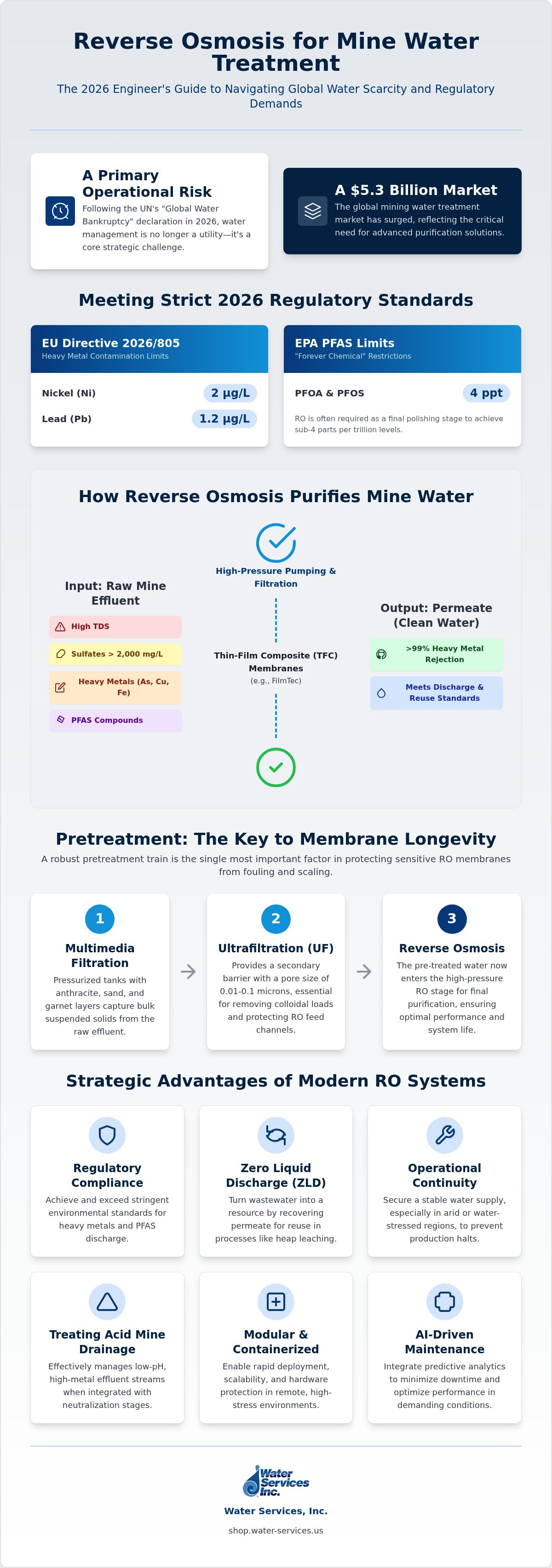
In January 2026, the United Nations declared a state of "Global Water Bankruptcy," officially shifting industrial water management from a secondary utility to a primary operational risk. For mining operators, this shift coincides with the global mining water treatment market reaching an estimated $5.3 billion. You likely already feel the pressure of meeting the EU's 2026/805 standards for heavy metals or the EPA's strict PFAS limits while managing high-TDS effluent in remote locations. Implementing effective reverse osmosis for mine water treatment is no longer just about filtration. It's a critical strategy for maintaining your social license to operate and ensuring long-term profitability.
We understand that the logistical difficulty of installing infrastructure in isolated regions often outweighs the technical challenge of the water itself. This 2026 engineering guide provides a technical roadmap to solve these complex wastewater hurdles through modular design and resource recovery. You'll discover how to achieve regulatory compliance for discharge and recover process water for reuse using high-performance components like FilmTec membranes and Goulds pumps. We will examine the integration of containerized RO plants, the role of AI-driven predictive maintenance, and specific pre-treatment protocols designed to minimize downtime in the most demanding environments.
Key Takeaways
- Learn how reverse osmosis for mine water treatment enables compliance with 2026 regulatory standards for heavy metals like nickel and lead.
- Discover why robust pretreatment is the primary factor in protecting membrane longevity against high-turbidity mine effluent.
- Evaluate the logistical benefits of containerized RO systems for rapid deployment and hardware protection in remote, high-stress environments.
- Compare high-performance FilmTec and Hydranautics membranes to select the optimal configuration for variable feed water quality.
- Explore strategies for resource recovery to minimize operational risk and achieve zero-liquid discharge goals in water-stressed regions.
The Role of Reverse Osmosis in Modern Mine Water Management
Reverse osmosis for mine water treatment acts as the primary barrier against dissolved solids and heavy metals that conventional chemical precipitation cannot remove. While traditional lime softening effectively manages pH and bulk metals, it often leaves residual sulfate and trace metal concentrations that exceed the strict 2026 environmental quality standards. For instance, the European Union's Directive 2026/805 now mandates Nickel levels as low as 2 µg/l and Lead levels at 1.2 µg/l. Achieving these metrics requires the high rejection rates offered by thin-film composite (TFC) membranes, which currently hold a 62.9% share of the RO market due to their superior selectivity and permeability.
Modern mining operations utilize RO to target a specific profile of pollutants that threaten local ecosystems and regulatory standing. The system design must account for high concentrations of specific ions, including:
- Sulfates: Concentrations often exceed 2,000 mg/L in raw effluent, requiring high-pressure membranes for effective reduction.
- Heavy Metals: Arsenic, copper, and iron ions are captured at rates exceeding 99% using standard industrial membranes.
- PFAS: Compliance with the EPA's 4 ppt limit for PFOA and PFOS often necessitates RO as a final polishing stage to reach sub-4 ppt levels.
Treating Acid Mine Drainage (AMD)
AMD occurs when sulfide-bearing minerals are exposed to oxygen and water, creating sulfuric acid that leaches heavy metals from the surrounding geology. This creates a low-pH, high-metal effluent that is traditionally difficult to manage. High-performance reverse osmosis for mine water treatment handles these complex flows by capturing dissolved metal ions and reducing overall acidity. Engineers typically integrate RO with an initial neutralization and precipitation stage. This multi-step approach prevents premature membrane scaling while ensuring the final permeate meets stringent discharge permits. Utilizing robust components like Goulds pumps ensures the system maintains the high feed pressures required to overcome the osmotic pressure of high-TDS AMD streams.
Process Water Recovery and Reuse
The 2026 shift toward Zero Liquid Discharge (ZLD) is driven by the reality of "Global Water Bankruptcy" declared earlier this year. Mining operations now view wastewater as a primary operational resource rather than a liability. By using RO permeate for heap leaching or flotation circuits, mines significantly reduce their external water footprint. This strategy provides a stable water supply in arid regions like the Middle East or parts of Africa, where water scarcity can halt production. Implementing a closed-loop system through RO technology isn't just about compliance; it's a critical economic strategy to ensure operational continuity in water-stressed environments.
Overcoming Feed Water Challenges: Pretreatment for Mining RO
Mine water is often considered the ultimate challenge for membrane longevity due to its extreme concentrations of dissolved solids and high variability. Effective reverse osmosis for mine water treatment depends entirely on a robust pretreatment train that shields sensitive membranes from fouling and chemical degradation. Without these stages, the high turbidity and mineral content typical of mine effluent can destroy a system within weeks of commissioning.
Scaling potential in sulfate-rich mine water refers to the thermodynamic likelihood of sparingly soluble salts, specifically calcium sulfate and barium sulfate, precipitating out of solution and forming a hard crystalline crust on the membrane surface as the brine concentration increases.
Filtration and Clarification Stages
Primary sediment removal starts with multimedia filter tanks. These pressurized vessels use layers of anthracite, sand, and garnet to capture bulk suspended solids. For sites with high colloidal loads, mobile ultrafiltration (UF) systems act as a secondary barrier. UF provides a physical pore size of approximately 0.01 to 0.1 microns, which is essential for protecting the feed channel of the RO membrane. You can explore a deeper breakdown of these technologies in our Industrial Water Filtration Systems guide. High-quality Pentair filter housings often serve as the final cartridge filtration stage to catch any remaining fine particulates before the high-pressure pump.
Chemical Preconditioning
Chemical dosing is the second pillar of a successful reverse osmosis for mine water treatment strategy. Polyamide membranes, such as those from FilmTec and Hydranautics, have a zero-tolerance policy for free chlorine. If your process uses chlorine for disinfection or oxidation, you must implement dechlorination via sodium bisulfite injection using Pulsafeeder metering pumps. Simultaneously, specialized antiscalants and water treatment components are required to inhibit the growth of calcium sulfate and silica crystals.
Precision is critical here. We utilize Walchem controllers and Signet flow sensors to automate these dosing cycles. This ensures that chemical levels remain optimal even when the feed water chemistry fluctuates, preventing both under-dosing and chemical waste. By maintaining strict control over the feed water parameters, you extend the interval between chemical cleanings and protect your capital investment in the membrane stack.
Deploying Modular and Containerized RO Systems in Remote Sites
Remote mining operations in Africa, South America, and the Middle East often face significant logistical barriers when establishing permanent water infrastructure. Traditional stick-built plants require extensive on-site civil engineering, long construction timelines, and specialized labor that is difficult to source in isolated regions. Containerized reverse osmosis for mine water treatment eliminates these hurdles by providing a factory-tested, plug-and-play solution. These systems are housed within standard ISO shipping containers, allowing for rapid deployment via existing global transport networks and immediate commissioning upon arrival at the site.
The modular nature of containerized units offers unparalleled scalability. As mine production increases or ore bodies expand, additional RO modules can be integrated into the existing treatment train without disrupting current operations. This incremental approach reduces initial capital outlays and allows for a more precise alignment between treatment capacity and actual water demand. By minimizing on-site construction, operators also reduce the environmental footprint and safety risks associated with large-scale building projects in sensitive or hazardous terrains.
Mobile Treatment Plant Rental vs. Purchase
Deciding between purchasing a permanent asset and opting for a mobile rental depends on the project's duration and financial strategy. Rental options are ideal for short-term dewatering needs, emergency response to unexpected flooding, or pilot testing new water chemistry profiles. From a financial perspective, rentals shift costs from capital expenditure (CAPEX) to operational expenditure (OPEX), which can be advantageous for mines with strict budget cycles. For a detailed comparison of these strategies, see our guide on Mining Wastewater Treatment Solutions. Permanent purchases are typically better for long-term production sites where the total cost of ownership over ten years is lower than continuous rental fees.
Ruggedized Engineering for Harsh Environments
Remote sites frequently expose equipment to extreme temperatures and corrosive atmospheres. Containerized units are ruggedized with industrial-grade HVAC systems to maintain optimal operating temperatures for sensitive electronics and membranes. To ensure high-pressure reliability in these demanding conditions, we integrate Goulds Water Technology Pumps known for their durability in heavy industrial service. Internal piping is typically constructed from high-grade stainless steel or specialized alloys to resist the corrosive effects of acidic mine water. These protective measures, combined with external epoxy coatings, ensure that the treatment plant maintains structural integrity despite exposure to salt air, high humidity, or desert heat.
Selecting Membranes and Antiscalants for High-TDS Mine Effluent
The success of reverse osmosis for mine water treatment depends on selecting the correct membrane chemistry to handle fluctuating Total Dissolved Solids (TDS). Thin-film composite (TFC) membranes are the industry standard, providing a critical balance between permeate flux and salt rejection. However, mining effluent often contains high concentrations of scale-forming ions that challenge these parameters. The 2026 generation of RO membranes utilizes advanced cross-linking in the polyamide layer to achieve sulfate rejection rates exceeding 99.5% even at high flux rates.
Choosing between Tier-1 manufacturers requires an analysis of specific fouling risks. DuPont’s FilmTec Fortilife series, launched in late 2025, is engineered for industrial users with variable feedwater quality, offering high reliability against biological and organic fouling. Conversely, the Hydranautics PRO-XS series released in early 2026 focuses on reducing pressure drop and energy costs in high-TDS applications. When performance declines, membrane autopsies provide essential data. These forensic examinations identify whether the fouling is mineral, organic, or biological, allowing engineers to adjust pretreatment or chemical dosing protocols accordingly.
Membrane Selection Criteria
Engineers must distinguish between Brackish Water (BW) and Seawater (SW) membranes based on the osmotic pressure of the feed source. SW membranes are necessary for deep mine dewatering where TDS levels can exceed 10,000 mg/L, requiring higher operating pressures. For process water containing residual flotation reagents, Fouling-Resistant (FR) chemistries are mandatory. These membranes feature a specialized surface charge that repels organic molecules. You can find a full range of replacement elements in our Water Treatment Collection.
Optimizing Chemical Dosing
Precision chemical delivery is the most effective way to extend membrane life. We utilize Pulsafeeder metering pumps to maintain exact antiscalant concentrations, preventing calcium sulfate and silica from precipitating. Monitoring the efficacy of these chemicals involves tracking the normalized permeate flow and salt passage. If these metrics deviate by more than 10%, a Cleaning-in-Place (CIP) protocol is initiated. A standard mining CIP uses specialized high and low pH cleaners to strip mineral scale and organic films without damaging the polyamide structure. To maintain your system's performance, order industrial-grade antiscalants and replacement filters directly from our distribution center.
Engineering Compliance and Recovery with Water Services, Inc.
Successful execution of reverse osmosis for mine water treatment requires more than off-the-shelf hardware. Site-specific water chemistry dictates every engineering decision, from the choice of membrane spacers to the configuration of high-pressure pump stages. Water Services, Inc. provides comprehensive support from the initial design phase through commissioning and long-term maintenance. Our global reach extends from our domestic base in Utah to international mining operations in Africa and the Middle East, ensuring that remote sites receive the same level of technical integrity as domestic facilities.
To ensure operational efficiency and minimize manual intervention, we integrate advanced Electric Power Controls into our systems. These components allow for automated management of flux rates, chemical dosing, and pressure monitoring. This level of automation is essential for maintaining compliance with 2026 discharge standards while optimizing the recovery of process water. By centralizing system management, operators can detect fouling trends early and initiate preventive maintenance before unplanned downtime occurs.
The Water Services Advantage
Founded in 1994, our organization brings over 30 years of industrial water treatment experience to every project. We specialize in the design of modular, containerized RO plants that withstand the rigors of demanding commercial environments. Our status as an authorized distributor for Goulds, FilmTec, and Hydranautics ensures your system is built with Tier-1 components known for industrial reliability. We don't just supply parts; we provide engineered solutions that prioritize technical performance over flashy presentation. Our inventory includes:
- Goulds Water Technology Pumps: High-pressure reliability for high-TDS feed water.
- Viqua UV Systems: Final polishing for biological control in reclaimed water.
- Harmsco and Pentair Filtration: Robust pretreatment to protect primary membrane assets.
- Replacement Components: Rapid distribution of sediment filters, carbon filters, and Ashcroft pressure gauges.
Getting Started with Your Mine Water Project
The first step in any project is a detailed feed water analysis to identify scaling ions, heavy metals, and organic contaminants. This data allows our engineers to model the system's performance and predict membrane longevity. Based on these findings, we consult with you on the economic viability of direct purchase versus rental options for your 2026 deployments. This ensures the solution aligns with your capital budget and operational goals. Contact our engineering team for a custom mining RO quote to begin your compliance and resource recovery project today.
Securing Operational Continuity through Advanced Water Recovery
The declaration of global water bankruptcy and the implementation of 2026 discharge standards have transformed wastewater from a liability into a strategic asset. Successful reverse osmosis for mine water treatment now relies on a combination of robust pretreatment, modular containerized engineering, and precision chemical dosing. By prioritizing Tier-1 hardware and site-specific system design, mining operators can achieve consistent regulatory compliance while ensuring the continuity of flotation and leaching circuits in water-stressed regions.
Water Services, Inc. has served as a technical partner for industrial water projects since 1994. We provide the global logistics and installation support necessary to deploy complex systems in remote environments across Africa, South America, and the Middle East. As an authorized distributor for Goulds and FilmTec, we maintain the inventory and engineering expertise to support your resource recovery goals. Our team understands the rigors of demanding commercial environments and the necessity of reliable equipment.
Shop Industrial RO Components and Containerized Systems to secure your operational water supply. Your path to efficient water management starts with reliable engineering.
Frequently Asked Questions
What is the typical recovery rate for reverse osmosis in mining?
Typical recovery rates for reverse osmosis for mine water treatment range between 70% and 85% for standard industrial configurations. In high-recovery systems, this can reach 95% depending on the specific saturation levels of calcium sulfate and silica in the feed water. Achieving these higher rates often requires intermediate treatment stages or specialized high-pressure membranes to overcome the increasing osmotic pressure as the brine concentrates during the process.
How does reverse osmosis handle Acid Mine Drainage (AMD)?
Reverse osmosis handles Acid Mine Drainage (AMD) by removing dissolved metal ions and reducing the acidity of the permeate. However, the raw AMD must undergo initial neutralization and bulk metal precipitation to prevent rapid membrane fouling. This multi-stage approach ensures that the RO system acts as a final polishing barrier, producing water that meets the 2026 environmental quality standards for discharge or process reuse.
What are the pretreatment requirements for RO in a mining environment?
Pretreatment in a mining environment typically involves a sequence of multimedia filtration, ultrafiltration, and chemical conditioning. Multimedia filter tanks remove bulk suspended solids while ultrafiltration (UF) provides a barrier against fine colloids. Chemical preconditioning includes the injection of antiscalants to inhibit mineral precipitation and dechlorination agents to protect polyamide membranes from oxidative damage. This sequence is essential for maintaining the operational integrity of the primary RO stack.
Can RO systems be used for Zero Liquid Discharge (ZLD) in mines?
RO systems are critical components of Zero Liquid Discharge (ZLD) strategies in modern mines. They serve as the primary concentration stage, significantly reducing the volume of wastewater that must be processed by downstream thermal evaporators or crystallizers. By concentrating the brine to high TDS levels, RO systems minimize the energy requirements and capital costs associated with final brine disposal, making closed-loop water management more economically viable.
How long do RO membranes last in mine water treatment?
Industrial RO membranes in mining applications generally last between two and five years. This lifespan depends heavily on the consistency of the pretreatment process and the frequency of chemical cleaning cycles. In environments with highly variable feed water quality, operators often use membrane autopsies to identify specific fouling patterns. This data allows for adjustments in chemical dosing that can extend the service life of the elements despite harsh conditions.
Are containerized RO systems suitable for remote, high-altitude mines?
Containerized RO systems are specifically engineered for remote and high-altitude mining sites. These units are housed in standard ISO containers equipped with industrial HVAC systems to maintain internal temperatures in extreme climates. Ruggedized internal components, such as Goulds pumps and stainless steel piping, ensure mechanical reliability at high elevations where air density and temperature fluctuations can impact the performance of standard, non-enclosed equipment.
What is the difference between renting and buying a mobile water treatment plant?
Renting a mobile water treatment plant is an operational expenditure (OPEX) ideal for short-term dewatering or pilot testing. It provides flexibility without the long-term commitment of ownership. Buying a plant is a capital expenditure (CAPEX) suited for permanent production sites where the project duration exceeds three years. Purchasing typically offers a lower total cost of ownership over the life of the mine compared to ongoing rental fees.
How do antiscalants prevent membrane fouling in high-sulfate water?
Antiscalants work by inhibiting the nucleation and growth of mineral crystals on the membrane surface. In high-sulfate mine water, these chemicals delay the precipitation of calcium sulfate and barium sulfate as the water becomes more concentrated. This process extends the time between cleaning cycles and prevents permanent physical damage to the membrane. Effective reverse osmosis for mine water treatment relies on precise dosing of these chemicals via automated controllers to handle fluctuating ion concentrations.
0 comentarios