

The lowest monthly payment can become the more expensive long-term choice. Choosing between renting vs buying a mobile water plant starts with comparing the full costs over three years, not just the initial outlay. Renting can suit a temporary need or a preference for scheduled payments, while buying may make more sense when long-term use and equipment ownership are priorities.
Predictable spending matters, especially when water treatment is essential to operations. But the payment alone does not show who handles maintenance, what the agreement covers, or how financing affects total cost. Those details shape the practical difference between renting and buying.
This article compares upfront and ongoing costs, payment predictability, maintenance responsibilities, ownership value, and financing. It also provides a decision guide to help match the option to project duration, operating needs, and budget priorities.
Key Takeaways
- Compare the full cost of renting and buying over your expected operating period, including upfront spending and ongoing expenses.
- Assess how rental or lease terms affect payment predictability, flexibility, and the option to upgrade equipment.
- Clarify who is responsible for routine maintenance and repairs, since those duties affect both cost and operating workload.
- Buying creates ownership value, but resale proceeds depend on the equipment’s condition and market demand.
- Review financing structures alongside the purchase cost to understand how payment timing fits your project budget.
Rental versus purchase costs and long-term value
Compare rental charges with purchase, installation, and ownership costs across the planned operating period. The best fit depends on duration, cash flow, and how closely the plant matches the required water treatment.
Monthly rental payments
A monthly rental spreads spending across the contract instead of concentrating it at purchase. Add each payment over the expected operating period, then compare that total with equipment purchase, installation, and ongoing ownership costs. A stable charge can help with budgeting, but longer rental periods increase cumulative payments. Contract length and included services also affect the comparison.
Purchase payments and break-even costs
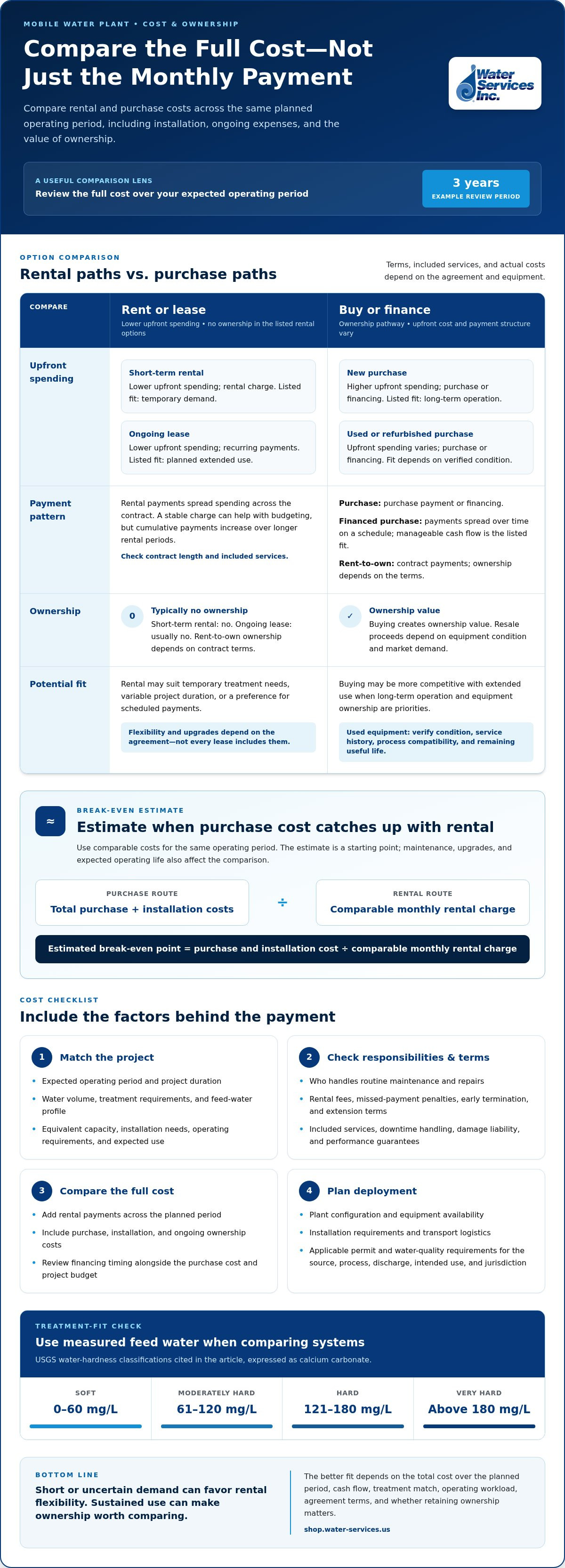
Buying requires a larger initial commitment, while rental payments accumulate over time. Estimate the break-even point by dividing total purchase and installation costs by the comparable monthly rental charge. Then account for maintenance, upgrades, and the plant’s expected operating life. A short project may end before purchase costs are recovered; extended use can make ownership more competitive.
Equipment rental and upfront costs
Equipment rental can avoid a large upfront payment and preserve working capital for other project needs. It may suit temporary treatment requirements or an uncertain project duration. Used or refurbished mobile water treatment plants can also be cost-effective when their condition, service history, process compatibility, and remaining useful life support dependable operation. Compare those factors with new equipment and rental terms.
Rental and purchase lead times depend on plant configuration, equipment availability, installation requirements, and transport logistics. These factors determine when a system can be deployed, so include them in the project schedule alongside the financial comparison.
Manufactured homes cost less per square foot than stick-built homes, but that comparison does not establish the value of a water plant. For treatment equipment, compare equivalent capacity, installation needs, operating requirements, and expected use. Housing payments and plant ownership costs are separate decisions with different cost drivers.
Water quality also affects treatment requirements. The U.S. Geological Survey classifies water as soft at 0 to 60 mg/L as calcium carbonate, and moderately hard at 61 to 120 mg/L as calcium carbonate. It classifies water as hard at 121 to 180 mg/L as calcium carbonate, and very hard above 180 mg/L as calcium carbonate. Use the measured feed-water profile when comparing systems.
| Option | Upfront spending | Payment pattern | Ownership | Best fit |
|---|---|---|---|---|
| Short-term rental | Lower | Rental charge | No | Temporary demand |
| Ongoing lease | Lower | Recurring | Usually no | Planned extended use |
| New purchase | Higher | Purchase or financing | Yes | Long-term operation |
| Used or refurbished purchase | Varies | Purchase or financing | Yes | Suitable verified condition |
| Financed purchase | Spread over time | Scheduled payments | Ownership pathway | Manageable cash flow |
| Rent-to-own | Lower at outset | Contract payments | Depends on terms | Potential future ownership |
Choose by comparing total cost, project duration, treatment requirements, and the value of retaining ownership.
How Does Ongoing Plant Leasing Work?
Short rentals, ongoing leases, and purchases differ in payment structure, flexibility, and ownership. Compare the agreement’s full term with the project’s expected duration and treatment requirements.
Rental agreements, fees, and risks
A short-term rental can run hourly, daily, or month to month, while leases for consumer goods commonly run for months or years. For a mobile plant, the agreement sets the rental period, recurring charge, included services, and return conditions. Compare those expenses with purchase and ownership costs over the same period, such as a three-year review.
Before signing, identify rental fees, missed-payment penalties, early termination terms, and rules for extending the agreement. Also define how downtime is handled, which party carries liability for damage, and what performance guarantees apply. Tie performance terms to measurable treatment targets, operating conditions, and acceptance testing so both parties can assess the same requirements.
Permit and water-quality requirements depend on the water source, treatment process, discharge, intended use, and applicable jurisdiction. Map those project details to the relevant federal, state, and local requirements before deployment. There is no single nationwide permit that applies to every plant.
Project duration, water volume, and treatment requirements all affect the rent-or-buy decision. Short-term or variable demand can favor rental flexibility, while sustained volume and stable treatment needs can support comparing ownership costs over the operating period.
Mobile treatment configurations include reverse osmosis, ultrafiltration, and ultraviolet systems. Their treatment functions differ, so process selection depends on the feed water and the contaminants or water-quality parameters the project needs to address.
Rental flexibility, upgrades, and moving
Rental agreements can suit projects with changing schedules because their terms may allow extensions or equipment changes. A water softener rental, for example, may allow an upgrade during the rental term. Treat this as a contract option, not a standard feature of every mobile plant lease.
Moving a rented plant requires coordination around the agreement’s delivery, removal, transport, and site requirements. Before relocating it, align the new site’s water source, connections, operating conditions, and treatment targets with the equipment configuration. A lease may reduce ownership responsibilities, but its fees and terms govern relocation costs and timing.
For a break-even comparison, divide purchase and installation costs by the comparable rental charge for the same period. Then add ownership expenses, including maintenance and upgrades, and compare the result with total rental payments. Compare plants with equivalent treatment capacity and operating requirements, not just headline payments.
Ownership places the asset with the buyer and makes the buyer responsible for ongoing costs. Leasing avoids a large purchase commitment but requires payments throughout the contract. Choose the structure that matches the project’s duration, volume profile, and need for flexibility.
Maintenance responsibilities
Maintenance affects both the total cost of a mobile water plant and the work required to keep it operating. Before deciding, compare the rental agreement’s service coverage with the buyer’s maintenance duties to determine who handles routine care, repairs, and replacement parts.
What rental agreements cover
Rental contracts assign maintenance duties differently, so identify the responsible party for each task. Review routine service, corrective repairs, parts, labor, and response procedures separately. A rental agreement may include regular service and repairs for a water softener, but mobile plant coverage depends on the contract. Record those duties before comparing rental expenses with ownership costs.
For a rented system, document how to report a fault, who authorizes work, and how downtime affects payments or project obligations. For example, a pump issue may require troubleshooting before the plant resumes treatment. The contract should define the repair process and clarify responsibility for damage, consumables, and service visits. These details determine the operator’s workload as well as the rental’s practical value.
Buyer maintenance and repair planning
Buying transfers maintenance responsibility to the owner. A buyer can add a maintenance plan but still needs to budget for routine service, repairs, replacement components, and upgrades. Build a maintenance schedule around the plant’s operating conditions and manufacturer instructions. Keep service records with operating data so recurring faults and component changes can inform future spending.
Water softener buyers are responsible for maintenance, though they can add a maintenance plan. Rental agreements for softeners usually include regular service and repairs. This distinction helps compare recurring rental charges with the cost of managing upkeep as an owner. The same cost categories matter for a mobile plant, but its contract determines who performs each task.
Budgeting for maintenance and upgrades
Separate equipment payments from upkeep in the operating budget. List rent or financing, planned service, repairs, consumables, and upgrades as distinct expense categories. A homeowner may compare rent or a mortgage with maintenance and home upgrades; a plant operator should likewise separate financing from treatment-system upkeep. This clarifies how ownership affects available cash and day-to-day work.
Before signing or buying, use this maintenance review:
- List routine inspection and service tasks for the plant.
- Assign responsibility for labor, parts, and repairs.
- Identify what happens during equipment downtime.
- Set aside budget capacity for maintenance and upgrades.
- Keep service records and review recurring repair needs.
Project needs matter too: a temporary operation may favor a rental arrangement with defined service coverage, while long-term ownership requires internal maintenance planning. Compare both options using the same plant configuration and operating demands. This makes it easier to judge not only what you will pay, but also how much maintenance work your team will manage.
Equity building through ownership
Buying a mobile water plant creates an owned asset, while ordinary rental payments provide access without transferring ownership. If the plant is financed, the owner’s equity is the asset’s value minus the outstanding loan balance. That balance can change as financing is repaid, equipment condition changes, and resale demand shifts. This differs from renting from a landlord, where payments do not build ownership in the asset.
Ownership can support long-term value when the plant remains useful for ongoing operations. The asset can stay in service, be adapted to later project needs, or be sold when it no longer fits. Buyers should consider anticipated use, condition, configuration, and resale prospects rather than assume the original purchase amount will be recovered. Resale value is never automatic.
Rental avoids ownership, so standard lease payments do not make the equipment a company asset. This structure can still suit a temporary need: the business pays for access during the required period and avoids retaining equipment after the project ends. Compare total payments over the agreement with ownership costs, including financing, maintenance, upgrades, and eventual disposal or sale.
Assessing the value of ownership
Use a three-year ownership review to compare the asset’s operating value with its costs. Record purchase or financing payments, maintenance, upgrades, and expected useful life. Then estimate how the plant supports production or treatment requirements during that period. Keep operating benefits separate from resale value so projected savings are not confused with equity.
For a financed purchase, the equity position changes as loan principal is repaid. Interest and other financing costs affect total spending but do not add to the asset’s resale value. Review the remaining loan balance alongside the plant’s condition and likely market demand. This gives a clearer picture of the financial position if the operation needs to sell or replace the equipment.
A rent-to-own agreement requires particular attention to its ownership terms. Some plans can impose a high penalty if the customer purchases before the agreement ends. Compare total payments and early-purchase terms with a direct purchase and a standard rental. The payment structure matters: only an agreement that transfers ownership builds an asset stake for the buyer.
Residential ownership reports provide context, not a forecast for industrial equipment. The Village Homes Austin Homebuyers Report says 88% of homeowners believed purchasing a mobile home was their best financial decision. That result concerns housing, not mobile water plants. Use it as a reminder to assess ownership goals separately from plant economics, and base the equipment decision on operating duration, financing, maintenance, condition, and resale demand.
Before choosing, write down three outcomes: how long the plant is needed, who will own it at the end, and what happens if requirements change. If continued use and asset retention matter, assess purchase equity against total costs. If the project has a defined end and retaining equipment adds little value, compare rental payments with the value of access and flexibility.
Financing and payment options for buying
Buying a mobile water plant can involve an upfront payment or financing, depending on the purchase arrangement. Compare the payment schedule with project cash flow, expected operating duration, and the plant’s role in production. The decision is not only about the amount due at purchase. It is also about how financing affects total spending and when funds are available.
Compare payment structures
A direct purchase concentrates equipment costs at the start, while financing spreads payments across an agreed schedule. This can preserve working capital, but financing adds costs beyond the equipment price. Compare the repayment schedule, interest, fees, any required deposit, and total paid over the agreement. Use the same plant configuration and installation scope in each comparison.
Financing terms determine how payment obligations fit the project. A shorter schedule can mean larger periodic payments and less time carrying debt. A longer schedule can ease periodic cash demands but extend repayment. Model each option against expected operating cash flow. Include maintenance, upgrades, and other plant expenses instead of treating the financing payment as the full cost.
Match financing to the project
Start by defining the plant’s intended use, required treatment process, and expected service life. Then determine whether the operation can support scheduled payments during both normal and lower-demand periods. For example, a plant serving steady production has a different cash-flow profile from equipment needed for a temporary project. Expected use helps assess whether borrowing fits the situation.
Before deciding, compare the purchase pathway with rental costs over the same operating period. Ownership may retain asset value, while financing creates repayment obligations and ownership costs. Rental avoids a purchase loan but ordinary rental payments do not build ownership. Include maintenance and upgrades for ownership, and all agreement payments for rental.
Use a simple review process to make the comparison practical:
- Define the treatment capacity and configuration required for the project.
- Separate equipment, installation, financing, and operating expenses.
- Compare payment timing with forecast cash flow.
- Calculate total repayment, including interest and fees.
- Assess the plant’s expected use and potential value after repayment.
Keep assumptions consistent. A financing comparison is misleading if one option includes installation and another does not. Likewise, equipment with different treatment capabilities is not an equivalent comparison. Document the configuration, payment timing, maintenance budget, and project duration before choosing a structure.
For a project that needs pumping equipment, review the configuration alongside the financing plan and available pump options. Equipment selection and payment structure should support the same operating requirements.
The right approach depends on cash-flow capacity, financing terms, expected operating life, and the value of ownership. Choose the payment structure that keeps total obligations clear and aligns with how long the plant will serve the operation.
Water Services: Goulds Water Technology Pumps
Water Services, Inc. helps project teams evaluate water-treatment components for mobile plant configurations. Turn to its offerings when the process design calls for pumping, ultraviolet disinfection, reverse osmosis membranes, or treatment chemicals. Goulds Water Technology Pumps support pumping requirements, while Viqua UV Water Purification Systems, Hydranautics RO Membranes, and Water Treatment Antiscalants and Chemicals serve distinct treatment functions.
Before selecting equipment, define feed-water characteristics, treatment outcomes, required flow, site conditions, and expected operating period. These inputs help determine which components fit the process and whether a purchase aligns with the operating plan. Water Services, Inc. is a relevant next step when you move from the rent-or-buy comparison to identifying equipment for a treatment system.
Contact Water Services, Inc. or visit shop.water-services.us to explore relevant equipment.
Move from comparison to system planning
Turn the rent-or-buy decision into a defined equipment plan. Document the feed-water profile, treatment goals, required flow, site conditions, and expected operating period. These inputs connect the financial choice to the system configuration your operation needs, rather than treating equipment ownership as a decision in isolation.
For teams choosing between renting and buying a mobile water plant, the next step is to align equipment selection with treatment requirements and project plans. Water Services, Inc. offers Goulds Water Technology Pumps, Viqua UV Water Purification Systems, and FilmTec Reverse Osmosis Membranes for water-treatment applications. Each has a distinct role in a system, so define the process before selecting components.
Bring your operating requirements into the discussion, including water source, treatment targets, and anticipated use. This gives the equipment review a practical starting point and keeps the decision grounded in the project’s actual needs.
Contact Water Services, Inc. to discuss options and take the next step toward a suitable system plan.
Frequently Asked Questions
How Can Leasing Make Spending More Predictable?
Leasing can make equipment spending more predictable by setting recurring payments for a defined term. The agreement lets teams forecast that fixed charge separately from variable expenses such as power, treatment chemicals, and water disposal. For example, a site with steady demand can budget the lease payment in its monthly operating plan, then track consumption costs independently. Review escalation clauses, service inclusions, and renewal terms because they can change future outlays.
What does it cost to rent a mobile water treatment plant in the United States?
Rental cost depends on the treatment process, required capacity, rental duration, transport, and site conditions. A reverse osmosis plant with specific feed-water needs may require a different configuration from an ultrafiltration system. The quoted total can also depend on installation, commissioning, service coverage, and removal at the end of the term. Compare proposals using the same capacity, treatment goals, and rental period, then include operating expenses in your budget.
How much does it cost to buy a mobile water treatment plant?
Purchase cost depends on plant configuration, treatment capacity, process requirements, installation scope, and controls. A system designed for a particular feed-water profile may need different components from one treating another source. Financing can also affect total spending through its repayment schedule and interest. To compare purchase options, define treatment targets and operating conditions first, then assess equipment, installation, financing, maintenance, and expected upgrades as separate cost categories.
What rental fees, deposits, mobilization, and operating costs should be included?
Build a complete rental estimate by listing recurring charges, any deposit, delivery and mobilization, installation, commissioning, and final removal. Add electricity, incoming water, chemicals, consumables, waste handling, operator labor, and any service costs excluded from the agreement. At a remote site, transport and access requirements can affect mobilization. Separate refundable deposits from nonrefundable fees, and note penalties, damage charges, and payment terms to avoid overlooking contract expenses.
When is renting versus buying a mobile water plant more cost-effective?
Renting can be more cost-effective for a temporary project, uncertain demand, or a process likely to change. Buying may make better financial sense when the plant will serve a stable, long-running requirement and ownership value matters. When choosing between renting and buying a mobile water plant, compare total payments over the intended use period, including financing, installation, upkeep, and the cost of ending or extending a rental.
Who is responsible for installation, operators, maintenance, repairs, and consumables under rental agreements?
The rental agreement assigns these responsibilities, so list each item separately. It may assign installation and commissioning to one party, while the site supplies operators, utilities, or consumables. Maintenance and repairs can also be divided by cause, such as routine wear versus damage from site conditions. Before mobilization, document operating procedures, reporting contacts, spare-parts access, downtime handling, and responsibility for waste streams.
0 comentarios