

Relying on manual inspections for critical infrastructure in 2026 is no longer a viable strategy; it's a liability. For professionals managing a chemical dosing pump for mining water treatment, the physical distance between the control room and the pump head often translates to delayed responses and expensive downtime. You already know that unscheduled failures in remote mining or military sites don't just interrupt workflows. They risk environmental non-compliance and drive up manual inspection costs that eat into your operational budget.
This guide demonstrates how modern remote pump monitoring systems eliminate these vulnerabilities by providing real-time oversight in the world’s most demanding environments. You'll discover how to transition from reactive repairs to predictive maintenance using advanced hardware like the Walchem Intuition-9, which supports up to 24 sensor inputs for total process transparency. We'll examine how integrating Goulds e-SVX Smart Pumps with Avensor monitoring can extend the lifespan of your industrial assets while automating alerts for flow and pressure anomalies. We provide a technical breakdown of the sensors and controllers required to reduce maintenance costs and maintain strict regulatory compliance across your global operations.
Key Takeaways
- Understand the technical shift from reactive maintenance to proactive, data-driven oversight through integrated telemetry and real-time sensor layers.
- Identify the specific sensors and logic controllers required to optimize a chemical dosing pump for mining water treatment in remote or hazardous zones.
- Evaluate the Total Cost of Ownership (TCO) and safety advantages of automated monitoring compared to high-risk, manual site inspections.
- Learn how to audit existing pump infrastructure and identify critical failure points to implement a robust remote oversight strategy.
- Discover how to leverage Goulds and Walchem hardware to retrofit legacy industrial systems for 2026 reliability standards.
What are Remote Pump Monitoring Systems?
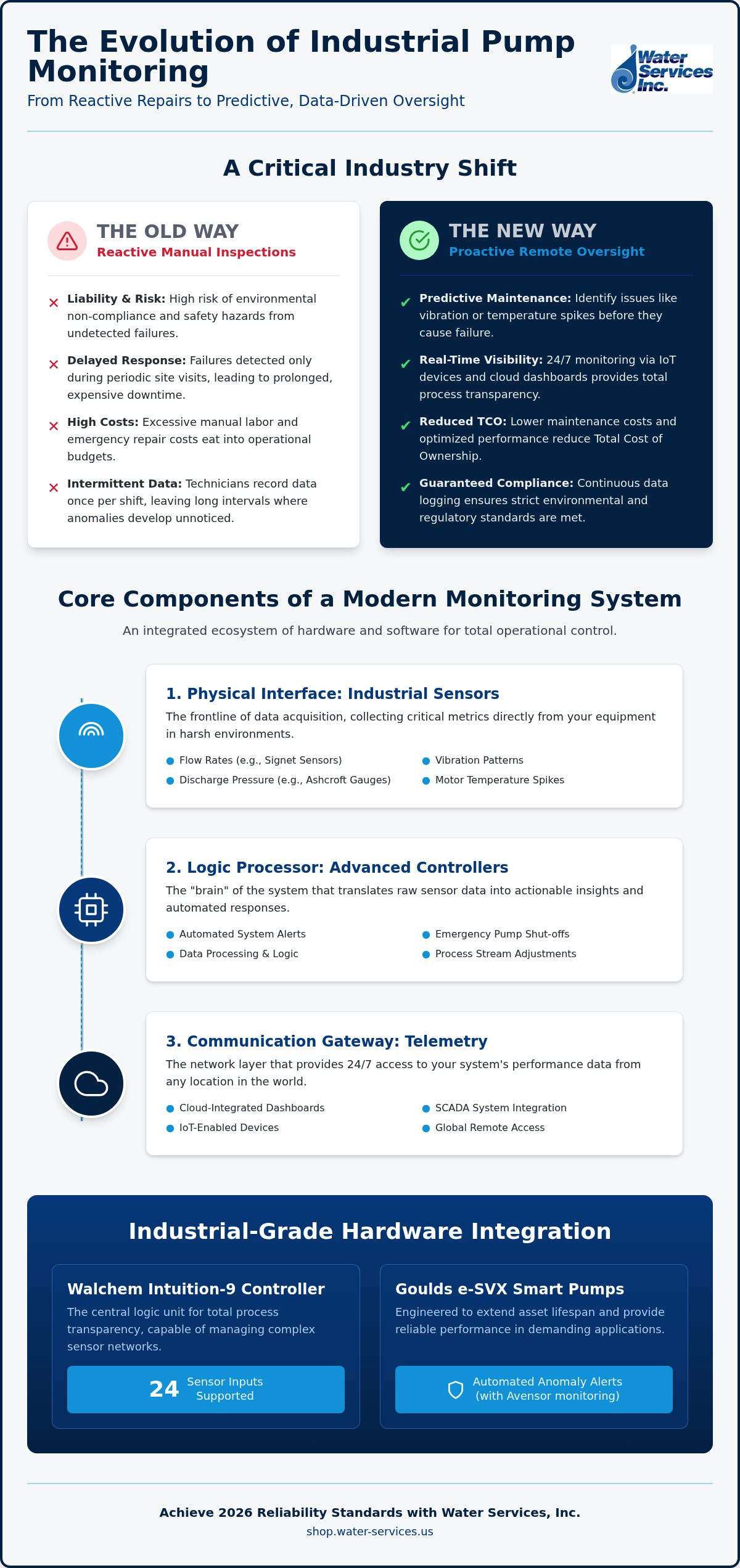
A remote pump monitoring system is a specialized hardware and software network designed to provide real-time visibility into equipment performance from any location. It functions as an integrated ecosystem of field sensors, logic controllers, and telemetry devices. For a chemical dosing pump for mining water treatment, these systems ensure that precise chemical volumes are introduced into the process stream without the need for constant on-site supervision. This technology facilitates a critical industry shift from reactive maintenance, where repairs occur only after a failure, to proactive, data-driven oversight.
Modern industrial operations depend on these systems to maintain environmental compliance and operational efficiency. In remote mining environments, a single pump failure can lead to significant downtime or regulatory penalties. Implementing mining wastewater treatment solutions requires robust oversight of discharge pressure, flow rates, and motor health to prevent catastrophic leaks or system overloads.
The Evolution of Industrial Pump Oversight
The management of a typical pumping station has transitioned from manual logbooks and periodic physical inspections to cloud-integrated dashboards. Previously, technicians recorded data points once per shift, leaving long intervals where anomalies could develop undetected. Modern SCADA (Supervisory Control and Data Acquisition) systems and IoT-enabled devices now provide 24/7 visibility. By 2026, these standards have become mandatory for operations requiring strict environmental compliance. Real-time data allows engineers to identify vibration patterns or temperature spikes that signal impending motor failure, allowing for scheduled intervention rather than emergency shutdown.
Key Metrics for Industrial Water Systems
Precision monitoring relies on the accuracy of the physical interface. Professionals utilize Signet flow sensors to track exact throughput, ensuring the chemical dosing pump for mining water treatment maintains the correct stoichiometric ratios. Pressure tracking is equally vital. Ashcroft industrial gauges allow operators to detect line blockages or seal failures by monitoring discharge pressure variations. These metrics provide the technical foundation for identifying anomalies before they escalate into hardware damage.
All raw data is processed through the logic layer, typically managed by Walchem controllers. These units translate sensor signals into actionable insights, such as automated alerts or emergency pump shut-offs. This level of integration ensures that every component, from the Goulds Water Technology Pumps to the chemical feed lines, operates within its specified engineering limits.
Core Components: Sensors, Controllers, and Connectivity
Industrial monitoring systems are structured into three primary technical layers: the physical interface, the logic processor, and the communication gateway. Each layer must function with high reliability to ensure the continuous operation of a chemical dosing pump for mining water treatment. When these components are properly integrated, they provide a comprehensive view of the process stream, allowing for immediate adjustments to maintain chemical balance and system integrity.
Industrial Sensors for Harsh Environments
The sensor layer serves as the frontline of data acquisition. In mining applications, water often contains high concentrations of suspended solids and corrosive chemicals. Selecting sensors with compatible metallurgy and chemical resistance is vital for long-term reliability. Precision components like Signet sensors are frequently integrated into modular systems to provide the granular data necessary for optimizing chemical dosing in mining. These sensors must be housed in NEMA-rated enclosures within the electric power controls assembly to protect sensitive circuitry from dust and moisture ingress.
Walchem Controllers: The Brain of the System
The logic layer is dominated by advanced controllers such as those from Walchem. These units act as the brain of the operation, processing raw analog and digital signals into actionable insights. For a chemical dosing pump for mining water treatment, the controller manages complex proportional-integral-derivative (PID) loops to maintain exact chemical concentrations despite fluctuating flow rates. Current models like the Walchem Intuition-9 offer up to 24 sensor inputs and 12 relay outputs, allowing for total system oversight. Operators can access these parameters through web-based dashboards or receive mobile push alerts for immediate response to process anomalies.
The communication layer bridges the gap between remote hardware and the central office. While Ethernet is preferred for sites with existing infrastructure, remote mining operations often rely on cellular or satellite telemetry. Connectivity must be robust enough to handle high-frequency data logging without significant latency. Powering these systems in off-grid locations requires a solar-plus-storage approach. A typical 2026 setup includes high-efficiency photovoltaic panels paired with lithium-iron-phosphate batteries to ensure 24/7 uptime even during periods of low solar irradiance. If you need to upgrade your field hardware, you can browse industrial controllers and sensors to find specific components for your technical requirements.
The Industrial Case for Remote vs. Manual Monitoring
The financial justification for transitioning to remote oversight centers on the Total Cost of Ownership (TCO). Manual monitoring requires significant recurring expenditures, including technician labor hours, vehicle maintenance, and fuel for remote site access. Automated monitoring shifts these costs toward a one-time capital expenditure followed by minimal software fees, resulting in a lower TCO over the equipment lifecycle. For a chemical dosing pump for mining water treatment, the cost of a single missed reading can exceed the price of the monitoring hardware if it results in a regulatory fine or a process shutdown.
Data integrity is another critical factor. Manual readings are prone to transcription errors and inconsistent timing, which complicates industrial water treatment compliance. Remote sensors provide timestamped, objective data that creates an unalterable audit trail for environmental regulators. This precision ensures that dosing rates remain within specified engineering tolerances, preventing the over-consumption of expensive water treatment chemicals. For operators who utilize weight-based monitoring to verify these dosing rates, Independent Scale Service offers the specialized calibration services required to maintain the integrity of industrial weighing systems.
Early detection of mechanical issues is the primary defense against catastrophic failure. Remote systems identify vibration patterns or temperature spikes that indicate cavitation or seal failure in centrifugal pumps before the hardware sustains permanent damage. In remote Africa operations, where lead times for replacement parts can span weeks, these predictive alerts are essential for maintaining uptime. Mean Time Between Failures (MTBF) represents the predicted elapsed time between inherent failures of a mechanical system during normal operation, and continuous monitoring allows operators to maximize this interval through targeted intervention. By identifying anomalies early, engineers can schedule maintenance during planned outages rather than responding to emergency motor burnouts.
Safety and Personnel Protection
Reducing the frequency of site visits in high-risk zones, such as active mining pits or remote military installations, directly improves safety outcomes. Remote diagnostics allow technicians to troubleshoot equipment from a central office, ensuring they only enter the field when physical repairs are necessary. When maintenance is required, personnel must utilize appropriate personal protective equipment (PPE) to mitigate risks from hazardous process chemicals and high-pressure lines. Modern digital monitoring systems also facilitate remote lockout-tagout (LOTO) verification. This allows safety officers to confirm equipment is de-energized and isolated via digital signatures before a technician begins work on the hardware, adding a critical layer of protection in demanding industrial environments.
Implementing a Monitoring Strategy for Remote Sites
Success in remote oversight begins with a comprehensive audit of existing infrastructure. Operators must evaluate the technical specifications of their Goulds Water Technology Pumps to determine which points require instrumentation. For a chemical dosing pump for mining water treatment, critical failure points often include suction line blockages, air binding, or diaphragm ruptures. Once identified, these points are equipped with specific sensors to establish a baseline of normal operation. This audit ensures that the monitoring system captures relevant data without over-instrumenting non-critical components.
The strategy must also define clear escalation procedures for on-site teams. When a sensor detects a deviation, the system needs to know exactly who to notify and what level of response is required. This structured approach transforms raw telemetry into a functional safety layer that protects both the hardware and the surrounding environment.
Selecting the Right Telemetry
Industrial sites require reliable data transmission paths tailored to their geographic location. 5G and LTE networks offer high bandwidth and low latency, making them ideal for sites within range of established cellular towers. However, ultra-remote water treatment plants in the Middle East or high-altitude mining sites often lack cellular coverage. In these scenarios, satellite monitoring (Satcom) provides the only viable link. While Satcom may have higher latency, it ensures 24/7 connectivity in the world's most isolated regions. Military applications require additional layers of data security, utilizing AES-256 encryption and private VPN tunnels to prevent unauthorized access to critical process data and control loops.
Thresholds and Alarm Management
Effective monitoring requires the precise configuration of threshold alerts to maintain system stability. Operators should establish "Warning" levels for minor deviations and "Critical" levels that trigger immediate escalation or automated pump shut-offs. This hierarchical approach prevents alarm fatigue, ensuring that on-site teams only receive notifications for events requiring physical intervention. Integrating these alerts with broader industrial water treatment systems allows for coordinated responses across the entire facility. For example, a low-flow alarm on a chemical dosing pump for mining water treatment can automatically pause the main process stream to prevent the discharge of untreated effluent. To begin your implementation, you can purchase professional-grade telemetry and control hardware directly from our authorized distribution center.
Industrial Integration: Leveraging Goulds and Walchem Technology
The integration of Goulds fluid handling technology with Walchem digital logic creates a robust framework for demanding industrial environments. This synergy is particularly evident when deploying a chemical dosing pump for mining water treatment, where precise chemical delivery must be maintained under varying hydraulic conditions. Standardizing on these two brands allows operators to simplify their spare parts inventory and streamline technical training for maintenance teams. By utilizing a specialized distributor, industrial users gain access to pre-configured hardware packages that are engineered for immediate field deployment.
Retrofitting legacy pumps with modern monitoring hardware is a cost-effective method to meet 2026 industrial standards. Instead of replacing entire pumping stations, engineers can install external sensors and Walchem controllers to bring older equipment into a centralized telemetry network. This transition provides the 24/7 visibility required for environmental compliance without the capital intensity of a full facility overhaul. It's a pragmatic approach to modernization that prioritizes technical integrity over flashy presentation.
Optimizing Goulds Water Technology Pumps
Operators can maximize the efficiency of their assets by monitoring performance curves in real-time. By comparing actual flow and pressure data against the manufacturer's specified curves, the system identifies when a pump is operating outside its Best Efficiency Point (BEP). This data-driven approach is vital for extending the service life of centrifugal models through vibration analysis and temperature tracking. Early detection of cavitation or imbalanced impellers prevents long-term shaft damage and avoids the high costs of emergency replacements. For facilities requiring hardware upgrades or new installations, the full pumps collection provides a direct source for professional-grade equipment.
Custom Engineered Monitoring Solutions
Water Services, Inc. specializes in the design and integration of modular water treatment systems. From our headquarters in Provo, Utah, we provide global support for containerized reverse osmosis (RO) and ultrafiltration plants, reaching remote project sites in Africa and the Middle East. Our approach focuses on technical integrity and logistical competence, ensuring that every monitoring solution is tailored to the specific rigors of mining and military applications. We offer consulting for complex water needs, assisting clients in selecting the correct metallurgy and sensor types for their unique process streams.
The future of heavy industry lies in autonomous pump stations that self-adjust based on real-time analytical data. As AI-driven logic becomes standard in 2026, the combination of Goulds hardware and Walchem intelligence will continue to serve as the benchmark for reliability in remote oversight. This evolution ensures that even the most isolated operations can maintain peak performance with minimal human intervention.
Future-Proofing Industrial Water Treatment with Real-Time Oversight
Transitioning to a remote oversight model is the most effective way to eliminate unscheduled downtime and maintain strict regulatory compliance. By integrating precision sensors with advanced logic controllers, operators gain the transparency required to protect high-value assets in the world's most demanding environments. This technical evolution ensures that every chemical dosing pump for mining water treatment operates within its specific engineered parameters, reducing manual inspection costs and extending equipment lifespan. Data-driven maintenance shifts the focus from reactive repairs to proactive system optimization.
Since 1994, Water Services, Inc. has provided global engineering support and specialized components for complex mining and military water solutions. As an authorized Goulds Water Technology distributor, we offer the logistical competence and technical expertise needed to support your projects in Africa, the Middle East, and beyond. We invite you to Shop Industrial Pumps and Monitoring Controls at Water Services, Inc. to secure professional-grade hardware for your 2026 operational requirements. Secure your infrastructure today with a partner that prioritizes technical integrity and industrial reliability.
Frequently Asked Questions
How does remote pump monitoring improve industrial efficiency?
Remote pump monitoring improves industrial efficiency by shifting operations from reactive to predictive maintenance models. By providing real-time data on flow and pressure, these systems allow engineers to identify mechanical wear or process drift before a failure occurs. This oversight reduces the frequency of expensive on-site inspections and prevents unscheduled downtime. It ensures that chemical consumption remains optimized, preventing waste and ensuring compliance with environmental discharge regulations across remote operations.
Can I install remote monitoring on my existing Goulds pumps?
You can install remote monitoring on existing Goulds Water Technology Pumps by retrofitting them with external sensors and digital controllers. This process involves installing Ashcroft pressure gauges and Signet flow sensors into the discharge lines and connecting them to a central Walchem controller. These hardware upgrades allow legacy equipment to meet 2026 industrial standards without the need for a full system replacement. This modular approach provides a cost-effective path to achieving 24/7 visibility.
What are the best sensors for monitoring mining wastewater?
The best sensors for mining wastewater are those engineered with high chemical resistance and NEMA-rated enclosures. Signet flow sensors provide the precision required for tracking throughput in corrosive environments. For pressure monitoring, Ashcroft industrial gauges are utilized to detect line blockages or seal failures. These components are selected for their durability against high-salinity and abrasive process streams, ensuring that the data used for equipment oversight remains accurate and reliable over long service intervals.
Is satellite connectivity reliable for pump stations in remote regions?
Satellite connectivity is a highly reliable option for pump stations located in ultra-remote regions where cellular or Ethernet infrastructure is unavailable. While Satcom systems may experience slightly higher latency compared to 5G networks, they provide the consistent uptime necessary for 24/7 telemetry. This is particularly critical for mining operations in Africa or the Middle East. These systems use encrypted data packets to ensure process security, allowing operators to monitor critical parameters from any global location.
What is the difference between SCADA and cloud-based pump monitoring?
The primary difference lies in data accessibility and infrastructure location. SCADA systems typically operate on local servers within a facility's private network, requiring on-site or VPN-based access. In contrast, cloud-based monitoring utilizes remote servers to host data, allowing authorized users to view real-time performance through web dashboards or mobile alerts from any internet-connected device. Cloud systems often offer faster deployment and lower upfront hardware costs, while SCADA provides deeper integration with complex, site-wide industrial automation.
How do Walchem controllers assist in chemical dosing monitoring?
Walchem controllers function as the logic layer of the system, processing raw signals from sensors to manage precise chemical dosing cycles. These units can automate pump speeds and valve positions based on real-time pH or flow measurements. For a chemical dosing pump for mining water treatment, a Walchem controller ensures that the correct volumes of antiscalants or coagulants are introduced into the process. They also manage alarm escalation, sending notifications to personnel when parameters exceed thresholds.
What happens if the communication network goes down at a remote site?
If the communication network fails, the local controller continues to manage the pump based on its internal logic and pre-programmed safety parameters. Advanced units like Walchem controllers are designed to operate autonomously, ensuring that the chemical dosing pump for mining water treatment remains functional even without a remote link. Most systems also include local data logging, which stores performance metrics during the outage and uploads the history once connectivity is restored, ensuring no gaps in compliance records.
Are remote monitoring systems compatible with solar power?
Remote monitoring systems are fully compatible with solar power, making them ideal for off-grid industrial sites. These systems typically consist of low-draw sensors and controllers that operate efficiently on 12V or 24V DC power. A standard 2026 installation for a remote mining site involves high-efficiency photovoltaic panels paired with lithium-iron-phosphate batteries. To support larger infrastructure, many operators now look toward utility scale battery energy storage systems Australia to provide the robust energy reserves required for continuous operation. This solar-plus-storage configuration ensures that the telemetry and logic layers remain active 24/7, providing continuous oversight even during periods of low solar irradiance.
0 comentarios