

With average commercial electricity rates reaching 13.54¢/kWh as of August 2026, a simple 10% reduction in pump speed can slash your power consumption by over 27%. Having the pump affinity laws explained is the first step toward reclaiming these wasted operational costs. Most industrial operators realize that centrifugal pumps are the primary drivers of their utility bills. Despite this, many systems continue to run at sub-optimal efficiency due to incorrect sizing or outdated control methods. You've likely seen the impact of rising costs on your bottom line and need a technical strategy to justify hardware upgrades.
Water Services, Inc. provides the precise mathematical framework required to master the relationships between pump speed, impeller diameter, and energy consumption. Mastering these variables is essential for maximizing efficiency in industrial water systems, especially with the June 30, 2026, deadline for Section 179D energy efficiency deductions approaching. We'll examine the three primary affinity laws and compare the ROI of VFD installations against impeller trimming. You'll learn how to use Walchem controllers and Goulds Water Technology Pumps to stabilize performance while significantly reducing operational overhead. This technical breakdown ensures your facility moves from guesswork to data-driven optimization.
Key Takeaways
- Master the mathematical relationships governing centrifugal pumps to accurately predict changes in flow, head, and power consumption.
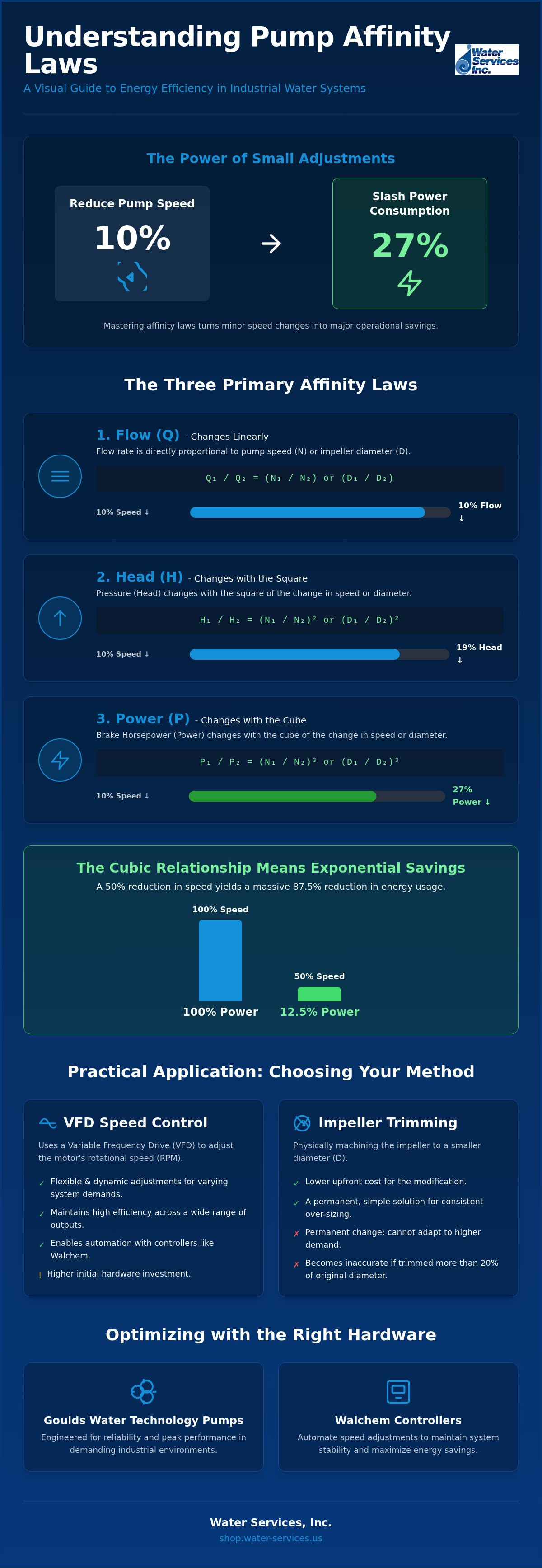
- Discover how the pump affinity laws explained in this guide allow for a 50% reduction in speed to yield an 87.5% reduction in energy usage.
- Compare the technical advantages of Variable Frequency Drives against permanent impeller trimming to determine the most cost-effective modification for your facility.
- Utilize Walchem controllers and Goulds Water Technology Pumps to automate speed adjustments and maintain peak efficiency across varying system demands.
- Identify how to calculate the Total Cost of Ownership for industrial water systems by factoring in cubic energy savings and current electricity rates.
What Are Pump Affinity Laws? The Physics of Fluid Movement
Pump affinity laws are a set of mathematical formulas used to predict the performance of centrifugal pumps under varying operating conditions. These laws define the relationship between variables such as rotational speed (RPM), impeller diameter, flow rate, total dynamic head, and brake horsepower. For engineers and facility managers, having Affinity laws explained is vital for maintaining system integrity while managing energy consumption. These principles apply specifically to rotodynamic equipment, providing a predictable roadmap for how a change in one parameter affects the entire hydraulic output.
Water Services, Inc. utilizes these relationships when specifying Goulds Water Technology Pumps for demanding industrial environments. The laws are categorized into two distinct groups: Speed Laws and Diameter Laws. Speed Laws describe how performance shifts when the pump's RPM changes; this typically occurs through a variable frequency drive. Diameter Laws predict the outcome of physically trimming an impeller to a smaller size. Both sets of rules are fundamental for ensuring that a pump operates within its Best Efficiency Point (BEP) without risking cavitation or motor overload. These laws are summarized by three core relationships:
- Flow: Changes linearly with speed or diameter.
- Head: Changes with the square of the speed or diameter.
- Power: Changes with the cube of the speed or diameter.
The Role of Geometric Similarity
Affinity laws only maintain accuracy when applied to pumps that are geometrically and dynamically similar. This means the internal proportions of the impeller and the volute casing must remain constant. If an impeller is trimmed too aggressively, typically beyond 20% of its original diameter, the geometric relationship breaks down. The laws become less reliable as the clearance between the impeller tips and the casing increases. Unlike centrifugal units, positive displacement pumps don't follow these rules because their flow is based on mechanical volume displacement rather than centrifugal force.
Centrifugal vs. Axial Flow Applications
The behavior of these laws remains consistent across most standard centrifugal configurations. In high-volume sectors like mining wastewater treatment solutions, understanding these limits prevents costly operational errors. While the flow changes linearly with speed, the power required changes cubically. This means even a slight reduction in RPM can lead to massive energy savings in large-scale dewatering or treatment processes. However, axial flow pumps may exhibit slight deviations in head and power relationships at very low speeds, requiring careful verification against manufacturer performance curves. This guide provides the pump affinity laws explained through the lens of practical industrial application rather than just theoretical physics.
The Three Primary Affinity Laws: Flow, Head, and Power
The three primary affinity laws provide the mathematical ratios needed to calculate changes in flow (Q), head (H), and power (P). When we have these pump affinity laws explained within an industrial context, we can accurately predict how adjusting the rotational speed (N) or impeller diameter (D) will alter output. These relationships allow engineers to model performance without physical testing. The formulas are typically expressed through the following ratios:
- Flow Ratio: Q1/Q2 = (N1/N2) or (D1/D2)
- Head Ratio: H1/H2 = (N1/N2)2 or (D1/D2)2
- Power Ratio: P1/P2 = (N1/N2)3 or (D1/D2)3
Flow Rate (Q) and Speed Proportionality
The first law states that the flow rate is directly proportional to the change in pump speed. If you adjust the RPM via a VFD, the GPM output follows a linear path. For example, a 10% speed increase results in exactly 10% more flow. This direct linear relationship is the most straightforward aspect of pump performance scaling. It ensures that flow adjustments remain predictable across the entire operating range of the motor.
The Square Law of Head (H)
The second law defines a square relationship between speed and pressure. Calculating the impact on Total Dynamic Head (TDH) is essential when slowing down a pump to meet lower demand. Because the relationship is squared, doubling the speed quadruples the pressure output. This is a vital calculation for industrial water filtration systems that require a specific PSI to overcome media resistance. If the speed drops by half, the head drops to 25% of its original value, which might fall below the system's static head requirements.
The Cubic Law of Power (P)
The third law, known as the Cube Law, dictates the energy consumption and motor requirements of the system. It has a dramatic effect on Brake Horsepower (BHP). A 50% reduction in speed leads to an 87.5% reduction in power consumption. This occurs because the power requirement is a function of the flow multiplied by the head. Since flow is linear and head is squared, their product is cubic. Selecting the right hardware from our electric power controls category is necessary to manage these dynamic electrical loads. Properly matched controls ensure the motor operates safely within its torque limits while capturing these massive energy savings. For expert guidance on hardware selection, you can consult with the engineering team at Water Services, Inc.
Impeller Trimming vs. Speed Control: Practical Engineering
Deciding between mechanical modification and electronic control is a critical engineering step for optimizing industrial systems. While both methods rely on the principles of the pump affinity laws explained in previous sections, they offer different levels of precision. Speed laws associated with VFDs are highly accurate because the physical geometry of the pump remains constant. Conversely, diameter laws are considered approximations. Trimming an impeller reduces its size but leaves the pump casing unchanged. This creates a larger clearance between the impeller tip and the volute, leading to hydraulic efficiency losses that the basic formulas don't fully capture.
The Mechanics of Impeller Trimming
Impeller trimming is a permanent solution for fixed-speed systems where the pump is consistently oversized for the application. By reducing the impeller diameter, you shift the entire pump curve downward to meet a specific duty point. However, this process isn't infinitely scalable. Engineers should rarely exceed a 20% reduction in diameter. Trimming beyond this threshold significantly increases internal turbulence and can degrade the Net Positive Suction Head (NPSH) performance. After any mechanical modification, it's essential to monitor system performance using Ashcroft pressure gauges to verify that the new operating pressure aligns with the calculated head requirements.
The VFD Advantage for Global Operations
For industrial sites with fluctuating water demands, Variable Frequency Drives (VFDs) provide superior flexibility. Unlike the static nature of a trimmed impeller, a VFD allows for real-time adjustments to match varying system requirements. Integrating Walchem controllers into the system acts as the brain for these optimizations. These controllers automate speed changes based on live sensor feedback from the field. VFDs preserve the pump's original efficiency curve much better than trimming because they don't introduce geometric imbalances within the volute. This is particularly advantageous for Water Services, Inc. clients in the mining or oil and gas sectors where operational conditions change seasonally. Choosing electronic speed control over mechanical trimming ensures the equipment remains versatile enough for future capacity increases without requiring additional hardware purchases.
Calculating Energy Savings and ROI in Industrial Water Systems
Translating theoretical formulas into financial data is the final step in having pump affinity laws explained for a corporate budget. The Cube Law provides the most significant leverage for industrial cost reduction. Because power consumption is proportional to the cube of the speed, marginal reductions in RPM yield exponential savings in kilowatt-hours (kWh). When modeling ROI, you must account for the August 2026 average commercial electricity rate of 13.54¢/kWh. For high-flow mining dewatering projects, where pumps often run 24/7, these savings can offset the initial capital expenditure of premium Goulds pumps within the first 12 to 18 months of operation.
The Financial Impact of the Cube Law
To calculate annual savings, first determine the current Brake Horsepower (BHP) and convert it to kilowatts. Use the power ratio formula to find the new power requirement at a reduced speed. A 20% reduction in speed reduces power demand by approximately 48.8%. It's necessary to factor in a 3% to 5% efficiency loss for the VFD and motor heat to ensure a conservative ROI model. These energy-efficient upgrades may also qualify for the Section 179D tax deduction, provided project construction began before the June 30, 2026 deadline. This deduction can range from $0.59 to $5.94 per square foot, which significantly improves the Total Cost of Ownership (TCO) for complex commercial reverse osmosis systems.
Optimizing Mobile and Containerized Systems
Affinity laws are equally vital for mobile water treatment plant rentals and containerized systems. In remote sites using diesel-driven pump sets, speed optimization directly reduces fuel consumption and logistical overhead. Reducing the engine RPM to match the actual required head prevents energy from being wasted as heat through a discharge throttle valve. We recommend using high-accuracy flow meters to verify that theoretical savings align with field performance. Water Services, Inc. integrates these calculations into every custom-engineered system to minimize long-term operational costs. You can contact our engineering team to request a custom ROI analysis for your facility.
Implementation: Selecting the Right Hardware with Water Services, Inc.
Water Services, Inc. applies the technical framework of the pump affinity laws explained throughout this guide to engineer high-performance modular systems. Moving from mathematical theory to physical implementation requires a deep understanding of how hardware reacts to variable operating conditions. Our Utah-based engineering team provides global support to ensure that every Goulds Water Technology pump is matched with the correct motor and control logic. This precision prevents common industrial failures such as motor overheating or hydraulic instability when operating outside of a pump's original design specifications.
Motor selection requires specific attention to Law 3. If a system is designed to operate at a reduced speed today but may require full capacity in the future, the motor must be sized for the peak cubic power demand. Failure to account for this can lead to catastrophic motor failure if the VFD is ever bypassed or increased to 60 Hz. Additionally, downstream components like replacement filters must be rated to handle the varied flow rates and pressure drops predicted by the first and second affinity laws. We ensure that every sediment filter, carbon block, and multimedia tank in the system maintains its integrity across the entire projected operating range.
System Integration and Control
Executing affinity law-based optimizations requires a sophisticated control interface. Pairing Goulds pumps with advanced Walchem controllers allows for the automation of speed adjustments based on real-time system demand. These controllers function as the brain of the operation, processing data from high-accuracy Signet flow sensors and Ashcroft pressure gauges. Establishing a reliable data baseline is mandatory before any optimization occurs. Without precise metrics, it is impossible to verify if the pump is adhering to its theoretical performance curve or if internal wear is causing a deviation from the affinity laws.
Maintenance Protocols for Optimized Pumps
Operating pumps at reduced speeds introduces unique maintenance requirements. While energy consumption drops, the reduction in internal fluid velocity can affect cooling and lubrication in certain pump designs. Maintenance teams should monitor vibration levels and motor heat regularly to ensure the equipment remains within safe operating limits. Ensuring PPE compliance is essential during these inspections, especially when working near high-voltage VFD cabinets or rotating shafts. Routine verification of pump curves allows operators to identify efficiency losses early. This proactive approach ensures that the energy savings calculated during the design phase are actually realized over the equipment's multi-decade lifespan.
Engineering for Efficiency: Next Steps in Pump Optimization
Mastering the cubic relationship between speed and power is the most effective way to combat rising industrial electricity rates. While mechanical trimming serves fixed-speed applications, Variable Frequency Drives provide the dynamic flexibility required for modern mining and oil and gas operations. Having the pump affinity laws explained allows your facility to transition from reactive maintenance to proactive energy management. This technical foundation ensures your hardware selections align with actual hydraulic demand rather than theoretical maximums.
Water Services, Inc. has provided global technical support and custom engineering since 1994. As an authorized distributor of Goulds Water Technology Pumps, we specialize in modular systems that prioritize technical integrity and long-term reliability. It's our priority to help you implement Walchem controllers and Signet sensors to capture documented energy savings. Explore Goulds Water Technology Pumps and Industrial Controls to start optimizing your system performance today. Your path to a more efficient industrial water system starts with precise hardware and a data-driven strategy.
Frequently Asked Questions
What is the most important pump affinity law for energy savings?
The Third Law, or Power Law, is the most critical for energy savings because it defines a cubic relationship between speed and power consumption. If you reduce the pump speed by half, the power requirement drops to 12.5% of the original value. This exponential reduction allows industrial facilities to achieve massive utility cost savings. Water Services, Inc. uses this law to justify the ROI of VFD installations on high-volume Goulds pumps.
Do affinity laws apply to all types of industrial pumps?
No, affinity laws apply exclusively to rotodynamic pumps, such as centrifugal and axial flow designs. They don't apply to positive displacement pumps like gear, diaphragm, or piston pumps because these units move a fixed volume of fluid per revolution regardless of pressure. Understanding this distinction is essential when having pump affinity laws explained for a facility with diverse equipment. Centrifugal pumps rely on velocity and centrifugal force, which follow these specific scaling rules.
How accurate are the affinity laws for impeller trimming?
Diameter laws for impeller trimming are useful approximations but are less accurate than speed laws. When an impeller is trimmed, the clearance between the blade tips and the pump casing increases, which causes hydraulic efficiency to drop. Accuracy remains high for small adjustments, but errors grow if the diameter is reduced by more than 20%. Physical testing or manufacturer performance curves are required to confirm exact output after significant mechanical modifications to the impeller.
Can I use affinity laws to calculate NPSH changes?
Yes, you can use these principles to estimate changes in Net Positive Suction Head Required (NPSHr). The NPSHr of a centrifugal pump generally varies with the square of the change in speed. If the pump speed is reduced, the required suction head also decreases significantly. This relationship is vital for avoiding cavitation in systems with low suction pressure. Water Services, Inc. engineers use these calculations to ensure system reliability across the entire operating range of the motor.
How does decreasing pump speed by 20% affect the power required?
Reducing the pump speed by 20% results in a power reduction of approximately 48.8%. This calculation follows the cubic relationship defined by the third affinity law, where the new power equals the old power multiplied by the speed ratio cubed (0.8 x 0.8 x 0.8 = 0.512). This means you only need 51.2% of the original power. Having the pump affinity laws explained in this way helps facility managers visualize the immediate impact on operational expenses.
Why do affinity laws fail at very low speeds?
Affinity laws lose accuracy at very low speeds because internal mechanical friction and fluid viscosity effects become disproportionately large. At standard operating speeds, these losses are a small percentage of total energy, but they don't scale down cubically like hydraulic power. Additionally, the Reynolds number changes at low velocities, which alters the flow characteristics within the pump casing. Most manufacturers provide a minimum recommended speed to ensure the pump maintains stable performance and adequate cooling.
What is the relationship between pump speed and head?
The relationship between pump speed and head is a square relationship. This means that the total dynamic head produced by the pump changes with the square of the ratio of the speed change. If you double the rotational speed, the head increases by a factor of four. Conversely, reducing the speed to 50% drops the head to 25% of its original value. This calculation is essential for ensuring the pump can still overcome system static pressure.
Should I trim my impeller or install a VFD for my Goulds pump?
Choosing between a VFD and impeller trimming depends on your specific system demand. A Variable Frequency Drive is the superior choice for systems with fluctuating flow requirements because it maintains efficiency across a wide range. Impeller trimming is a permanent, lower-cost solution for fixed-speed pumps that are consistently oversized for their application. Water Services, Inc. recommends VFDs for most modern industrial applications to preserve the original pump curve and allow for future capacity increases.
0 comentarios