

A stable controller reading can still fail to reflect process conditions accurately. A reliable pH and ORP controller calibration procedure checks the full measurement chain, from sensor condition and wiring to reference-solution handling and controller settings. Adjusting the display alone may leave the cause of drift untouched.
The wrong buffer or ORP reference solution, a contaminated electrode, or a poorly planned calibration can affect readings, dosing, and alarms. The correct steps depend on the sensor and controller, so follow model-specific instructions for solutions, menu settings, and acceptance criteria. This guide walks through how to prepare, calibrate, verify, and maintain industrial pH and ORP measurements. It explains how pH calibration differs from an ORP check, how to reduce contamination and temperature-related errors, and what to inspect when readings remain unstable. It also covers process safeguards to plan before calibration, including how to manage dosing and alarms while measurement is temporarily affected.
Key Takeaways
- Use a model-specific pH and ORP controller calibration procedure, guided by the controller and electrode manuals.
- Choose pH buffers or ORP reference solutions for the specific check, and follow solution labels and temperature conditions.
- Distinguish pH calibration from ORP verification or adjustment instead of applying one method to both measurements.
- Check the electrode, controller display, signal output, PLC, and process response as separate parts of the measurement chain.
- Record as-found and as-left readings against site-defined criteria, then use drift and maintenance records to refine the schedule.
Why pH and ORP controller calibration matters in water treatment
Calibration checks the measurement chain, not just a controller setting. It compares the instrument’s measurement with a known reference and applies a correction only when the instrument and site procedures allow it. If the reading has drifted, operators may make dosing decisions based on inaccurate information, alarms may activate too early or too late, and process records may no longer reflect actual conditions. A reliable pH and ORP controller calibration procedure helps distinguish measurement error from a real process change.
Operational distinction: Calibration adjusts measurement response against a reference. Verification checks whether that response meets defined criteria without necessarily changing it.
What pH and ORP controllers measure
A pH measurement indicates how acidic or alkaline a solution is. It doesn’t identify a specific chemical. In water treatment, operators use pH readings to monitor process conditions and inform decisions such as whether chemical dosing needs adjustment. The reading is useful only when the sensor and controller are responding reliably.
ORP is measured in millivolts and indicates oxidation-reduction conditions. It isn’t a direct measurement of a particular contaminant. Understanding Oxidation-Reduction Potential helps put the reading in context: operators use ORP alongside process knowledge to monitor treatment conditions and guide operational decisions.
When a calibration check is warranted
Review calibration needs during scheduled maintenance, after sensor service, when readings appear questionable, or when process conditions change. A sudden difference between the controller and another credible process indicator can prompt investigation, but it doesn’t prove the sensor needs adjustment. Follow the controller and electrode manuals and site procedures for calibration frequency and acceptance tolerances. These depend on the instrument and application.
Calibration is not cleaning or repair
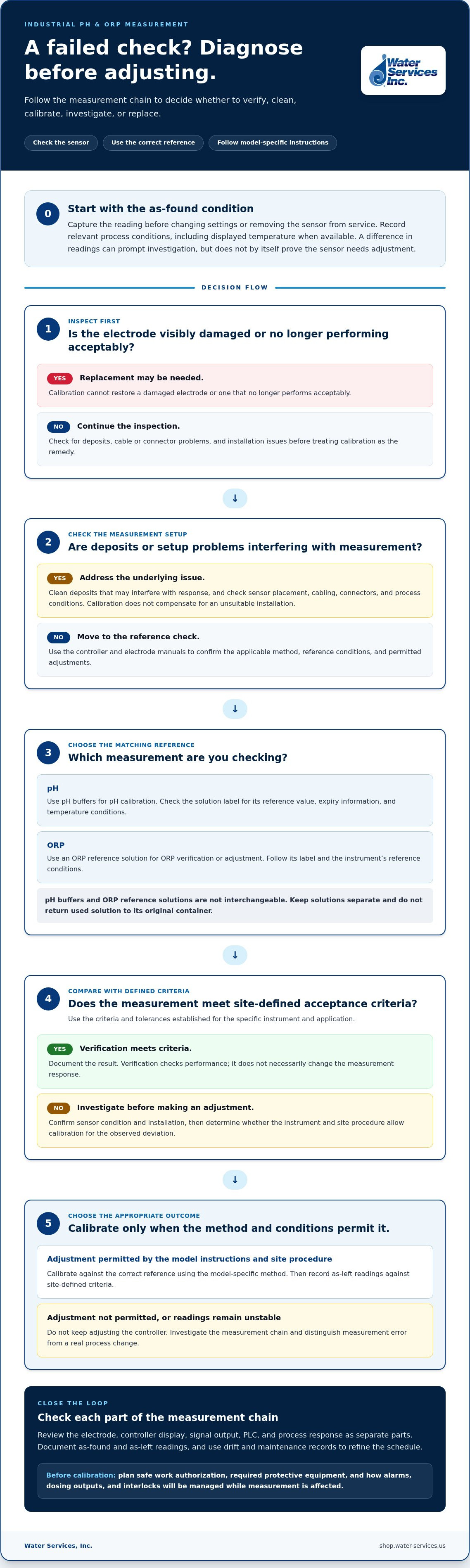
Verification, cleaning, calibration, and replacement address different needs. Verification checks performance against defined criteria. Cleaning removes deposits that may interfere with the sensor’s response. Calibration corrects an allowable measurement deviation. Replacement is needed when the electrode is damaged or no longer performs acceptably. Calibration can’t restore a damaged electrode or compensate for an unsuitable installation, such as poor sensor placement or process conditions outside the instrument’s intended use.
Treat a failed check as a reason to investigate the measurement chain, not as a prompt to keep adjusting the controller. Confirm the sensor condition and installation before relying on a corrected reading for dosing, alarms, or process records.
Prepare the controller, electrodes, and reference solutions before calibration
Good preparation helps prevent an avoidable adjustment from creating a process-control problem. Before starting the pH and ORP controller calibration procedure, confirm the instrument setup, reference solutions, sensor condition, and site controls. A pH buffer and an ORP reference solution are not interchangeable: each is for a different measurement check.
Confirm the instrument and measurement conditions
Record the controller model, electrode type, configured measurement range, temperature input, and current settings. For Walchem controllers and other instruments, use the manual for the specific model and electrode. It defines the applicable calibration mode, permitted adjustments, and reference conditions. Don’t assume menu paths or acceptance limits are the same across controller models.
Capture the as-found reading before changing settings or removing the sensor from service. Also record process conditions needed to interpret that reading, including the displayed temperature when available. This baseline helps distinguish a calibration change from a change in the process or measurement setup.
Prepare the sensor, solutions, and safe work area
Inspect the electrode, cable, and connectors for visible damage, loose connections, or fouling. Deposits or installation issues can affect measurement response, so don’t assume calibration is the remedy. Prepare correctly identified solutions and check each container’s label for the reference value, expiry information, and temperature conditions. Use pH buffers for pH calibration and an ORP reference solution for ORP verification or adjustment. Keep solutions separate, and don’t return used solution to its original container.
Use this pre-check sequence before beginning:
- Identify the controller and electrode models, measurement range, and temperature input.
- Review the instrument and electrode manuals for the required method and reference conditions.
- Inspect the sensor, cabling, connectors, and installation for visible problems.
- Prepare the correct pH buffers or ORP reference solution, checking labels and preventing cross-contamination.
- Document as-found readings and confirm the work area is ready.
Calibration can affect more than the displayed value. Follow site procedures for safe work authorization, required industrial personal protective equipment, and management of alarms, dosing outputs, and interlocks. Decide how these functions will be handled before isolating a sensor or entering calibration mode. Their role in the measurement chain is especially relevant in industrial water treatment systems, where readings can inform monitoring and dosing decisions. Review the process impact and follow approved site controls throughout the task.
Follow the correct pH and ORP controller calibration procedure
Use the instrument and electrode manuals for solution values, temperature conditions, calibration-point requirements, and menu paths. The steps below outline a general workflow, but they don’t replace model-specific instructions. pH and ORP need different references and adjustment logic, so they don’t share one interchangeable calibration routine.
Calibrate a pH controller with suitable buffer solutions
Rinse the electrode as specified by its manufacturer, then place it in the selected pH buffer. Allow the reading to stabilize before proceeding. Enter the buffer value according to its label, applicable temperature conditions, and controller instructions. Repeat for each required calibration point, using clean handling and preventing carryover between solutions. The controller manual determines how many points to use for the instrument and application.
After calibration, review any slope, offset, or error indicators provided by the controller. Compare them with the acceptance criteria for that model and site procedure. An out-of-range result may point to electrode condition or solution handling, rather than a setting that should be repeatedly adjusted.
Verify or adjust an ORP controller with a reference solution
Use an ORP reference solution suitable for the electrode and controller. Record the value stated on its label under the applicable temperature conditions. Rinse or handle the electrode as instructed, immerse it in the solution, and wait for the reading to stabilize. Compare the displayed millivolt reading with the reference, then make only adjustments permitted by the manual.
Some systems emphasize verification and electrode-condition checks rather than routine user adjustment. If the reading won’t stabilize or falls outside site criteria, investigate the sensor and setup before changing the controller value. Don’t assume one ORP reference value or tolerance applies to every instrument.
Compare pH and ORP calibration decisions
| Check | pH | ORP |
|---|---|---|
| Reference | Suitable pH buffer solution | Suitable ORP reference solution |
| Reading | pH value, with temperature conditions considered | Millivolts, interpreted against the solution’s stated value |
| Action | Enter required buffer points and assess available slope or offset indicators | Verify stability and compare with the reference; adjust only if permitted |
| Acceptance | Use controller and site criteria | Use controller and site criteria |
Calibration affects measurement inputs used in process decisions, including dosing. For practical context on how those decisions connect with treatment operations, see a water treatment chemical dosing guide. Keep calibration values and resulting adjustments within the controller’s instructions and the site’s approved procedures.
Verify readings, troubleshoot drift, and document calibration results
Calibration is only one part of the check. Before returning the measurement to service, confirm that the electrode, controller, signal path, and process response agree. A stable display alone does not verify the complete measurement loop.
Check the complete measurement and signal loop
After reinstalling the electrode, allow the reading to settle at its measurement location and confirm it remains stable under actual process conditions. Compare the displayed value with the as-left calibration result, accounting for any expected difference between the reference solution and the process sample.
Then trace the signal downstream. Where configured, verify the 4-20 mA output or digital communication against the controller setup and receiving system, such as a PLC. Confirm that displayed values, transmitted values, and configured ranges correspond. Follow approved site procedures to check alarms, interlocks, and control outputs before restoring automatic operation. Don’t force an output or bypass an interlock unless the site procedure authorizes that test.
Diagnose readings that will not stabilize
If the reading drifts or repeatedly fails acceptance criteria, troubleshoot systematically before making further adjustments. Check that the reference solution is suitable and usable, then inspect sensor cleanliness, immersion, temperature conditions, and connector integrity. Review wiring and grounding if the signal is noisy or changes unexpectedly.
Persistent instability can also point to electrode aging or process interference. A large correction or repeated failure after calibration is a reason to investigate the sensor and installation rather than mask the symptom with an unsupported offset. Record the issue and follow site maintenance procedures if the cause isn’t resolved.
Record traceable calibration results
Keep a record that lets the next operator understand what changed and whether the instrument passed the site’s criteria. Include:
- Date, technician, controller identification, and electrode identification.
- Reference solution details, including stated value and applicable temperature conditions.
- As-found and as-left readings, any controller adjustments, and verification results.
- Corrective work, such as cleaning, wiring checks, or sensor replacement.
Compare results with the facility calibration schedule and applicable quality records. Trends in drift or repeated failures can help guide maintenance decisions. For process-control equipment used alongside these measurements, explore electric power controls.
Build a repeatable pH and ORP maintenance program around the controller
A calibration record is more useful when it informs the next maintenance decision. Build the schedule around manufacturer instructions, site procedures, process risk, and evidence from previous checks. The aim isn’t to impose one interval on every sensor. It’s to spot recurring drift, cleaning needs, replacement patterns, or failed checks early enough to plan a response.
Set calibration intervals from operating evidence
Start with the instrument requirements and the facility’s existing calibration schedule. Review records for trends: a sensor that repeatedly needs correction, frequent cleaning, or recurring failures may need closer attention or further investigation. Demanding process conditions can also warrant a more cautious review, but interval changes should follow documented site decisions rather than a universal rule.
Assign clear responsibilities. Operators can report unusual readings and process conditions; instrumentation staff can carry out checks and evaluate performance; maintenance personnel can document cleaning, repairs, and sensor replacement. Keep calibration results and corrective work in records that support consistent handoffs and future schedule reviews.
Match controller and sensor integration to the process
Reliable measurement depends on more than calibration. Confirm that the controller and electrode suit the required measurement range and installation, and that the temperature input and configured signals match the process setup. Controller outputs also need to align with the receiving equipment and site control strategy. A well-maintained pH and ORP controller calibration procedure supports this setup, but it can’t compensate for a sensor mismatch or incorrect configuration.
Walchem controllers are one option for industrial water-treatment applications. Review the specific controller and electrode documentation when assessing compatibility and configuration. For broader context, explore industrial water treatment systems, where measurement, control, and treatment equipment work as part of a wider process.
Choose a practical next step for system reliability
Keep the operating sequence consistent: identify the equipment, prepare the correct references, follow the applicable calibration method, verify the measurement and signal path, then record the results. Use records to decide whether the next action is routine maintenance, further troubleshooting, or a schedule review.
Controller selection is part of building a fit-for-process system. Explore the electric power controls collection for control equipment relevant to industrial water-treatment applications.
Make Every Calibration Check Count
A dependable pH and ORP controller calibration procedure starts with the right reference for each measurement, follows the specific controller and electrode instructions, and ends with verification of the complete signal path. Keep pH calibration distinct from ORP verification or adjustment. Record as-found and as-left results, investigate persistent drift, and use maintenance history to guide future checks.
These habits support consistent process monitoring and informed dosing decisions. Controller configuration and sensor compatibility matter too, so consider how each instrument fits the wider treatment process, not just the calibration task.
Water Services, Inc. supplies Walchem controllers and industrial water-treatment equipment for applications across process, wastewater, mining, and oil and gas sectors. Explore industrial control equipment available for water-treatment applications.
With a documented routine and equipment suited to the process, your team can approach each check with greater clarity and confidence.
Frequently Asked Questions
Is pH and ORP controller calibration the same procedure?
No. They’re related measurement tasks, but they use different references and procedures. The pH and ORP controller calibration procedure typically uses suitable pH buffers to check and calibrate the electrode-controller response. ORP work commonly verifies the displayed millivolt reading against an appropriate reference solution, with adjustments depending on the instrument. Follow the controller and electrode manuals for solution handling, temperature conditions, permitted adjustments, and acceptance criteria.
How often should a pH or ORP controller be calibrated?
There’s no single interval for every industrial process. Start with the instrument manufacturer’s instructions and your site’s quality or maintenance procedures. Then review process risk, sensor condition, drift records, and operating history to set a documented interval. Reassess it after sensor replacement, unusual readings, or relevant process changes. Use the facility’s defined criteria to decide whether the schedule remains appropriate.
What solutions are used to calibrate pH and ORP controllers?
pH calibration uses buffer solutions selected for the measurement range and controller procedure. ORP verification uses a suitable reference solution with a stated value for the applicable conditions. Check each solution’s label, condition or expiry information, and temperature guidance. Follow the instrument instructions for handling. Don’t substitute pH buffers for ORP references or assume that one ORP reference value applies to every controller and procedure.
Can an ORP controller be calibrated with a pH buffer?
No. A pH buffer provides a known pH reference; it isn’t an ORP reference solution. ORP is displayed in millivolts and should be checked with a suitable ORP reference under the conditions specified for the instrument. Consult the controller and electrode instructions to determine whether the task is verification, adjustment, or both. Record the reference solution and result so the check can be interpreted later.
What should I do if a pH or ORP reading will not stabilize?
Check the reference solution, electrode cleanliness, immersion, temperature, connectors, and wiring. Allow the stabilization time specified by the instrument procedure. If the reading remains unstable, investigate electrode condition, installation, and possible process interference instead of repeatedly forcing an adjustment. Follow site procedures for taking a control loop out of service, especially if dosing or alarms may be affected. Document the fault and corrective actions.
Do I need to remove the electrode from the process to calibrate it?
It depends on the sensor design, installation, and controller procedure. Some checks require placing the electrode in prepared reference solutions, while other verification methods may differ. Follow the manufacturer’s instructions and site safety requirements before isolating or removing a sensor. Plan how to manage dosing, alarms, and control outputs during the work, and document any temporary operating-mode changes before restoring normal operation.
How do I know whether calibration succeeded?
A success message alone doesn’t confirm the complete measurement loop. Review the controller’s calibration indicators against model-specific criteria, then check the reading and any configured output or communication path. Record as-found and as-left values, reference solution details, and adjustments. If results remain outside site limits or drift returns quickly, investigate the electrode, installation, wiring, and process conditions. Follow site procedures before returning the loop to automatic control.
0 comentarios