

A multimedia filter can underperform even when its media layers are selected correctly. The problem may be vessel sizing, service flow, or backwash capacity rather than the media itself. That is why multimedia filter design and operation need to be evaluated together, with hydraulics and cleaning conditions matched to the incoming water and required duty.
Suspended solids need to be captured, but uncertainty about bed configuration, pressure loss, and backwash timing can make equipment comparisons difficult. This guide explains how the filtration cycle works, what anthracite, sand, and garnet can contribute to a layered bed, and which process data are needed to assess a design.
You’ll also learn how to recognize operating signals, including rising differential pressure, that may call for investigation or backwashing. From checking tank suitability to comparing service and backwash requirements with manufacturer documentation, this guide offers a practical framework for evaluating a multimedia filter for your process.
Key Takeaways
- Compare filter configurations using feedwater quality, required flow, treated-water targets, and site constraints.
- Assess media choices against particle-capture needs, pressure-loss behavior, and practical backwash requirements.
- Set an operating baseline and track influent and effluent quality alongside flow and differential pressure.
- Apply multimedia filter design and operation principles to determine whether a proposed system fits your process conditions.
- Prepare process and installation details before comparing multimedia filter tanks or requesting technical review.
What Is Multimedia Filter Design and Operation?
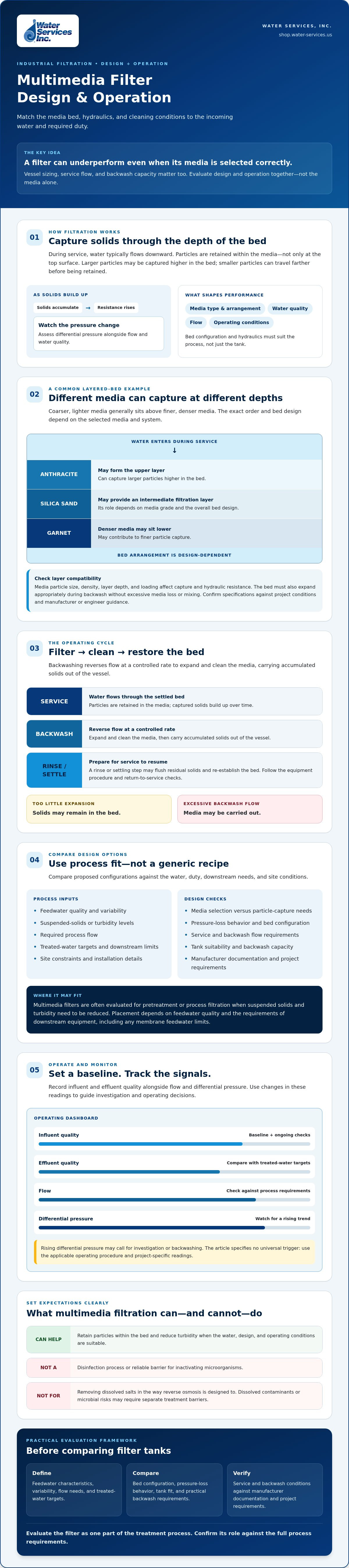
Multimedia filtration is depth filtration through a layered media bed that captures suspended solids as water passes through it. Unlike a single-media bed, a multimedia bed combines materials with different characteristics so particles can be retained at different depths, not only at the surface. Media type and arrangement, water quality, flow, and operating conditions all affect performance.
Multimedia filter design and operation involves more than choosing a tank. It means matching the filter bed and hydraulics to the process, then operating the unit so captured solids can be removed without disrupting the bed. Media filters provides a general overview of single-media, dual-media, and multimedia filtration. Confirm actual media specifications and expected performance against project data and manufacturer documentation.
Where industrial multimedia filters fit in a treatment train
Industrial multimedia filters are often evaluated for pretreatment or process filtration when suspended solids and turbidity need to be reduced. Their position in a treatment train depends on feedwater quality and the requirements of downstream equipment. Variable solids loading, for example, can affect filter run time and cleaning frequency. A downstream membrane process may also have specific feedwater requirements. Base filter placement on representative water analysis and the needs of the next treatment stage, rather than assuming the filter suits every source or application.
What a multimedia filter can and cannot do
A suitably selected filter bed can retain particles within the media and reduce turbidity, but results depend on the water, design, and operating conditions. It is not a disinfection process and should not be treated as a reliable barrier for inactivating microorganisms. It also does not remove dissolved salts in the way reverse osmosis is designed to. Dissolved contaminants or microbial risks may require separate treatment barriers selected for those needs.
Before setting performance expectations, define the influent water characteristics and treated-water targets. Useful inputs include suspended-solids or turbidity levels, expected variability, process flow requirements, and downstream limits. Without these details, a general description of filtration cannot establish whether a particular media arrangement or tank will meet the application’s needs. Evaluate the filter as one part of the treatment process, then verify its role against the full process requirements.
How Media Layers and the Filtration Cycle Work
During service, water flows through the bed and particles are retained within the media, not just on the upper surface. Larger particles may be captured higher in the bed, while smaller particles can travel farther before being retained. As solids accumulate, resistance to flow increases. Assess the resulting pressure change alongside water quality and flow.
Media density and particle size together determine how layers settle: coarser, lighter media generally sits above finer, denser media. The exact order depends on the selected media and system design. Layer compatibility matters because the bed must filter as intended and expand appropriately during backwash without excessive media loss or mixing.
How anthracite, silica sand, and garnet may function in a bed
In a common arrangement, anthracite may form the upper layer to capture larger particles, silica sand may provide an intermediate filtration layer, and denser garnet may sit below for finer capture. This is an example, not a fixed recipe. Media grade, particle-size distribution, density, layer depth, and loading affect particle capture and hydraulic resistance. Check the media specifications and bed design against project conditions and manufacturer or engineer guidance.
What happens during filtration, backwash, and rinse
During filtration, water typically flows downward through the settled bed. Captured solids build up over time, increasing pressure loss and potentially affecting flow or effluent quality. Backwashing reverses the flow at a controlled rate to expand and clean the media, carrying accumulated solids out of the vessel. The rate must suit the media and equipment. Too little expansion can leave solids behind, while excessive flow can carry media out.
After backwashing, a rinse or settling step may be needed to flush residual solids and re-establish the bed before service resumes. The sequence, flow settings, and return-to-service checks vary by equipment. Follow the applicable operating procedure and confirm recovery using the specified readings and water-quality checks. A specific equipment example is provided in the Operation & Maintenance Of Multi-Media Filter manual. Use that manual for its applicable unit, not as a substitute for project-specific requirements.
These interactions are central to multimedia filter design and operation: media selection, hydraulic conditions, and backwash performance need to be considered together. For project evaluation, review multimedia filter tanks and water-treatment equipment as components of the wider process.
How to Compare Multimedia Filter Design Options
Compare designs against the actual feedwater and process duty, not a generic capacity label. A suitable configuration must meet the treated-water objective while fitting available hydraulics, backwash resources, and site conditions. More media layers do not automatically produce cleaner water. Additional layers can change resistance and backwash behavior, so each arrangement needs to be justified by the capture requirement and verified design data.
| Comparison factor | Questions to resolve | Why it matters |
|---|---|---|
| Feedwater quality | What are the suspended-solids concentration, particle characteristics, turbidity, and expected variability? | These conditions influence media selection, loading, and expected run behavior. |
| Flow requirements | What service flow is required, and how does demand vary across the operating schedule? | Vessel area and hydraulic loading must suit actual operating conditions. |
| Treated-water targets | What effluent quality is required, and what limits apply to downstream processes? | The target defines whether a proposed filter configuration is appropriate for its role. |
| Operating constraints | Are backwash water, discharge capacity, access, and maintenance resources available? | A design must be operable and maintainable at the site, not just suitable on paper. |
Which feedwater and process data should guide selection?
Start with representative water analysis. Record suspended-solids concentration, particle characteristics, turbidity, and how these change over time or with operating conditions. Pair the results with required service flow, operating schedule, and downstream water-quality objectives. If the source varies, a single sample may not represent the design case. Collect samples across relevant conditions and have them analyzed before comparing equipment.
How vessel and backwash constraints change the comparison
Check the available footprint, vessel pressure rating, inspection access, and maintenance requirements. Confirm that the site can supply the required backwash water and handle the resulting discharge. Review valve or control sequence needs alongside practical operating procedures. These constraints can rule out a media arrangement that otherwise appears suitable.
Calculate vessel size and hydraulic loading from verified process data, not a rule of thumb. Request project-specific confirmation of service and backwash flow rates, bed depths, and media expansion criteria. Compare configurations on the same basis: capture requirements, pressure-loss behavior, and whether the available resources can clean the bed effectively. In multimedia filter design and operation, the appropriate option is one that meets the process target and can be operated consistently within site limits.
How to Operate and Monitor a Multimedia Filter
Consistent operation starts with a clean-filter baseline. Record service flow, differential pressure, influent and effluent turbidity, and relevant feedwater changes under normal conditions. These readings help operators distinguish routine variation from a developing issue. Use the same measurement points and methods each time so trends can be compared.
Review differential pressure and effluent quality together. A change in either can signal a need to investigate, but neither identifies the cause on its own. A pressure increase may reflect solids loading or another hydraulic issue. A change in effluent quality may have several possible causes. Interpret both against site baselines, process requirements, and the equipment’s approved limits.
Which operating indicators should operators record?
Keep a consistent log that links operating conditions with treatment results. Include:
- Service flow and differential pressure across the filter.
- Influent and effluent turbidity, noting sampling locations and methods.
- Feedwater changes that could affect solids loading or particle characteristics.
- Backwash timing, sequence, and observations, along with post-backwash readings.
Compare current readings with established site baselines and equipment documentation. A trend is often more useful than an isolated measurement. Before treating an apparent change as a process problem, confirm that instruments are being read consistently.
How to recognize breakthrough, fouling, or ineffective backwashing
If effluent quality declines, differential pressure behaves unexpectedly, or flow changes, investigate rather than assuming a single cause. First check feedwater conditions and measurement reliability. Then review whether backwash flow, sequence, and duration followed the approved procedure. If symptoms persist, the media condition or other equipment issues may need inspection by qualified personnel.
After corrective action or backwashing, verify recovery using the required water-quality and operating checks before returning the unit to routine service. Document the observations, actions taken, and results. Backwash triggers and operating limits vary by equipment and application, so follow the applicable manufacturer documentation and site procedures rather than relying on a universal threshold.
This disciplined workflow connects multimedia filter design and operation with measurable process performance. For relevant water-treatment equipment, compare equipment requirements with your site data and operating procedures.
Selecting a Multimedia Filter Tank for Your Application
Evaluate a tank as one component of the treatment process, not as a standalone vessel choice. Before comparing options, assemble the information that defines the duty: representative water analyses, required service flow, treated-water objectives, operating schedule, available backwash water, discharge constraints, and site layout. This information helps suppliers assess whether the stated operating envelope aligns with actual process conditions.
Standardized equipment may suit a defined duty with familiar operating requirements. More complex or constrained applications may call for engineered integration, particularly when feedwater varies, downstream targets are demanding, or footprint and backwash capacity limit the available configurations. The right approach depends on the project, not on a general preference for one equipment type.
What to confirm in a filter specification
Review the design flow, feedwater assumptions, media type and arrangement, vessel pressure limits, and backwash requirements. Confirm which controls, instruments, connections, and commissioning documents are included and which must be provided separately. Check the stated operating envelope against expected flow and water-quality conditions. Verify media specifications, design ranges, and performance expectations against project data and manufacturer documentation.
Construction and access matter as well. Confirm that vessel materials and internal components are compatible with the water and operating environment. Review how operators will read pressure and flow, access the vessel for inspection, and carry out routine maintenance. These details affect whether the tank can be integrated safely and practically at the site.
When to seek project-specific engineering support
Request technical review when feedwater quality changes significantly, treated-water targets are demanding, backwash capacity is limited, or installation space creates constraints. Prepare the information needed to evaluate those conditions:
- Water analyses that represent expected feedwater variation.
- Required and variable process flows, plus the operating schedule.
- Downstream water-quality objectives and process limits.
- Backwash water availability, discharge handling, and site constraints.
These inputs help determine how multimedia filter design and operation should fit the wider process. Water Services, Inc. offers multimedia filter tanks and industrial water-treatment equipment, along with project-based engineering and design for industrial applications. Review industrial water-treatment equipment and discuss your application requirements when evaluating a suitable tank and its role in the treatment process.
Build Your Filter Evaluation Around Process Data
Reliable filtration depends on a suitable media bed, hydraulic conditions matched to the process, and a backwash cycle the site can support. Compare filter options using representative feedwater data, required flow, treated-water targets, and operating constraints. Then monitor influent and effluent quality alongside flow and differential pressure to guide operating decisions.
That is the core of multimedia filter design and operation: evaluate the tank as one part of the treatment process, and verify media specifications, operating limits, and backwash requirements against project conditions and manufacturer documentation.
Water Services, Inc. offers multimedia filter tanks and industrial water-treatment equipment, with project-based engineering and design for industrial applications. Review industrial water-treatment equipment as you prepare to evaluate options for your process. Clear requirements and verified technical information make it easier to compare suitable configurations.
Frequently Asked Questions
What does a multimedia filter remove from water?
A multimedia filter is used primarily to reduce suspended solids and turbidity by capturing particles within a layered media bed. Its performance depends on feedwater characteristics, media selection, hydraulics, and operating conditions. It does not disinfect water or reliably remove dissolved contaminants such as salts. Define incoming water quality and required effluent targets before making removal claims or deciding whether additional treatment barriers are needed.
How does a multimedia filter work?
Water typically flows through the media bed during service, where particles are retained at different depths rather than only on the bed surface. As solids collect, pressure loss may rise and effluent quality may change. Controlled backwashing reverses the flow to expand and clean the bed. Rinsing may follow before service resumes. Follow the equipment manual and site procedures for the specific sequence and settings.
What media are used in a multimedia filter?
Common examples include anthracite, silica sand, and garnet. A typical arrangement may place lighter, coarser anthracite above sand and denser garnet, but neither the media nor the order is universal. Particle size, density, water characteristics, capture needs, and backwash conditions guide selection. Confirm media grades, bed depths, and loading against project data and manufacturer documentation rather than assuming one standard configuration fits every application.
How often should a multimedia filter be backwashed?
There is no single backwash interval for every multimedia filter. Timing depends on feedwater solids, flow, filter design, operating history, and equipment-specific triggers. Track differential pressure and effluent quality against established baselines and the manufacturer’s limits. Follow the approved procedure when a trigger is reached, then confirm the filter has recovered before returning it to routine service.
What causes high differential pressure in a multimedia filter?
High differential pressure can indicate accumulated solids or another restriction affecting flow through the filter. Changes in feedwater, operating flow, media condition, or backwash effectiveness may also contribute. Do not assume the cause from the pressure reading alone. Compare it with flow and effluent quality, check instrument readings, and review recent operating and backwash records against equipment documentation and site procedures.
Can a multimedia filter be used before reverse osmosis?
Yes, a multimedia filter may be considered as pretreatment before reverse osmosis when suspended-solids reduction is needed. Suitability depends on the feedwater and the RO system’s required feedwater quality. Multimedia filtration alone does not establish that membrane feed requirements are met. Evaluate representative water analyses, treated-water targets, and operating conditions, then confirm the complete pretreatment design against membrane and equipment manufacturer guidance.
How do you size an industrial multimedia filter?
Size an industrial multimedia filter using verified process data, not a generic rule of thumb. Key inputs include required and variable flow, feedwater solids and turbidity, treated-water targets, operating schedule, media configuration, allowable pressure loss, and available backwash water and discharge capacity. These factors inform vessel area and hydraulic loading. Confirm design flow, bed details, and backwash criteria with project engineering and manufacturer documentation.
0 comentarios