

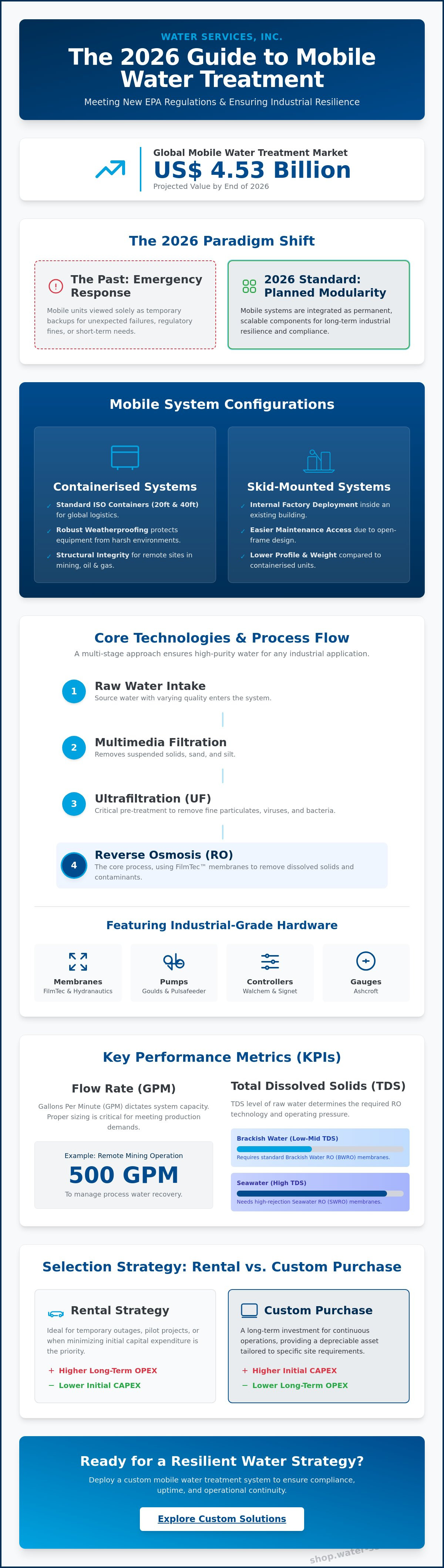
By the end of 2026, the global mobile water treatment market is projected to reach US$ 4.53 billion as industries race to meet new EPA PFAS monitoring requirements. Industrial operators understand that waiting for permanent infrastructure isn't an option when regulatory fines or water scarcity threaten to halt production. If you're managing a remote mining site or an oil and gas facility, the logistical complexity of maintaining water quality is a constant operational burden. A single non-compliant discharge event can lead to significant penalties, especially with new regulations like the April 2026 EPA ruling on hazardous constituents.
You likely recognize that compliance and uptime are non-negotiable for your bottom line. This 2026 guide demonstrates how containerised and modular mobile water treatment systems solve these critical supply challenges in remote environments. We'll preview the essential engineering specifications, including the integration of FilmTec reverse osmosis membranes and Goulds pumps, that ensure your workforce has potable water and your discharge meets every environmental standard. We'll also cover the specific Texas TCEQ standards and the shift toward decentralized, smart-monitored systems that define the current industrial landscape.
Key Takeaways
- Understand the 2026 transition from emergency response to "planned modularity" using containerised and skid-mounted purification systems for long-term industrial resilience.
- Identify high-performance hardware specifications for mobile units, including the use of FilmTec membranes and Goulds pumps for industrial-grade reverse osmosis.
- Learn how to deploy mobile water treatment to address site-specific challenges like acid mine drainage in mining and produced water recovery in remote oil fields.
- Establish site readiness protocols by conducting raw water characterization and integrating specialized electric power controls for stable remote operation.
- Compare CAPEX and OPEX financial models to determine when to invest in a custom containerized plant versus utilizing a rental strategy for temporary outages.
What is Mobile Water Treatment? Definition and 2026 Standards
Industrial mobile water treatment utilizes self-contained, transportable purification units designed for rapid deployment. These systems typically employ containerised, skid-mounted, or trailer-based configurations to deliver high-purity water to remote or temporary industrial sites. In 2026, the industry has shifted away from viewing these units solely as emergency backups. Engineers now implement "planned modularity," where mobile systems function as permanent, scalable components of a facility's water infrastructure. This approach allows for immediate response to fluctuating demand or changing influent water quality without the long lead times of traditional civil engineering projects.
The core advantage lies in the speed of integration. A standard mobile water treatment plant can move from delivery to full operation in days. This efficiency is critical for meeting the 2026 EPA standards for PFAS monitoring and managing localized water scarcity. By integrating portable water purification technologies into existing workflows, operators achieve a minimal site footprint while maintaining the capacity to scale up as production increases. The process typically begins with raw water intake, followed by multi-stage filtration using multimedia filter tanks, and culminates in high-purity process water suitable for boilers or cooling towers.
Modular vs. Containerised Systems
Standard 20ft and 40ft ISO container configurations dominate the market for global shipping. These units provide robust weatherproofing and structural integrity, making them ideal for harsh environments in Africa or the Middle East. They protect sensitive equipment like Ashcroft pressure gauges and Viqua UV systems from extreme temperature swings and dust. Skid-mounted units offer a different value proposition. They're designed for internal factory deployment where an existing building provides shelter. While skids lack the rugged exterior of a container, they allow for easier access to components like Pulsafeeder metering pumps or Signet flow sensors during routine maintenance and calibration.
Key Performance Metrics (GPM and TDS)
Industrial-scale operations require precise capacity planning. Flow rate, measured in Gallons Per Minute (GPM), dictates the size and number of units required. For instance, a mining operation might require 500 GPM to manage process water recovery. Total Dissolved Solids (TDS) levels also determine the technology stack. High TDS levels in brackish water or seawater necessitate advanced FilmTec or Hydranautics RO membranes to achieve potable standards. Flux rate is defined as the volume of water that passes through a unit area of membrane over a specific time period. Monitoring these metrics through Walchem controllers ensures the system operates within its designed engineering limits and maintains business continuity.
Core Technologies in Mobile Treatment Units
High-reliability mobile water treatment systems utilize a multi-stage approach to manage fluctuating influent quality. These systems often begin with multimedia filter tanks to remove suspended solids before water reaches finer filtration stages. For applications requiring the removal of viruses or bacteria, mobile ultrafiltration systems serve as a critical pre-treatment step. This sequential design protects downstream equipment and ensures the final effluent meets exact industrial specifications. Integrating these technologies into a single transportable unit requires precise engineering to maintain flow rates without compromising water quality.
Reverse Osmosis and Membrane Filtration
Reverse osmosis (RO) is the primary technology for dissolved solids removal in modern industrial setups. Utilizing FilmTec Reverse Osmosis Membranes allows for high-rejection performance in both brackish and seawater configurations. In mobile trailers, these membranes must withstand varying pressure requirements. Brackish water RO typically operates at lower pressures than seawater desalination units. Managing membrane fouling is a priority in high-turbidity remote environments. Operators use specialized water treatment antiscalants and Pulsafeeder metering pumps to prevent mineral scaling and biological growth on membrane surfaces. This maintenance protocol extends membrane life and reduces the frequency of cleaning cycles.
Disinfection and Pumping Hardware
Ensuring potable water safety for remote workforces requires robust disinfection. Integrating Viqua UV Water Purification Systems provides a chemical-free method to neutralize pathogens without altering water taste or odor. This is particularly valuable for mining and military camps where chemical logistics are difficult. System pressure is maintained by Goulds Water Technology Pumps, which are selected for their durability in continuous-duty industrial applications. Consistent pressure is vital for maintaining RO flux rates and overall system throughput.
Accurate monitoring is the final layer of a reliable mobile unit. Signet flow sensors and Walchem controllers provide real-time data on system performance. These tools allow operators to track flow rates and chemical dosing levels from a centralized interface. If you need to replace aging components or upgrade your current hardware, you can find a wide selection of industrial water treatment components to maintain your system's integrity. Precise Ashcroft pressure gauges and Pentair filter housings complete the assembly, ensuring every technical metric remains within tolerance throughout the project lifecycle.
Industrial Applications: From Mining to Military
Mobile water treatment systems provide the flexibility required for heavy industrial sectors where water quality directly impacts production efficiency. In the mining sector, operators deploy these units to manage acid mine drainage and recover process water from tailings ponds. This recovery process is essential for maintaining a closed-loop system, especially in regions where water rights are strictly regulated. Similarly, the oil and gas industry utilizes mobile units for treating produced water. This allows for safe reinjection or reuse in hydraulic fracturing, reducing the environmental impact of remote field operations.
Military and humanitarian organizations rely on rapid-response systems to provide potable water for field hospitals and remote camps. These systems must convert local, often contaminated, water sources into safe drinking water within hours of arrival. Disaster recovery scenarios also demand this level of agility. When municipal infrastructure fails due to flooding or mechanical breakdown, mobile units restore supply to critical facilities like hospitals and schools, preventing a total collapse of local services.
Remote Site Challenges in Africa and the Middle East
Deploying water infrastructure in Africa or the Middle East presents unique engineering hurdles. High ambient temperatures and constant sand ingress require specialized enclosures and robust pre-filtration. The logistical complexity of moving containerized reverse osmosis plants to landlocked regions necessitates a modular design that fits standard shipping dimensions. In 2026, many of these regions are adopting Zero Liquid Discharge (ZLD) trends. This requires mobile units to achieve higher recovery rates, often utilizing advanced Hydranautics membranes and precise chemical dosing to meet local discharge standards.
Emergency Response and Planned Outages
Planned maintenance at fixed facilities often creates a temporary gap in water production. Mobile units serve as a reliable bridge during these upgrades, ensuring business continuity without the need for a total plant shutdown. By maintaining water quality standards during repairs, companies avoid the potential for significant fines associated with non-compliant discharge. For example, refineries often hire temporary filtration units during cooling tower turnarounds. This strategic use of mobile hardware ensures that environmental compliance isn't sacrificed for operational expediency. It's a pragmatic solution for keeping a facility running while permanent systems are offline for overhaul or expansion.
Operational Logistics and Site Readiness
Successful deployment of a mobile water treatment system depends on rigorous site preparation and engineering alignment. The process begins with a comprehensive site survey and raw water characterization. This analysis provides the baseline data for total dissolved solids (TDS), pH levels, and specific contaminant concentrations, such as PFAS or heavy metals. Without accurate water quality data, the system's membrane configuration and chemical dosing schedules cannot be optimized. This foundation ensures that the unit performs to its technical specifications from the moment it's commissioned.
Site readiness also involves preparing the physical and electrical infrastructure. Mobile units require a stable, level pad and reliable power access. Integrating specialized electric power controls is necessary to manage the load from high-pressure pumps and sensitive monitoring equipment. Connection points for inlet and outlet plumbing must be standardized, often utilizing camlock or flanged fittings to bridge the gap between the mobile unit and existing plant piping. If you're preparing a site for a new installation, you can source essential industrial components to ensure your infrastructure is ready for integration.
Personnel safety remains a primary concern during setup and daily operation. Operators must have access to appropriate personal protective equipment (PPE), including chemical-resistant gloves and eye protection for handling antiscalants or cleaning chemicals. Clear safety protocols for high-pressure systems and electrical components must be established before the system goes live. This utilitarian approach to site readiness minimizes delays and protects both the equipment and the workforce.
The Deployment Timeline
- Step 1: Engineering Review and Water Analysis. Technical experts evaluate influent quality and define treated water requirements.
- Step 2: System Configuration and Factory Acceptance Testing (FAT). The unit is calibrated and tested at the source facility to ensure all components, from Walchem controllers to Goulds pumps, meet performance benchmarks.
- Step 3: Logistical Transit. The system is transported via sea, rail, or heavy-haul truck, depending on the remote site's location and accessibility.
- Step 4: On-site Commissioning and Operator Training. Engineers finalize plumbing and electrical connections, followed by hands-on training for local staff.
Remote Monitoring and Maintenance
Modern mobile units utilize IoT and cloud-based controllers for real-time performance tracking. These systems allow for predictive maintenance, enabling operators to identify when to swap replacement sediment and carbon filters or FilmTec membranes before a critical failure occurs. Monitoring flux rates and pressure differentials through remote telemetry ensures the system operates within its design envelope. Remote telemetry enables off-site engineers to adjust dosing and flow parameters in real-time, which significantly reduces the need for constant on-site technical supervision and its associated labor costs.
Selection Strategy: Rental vs. Custom Purchase
Deciding between renting or purchasing a mobile water treatment system depends on the project's lifespan and the facility's financial structure. Capital Expenditure (CAPEX) models are preferred for permanent remote installations where the equipment will serve the site for several years. This approach allows for full ownership and long-term depreciation of the assets. Conversely, an Operating Expenditure (OPEX) model, such as a rental agreement, is more efficient for temporary remediation, emergency response, or pilot testing. Renting provides the flexibility to scale capacity up or down as project requirements change without a significant upfront investment.
Calculating the Total Cost of Ownership (TCO) is essential for an accurate selection strategy. Beyond the initial acquisition or monthly rental fee, engineers must factor in the cost of consumables and logistics. This includes the regular replacement of sediment and carbon filters, along with the consistent application of water treatment antiscalants to protect membranes. Power consumption and the cost of shipping to remote regions also impact the final budget. A utilitarian analysis of these variables ensures the chosen model supports both operational goals and fiscal constraints.
Custom Engineering for Specific Contaminants
Standardized mobile units often fail when faced with the high particulate loads found in mining wastewater treatment. These scenarios require custom-engineered solutions that integrate specialized hardware like Harmsco filtration products or Pentair filter housings. Off-the-shelf systems don't always offer the precise configuration needed to manage complex chemical compositions or high-stakes compliance requirements. Investing in project-based design fees ensures the system is tailored to the specific raw water analysis, which reduces the risk of downtime and regulatory penalties.
The Road Ahead: Mobile Water in 2026
The 2026 market is characterized by a drive toward higher efficiency and decentralized management. Emerging wastewater treatment technologies are now being integrated into modular platforms to support Zero Liquid Discharge (ZLD) initiatives. This trend reflects a global shift toward resource recovery and more stringent environmental standards. As industries adapt to these changes, the need for reliable, expertly configured hardware becomes paramount. Water Services, Inc., headquartered in Provo, Utah, continues to provide these critical industrial solutions, leveraging our domestic reliability to serve a broad, worldwide market with precision and stability.
Securing Future Industrial Water Infrastructure
Strategic adoption of mobile water treatment is now a requirement for maintaining compliance and business continuity in 2026. This guide has detailed how modular systems bridge the gap between temporary outages and long-term remote production. By prioritizing high-performance components like FilmTec membranes and Goulds pumps, operators ensure their infrastructure withstands the rigors of extreme environments. Site readiness and IoT-driven monitoring further reduce the total cost of ownership by preventing unplanned downtime and optimizing chemical dosing.
Water Services, Inc. was founded in 1994 and brings over 30 years of global water infrastructure experience to your project. As an authorized distributor for Goulds, Viqua, and FilmTec, we provide the technical integrity required for high-stakes industrial applications. Our global project history spans demanding regions across Africa, the Middle East, and South America, ensuring your logistical and engineering challenges are met with seasoned expertise. Consult with our engineers for a custom mobile water treatment solution to secure your facility's operational future. It's the most reliable way to maintain industrial success in a changing regulatory landscape.
Frequently Asked Questions
How fast can a mobile water treatment system be deployed to a remote site?
Standard systems can be operational within 48 to 72 hours of arrival if the site is properly prepared with the necessary pads and plumbing connections. The total timeline from the initial engineering review to final commissioning depends on logistical transit times and the complexity of the raw water characterization. Pre-configured units allow for the fastest response during emergency outages or unplanned infrastructure failures.
What are the power requirements for a containerised reverse osmosis plant?
Power requirements are determined by the system's flow rate and the osmotic pressure needed for desalination. Industrial-scale units typically require 460V, 3-phase electrical service to drive high-pressure Goulds pumps and auxiliary equipment. Smaller modular units may operate on 230V single-phase power, but engineers must verify the local grid's stability or provide dedicated generators for remote operation.
Can mobile water treatment units handle seawater desalination?
Yes, mobile water treatment systems can be specifically engineered for seawater desalination using high-rejection FilmTec or Hydranautics membranes. These units include specialized energy recovery devices and high-pressure pumping hardware to manage TDS levels exceeding 35,000 ppm. Proper pre-treatment is essential to prevent membrane scaling and biological fouling in these high-salinity applications.
What is the difference between a skid-mounted and a containerised system?
A containerized system is fully enclosed within a standard ISO shipping container for maximum weather protection and ease of global transport. This makes it ideal for harsh outdoor environments or remote mining sites in Africa and the Middle East. A skid-mounted system is an open-frame assembly designed for installation within an existing building or sheltered factory floor where external environmental protection isn't required.
Are mobile water treatment systems compliant with environmental discharge regulations?
Compliance is achieved by tailoring the treatment stages to meet specific local and federal standards, including 2026 EPA PFAS monitoring rules. Systems utilize multi-stage filtration and chemical dosing to ensure effluent meets Zero Liquid Discharge (ZLD) requirements or municipal discharge permits. Real-time monitoring through Walchem controllers provides the documentation necessary to prove continuous regulatory compliance.
Do I need a full-time operator for a mobile water treatment unit?
Most modern units don't require a full-time operator due to advanced automation and remote telemetry. IoT-enabled sensors track performance metrics like flow rate and pressure differentials, alerting off-site engineers to any deviations. Local personnel only need to perform routine tasks such as replacing sediment filters or refilling antiscalant tanks as indicated by the system's automated maintenance schedule.
What types of water sources can mobile units treat?
These units treat a wide variety of sources including brackish groundwater, surface water, seawater, and industrial process wastewater. The specific configuration of multimedia filter tanks and ultrafiltration membranes allows the system to handle high-turbidity influent. Custom media can also be integrated to target specific heavy metals or organic contaminants found in mining and oil field applications.
Is it more cost-effective to rent or buy a mobile water treatment plant?
Renting is usually more cost-effective for short-term remediation or planned maintenance outages lasting less than 12 months. Purchasing a custom-designed system is the better financial choice for long-term remote sites where the equipment will be integrated into the facility's permanent infrastructure. A thorough analysis of CAPEX versus OPEX goals will determine the most efficient model for your specific project.
0 comentarios