

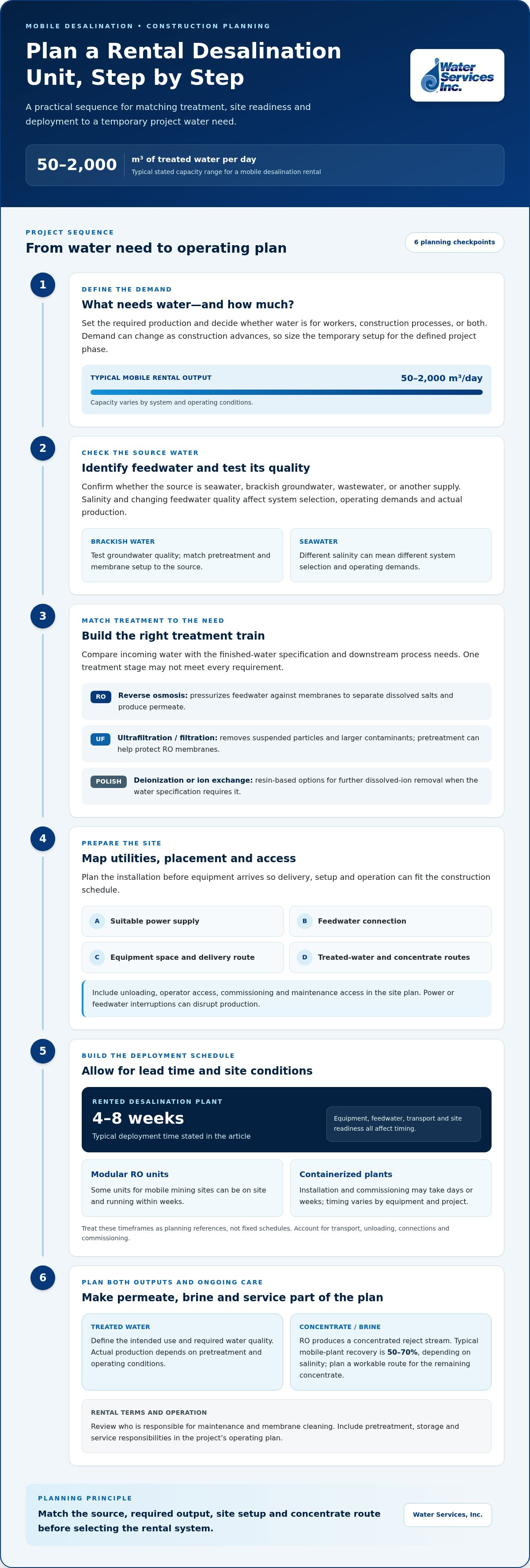
Leasing a mobile desalination unit can provide temporary water during construction without making a permanent plant part of the project. A mobile desalination unit rental for construction sites can typically deliver 50-2,000 m³ of treated water per day, while deployment of a rented desalination plant typically takes 4-8 weeks. The right system depends on feedwater quality, required output, site conditions and how the brine will be managed.
Water demand can change as construction advances, making a temporary treatment setup useful for a defined project phase or while permanent infrastructure is built. The decision involves more than production capacity: pretreatment, storage, maintenance, and brine handling must also fit the site’s operating plan. This article explains why projects rent mobile desalination units, what affects deployment and rental terms, and how to plan capacity and brine management.
Key Takeaways
- Match treatment to the site’s water source and end use: reverse osmosis, deionization, ion exchange and filtration address different treatment needs.
- Plan deployment around feedwater quality, required output and site access so equipment delivery and setup align with construction schedules.
- Review rental terms for maintenance and membrane cleaning, and account for how service responsibilities fit the project’s operating plan.
- Design brine handling alongside desalination: typical mobile plant recovery is 50-70%, depending on salinity, so the remaining concentrate needs a practical management plan.
- Map out power, water connections, placement and equipment access before setup; pumping and RO membrane components are key parts of a treatment system.
Why Lease Mobile Water Treatment Equipment?
Renting gives construction projects temporary treatment capacity without requiring a permanent plant. Common challenges include changing feedwater quality, membrane fouling, power interruptions, and concentrate disposal. Actual production depends on pretreatment and operating conditions.
Brackish Water and Seawater Treatment
Reverse osmosis treats brackish groundwater and seawater by pressurizing feedwater against membranes that separate dissolved salts from permeate. The source matters: seawater and brackish groundwater differ in salinity, affecting system selection and operating demands. Identify the source and test its quality, then match pretreatment and membrane configuration to the feedwater.
A portable reverse-osmosis drinking-water system can produce freshwater with a total dissolved solids level of 600 ppm or lower. That figure does not by itself establish suitability for every site use. Define the intended use, required production and incoming water characteristics before choosing the treatment train.
Mobile RO and Ultrafiltration Units
Mobile reverse-osmosis units can provide temporary desalination, while ultrafiltration removes suspended particles and other larger contaminants. The processes have different roles: filtration can reduce solids before reverse osmosis, which targets dissolved salts. A site treating brackish groundwater may need a different setup from one treating seawater or recycling wastewater.
Deionization and ion exchange use resin-based treatment to remove dissolved ions. They can serve as polishing steps when the water-use specification requires further ion removal. Compare source-water quality with the required finished-water quality and downstream process needs; one treatment stage may not meet every requirement.
Plant Hire, Operation, and Components
Renting a reverse-osmosis plant can provide temporary treatment for wastewater recycling, boiler feedwater, or cooling-tower filtration. A typical system uses feed pumps to supply pressure, pretreatment filters to reduce suspended material, membrane elements to separate salts, and controls to monitor operation. The layout should match the site’s feedwater and end use so the components can support stable production.
Feedwater passes through pretreatment before reaching the reverse-osmosis membranes. The membranes produce permeate and a concentrated reject stream. Filtration protects downstream components from particles, while the pump provides the pressure required for separation. Deionization or ion exchange can be added when the process needs further dissolved-ion removal.
Risks and Limitations
Changes in feedwater can affect membrane performance and the volume or quality of treated water. Suspended solids can foul membranes if pretreatment is insufficient, while dissolved salts concentrate in the reject stream. Plan for both outputs: specify the intended use for permeate and a workable concentrate-handling route before the plant starts operating.
Site conditions matter, too. The unit needs suitable power, a feedwater supply, space for equipment, and access for operation and maintenance. Power or feedwater interruptions can disrupt production, and a poorly matched treatment train may not meet the required water quality. Define water demand, source conditions, and brine-management needs before selecting equipment.
Rapid deployment of mobile treatment systems
Mobile treatment can bridge water-supply needs during new construction, plant upgrades, or interruptions to municipal supply. Deployment timing depends on the equipment, feedwater, transport, and site readiness.
Emergency and Project-Specific Deployment
Emergency and disaster-response projects may need potable water before permanent infrastructure is restored. A rented desalination plant typically takes 4-8 weeks to deploy, so that lead time matters when planning response capacity. Identify the required water use, available feedwater, and intended production before selecting equipment. Brackish water and seawater call for desalination, while other sources may need a different treatment approach.
Start by assessing demand and source-water quality. New construction and plant upgrades are situations where temporary treatment can support water supply. Define whether water is needed for workers, construction processes, or both. Then match capacity and system configuration to those needs rather than assuming one mobile system will suit every site or emergency.
Deployment and Relocation
Some modular reverse-osmosis units for mobile mining sites can be on site and running within weeks, while containerized desalination plants for mining may be installed and commissioned in days or weeks. Timelines vary by equipment and project conditions, so treat these as planning references, not fixed schedules. For a remote construction site, include transport, unloading, connection, commissioning, and operator access in the deployment plan.
Containerized desalination plants can travel to mining sites by truck or barge. This flexibility can support relocation when work moves between site areas or a temporary facility changes position. Before moving a treatment system, plan its new location, feedwater connection, treated-water delivery, power supply, and concentrate route. Coordinate the move with ongoing construction water needs.
Site Utilities, Space, and Access
Site preparation affects how quickly a rental treatment system can start. Map the placement area, delivery route, unloading point, and connections before the equipment arrives. The system needs access to its feedwater source and a route for treated water. For desalination, plan concentrate handling as well. A remote site may require a different logistics plan from a project near municipal infrastructure.
List available utilities and operating interfaces for the selected equipment. Confirm where power, feedwater piping, product-water storage, and drainage or brine collection will connect. Leave working access for inspection and routine operation, and keep transport paths clear for installation or later relocation. Where ultrafiltration is part of the treatment train, ultrafiltration treatment equipment can be considered alongside the project’s water-quality needs.
Rental financing and contract options
A rental agreement should match treatment capacity to the project’s water needs and operating period. Compare the contract scope, maintenance responsibilities, and power plan before committing.
Short- and Long-Term Rental Terms
Short-term hire can suit a defined construction phase, temporary water supply, or interruption to an existing system. Longer rental periods may fit projects with continuing treatment demands or sites awaiting permanent infrastructure. Mining sites with short lifespans of 1-2 years are candidates for rented modular desalination plants, a useful example for projects with a fixed operating horizon.
Review what the agreement covers, not just its duration. Rental contracts may include regular maintenance and membrane cleaning. Establish when these tasks happen, who performs them, and how system status is documented. Also define responsibilities for feedwater, treated-water storage, brine handling, and site connections.
Map expected water demand against the construction schedule. Earthworks, concrete work, and worker facilities can have different supply and water-quality requirements. A staged plan helps identify when treatment capacity is needed, how demand may change, and whether the temporary system can support the full project period.
Contract Scope and Investment Planning
Renting replaces the purchase of a permanent asset with temporary equipment for a defined need, but it does not eliminate project costs. Transport, installation, utilities, operation, and concentrate management still require planning. Create a scope checklist covering the treatment process, required production, feedwater characteristics, and site interfaces included in the agreement.
Compare contract terms with the project schedule and operating plan. Identify the rental start and end conditions, how to extend or shorten the term, and who is responsible for maintenance downtime. For example, a site with changing construction phases should align the rental period with its water demand rather than assume demand will remain constant.
Solar, Hybrid, and Power Supply Options
Plan power around the treatment system’s load and the site’s available supply. A grid connection may suit a project with dependable utility access; a remote location may need independent generation. Solar or hybrid power can be assessed where site conditions and operating needs support those configurations. Compare available power with the system’s operating schedule and the site’s other electrical loads.
Before finalizing a contract, document the power connection, backup arrangements, and responsibility for fuel or energy equipment. Include pumps, controls, and pretreatment components in the electrical plan. A desalination unit cannot meet its production target if its feed pump or controls lack a suitable power source. Align the power schedule with expected water quality and daily site demand.
Mobile desalination and brine treatment systems
Mobile desalination combines a modular treatment plant with a site-specific concentrate-management plan. Assess capacity, feedwater salinity, recovery, and the brine route together. For a mobile desalination unit rental for construction sites, include brine handling in the initial equipment and site plan.
Handle reject brine and treatment chemicals separately and in a controlled way. Collect concentrate in a suitable containment system, then determine its disposal route based on its composition and the site’s available options. Keep chemical residuals separate from brine and other waste streams.
Rental desalination plants vary in capacity and recovery, with performance depending on feedwater salinity. Recovery describes the portion of feedwater converted into product water; the balance remains concentrated reject. A coastal site treating seawater therefore needs a plan for both its production target and resulting brine volume.
Feedwater can contain dissolved salts and other constituents that influence membrane performance and concentrate characteristics. Portable desalination units can typically treat feedwater with TDS up to 40,000 ppm. That limit helps frame equipment selection, but water analysis and required finished-water quality guide the treatment configuration.
Containerised plants rented for mining are commonly supplied in 20 ft or 40 ft containers. These modular systems can be transported to remote projects and placed near the feedwater source or point of use. A seawater desalination system installed in a 40-ft. container on a Greek island produces 300 m³/day of potable water, showing how containerised mobile water treatment can serve defined demand.
Plan brine management during system design, not after installation. Map the concentrate outlet, collection area, transfer route, and final handling method before deployment. Salinity and other water constituents affect which route is practical. Keep concentrate separate from product water, stormwater, and unrelated site waste.
Define how treatment chemicals will be used and handled. Antiscalants may control scale formation in reverse-osmosis systems, while other chemicals serve specific process needs. Record dosing points and residual streams in the operating plan. Identify and contain chemical containers and residuals, keeping them separate from brine collection.
Before selecting a mobile desalination unit rental for construction sites, match plant capacity to daily demand and plan brine storage or removal. A modular system can move as work progresses, but its feedwater connection, concentrate route, and product-water delivery must move with it. The key question is whether the site can manage both outputs throughout the rental period.
What site utilities, space, access, and setup are needed for a rental desalination unit?
A rental desalination unit needs a suitable feedwater connection, power, space for equipment, and routes for product water and concentrate. Plan these interfaces before delivery. A containerised plant may arrive in a 20 ft or 40 ft container, so the access route and placement area must accommodate its dimensions and unloading method.
Utilities and Water Connections
Start with the power supply. Record the available connection and decide whether the site needs a separate generation plan. Pumps, controls, and treatment equipment all need a compatible supply. Do not assume a nearby construction connection can support the treatment system as well as other site loads.
Next, map the feedwater route from source to plant. For seawater or brackish groundwater, identify the intake point and pipe route. Plan separate lines for treated-water delivery and reject brine. If the project uses storage tanks, place them where operators can reach the connections and monitor water movement during production.
Space, Delivery, and Placement
Choose a firm, accessible area for the plant, with room for connections and routine operation. Keep the delivery path clear for the truck or barge carrying containerised equipment. A 40 ft containerised desalination system has been installed on an island in Greece, demonstrating why placement and transport planning matter for coastal and remote locations.
Plan space for the entire treatment train, not just the main container. Pretreatment, filtration, pumps, storage, and chemical handling may need separate areas. Leave practical access for inspection and maintenance, and keep the brine collection route separate from product-water piping. A crowded layout can complicate operation and relocation.
Setup and Commissioning Plan
Before installation, document the water source, intended use, connection points, and concentrate destination. Share a simple site layout showing the plant, feedwater intake, product-water outlet, power connection, and brine route. This clarifies installation interfaces and helps identify conflicts with construction traffic or other temporary services.
During setup, connect utilities and piping to match the system configuration, then commission the treatment stages in sequence. Check that feedwater reaches pretreatment, product water flows to its planned storage or use point, and concentrate reaches its designated containment or handling route. Keep operator access clear as surrounding work changes.
Use a pump equipment selection that aligns with the project’s water-transfer requirements as part of planning the site connections.
Water Services, Inc.: Goulds Water Technology Pumps
Water Services, Inc. supports construction water-treatment planning with equipment for pumping and treatment stages. Goulds Water Technology Pumps address project pumping needs, while FilmTec Reverse Osmosis Membranes and Hydranautics RO Membranes serve reverse-osmosis system requirements. Viqua UV Water Purification Systems are an option when ultraviolet treatment is part of the planned process.
These products can help when defining system components, replacement needs, or treatment stages for a temporary site setup. Match equipment to the feedwater, required water quality, and site configuration in your project plan.
Contact Water Services, Inc. to discuss your equipment needs, or visit shop.water-services.us.
Set Up Your Next Water-Planning Decision
Before selecting mobile desalination unit rental for construction sites, define the project’s treatment requirements and equipment interfaces. Clear specifications help distinguish the rental arrangement from the components needed to prepare, pump, and manage water on site.
Water Services, Inc. offers Goulds Water Technology Pumps, Viqua UV Water Purification Systems, and FilmTec Reverse Osmosis Membranes. These products can inform project decisions about pumping and treatment, alongside the site’s water source, intended use, and process design.
Contact Water Services, Inc. about water-treatment equipment to discuss the equipment side of your project plan. A well-defined treatment scope gives your team a practical starting point for the next stage of site planning.
Frequently Asked Questions
How long does it take to deploy a rented RO system?
A rented desalination plant typically takes 4-8 weeks to deploy. Modular RO units for mobile mining sites can be running within weeks, while containerised plants can be installed and commissioned in days or weeks. For a construction schedule, include equipment transport, site preparation, utility connections, commissioning, and any required process adjustments. Readiness of the site and the treatment configuration affect how deployment fits the project timeline.
What is a Portable Desalination Unit?
A portable desalination unit is a transportable treatment system that removes dissolved salts from feedwater, commonly through reverse osmosis. It can produce water from seawater or brackish sources where a fixed plant is impractical. Portable equipment ranges from compact units to containerized systems. For a remote work area, a smaller unit may meet limited demand, while a larger modular plant can support broader site operations.
What types of mobile desalination units are available for construction sites?
Construction projects can use portable RO units, modular containerised RO plants, or systems combining desalination with pretreatment. Portable units commonly produce 500 L/day to 3 m³/day; larger rental plants can serve higher site demands. Mobile ultrafiltration is another option for removing suspended particles, but it doesn’t desalinate water by itself. Select the type by matching source water, intended use, and required output.
How much does it cost to rent a mobile desalination unit in the United States?
Rental cost depends on system capacity, feedwater salinity, pretreatment needs, rental duration, transport, installation, and maintenance scope. Power requirements and brine handling can also affect the project budget. Treating seawater, for example, may require a different configuration from treating brackish groundwater. Compare the complete treatment and operating scope, not just equipment rental. No single rental price applies to every project.
What rental terms, minimum periods, and delivery fees do desalination equipment providers offer?
Rental agreements can cover short-term or long-term use, with terms defining equipment scope, operating period, maintenance responsibilities, and the process for return or extension. Some contracts may include regular maintenance and membrane cleaning. Minimum periods and delivery charges depend on the agreement, transport distance, equipment format, and site access. Review delivery, setup, servicing, and end-of-rental arrangements as separate contract items.
What capacity and water output do construction sites need from a mobile desalination unit?
Choose capacity by calculating the site’s daily water demand and identifying when peak use occurs. Typical rental desalination plants range from 50-2,000 m³/day, so projects should compare required usable output against that range. Separate potable, process, and other site uses in the demand estimate. Then account for the feedwater and the water lost to concentrate, since plant capacity and finished-water production aren’t identical.
How do reverse osmosis and other mobile desalination technologies compare for job sites?
Reverse osmosis separates dissolved salts through membranes, making it a common choice for desalinating seawater and brackish water. Ultrafiltration removes suspended particles, so it can support pretreatment but does not replace salt removal. Ion exchange and deionization use resins to remove dissolved ions and can serve specific polishing needs. Compare processes based on the contaminants that matter and the required end use; they are not interchangeable.
What water sources can mobile desalination units treat, and what feed-water testing is required?
Mobile desalination systems can treat seawater and brackish groundwater. Reverse-osmosis systems can also support wastewater recycling when configured for that application. Feedwater testing should establish total dissolved solids or salinity, suspended solids, hardness, and other constituents that can affect treatment or scaling. Check whether source quality changes during the project, such as after rainfall or a change in intake conditions. Test results guide pretreatment and membrane selection.
0 comentarios