

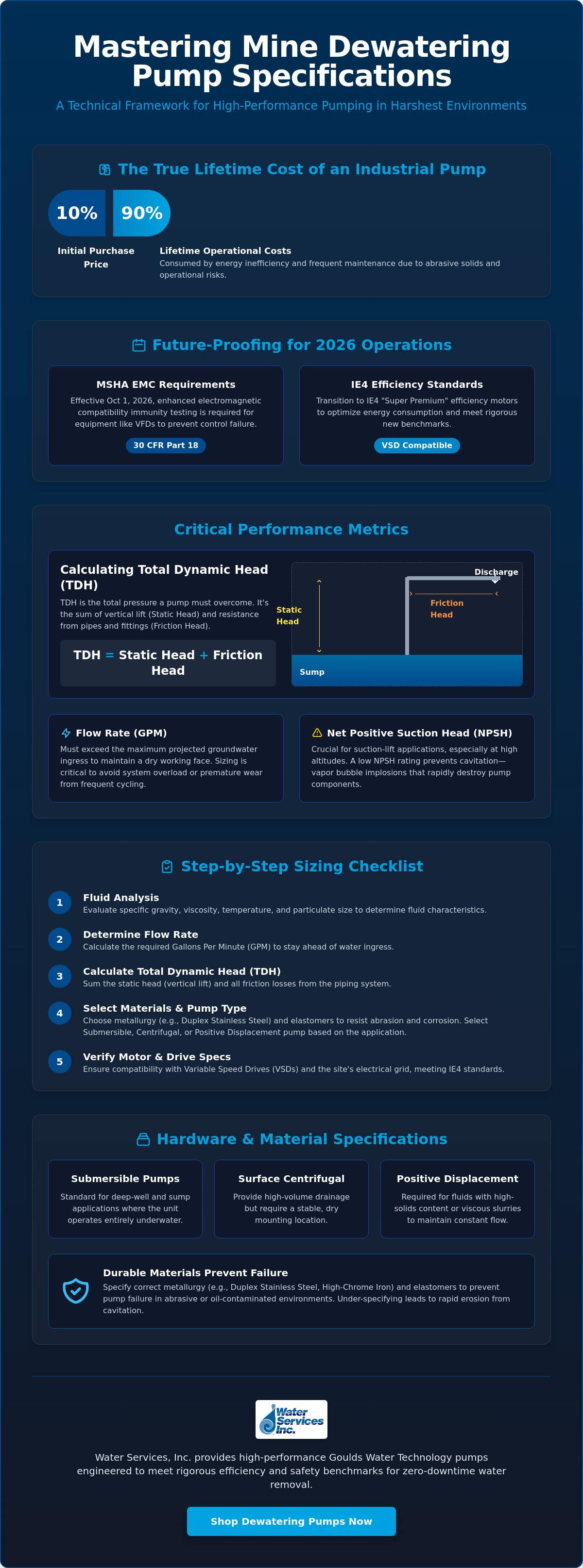
The initial purchase price of an industrial pump represents only 10% of its total lifetime expenses. For mining operators, the remaining 90% is often consumed by energy inefficiency and frequent maintenance due to abrasive solids. Evaluating precise mine dewatering pump specifications is the only way to mitigate these operational risks and avoid underperformance. You already know that a single pump failure can halt production and compromise site safety.
This guide provides the technical framework required to select high-performance dewatering pumps that withstand the harshest mining environments. We will analyze the October 1, 2026 MSHA electromagnetic compatibility requirements and the transition to IE4 super premium efficiency motor standards. You will learn to optimize energy consumption using the Pump Energy Index (PEI) and select durable materials to ensure zero-downtime water removal. This technical overview covers Goulds Water Technology configurations and the engineering metrics necessary for environmental discharge compliance.
Key Takeaways
- Learn to calculate Flow Rate and Total Dynamic Head (TDH) to ensure dewatering systems effectively overcome vertical lift and pipe friction.
- Master mine dewatering pump specifications that prioritize Variable Speed Drive (VSD) compatibility for improved energy efficiency and mechanical longevity.
- Identify the correct metallurgy and elastomers, such as duplex stainless steel, to prevent pump failure in abrasive or oil-contaminated environments.
- Follow a step-by-step sizing checklist that includes fluid analysis for specific gravity and particulate size to ensure precise equipment selection.
- Understand how Goulds Water Technology pumps integrate with downstream wastewater treatment solutions to maintain strict environmental discharge compliance.
Understanding Mine Dewatering Pump Specifications for 2026 Operations
Mine dewatering pump specifications represent the quantified mechanical limits of fluid displacement within a specific industrial environment. These metrics are not merely suggestions; they define the physical boundaries of what a pump can safely and efficiently achieve. In the context of modern mining, Mine dewatering requires an exact alignment between the equipment's rated capacity and the site's hydraulic demand. Precision in these figures prevents catastrophic system failure and ensures continuous operation.
Current 2026 standards prioritize Variable Speed Drive (VSD) compatibility. This shift follows the MSHA final rule on EMC immunity testing, effective October 1, 2026, which revises 30 CFR Part 18 to include enhanced testing for imported equipment like VFDs. Modern mine dewatering pump specifications must now account for these electromagnetic compatibility requirements to ensure electronic controls don't fail in gassy or high-interference environments. High-performance units, such as those found in the Goulds Water Technology Pumps catalog, are engineered to meet these rigorous IE4 efficiency and safety benchmarks.
Engineers must distinguish between nominal performance and the operational duty point. Nominal specs reflect laboratory conditions with clean water at sea level. The duty point is the reality of your mine; it accounts for specific gravity, altitude, and friction loss. Goulds Water Technology remains a preferred choice because their technical data sheets provide transparent duty point curves, allowing for more accurate system sizing than generic alternatives.
Primary Categories of Dewatering Hardware
Selection begins with identifying the correct hardware category for the application. Submersible pumps are the standard for deep-well and sump applications where the unit must operate entirely underwater. Surface-mounted centrifugal pumps provide high-volume drainage but require a stable, dry mounting location. For fluids with high-solids content or viscous slurries, positive displacement pumps are required to maintain constant flow against varying pressures.
The Impact of Inaccurate Specifications
Under-specifying a pump leads to cavitation, where vapor bubbles form and implode against the impeller. This erosion can destroy a high-chrome iron component in weeks. Conversely, over-specifying leads to motor burnout if the motor doesn't have proper voltage or phase matching for the site's electrical grid. The cost of operational downtime far exceeds the initial investment in correct technical specifications. Accurate data ensures your water removal strategy remains compliant with environmental discharge regulations while minimizing energy waste.
Critical Performance Metrics: Flow Rate, Head, and Horsepower
Hydraulic performance is defined by the intersection of flow rate and total pressure. Accurate mine dewatering pump specifications require a precise calculation of Gallons Per Minute (GPM) against the total resistance of the system. You must size the pump to exceed the maximum projected groundwater ingress rate to maintain a dry working face. If the GPM rating is too low, the system won't keep pace with seasonal flooding; if it's too high, the pump will cycle frequently, causing premature motor wear.
Net Positive Suction Head (NPSH) is a critical specification for suction-lift applications. As site altitude increases, atmospheric pressure drops. This reduces the available NPSH and significantly increases the risk of cavitation. Unlike standard centrifugal pumps used at sea level, mining pumps at high elevations require a lower NPSH Required (NPSHr) rating to operate safely. Consult the manufacturer's efficiency curve to identify the Best Efficiency Point (BEP). Operating as close to the BEP as possible ensures the highest hydraulic efficiency and the lowest mechanical vibration.
Calculating Total Dynamic Head (TDH)
Total Dynamic Head (TDH) is the sum of static head and friction head. Static head is the vertical distance the fluid must travel from the sump to the discharge point. Friction head represents the resistance caused by pipe walls, valves, and fittings. In long-distance mining pipe runs, friction head can account for a substantial portion of total pressure requirements. Using Ashcroft pressure gauges allows for real-time verification of head, helping operators identify when pipe scaling or internal blockages are increasing system resistance. Common errors in underground-to-surface lift calculations often stem from ignoring the specific gravity of the fluid, which directly impacts the pressure needed to move the column of water.
Horsepower and Motor Selection
Motor horsepower must be matched to the specific gravity of the mine water. Fluids laden with abrasive solids or minerals are denser than clean water, requiring significantly more torque to move the same volume. For remote sites, electrical specifications such as voltage, frequency, and phase must be verified against the local grid or generator capacity. Standard 460V, 3-phase, 60Hz configurations are common, but variations in remote infrastructure can lead to voltage drops that overheat motors. Specify Class H insulation and built-in thermal protection for high-heat environments to prevent winding failure during peak operation. For reliable performance in these demanding conditions, you can browse industrial pump options that meet these specific electrical and mechanical standards.
Material Specifications for Abrasive and Corrosive Environments
Material selection is as critical as hydraulic sizing when defining mine dewatering pump specifications. While standard cast iron is sufficient for neutral pH water with minimal solids, it fails rapidly in the presence of abrasive particulates or acidic runoff. Mining operators must specify metallurgy based on the chemical and physical characteristics of the fluid to prevent premature casing breach or impeller erosion. Selecting the wrong alloy can lead to a total system failure within weeks of deployment.
CD4MCu duplex stainless steel is the preferred specification for environments that are simultaneously corrosive and abrasive. This alloy provides higher yield strength and superior pitting resistance compared to standard 316 stainless steel. For high-solid slurries, high-chrome iron with at least 27% chromium content offers the hardness required to resist the cutting action of quartz and other hard minerals. Specialized ceramic or tungsten carbide coatings can be applied to internal surfaces to further extend component life in extreme wear scenarios.
Elastomer selection must account for hydrocarbons often found in mine sumps. Standard EPDM seals may swell and fail if exposed to oil-contaminated water. In these cases, Viton (FKM) or Nitrile (Buna-N) O-rings and seals are required to maintain technical integrity. When dealing with Acid Mine Drainage (AMD), where pH levels often drop below 4.0, the use of high-alloy materials or specialized thermoplastic linings is mandatory to prevent rapid wall thinning and structural degradation.
Wear-Resistant Components
Mechanical seal faces must be specified according to the hardness of the suspended solids. Silicon carbide faces offer superior abrasion resistance compared to tungsten carbide in most mining applications. Incorporating replaceable wear plates is a cost-effective strategy to maintain factory clearances as the pump ages. These plates allow operators to restore hydraulic efficiency without replacing the entire pump casing. During the replacement of these heavy, often sharp-edged components, the use of proper PPE and safety gear is essential to protect maintenance personnel from mechanical and chemical hazards.
Corrosion Resistance in Acidic Mines
Mapping material specs to the Langelier Saturation Index (LSI) helps predict if the mine water will be scale-forming or corrosive. A negative LSI indicates aggressive water that will leach minerals from metal surfaces, necessitating the use of 316L or 904L stainless steel grades. For saline environments or high-chloride water, duplex alloys are required to prevent stress corrosion cracking. Protective internal epoxy linings or rubber coatings provide an additional barrier, ensuring the base metal remains isolated from chemically aggressive fluids.
Sizing Your Dewatering System: A Step-by-Step Specification Checklist
Systematic sizing ensures the selected hardware operates within its intended mechanical envelope. This checklist translates site data into actionable mine dewatering pump specifications. Sizing a system requires more than matching a pump to a pipe diameter; it involves a rigorous review of fluid dynamics and site infrastructure. Follow these five steps to define your requirements before procurement.
- Step 1: Conduct a fluid analysis. Determine the specific gravity (SG) and particulate size of the mine water. High SG fluids require increased motor torque and specific metallurgy.
- Step 2: Map the physical layout. Calculate the static head from the sump to the discharge point. Factor in pipe friction losses based on total run length and the number of valves or elbows.
- Step 3: Select the pump type. Choose submersible units for deep sumps or surface-mounted centrifugal pumps for high-volume drainage. Portability requirements will determine if the unit needs a skid or trailer mount.
- Step 4: Cross-reference site power. Match motor electrical specs with available voltage, phase, and frequency. Ensure compliance with the IE4 motor efficiency standards previously discussed.
- Step 5: Verify downstream compatibility. Ensure the pump's discharge pressure and flow rate align with the capacity of existing filtration or RO systems to prevent backpressure issues.
Precision in these steps prevents the common errors of over-sizing or under-sizing, both of which lead to increased total cost of ownership. Select your next system component by visiting our industrial equipment catalog.
Fluid Analysis and Solid Handling
Determining the maximum spherical solids handling specification is essential for preventing impeller clogs. If the fluid analysis identifies particulates larger than the pump's rated clearance, an inlet strainer or a different impeller design is required. Viscosity also plays a major role in thickener underflow or tailings applications, where fluid resistance is significantly higher than clean water. Operators should use water flow meters to validate design flow in real-time, ensuring the pump maintains the velocity needed to keep solids in suspension.
Environment and Portability
Environmental conditions dictate the required ambient temperature ratings for the motor and controls. Pumps deployed in Arctic conditions require heaters or specialized lubricants, while tropical mines need enhanced cooling and moisture-resistant insulation. For mobile needs, specify skid-mounted frames for durability or trailer-mounted systems for rapid deployment across different site levels. Underground deployment requires specific lifting lug and frame strength specs to handle the rigors of vertical transport through mine shafts and tight tunnels.
Integrating Goulds Water Technology Pumps into Your Mine Water Strategy
Goulds Water Technology remains the primary choice for high-head mining applications because their engineering handles the extreme hydraulic demands of deep-pit operations. These pumps are built to operate at the intersection of high pressure and high volume, ensuring the mine remains dry even during peak groundwater ingress. Adhering to strict mine dewatering pump specifications ensures that these units perform as intended when integrated into a broader water management strategy. Successful operations view dewatering not as an isolated task, but as the critical first stage in mining wastewater treatment solutions designed for resource recovery and regulatory compliance.
Custom engineering services allow for the development of containerized and mobile dewatering skids tailored to specific site geometries. These systems incorporate Goulds hardware with robust frames and integrated controls, providing a turnkey solution for rapid deployment. Technical support and maintenance for global mining operations ensure that these assets maintain their design efficiency throughout their lifecycle. This level of integration is necessary to manage the total cost of ownership in specialized industrial environments.
From Dewatering to Discharge
Raw mine water often contains suspended solids and chemical contaminants that require pre-filtration before entering industrial water filtration systems. Managing flow surges is essential to protect sensitive downstream equipment, such as FilmTec or Hydranautics RO membranes, from pressure spikes. Automated control integration using Walchem controllers or Signet flow sensors allows for real-time monitoring of fluid characteristics. These sensors trigger adjustments in pump speed via VFDs, ensuring the system remains within its Best Efficiency Point while maintaining stable feed pressure for water treatment plants.
Procuring Industrial Pumps and Components
Navigating the Water Services, Inc. pump collection provides access to a curated selection of Goulds hardware designed for heavy industrial use. For remote mine sites, the benefits of modular, containerized systems are significant, as they reduce on-site assembly time and ensure component compatibility. These systems arrive pre-wired and pre-plumbed, meeting all specified electrical and mechanical standards for immediate operation. If your site requires a specialized configuration, consult with our engineers for custom mine dewatering specifications to ensure your equipment matches your unique hydraulic and chemical profile.
Optimizing Hydraulic Infrastructure for 2026 and Beyond
Proper system selection requires a rigorous alignment of hydraulic demand with the latest regulatory standards. The transition to IE4 motor efficiency and the 2026 MSHA electromagnetic compatibility rules change how operators must evaluate equipment. By prioritizing precise mine dewatering pump specifications, you ensure that your hardware withstands abrasive particulates and corrosive runoff while maintaining peak energy efficiency.
Water Services, Inc. is an Authorized Goulds Water Technology Distributor with extensive global experience across the African and South American mining sectors. We provide custom engineering for containerized water treatment and mobile dewatering skids designed for rapid deployment. Our technical team ensures your equipment integrates seamlessly with downstream filtration and RO systems to meet environmental discharge mandates.
Browse Goulds Water Technology Pumps and Industrial Hardware to secure the components required for your next project. We look forward to supporting your site's operational stability and logistical success.
Frequently Asked Questions
What is the most important specification for an underground mine pump?
Total Dynamic Head (TDH) is the most critical specification for underground mine pumps because it determines if the unit can successfully lift water to the surface. Failure to account for the vertical distance and pipe friction results in zero flow. Additionally, solids handling capability is essential to prevent internal clogging from mine grit. These mine dewatering pump specifications must be verified against the deepest point of the sump to ensure continuous operation.
How do I calculate Total Dynamic Head (TDH) for a vertical mine shaft?
To calculate TDH for a vertical shaft, you must sum the static head and the friction head. Static head is the exact vertical distance from the water level to the discharge point. Friction head is the resistance created by the pipe walls and fittings. Use hydraulic tables to determine friction loss based on your pipe diameter and flow rate. Accurate calculations prevent motor overload and hydraulic cavitation during high-lift operations.
Can I use a standard centrifugal pump for mine dewatering with high solids?
Standard centrifugal pumps are generally unsuitable for high-solids dewatering because their impellers and casings aren't hardened against abrasive wear. For fluids with significant particulate content, you should specify a slurry pump or a centrifugal unit with a recessed impeller. These designs allow solids to pass through without impacting the primary hydraulic surfaces. Using the wrong pump type results in rapid efficiency loss and frequent mechanical seal failure.
What material is best for acidic mine water with a pH below 4?
Duplex stainless steel, specifically CD4MCu, is the best material for handling acidic mine water with a pH below 4. This metallurgy provides the necessary corrosion resistance to prevent rapid wall thinning while offering the mechanical strength to resist abrasive wear. For extreme acidity, some operators utilize thermoplastic-lined pumps or high-nickel alloys. Selecting the correct material ensures the structural integrity of the pump casing remains intact over long-term deployment.
What is the difference between a high-head and a high-volume dewatering pump?
High-head pumps are engineered to generate the pressure required to move water over significant vertical distances or long pipelines. High-volume pumps prioritize the total amount of fluid displaced per minute, usually for shallow sumps or open-pit drainage. High-head units typically feature multi-stage impellers or smaller diameters to increase velocity. High-volume units utilize larger discharge ports and impellers designed for maximum flow rate at lower discharge pressures.
How does altitude affect the performance specifications of a surface pump?
Altitude reduces atmospheric pressure, which directly decreases the Net Positive Suction Head (NPSH) available to a surface pump. As the NPSH available drops, the risk of suction-side cavitation increases significantly. Surface pumps operating at high elevations must be derated or selected with a lower NPSH requirement. Failure to adjust mine dewatering pump specifications for altitude leads to noisy operation, vibration, and eventual destruction of the impeller and mechanical seals.
Why are variable frequency drives (VFDs) recommended for mine dewatering?
Variable Frequency Drives (VFDs) are recommended because they allow the pump to match its output to the actual water ingress rate. This prevents the energy waste associated with constant full-speed operation and reduces mechanical stress through soft-starting. VFDs also help maintain a constant sump level, which stabilizes downstream water treatment processes. By adjusting motor speed, operators can significantly extend the mean time between failures for both the motor and wet-end components.
How often should dewatering pump specifications be reviewed for an active site?
You should review dewatering pump specifications at least annually or whenever the mine layout changes significantly. As a mine deepens or expands, the static head and pipe friction requirements increase, often rendering existing pumps obsolete. Seasonal changes in groundwater levels also necessitate a review of flow rate requirements. Regular audits of hydraulic performance ensure the system remains optimized for the current duty point rather than historical site conditions.
0 comentarios