

What if the biggest Legionella risk in your facility isn’t a lack of treatment, but a control plan that misses one of its water systems? Legionella prevention in industrial water systems takes more than choosing a single treatment device. Cooling towers, process equipment, and building water systems can have different operating conditions and exposure pathways, so each needs to be assessed on its own.
That complexity is familiar to industrial teams. General guidance can be difficult to translate into site-specific controls, especially when monitoring, maintenance, and corrective actions involve multiple departments. A documented, risk-based water management program gives teams a practical framework for coordinating that work.
This guide explains the conditions that can support Legionella growth and spread, and how to assess risks across different systems. You’ll learn how to structure monitoring, define responses to control failures, and evaluate treatment equipment as one part of a broader program. Pumps, UV systems, metering equipment, and controllers can support water-treatment planning, but their selection should align with facility-specific controls and system requirements.
Key Takeaways
- Map each water system separately to identify where operating conditions and exposure pathways create distinct risks.
- Use a clear sequence to assess hazards, set controls, assign responsibilities, and keep program records.
- Compare operational practices, disinfection, and supplemental treatment by system fit, dependencies, and verification needs.
- Apply a practical checklist to track system changes, monitoring, maintenance, corrective actions, and program reviews.
- Legionella prevention in industrial water systems relies on matching equipment to defined system functions within a broader control strategy.
Legionella Prevention in Industrial Water Systems: Where Risk Begins
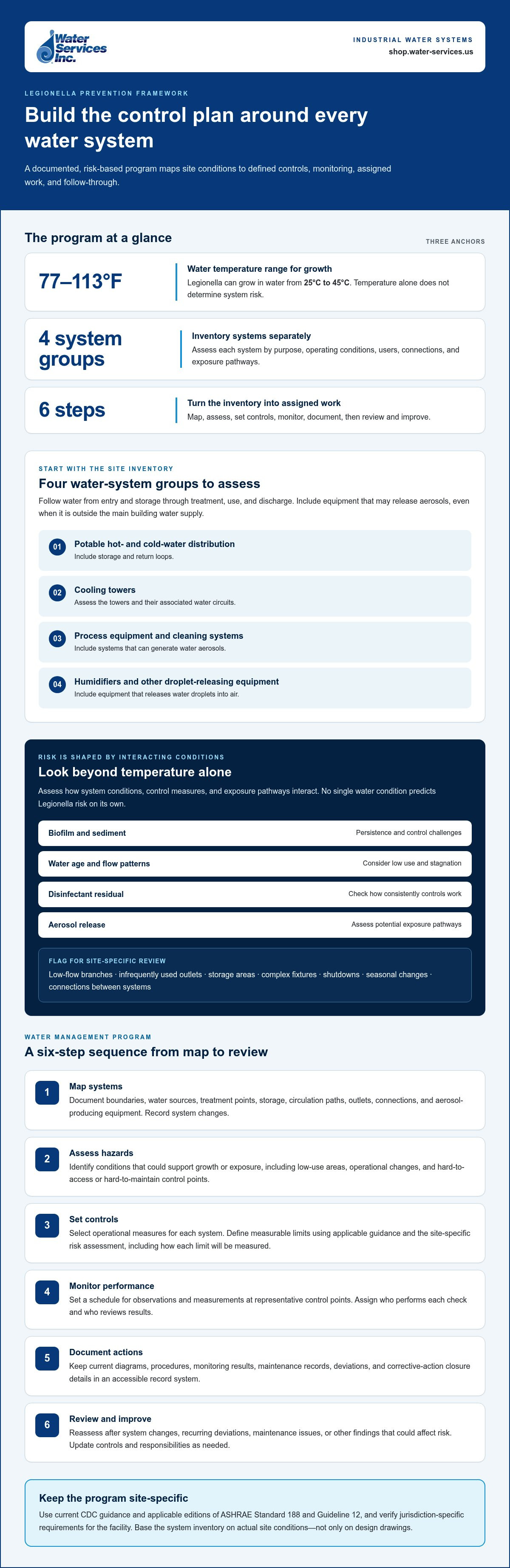
Legionella prevention in industrial water systems means reducing conditions that support bacterial growth and limiting opportunities for exposure through coordinated, monitored controls. Start by understanding what each system does. Potable water, process water, and cooling water have different purposes, operating conditions, users, and exposure pathways. They shouldn’t be treated as interchangeable just because they’re all present at the same facility.
Risk can be influenced by several interacting conditions. Biofilm and sediment can provide places where organisms persist, while water temperature, age, flow patterns, and disinfectant residual can affect how consistently controls work. Legionella can grow in water in the temperature range of 77°F to 113°F (25°C to 45°C), but temperature alone doesn’t determine a system’s risk. Exposure is commonly associated with inhaling contaminated aerosols, making cooling towers and other aerosol-generating equipment important to assess. The Legionella bacteria overview provides background on the organism and its transmission.
Which industrial facility water systems need assessment?
Start with an inventory that follows water from entry and storage through treatment, use, and discharge. For each system, record its purpose, normal operating conditions, users, and physical connections. Include equipment that may create aerosols, even if it isn’t part of the main building water supply. This inventory helps teams see where controls and monitoring need to differ.
- Potable hot- and cold-water distribution, including storage and return loops.
- Cooling towers and associated water circuits.
- Process equipment or cleaning systems that can generate water aerosols.
- Humidifiers and other equipment that releases water droplets into air.
Flag low-flow branches, infrequently used outlets, storage areas, and complex fixtures for site-specific review. Consider how routine operation, shutdowns, seasonal changes, or connections between systems may affect water movement and control. Base the inventory on actual site conditions, not just the system shown on a design drawing.
How do biofilm and water conditions affect Legionella risk?
Biofilm is a layer of microorganisms attached to a surface, often within a protective matrix. It can shelter organisms from environmental stresses and make consistent control more difficult. Sediment can accumulate in tanks, low-flow areas, or equipment, while stagnation and changing water conditions can disrupt expected flow or disinfectant residual. These factors matter differently across systems, so assess how they occur together.
No single water condition predicts Legionella risk on its own; risk depends on how system conditions, control measures, and exposure pathways interact.
For each identified system, connect observed conditions to a practical monitoring point. Note where water age may increase during low use, where sediment can collect, and where aerosols may be released. This site-specific view gives the water management team a sound basis for selecting controls and deciding what to track over time.
How to Build a Legionella Water Management Program for Industrial Sites
A useful water management program turns a facility inventory into assigned work, measurable controls, and documented follow-through. For Legionella prevention in industrial water systems, one site-wide checklist may not fit every circuit. Build the program around each system’s purpose and operating conditions, then coordinate responsibilities through a defined review process. Use current CDC guidance and applicable editions of ASHRAE Standard 188 and Guideline 12, and verify jurisdiction-specific requirements for the facility.
Use this sequence to establish the program:
- Map systems. Document system boundaries, water sources, treatment points, storage, circulation paths, outlets, connections, and aerosol-producing equipment. Record changes as systems are modified.
- Assess hazards. Identify where conditions could support growth or exposure, including low-use areas, changes in operation, and control points that may be difficult to access or maintain.
- Set controls. Select operational measures for each system and define measurable limits using applicable guidance and the site-specific risk assessment. State how each limit will be measured.
- Monitor performance. Set a schedule for observations and measurements at locations that represent the control points. Assign who performs each check and who reviews the results.
- Document actions. Keep current diagrams, procedures, monitoring results, maintenance records, deviations, and corrective-action closure details in an accessible record system.
- Review and improve. Reassess the program after system changes, recurring deviations, maintenance issues, or other findings that could affect risk. Update controls and responsibilities as needed.
How should a facility map systems and assign responsibilities?
Each system record should show how water moves from its source through storage and circulation to points of use or release. Include equipment that creates aerosols and note connections between systems. Assign a water management program coordinator to maintain the overall plan, a system owner for each circuit, and an operations lead for routine checks. Name a maintenance lead for repairs and a records custodian for controlled documentation. Define who receives an escalation and who can authorize corrective actions. OSHA’s Legionella prevention guidelines provide additional workplace prevention context.
What should monitoring and documentation include?
Monitoring records should capture the location, date, result, person responsible, and any relevant operating condition. Depending on the system’s controls, observations and measurements may include flow, temperature, disinfectant residual, or equipment status. Document maintenance, calibration where applicable, control-limit deviations, assigned responses, completion evidence, and the reviewer who closes each item. Set the review frequency and escalation path in the written program rather than relying on informal handoffs.
Sampling can help evaluate conditions or investigate a concern, but results represent a point in time and need context. Define why and where samples are collected, who interprets the results, and how findings affect the program. Sampling doesn’t replace routine operation, monitoring, or maintenance. When treatment equipment supports a defined control function, align its selection and operating needs with the program. Explore industrial water-treatment equipment as one part of that planning.
Comparing Legionella Controls: Operational Practices, Disinfection, and Equipment
No single control performs every role. System design and flow management address conditions that allow water to stagnate, maintenance keeps controls working as intended, and disinfection or supplemental treatment may provide additional barriers. For Legionella prevention in industrial water systems, the right combination depends on system type, water chemistry, operating conditions, and program goals. Give each measure a defined function and a way to verify it.
| Control approach | Purpose | System fit | Operational dependency | Limitations | Verification needs |
|---|---|---|---|---|---|
| Design and flow management | Reduce stagnant zones and support suitable circulation. | Distribution networks, storage, and process loops. | System operation and configuration must maintain intended flow. | Design changes alone don’t address every existing condition. | Review system layout, flow conditions, and changes over time. |
| Routine maintenance | Keep components and control measures in working condition. | All managed water systems. | Requires planned inspection, servicing, and records. | A one-time repair won’t replace ongoing oversight. | Track maintenance completion, findings, and follow-up actions. |
| Disinfection | Manage microbial risks using a defined treatment approach. | Must be selected for the system and its water characteristics. | Depends on correct operation and routine monitoring. | Effectiveness and suitability vary with site conditions. | Measure the relevant control parameters and document results. |
| Supplemental UV treatment | Provide a treatment barrier at a defined point. | Systems where the treatment location and operating conditions suit UV. | Depends on validated design and operation. | Doesn’t provide disinfectant residual through downstream distribution or control established downstream biofilm by itself. | Verify operation against the system’s specified requirements. |
When can UV disinfection support a control program?
UV can serve as a treatment barrier when its design and operating conditions are validated for the intended application. Its role is limited to the treatment point: it doesn’t leave a disinfectant residual in downstream piping. Point-of-treatment performance also doesn’t prove that biofilm farther along the system is controlled. Water Services, Inc. offers Viqua UV water purification systems for treatment planning, as one component of a broader Legionella control program.
Why are maintenance and system design part of prevention?
Dead legs, low-flow branches, poorly managed storage, and inadequate circulation can undermine consistent control. Review these features during design and whenever equipment or operating patterns change. Inspection and maintenance must continue as part of the program, with findings documented and assigned for action. For broader system context, see this industrial water treatment systems guide.
Compare controls by their purpose, location, and dependencies before combining them. A treatment component should fit the facility’s defined system function and operating plan. Water Services, Inc.’s industrial water-treatment equipment can be considered alongside operational controls, maintenance, and program verification.
Industrial Legionella Prevention Checklist: Monitoring, Corrective Action, and Review
A checklist makes routine control work visible and repeatable. For Legionella prevention in industrial water systems, it should connect operational changes to the controls, records, and people responsible for follow-through. Set monitoring methods and limits for each system through its risk assessment and applicable guidance. Avoid applying one temperature target, chemical limit, sampling schedule, or remediation method across systems with different purposes and conditions.
Use these prompts in the facility’s documented program:
- System changes: Record additions, modifications, shutdowns, changes in water use, and equipment or control adjustments. Update system records and assess whether existing controls still fit.
- Routine monitoring: Log each required observation or measurement with its location, date, result, and responsible person. Note unusual operating conditions that may help explain a deviation.
- Maintenance: Track inspections, servicing, repairs, and identified defects. Assign follow-up work and record when it’s completed.
- Records: Keep procedures, results, maintenance logs, and corrective-action records together in a controlled, accessible location. Make record ownership clear.
- Program review: Review trends, open actions, and changes that could affect system risk. Record decisions, assigned owners, and any revisions to the program.
What should teams do when a control measure is outside its limit?
Use the facility’s documented response process. The program should identify an accountable owner and escalation path before a deviation occurs. That owner can coordinate an assessment of the affected system area, potential exposure pathways, recent operational or equipment changes, and relevant monitoring and maintenance records. Keep the response specific to the system rather than applying a generic remedy.
Document the deviation, immediate steps, assigned actions, and evidence used to verify completion. Record who reviewed the response and the basis for decisions about returning to normal operation. If the event raises sampling or remediation questions, use current public-health guidance and the site response plan to direct those decisions.
How should a facility review whether its program is working?
Review whether controls are being checked as planned and whether deviations are resolved, not just whether records exist. Look for recurring out-of-range results, repeated maintenance findings, overdue actions, and changes in equipment, occupancy, water use, or operating conditions. These patterns can show where the assessment, procedures, or assigned responsibilities need updating.
A monitoring result only has meaning when interpreted against the system, its operating conditions, and the control it is intended to verify. Sampling decisions should follow a stated rationale and be interpreted in context, alongside routine monitoring and maintenance. Close each review by recording conclusions, required changes, owners, and completion steps. For facilities reviewing related electric power control equipment, align equipment planning with the control functions defined in the site program.
Integrating Water Treatment Equipment into a Legionella Prevention Strategy
Treatment equipment can support a defined control measure, but it can’t replace a site-specific water management program. For Legionella prevention in industrial water systems, start with the documented control need, not a device. Identify the system and treatment location, operating flow conditions, water characteristics, monitoring method, and the result the control is intended to support. Then determine how the equipment fits with existing operation, maintenance, and response procedures.
How should equipment fit into an engineered control approach?
Each component should have a clear role in the system design. A pump may support circulation or transfer; a metering pump may deliver a treatment chemical as part of a defined process; a controller may support measurement and process control; and UV equipment may provide a treatment barrier at a specified location. These functions are not interchangeable, and no single component establishes control across an entire facility.
Water Services, Inc. supplies UV systems, pumps, metering pumps, and other water-treatment equipment for industrial projects. Equipment selection, sizing, compatibility, and performance validation depend on project-specific engineering, including flow conditions, water chemistry, installation location, and operating requirements. Chemical treatment planning also needs to account for the intended application and system conditions. Evaluate equipment in the context of the system-level project scope, rather than as a standalone Legionella solution.
Before procurement, define how the component’s function will be monitored and what records will show it is operating as intended. Identify the measurement point, responsible operator, maintenance requirements, and response if the control falls outside its established limits. This connects engineering decisions to facility management procedures and helps teams evaluate whether equipment continues to serve its intended purpose.
What practical next step can facility teams take?
Prepare a concise project package before evaluating equipment options. Include current system maps, operating data, water characteristics relevant to the treatment process, existing controls, monitoring records, and known gaps. Note proposed changes and define the specific control need the equipment is meant to address. This gives the engineering review a practical basis and keeps the discussion focused on system fit.
Water Services, Inc. designs modular water-treatment systems, so equipment planning can be part of a broader treatment configuration where appropriate. Distinguish equipment functions from the facility’s wider Legionella controls, including operational practices, monitoring, maintenance, and program review. Once the system requirements and intended role are defined, explore Water Services, Inc. water-treatment options as a starting point for project planning.
Turn Your Water Management Plan into the Next Project Step
Make the next move specific: identify one documented control gap, define the system function that needs support, and prepare the operating information required to evaluate options. This keeps equipment planning tied to facility needs rather than treating a device as a complete prevention strategy. Sustained Legionella prevention in industrial water systems depends on coordinating water management goals with the equipment selected to support them.
Water Services, Inc. supplies Viqua UV Water Purification Systems and other water-treatment equipment, and designs modular water-treatment systems. This equipment and engineering support can be part of broader treatment planning. Equipment remains one component of a site-specific program, with performance and suitability dependent on the application and engineering requirements.
Prepare your system information and project scope, then explore Water Services, Inc. equipment and treatment solutions for your industrial water-treatment project. Clear requirements help connect equipment planning to the controls your facility has defined.
Frequently Asked Questions
Is Legionella prevention only relevant to cooling towers?
No. Cooling towers are one potential source because they can release water aerosols, but they aren’t the only systems to assess. A facility review should also consider potable hot- and cold-water distribution and equipment such as humidifiers or process devices that can create aerosols. For example, a production area and an employee washroom may need separate control decisions because their water use and operating patterns differ.
What conditions allow Legionella to grow in a facility water system?
Several interacting conditions can influence growth, including biofilm, sediment, temperature, water age, and disinfectant residual. Their effect depends on how the system operates. An infrequently used branch, for example, may have different conditions from a continuously operating loop, even within the same building. Record observations alongside system operating data, then evaluate them together. One reading or visible deposit alone can’t establish the facility’s overall risk.
Can UV disinfection prevent Legionella throughout an industrial water system?
Not by itself. UV can treat water at a designed treatment point, but it doesn’t leave a disinfectant residual in downstream piping. Water moving through untreated downstream sections, or biofilm already attached to those surfaces, won’t automatically be addressed by a UV unit. Include UV only as a defined barrier in the system plan, with operating conditions and verification criteria suited to the application.
Does Legionella testing replace a water management program?
No. Testing provides a snapshot from selected sampling locations and times; it doesn’t maintain circulation, perform maintenance, or verify every routine control. A result from one outlet, for example, doesn’t describe conditions throughout a complex system. A management program defines ongoing responsibilities and how findings are interpreted and acted on. Set the sampling purpose and response steps before collecting samples, so results inform decisions rather than stand in for them.
What should a facility do after a positive Legionella result?
Follow the facility’s written response plan and applicable public-health guidance. Don’t treat a positive result as a complete map of system conditions. The response team should determine which areas and uses may be relevant, review system and monitoring records, and assign actions to an accountable lead. Record the basis for decisions, follow-up verification, and criteria for resuming normal operation. Sampling and remediation decisions should reflect current guidance and site conditions.
How often should an industrial water system be tested for Legionella?
There isn’t one sampling interval suitable for every industrial system. Set a schedule through the site’s risk assessment, water management program, applicable guidance, and jurisdictional requirements. State who approves sampling, which locations address the assessment question, and who reviews findings. Revisit the schedule after a process change, prolonged shutdown, or altered water use. Legionella prevention in industrial water systems depends on tracking routine controls, not testing alone.
0 comentarios