

National commercial electricity rates reached an average of 14.37¢ per kilowatt-hour this June, turning inefficient motors into significant financial liabilities. If your facility continues to patch outdated equipment, you're losing more than just maintenance hours; you're ignoring a direct drain on the company's bottom line. Successfully justifying a pump upgrade to management in 2026 requires moving beyond technical specifications. You must present a business case built on energy ROI, regulatory compliance, and risk mitigation.
It's a common challenge when emergency repairs pull your crew away from scheduled tasks, especially when a catastrophic system failure feels inevitable. You know that industrial reliability is the backbone of production, but your board needs to see the financial impact. This guide provides the framework to translate mechanical failures into a data-backed proposal that management cannot ignore. You'll learn how to leverage the June 30, 2026, Section 179D tax deduction deadline and upcoming DOE IE4 efficiency standards to secure faster payback periods for high-performance hardware like Goulds Water Technology pumps or Pulsafeeder metering systems.
Key Takeaways
- Quantify the "quiet drain" of legacy systems by calculating Total Cost of Ownership, moving beyond the initial purchase price to include energy waste and emergency maintenance labor.
- Secure project approval by justifying a pump upgrade to management through a data-backed pitch tailored to the specific priorities of the CFO and COO.
- Mitigate operational risk by aligning your equipment strategy with 2026 EPA standards and DOE efficiency mandates to avoid environmental fines and remediation costs.
- Build a defensible business case using concrete metrics from repair logs and energy draws to prove the reliability and performance of industrial-grade hardware.
- Optimize long-term profitability through right-sizing, ensuring your new pumping system avoids the significant energy waste associated with over-specified legacy equipment.
The Hidden Costs of Maintaining Legacy Pumping Systems
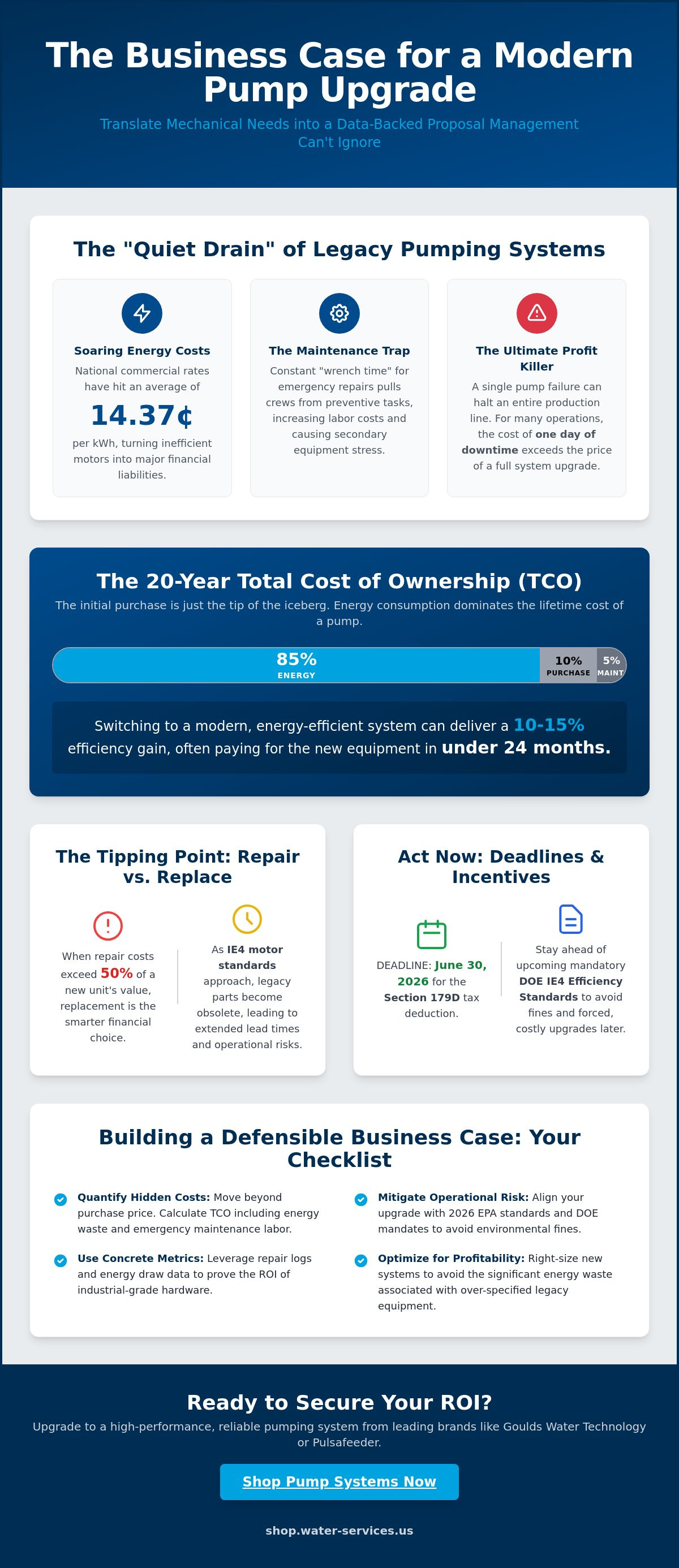
Legacy pumps often function as a "quiet drain" on operational budgets. These units don't always fail spectacularly; instead, they consume capital through incremental waste. As mechanical tolerances degrade, the motor must work harder to maintain flow rates. With national commercial electricity rates averaging 14.37¢ per kWh as of June 2026, even a minor efficiency drop results in thousands of dollars in annual losses. This is the primary hurdle when justifying a pump upgrade to management. Financial stakeholders must see that the status quo is more expensive than the capital expenditure required for modern hardware.
The maintenance trap further complicates the budget. "Wrench time" represents a significant labor cost when crews are pulled from preventive tasks to handle emergency repairs. These costs are compounded by the high price of expedited shipping for replacement parts. Beyond the pump itself, legacy hardware causes secondary equipment stress. Vibration and pressure surges from a failing unit can damage valves, seals, and downstream filtration components like multimedia filter tanks or Pentair filter housings. Inefficient industrial pumping systems also hinder corporate sustainability goals. Securing approval for new equipment involves justifying a pump upgrade to management by highlighting these hidden operational drains.
The Escalation of Repair vs. Replace Costs
Rebuilding centrifugal pumps eventually hits a curve of diminishing returns. The tipping point typically occurs when repair costs exceed 50% of the value of new equipment. Beyond the direct invoice, you must consider parts availability. As manufacturers shift production to meet the upcoming June 2027 IE4 motor efficiency standards, components for legacy units become obsolete. This leads to extended lead times that threaten operational continuity. Buying a new unit ensures you have access to a current supply chain and modern warranty protections.
Unplanned Downtime: The Ultimate Profit Killer
In sectors like mining or oil operations, the hourly cost of a production halt is staggering. Reliability directly correlates to plant availability metrics. A single pump failure can stop an entire process line, leading to missed delivery schedules and reputational damage. Presenting a business case for new pump systems requires quantifying these risks. When the cost of one day of downtime exceeds the price of a full system upgrade, such as a Goulds Water Technology pump, the financial choice is clear. Reliability is a strategic asset, not just a maintenance goal.
Building the Financial Case: ROI, TCO, and Energy Efficiency
Shifting the conversation from capital expenditure to operational savings is critical when justifying a pump upgrade to management. Decision-makers often focus on the initial invoice, yet the purchase price is a fraction of the long-term financial impact. A robust business case centers on the Total Cost of Ownership (TCO) and the rapid return on investment provided by modern efficiency standards. With national commercial electricity rates averaging 14.37¢ per kWh as of June 2026, energy waste is no longer a manageable overhead expense. It's a direct threat to margin stability.
The 20-Year TCO Framework
Total Cost of Ownership (TCO) is the sum of purchase, installation, energy, and maintenance costs over the entire service life of the asset. In a typical 20-year industrial cycle, the initial purchase represents only 10% of the total spend. Maintenance accounts for approximately 5%, while energy consumption dominates the remaining 85%. By selecting energy-efficient pump systems, facilities can achieve a 10% to 15% efficiency gain. This improvement frequently pays for the new equipment in under 24 months through reduced utility draws alone.
The financial timing is particularly advantageous in early 2026. The Section 179D tax deduction offers a significant window for projects where construction begins by June 30, 2026. This deduction ranges from $0.59 to $5.94 per square foot based on energy savings and labor requirements. Leveraging these federal incentives alongside local utility rebates for Super Premium (IE4) motors significantly lowers the barrier for entry. Facilities that act now avoid the higher costs of mandatory compliance when IE4 standards become law on June 1, 2027.
Variable Frequency Drives (VFDs) and Smart Controls
Mechanical wear often stems from pumps running at fixed speeds regardless of actual demand. Integrating Electric Power Controls like Variable Frequency Drives allows the motor to match the required flow rate precisely. This modulation reduces heat generation and extends the life of internal components. Using Walchem Controllers provides an additional layer of protection by monitoring system parameters to prevent dry-run failures. These smart systems reduce maintenance labor by projecting man-hour savings over a 5-year period, as technicians spend less time on reactive repairs. Evaluating industrial-grade pump options now ensures your facility is prepared for the volatile energy market of the late 2020s.
Operational Justification: Reliability, Compliance, and Safety
Operational stability is a prerequisite for industrial profitability. While energy savings provide a clear financial return, the operational risks of maintaining legacy systems often present the most urgent reason for justifying a pump upgrade to management. In 2026, the regulatory environment has become increasingly stringent. New EPA and state-specific wastewater discharge standards mandate precise control over effluent quality. Failing to meet these requirements results in more than just administrative headaches; it leads to significant environmental fines and the high cost of site remediation.
Reliability is especially critical for remote sites in the mining and military sectors. These environments cannot afford the logistical burden of "standard" grade equipment that requires frequent intervention. A pump failure in a remote location involves specialized transport for parts and technicians, often doubling the effective cost of the repair. Upgrading to high-performance hardware ensures that plant availability metrics remain high, protecting the facility from the reputational and financial fallout of unplanned production stops.
Meeting Industrial Discharge Standards
Modern wastewater protocols require exact chemical dosing to neutralize contaminants before discharge. Achieving this level of precision is difficult with aging equipment that suffers from flow fluctuations. Integrating Pulsafeeder Metering Pumps allows for the consistent, automated delivery of treatment chemicals. This technology is a cornerstone of Mining Wastewater Treatment Solutions, where compliance and resource recovery are top priorities. Furthermore, maintaining consistent flow rates is essential for the optimal performance of Reverse Osmosis membranes, which are easily fouled by the pressure surges common in legacy systems.
Safety and PPE Requirements
Frequent repairs on outdated systems increase the "hot work" and chemical exposure risks for your maintenance crew. Legacy pumps often leak at the seals, requiring technicians to wear extensive Personal Protective Equipment during routine inspections. This creates a hazardous work environment and slows down maintenance cycles. Modern designs, such as a sealed Goulds Water Technology unit, virtually eliminate these leaks. By justifying a pump upgrade to management through the lens of workplace safety, you demonstrate a commitment to reducing recordable incidents and lowering insurance premiums. A reliable, sealed system is always safer than an aging, leaking one.
The Pitch: How to Present the Upgrade to the Board
Securing approval for capital expenditures requires a shift from maintenance logs to executive summaries. When justifying a pump upgrade to management, your presentation must align with high-level corporate objectives. Technical reliability is the foundation, but financial impact is the closer. Follow this five-step process to build a case that withstands executive scrutiny.
- Step 1: Gather the Data. Document every repair instance, the specific man-hours lost to "wrench time," and the current energy draw of the aging unit. Real-world metrics from your facility carry more weight than theoretical averages.
- Step 2: Identify the Persona. Tailor your message. The CFO prioritizes Return on Investment (ROI) and tax advantages like Section 179D. The COO focuses on plant availability and meeting production quotas.
- Step 3: Present the "Cost of Inaction." Quantify the financial risk of a system failure occurring next month. Contrast the price of a planned upgrade with the exponential costs of emergency shipping and lost production.
- Step 4: Propose the Solution. Lead with the 2-year payback period and the reliability of industrial-grade hardware. Focus on how new equipment stabilizes operational costs.
- Step 5: Provide a Clear Implementation Timeline. Detail how the installation will be phased to minimize production gaps. A well-planned schedule reduces the perceived risk of the project.
Translating Technical Specs into Business Value
Technical specifications often lose their impact in the boardroom. Instead of discussing High Gallons Per Minute (GPM), frame the upgrade as "increased production throughput." Replace mentions of NEMA Premium efficiency with a "guaranteed 15% reduction in monthly utility spend." You must frame a pump upgrade as a productivity multiplier rather than a cost center to gain executive buy-in. This approach shifts the focus from what the equipment costs to what the equipment earns for the facility.
Addressing the Budget Objection
Budget constraints are the most common hurdle. If a full capital outlay isn't feasible, suggest a phased rollout for large facilities to spread CAPEX over multiple fiscal quarters. For immediate emergency needs, investigate "Rental to Purchase" options that allow for rapid deployment while the final budget is finalized. Utilizing the "Design and Engineering" support provided by Water Services, Inc. ensures your system is right-sized from the start, preventing the energy waste of over-specified hardware. To move your project forward, request a technical quote for Goulds or Pulsafeeder systems that includes a projected energy ROI analysis.
Strategic Sourcing: Why Professional Grade Equipment Wins
The final pillar of a successful business case rests on the hardware itself. Selecting professional-grade equipment is a strategic decision that mitigates long-term operational risk. When justifying a pump upgrade to management, you must demonstrate that the chosen brand provides more than just a mechanical solution. It provides a 15-year asset backed by global support and parts availability. High-performance brands like Goulds Water Technology offer the industrial reliability required to prevent the "maintenance trap" discussed in earlier sections.
This emphasis on sourcing high-performance, specialized assets is a universal business strategy; for those in the digital manufacturing or textile sectors, relying on Embroidery n Sewing for expert-grade designs ensures that production quality remains high and equipment is utilized efficiently.
Right-sizing for the 2026 industrial landscape is equally vital. Many legacy systems were over-specified, leading to significant energy waste and premature motor wear. Modern engineering allows for precise selection based on actual system demand. This ensures the equipment operates at its Best Efficiency Point (BEP), maximizing the ROI of your capital investment. For specialized applications in mining or oil and gas, custom engineering ensures the pump handles abrasive or corrosive media without the frequent seal failures common in standard-grade units.
Selecting the Right Centrifugal Pump
Choosing the correct hardware is the most critical step in the procurement process. Goulds Water Technology Pumps are engineered for high-head industrial applications where uptime is non-negotiable. These units are central to modern Industrial Water Treatment Systems, providing the hydraulic stability needed for high-purity processes. To ensure your business case is accurate, consult with a Water Services engineer. A technical validation of your ROI model confirms that the projected energy savings and maintenance reductions are achievable based on your specific site conditions.
The Role of System Integration
A pump does not operate in isolation. Its performance depends on the sensors and flow meters that monitor system health. Integrating these components allows for real-time data collection, which is essential for justifying a pump upgrade to management during future budget cycles. Modular, containerized systems offer a "plug-and-play" advantage that simplifies the approval process. These systems reduce installation variables and minimize production downtime, making them highly attractive to COOs focused on logistical efficiency. Proposing a complete, integrated solution demonstrates a sophisticated understanding of plant architecture and long-term stability.
Browse our full catalog of Goulds Industrial Pumps to start building your business case with reliable, high-efficiency hardware.
Secure Your 2026 Operational Strategy
Transitioning from reactive maintenance to a proactive equipment strategy is essential for protecting your facility's margin. By focusing on Total Cost of Ownership and energy-efficient ROI, you move beyond the technical failures of legacy hardware. Successfully justifying a pump upgrade to management requires a clear focus on long-term stability and regulatory compliance. You've learned how to quantify the hidden costs of downtime and how to leverage 2026 tax incentives to accelerate payback periods. Implementing these strategies now ensures your system remains resilient against rising utility rates and stricter efficiency mandates.
Water Services, Inc. is an authorized distributor of Goulds Water Technology and has provided custom engineering for the mining, oil, and gas sectors since 1994. Our global logistics and technical support capabilities ensure your upgrade project remains a high-performance asset for years to come. Request a Technical Quote for Goulds Water Technology Pumps to begin validating your business case today. Taking the first step toward modernization is the most effective way to eliminate operational stress and stabilize your production throughput.
Frequently Asked Questions
What is the most convincing metric for management when justifying a pump upgrade?
Total Cost of Ownership (TCO) is the most persuasive metric for financial stakeholders. It moves the focus from the initial invoice to the 85% of lifetime costs dominated by energy consumption. Highlighting a 2-year payback period through energy savings is often the tipping point for executive approval in a professional business case.
How do I calculate the ROI of a new industrial pump?
ROI is calculated by dividing the annual savings from energy reduction, maintenance labor, and avoided downtime by the total cost of the upgrade. Use the June 2026 commercial electricity rate of 14.37¢ per kWh to forecast utility savings accurately. Subtracting your current annual repair invoices from the projected budget provides a clear net gain for the facility.
Is it better to repair a pump or replace it entirely?
Replacing is generally superior if repair costs exceed 50% of the value of a new unit. Legacy hardware often lacks the efficiency required to meet the upcoming June 2027 IE4 motor standards. Investing in a new Goulds Water Technology pump ensures parts availability and modern warranty protection that rebuilt units simply can't match.
What are the risks of delaying a pump upgrade in a mining or industrial setting?
The primary risks include catastrophic system failure and non-compliance with 2026 EPA discharge standards. In mining environments, unplanned downtime costs thousands of dollars per hour in lost production. Delaying the upgrade also increases the risk of workplace safety incidents due to leaking seals or frequent repairs on pressurized systems.
Can I get government or utility rebates for upgrading to a more efficient pump?
Yes, several financial incentives are available for projects starting by June 30, 2026. The Section 179D tax deduction provides significant relief for energy-efficient commercial building upgrades. Many local utilities also offer direct rebates for switching to Super Premium (IE4) efficiency motors to reduce overall grid strain.
How do smart controls and VFDs factor into the business case for a new pump?
Smart controls and VFDs are critical for justifying a pump upgrade to management because they significantly reduce mechanical wear. By matching motor speed to actual demand, these systems eliminate the energy waste of fixed-speed operation. Integrating Walchem controllers also prevents dry-run failures, protecting the capital investment from preventable damage.
What data points should I collect before presenting a pump upgrade to the board?
Collect repair logs, energy draw measurements, and documented hours of unplanned downtime from the last 12 months. You should also track the lead times for replacement parts and the cost of expedited shipping. This data builds a factual foundation that proves the current system is a financial liability rather than a functioning asset.
How does Total Cost of Ownership (TCO) differ from the initial purchase price?
Total Cost of Ownership (TCO) accounts for the entire life cycle of the pump, while the purchase price only covers the initial acquisition. In industrial settings, the purchase price is typically only 10% of the TCO. Energy usage represents 85% of the total cost, making high-efficiency units significantly cheaper over a 20-year service period.
0 comentarios