

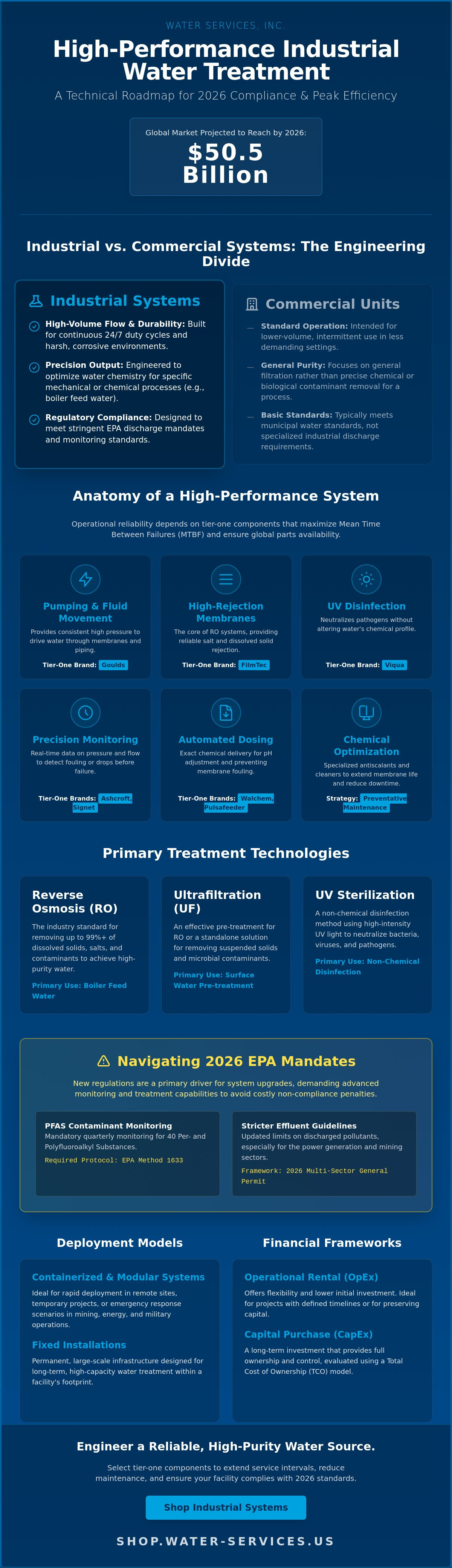
The global industrial water treatment market is projected to reach $50.5 billion by the end of 2026, yet many facilities continue to lose significant capital to preventable membrane fouling and pump failure. You likely recognize that maintaining high-purity standards while managing operational overhead is a constant struggle for your facility. Inefficient industrial water treatment systems often lead to spiraling costs and unexpected downtime in critical sectors like mining, energy, and military operations where reliability is non-negotiable.
This guide provides a technical roadmap for engineering high-performance infrastructure that meets the latest 2026 EPA standards, including the mandatory quarterly monitoring for 40 PFAS compounds using Method 1633. You'll learn how to select tier-one components, such as FilmTec membranes and Goulds Water Technology pumps, to extend service intervals and reduce maintenance frequency. We'll also evaluate the engineering trade-offs between modular containerized reverse osmosis plants and fixed installations. This analysis ensures you can identify a reliable, high-purity water source that complies with the 2026 Multi-Sector General Permit requirements while maximizing your system's operational lifespan.
Key Takeaways
- Identify the specific engineering criteria that distinguish industrial water treatment systems from commercial units, focusing on high-volume flow and equipment durability.
- Maximize Mean Time Between Failures (MTBF) by selecting tier-one components like Goulds pumps and FilmTec membranes for critical infrastructure.
- Evaluate the operational benefits of containerized reverse osmosis and mobile ultrafiltration systems for rapid deployment in remote or high-stakes environments.
- Utilize a Total Cost of Ownership (TCO) framework to navigate the financial trade-offs between capital expenditure and operational rental models.
- Implement precise chemical optimization strategies using specialized antiscalants and metering pumps to prevent membrane fouling and reduce system downtime.
What are Industrial Water Treatment Systems?
Industrial water treatment systems are specialized engineering solutions designed to remove physical, chemical, and biological contaminants from water used in large-scale production environments. Unlike standard commercial filtration, these systems operate at high flow rates and must maintain extreme durability under continuous 24/7 duty cycles. This industrial water treatment overview highlights that the primary objective is to optimize water quality for specific mechanical or chemical processes while ensuring compliance with environmental discharge mandates.
The distinction between commercial and industrial systems lies in the precision of the output and the ruggedness of the hardware. Industrial systems utilize heavy-duty components like Goulds pumps and Ashcroft pressure gauges to withstand corrosive environments. In 2026, the regulatory landscape has become a primary driver for system upgrades. New EPA standards regarding PFAS monitoring and power plant effluent guidelines require facilities to adopt more sophisticated industrial water treatment systems to avoid non-compliance penalties. Key applications include boiler feed water, cooling tower makeup, and high-purity process water for manufacturing.
Primary Technologies in Industrial Water Treatment
Reverse Osmosis (RO) remains the industry standard for removing dissolved solids and achieving high-purity water. Systems utilizing FilmTec or Hydranautics membranes provide reliable salt rejection for critical boiler feed applications. Ultrafiltration (UF) serves as an effective pretreatment for RO or a standalone solution for removing suspended solids and microbial contaminants from harsh surface water. For non-chemical disinfection, high-intensity UV sterilization systems, such as those from Viqua, provide a reliable method to neutralize pathogens without altering the water's chemical profile.
Process Water vs. Wastewater Treatment
Process water treatment focuses on the incoming supply. It ensures that the water chemistry aligns with specific manufacturing requirements to prevent scaling in heat exchangers or contamination in chemical blending. Conversely, wastewater treatment manages the discharge stream. This process removes oils, heavy metals, and chemicals before the water returns to the environment. Many modern facilities are now implementing Zero Liquid Discharge (ZLD) strategies. These advanced configurations recover all liquid waste for reuse, leaving only solid waste for disposal, which significantly reduces freshwater consumption and discharge costs.
Critical Components of a High-Performance System
The operational reliability of industrial water treatment systems depends entirely on the technical integrity of their individual sub-assemblies. Engineering for 2026 requires components that can withstand high-pressure environments while maintaining strict adherence to EPA's industrial effluent guidelines. Selecting tier-one brands like Goulds, FilmTec, and Viqua ensures global parts availability and a significantly higher Mean Time Between Failures (MTBF) compared to generic alternatives. When a single component fails, it can compromise the entire process loop, leading to costly downtime in mining or energy production.
Precision monitoring is the first line of defense against system degradation. High-performance systems integrate Ashcroft pressure gauges and Signet flow sensors to provide real-time data on membrane performance and fluid dynamics. These instruments allow operators to detect fouling or pressure drops before they escalate into catastrophic failures. Automated dosing is equally critical. By pairing Walchem controllers with Pulsafeeder metering pumps, facilities can achieve exact chemical delivery for scale inhibition and pH adjustment. This level of control is essential for protecting expensive downstream assets and ensuring consistent water purity.
Pumping and Fluid Movement with Goulds Technology
Goulds Water Technology centrifugal pumps are the industry standard for heavy-duty fluid movement. These pumps provide the consistent pressure required to drive water through reverse osmosis membranes and across extensive facility piping. Engineers must select pumps based on specific technical metrics, including maximum head and Gallons Per Minute (GPM) requirements, to ensure the system remains efficient under variable loads. You'll find that sourcing industrial centrifugal pumps from established manufacturers simplifies long-term maintenance by providing predictable wear patterns and readily available seal kits.
High-Efficiency Filtration: Membranes and UV
Membrane selection determines the salt rejection rates and energy efficiency of the entire plant. FilmTec reverse osmosis membranes are frequently specified for brackish water applications due to their high flux and durability. In contrast, Hydranautics membranes offer specialized high-rejection options for seawater desalination and complex wastewater recovery. Pre-treatment stages typically utilize multimedia filter tanks and Pentair filter housings to remove suspended solids, which protects the sensitive RO layers from premature fouling. For facilities requiring non-chemical disinfection, Viqua UV systems provide high-intensity ultraviolet light to neutralize pathogens without adding residual chemicals to the process stream. This combination of mechanical and light-based filtration ensures a high-purity output that meets the most demanding industrial specifications.
Modular and Containerized Solutions for Remote Sites
Remote industrial operations in the mining, energy, and military sectors require industrial water treatment systems that bypass the lengthy timelines of traditional civil engineering. Containerized reverse osmosis plants and mobile ultrafiltration systems provide a plug-and-play alternative to fixed installations. These systems are housed within standard ISO shipping containers, offering immediate weather protection and simplified logistics. By integrating all necessary components—including Goulds pumps, multimedia filter tanks, and Walchem controllers—into a single footprint, facilities can move from design to on-site commissioning in significantly less time than traditional builds.
Engineering for remote environments requires a focus on ruggedization. Custom-engineered units often feature advanced insulation, internal HVAC systems, and reinforced exteriors to maintain operational integrity in extreme climates. When selecting the appropriate technology for these sites, engineers often consult the Industrial Wastewater Treatment Technology Database to ensure the chosen process matches the specific contaminant profile of the local source water. This data-driven approach ensures that the containerized water treatment plants deployed are capable of meeting high-purity requirements without frequent component failure.
Mining and Oil & Gas Applications
In remote exploration and production, managing high-salinity brackish water is a primary technical challenge. Modular systems equipped with Hydranautics RO membranes allow operators to treat local groundwater for use in drilling or mineral processing. Many mining sites also utilize mobile ultrafiltration systems to treat tailings water for reuse. This closed-loop approach reduces the total cost of water procurement and ensures compliance with environmental discharge permits in regions with strict water scarcity regulations. The ability to relocate these assets as production zones shift provides a level of financial flexibility that fixed plants cannot match.
Military and Emergency Response Water
Military forward operating bases and emergency response teams require portable RO systems that can produce potable water from high-sediment surface sources. These ruggedized units must utilize standardized parts, such as Pentair filter housings and Ashcroft pressure gauges, to ensure logistical ease in the field. Reliability is paramount here; a system failure in a remote deployment can have immediate mission-critical consequences. By using modular designs, maintenance teams can quickly swap out replacement sediment and carbon filters or replace a Pulsafeeder metering pump without specialized tools. This modularity ensures that clean water production remains constant, regardless of the local infrastructure's condition.
Selecting Your System: Rental vs. Purchase Framework
Deciding between renting and purchasing industrial water treatment systems requires a rigorous analysis of the Total Cost of Ownership (TCO). This calculation must extend beyond the initial price tag to include energy consumption, chemical dosing requirements, and the frequency of component replacement. In 2026, the global industrial water treatment market is projected to reach $50.5 billion, reflecting a shift toward more complex, high-purity requirements that demand precise financial planning. Decision-makers must weigh the immediate Capital Expenditure (CAPEX) of a purchase against the ongoing Operational Expenditure (OPEX) of a rental agreement to determine which model suits their 2026 budget.
Custom engineering is a significant factor in this decision. A purchased system allows for a bespoke treatment chain designed for your facility's exact water chemistry. This precision reduces the risk of membrane fouling and ensures that components like Walchem controllers and Signet flow sensors are perfectly calibrated to your specific flow rates. For permanent operations, the long-term ROI of ownership typically outweighs the recurring costs of a rental agreement. Facilities that own their assets gain full control over their maintenance cycles and can source industrial water treatment equipment directly to optimize system performance.
When to Purchase a Custom System
Permanent facilities with long-term production goals should prioritize purchasing. It's the most cost-effective path for sites with stable water demands over a five-to-ten-year horizon. Ownership enables the installation of highly specialized treatment chains, such as those requiring specific FilmTec RO membranes for brackish water or Harmsco filtration products for high-flow sediment removal. By owning the equipment, you eliminate the premium paid for rental flexibility and significantly reduce monthly operational overhead. This model also allows for deeper integration with existing plant automation and SCADA systems for real-time monitoring.
The Case for Mobile Equipment Rental
Mobile equipment rental is the superior choice for temporary construction sites, emergency outages, or seasonal capacity spikes. These systems, often delivered as containerized reverse osmosis plants or mobile ultrafiltration units, provide high-purity water without the need for a large upfront investment. Rental agreements typically include technical support and commissioning, which reduces the burden on your internal engineering team. This flexibility is vital for short-term projects where the cost of a permanent installation cannot be amortized. It allows you to maintain strict compliance with environmental discharge permits while keeping your capital available for other core business needs.
Ready to upgrade your facility's infrastructure? Explore our full catalog of industrial water treatment solutions to find the right equipment for your 2026 requirements.
Maintenance and Chemical Optimization for Longevity
Preventative maintenance protocols define the operational lifespan of industrial water treatment systems. A reactive approach to equipment failure results in unmanaged downtime and high replacement costs. It's critical for facilities to prioritize on-site commissioning to establish baseline performance metrics for all tier-one hardware. By utilizing Walchem controllers and Signet flow sensors, operators can monitor water quality in real-time, ensuring that fluid dynamics remain within the specified ranges for Goulds pumps and FilmTec membranes. This data-driven strategy allows for the identification of fouling or scaling before it causes permanent damage to high-value assets.
The technical integrity of your system also depends on the accuracy of its instrumentation. Ashcroft pressure gauges provide the necessary data to track pressure drops across different stages of the treatment chain. When these metrics deviate from the established baseline, it often indicates the need for immediate intervention. Maintaining a steady communication rhythm between monitoring hardware and automated controllers ensures that the system responds dynamically to changes in feed water quality, which is essential for protecting downstream processes in energy and mining sectors.
Chemical Dosing and Scale Inhibition
The global industrial water treatment chemicals market is valued at $24.86 billion in 2026, reflecting the essential nature of chemical optimization. High-recovery reverse osmosis systems require precise scale inhibition to prevent mineral deposits from obstructing membrane pores. Pulsafeeder metering pumps provide the accuracy needed for consistent delivery, while Walchem controllers automate the dosing process based on real-time sensor feedback. This automation reduces manual labor requirements and eliminates the risk of human error in chemistry management. Selecting the correct antiscalants and biocides is a technical requirement for maintaining the salt rejection rates of Hydranautics membranes over multi-year cycles.
Replacement Parts and Consumables
Pre-treatment stages demand a rigorous schedule for replacing sediment and carbon filters. These consumables protect downstream RO membranes from chlorine and particulate matter that can cause irreversible oxidation or physical abrasion. Operators should monitor the differential pressure across Pentair filter housings and Harmsco housings to determine the optimal timing for filter changes. For the reverse osmosis stage, membrane replacement is typically necessary when normalized permeate flow drops by 10% to 15% or when salt passage increases significantly. Maintaining a local stock of critical spares ensures that maintenance can be performed during scheduled windows rather than emergency outages. For technical specifications and procurement, you can Browse the industrial equipment catalog at Water Services to source verified components.
Engineering Reliable Water Infrastructure for 2026 and Beyond
Successful operation of industrial water treatment systems hinges on the synergy between tier-one hardware and precise chemical management. As regulatory requirements for PFAS and effluent discharge tighten, the focus must remain on high-purity output and component durability. Whether your facility requires modular containerized plants for remote mining zones or fixed assets for energy production, selecting reliable brands like Goulds, Viqua, and FilmTec is the most effective way to reduce system downtime and operational costs.
We bring over 30 years of global water infrastructure experience to every project, specializing in the rigors of remote mining and military deployments. As an authorized distributor for leading manufacturers, we ensure your system is engineered for maximum efficiency and logistical simplicity. If you're ready to optimize your facility's performance and ensure long-term regulatory compliance, request a custom engineering quote for your industrial water system today. Your facility can achieve consistent, high-purity results with the right engineering strategy and hardware selection.
Frequently Asked Questions
What is the difference between commercial and industrial water treatment?
Industrial systems are engineered for higher flow rates and continuous 24/7 duty cycles compared to commercial counterparts. They utilize rugged components like Goulds centrifugal pumps and Ashcroft gauges to withstand corrosive environments. While commercial units focus on basic potability, industrial water treatment systems prioritize extreme purity for specific manufacturing processes or energy production loops. This distinction ensures the equipment can handle the rigors of heavy industry without frequent failure.
How often do industrial reverse osmosis membranes need to be replaced?
Industrial RO membranes typically require replacement every three to five years, though this depends on feed water quality and maintenance. Operators should track normalized permeate flow and salt passage using Walchem controllers. A 10% to 15% drop in flow or a significant increase in salt passage indicates that FilmTec or Hydranautics membranes have reached their service limit. Regular chemical cleaning with appropriate antiscalants can extend this interval by preventing irreversible mineral scaling.
Can industrial water treatment systems be customized for specific mining contaminants?
Yes, industrial water treatment systems are frequently customized to address specific mining contaminants like heavy metals, sulfates, and high salinity. Custom engineering involves selecting specialized RO membranes and multimedia filter tanks to treat tailings water for reuse. This allows mining operations to meet 2026 EPA effluent guidelines while reducing the total cost of freshwater procurement. Engineering the system to match site-specific chemistry prevents premature fouling and optimizes the Mean Time Between Failures.
What are the benefits of containerized water treatment plants for remote sites?
Containerized plants offer rapid deployment and immediate weather protection in harsh remote environments. These ISO shipping container units are pre-assembled with pumps, membranes, and controllers, allowing for plug-and-play installation. This modular approach is ideal for mining exploration or military bases where traditional civil construction is not logistically feasible. The ruggedized exterior protects sensitive components like Viqua UV systems and Walchem controllers from extreme temperatures and dust, ensuring consistent performance in the field.
How do I calculate the GPM requirements for my industrial facility?
To calculate GPM, sum the maximum simultaneous water demand of all equipment and add a 15% safety factor. Use Signet flow sensors to establish baseline data for existing processes. Correct sizing prevents cavitation in Goulds pumps and ensures the reverse osmosis membranes receive constant feed pressure. This technical approach avoids the operational inefficiencies of under-sized systems and ensures that your facility maintains adequate pressure during peak production cycles without wasting energy.
Is it better to rent or buy a mobile water treatment unit?
Renting is preferable for short-term projects or seasonal capacity spikes, while buying offers a better long-term ROI for permanent facilities. Rental units allow companies to avoid upfront CAPEX and often include outsourced maintenance. Conversely, purchasing allows for full system customization and eliminates recurring monthly rental fees, which is more cost-effective for stable, multi-year operations. Facilities should evaluate their five-year water demand forecast before deciding which financial model best supports their 2026 operational budget.
What role do UV sterilizers play in industrial water loops?
UV sterilizers, such as Viqua systems, provide non-chemical disinfection by neutralizing pathogens with high-intensity ultraviolet light. They are essential in industrial loops where residual chemicals could interfere with sensitive manufacturing processes. UV systems are often installed as a final polishing step or within cooling tower loops to prevent biological growth without altering the water's chemical profile. This technology is particularly effective in high-purity loops where maintaining a specific conductivity or pH level is critical for production.
How does zero liquid discharge (ZLD) impact operational costs?
Zero liquid discharge (ZLD) increases upfront capital expenditure and energy consumption but eliminates wastewater discharge fees. These systems recover nearly 100% of process water for reuse, which is critical in regions facing water scarcity or strict 2026 EPA effluent standards. While the operational cost per gallon is higher due to thermal evaporation, the total cost of compliance and freshwater procurement is often reduced over the system's lifespan, making it a viable long-term strategy for industrial facilities.
0 comentarios