

A single misinterpretation of a chemical indicator can lead to immediate production shutdowns or severe regulatory penalties. You likely recognize that while sophisticated industrial water quality monitoring systems provide deep data, they don't always offer the immediate, on-site verification required for rapid operational decisions. Waiting days for laboratory results often leaves your facility vulnerable to non-compliance, particularly as the EPA's 2026 Multi-Sector General Permit introduces more rigorous reporting standards. Relying on slow turnaround times isn't just inefficient; it's a risk to your process integrity.
This guide demonstrates how to select the most reliable, rapid-response chemical test strips to maintain industrial compliance and protect your infrastructure. You'll learn to identify which technical specifications match specific industrial sanitizers and how to implement a cost-effective monitoring protocol. We will examine the essential parameters for immediate verification and the simplified documentation methods needed to satisfy audit requirements. This technical overview provides the clarity required to bridge the gap between expensive lab analysis and the daily necessity of physical water safety verification.
Key Takeaways
- Understand the role of chemical test strips as a vital manual verification layer within industrial water quality monitoring systems to mitigate the risk of sensor failure.
- Learn to match strip sensitivity to specific industrial sanitizer types and concentration ranges to ensure effective disinfection and personnel safety.
- Identify key performance criteria, such as the distinction between semi-quantitative and quantitative readings, to maintain high accuracy in harsh environments.
- Streamline compliance documentation by utilizing multi-parameter strips that test up to 10 variables simultaneously for immediate process verification.
The Role of Test Strips in Industrial Water Quality Monitoring Systems
Automated industrial water quality monitoring systems provide continuous data streams, but they require physical validation to ensure technical integrity. Relying solely on digital sensors introduces risks associated with electrode fouling, calibration drift, and electronic failure. Manual chemical monitoring serves as a critical secondary verification layer. It confirms that the data displayed on a controller matches the actual chemical state of the process water. In 2026 industrial operations, this redundancy isn't just a preference; it's a requirement for maintaining process stability and avoiding costly regulatory fines.
For remote industrial sites, such as mining facilities or containerized reverse osmosis plants, point-of-use testing is indispensable. Transporting samples to a central laboratory is often logistically impossible or involves delays that render the data obsolete. Chemical test strips are the most cost-effective compliance tool for these environments. They require no power, no specialized calibration, and minimal training. By enabling immediate on-site adjustments, rapid testing prevents process downtime and protects expensive infrastructure like RO membranes and filtration media from chemical damage.
Manual vs. Automated Monitoring: A Hybrid Approach
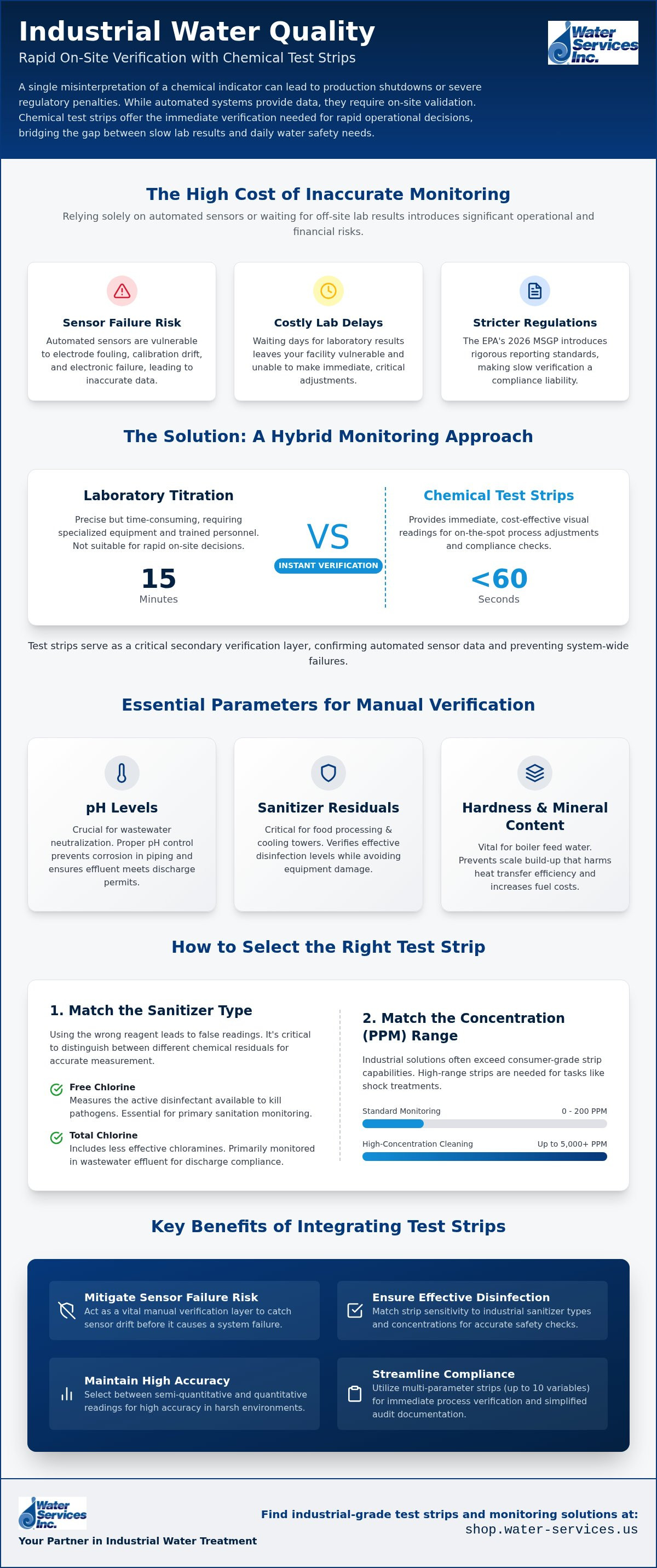
Digital sensors are precise but vulnerable to the harsh conditions of industrial fluids. A hybrid approach uses chemical test strips to validate digital accuracy and identify sensor drift before it triggers a system-wide failure. The speed advantage of dipsticks over laboratory titration is significant. While a full titration might take fifteen minutes, a test strip provides a visual ppm reading in under sixty seconds. Many regulatory frameworks now mandate this secondary chemical verification to prove that automated industrial water quality monitoring systems are functioning within specified tolerances. It's a reliable fail-safe against the risks of blind automation.
Key Parameters Tracked in Industrial Environments
Monitoring specific metrics is essential for equipment longevity and safety. Most industrial facilities focus on three primary categories for manual verification:
- pH Levels: Essential for process water and wastewater neutralization. Accurate pH control ensures that effluent meets discharge permits and prevents corrosion in metallic piping.
- Sanitizer Residuals: Critical in food processing and cooling tower management. Strips verify that sanitizer levels are high enough for disinfection but low enough to avoid damaging sensitive equipment.
- Hardness and Mineral Content: Vital for boiler feed water protection. Frequent testing prevents scale build-up, which directly impacts heat transfer efficiency and fuel consumption.
By integrating these manual checks into a daily protocol, operators can ensure that their chemical dosing pumps and controllers are performing as intended. This proactive approach identifies chemistry imbalances early, allowing for immediate correction through water treatment antiscalants or chemicals before they lead to hardware degradation.
Selecting Strips Based on Industrial Sanitizer Requirements
Effective sanitation relies on precise chemical concentrations. While industrial water quality monitoring systems often utilize electronic sensors to track general disinfection levels, these devices frequently lack the specificity to distinguish between different chemical residuals. Selecting the correct test strip requires matching the indicator's sensitivity to the specific sanitizer in use. Using the wrong reagent leads to false negatives or dangerously inaccurate ppm readings that compromise facility safety.
Understanding parts per million (ppm) ranges is fundamental for both disinfection efficacy and personnel safety. Industrial cleaning solutions often exceed the measurement capabilities of standard consumer-grade strips. For instance, monitoring free chlorine in cooling towers requires a different sensitivity than monitoring total chlorine in wastewater effluent. Free chlorine represents the active disinfectant available to kill pathogens, whereas total chlorine includes chloramines that are less effective. Precise monitoring prevents the over-application of water treatment chemicals, which protects downstream equipment from oxidative stress.
Selecting strips for high-concentration industrial cleaning solutions requires a technical understanding of the chemical's potency. When preparing shock treatments for fouled systems, concentrations can surpass 5,000 ppm. Standard sensors might struggle to provide an accurate reading at these extremes without complex dilution steps. Specialized high-range strips eliminate the need for manual dilution, reducing the margin for human error and providing immediate verification of chemical strength during critical cleaning cycles.
Quaternary Ammonium (Quat) vs. Chlorine Strips
Quaternary Ammonium compounds are standard for food-contact surface sanitizing. For these applications, color chart precision in the 150-400 ppm range is critical. If the concentration falls below 150 ppm, disinfection is inadequate; above 400 ppm, the solution may leave toxic residues. In contrast, high-range chlorine strips are necessary for industrial bleaching and heavy-duty disinfection where concentrations often reach 1,000 to 10,000 ppm. Standard low-range strips will simply bleach out at these levels, providing no usable data for the operator.
Peracetic Acid (PAA) and Iodine Monitoring
Peracetic Acid has become a preferred no-rinse sanitizer in brewing and dairy operations due to its rapid efficacy and lack of harmful byproducts. PAA strips must be calibrated to detect residuals as low as 10 ppm to ensure thorough rinsing isn't required. Iodine test strips serve specialized roles in medical environments and certain food processing sectors. Identifying the correct reagents is vital because these chemicals react differently with various pad materials. Always verify that your strip's reactive pad is designed for the specific chemical residual you intend to measure to avoid cross-interference from other dissolved solids.
Performance Criteria: Accuracy, Sensitivity, and Reliability
Technical reliability in water testing depends on the physical integrity of the reagents. While digital industrial water quality monitoring systems deliver high-resolution numerical outputs, chemical test strips categorize results into specific ppm ranges. This semi-quantitative approach is sufficient for most field verifications, provided the operator understands the variables affecting color development. Accuracy isn't just a product of the strip's chemistry; it's a result of standardized testing protocols and environmental control.
Industrial environments present unique challenges for visual color matching. High-bay LED lighting or sodium vapor lamps can shift the perceived color of a reactive pad, leading to incorrect readings. Operators should perform color matching under consistent, neutral lighting whenever possible. Temperature also plays a critical role. Most reagents are calibrated for use between 15°C and 30°C. If you're testing effluent in a cold mining environment or high-temperature process water, the reaction time may need adjustment to reach full color saturation. Ignoring these variables leads to user error that compromises your water treatment monitoring accuracy.
Shelf life is the most overlooked factor in reliability. Chemical reagents degrade over time, especially when exposed to air. Using an expired strip isn't just a minor technicality; it's a risk to your process integrity. Most industrial-grade strips have a 24-month shelf life from the date of manufacture, but this assumes the container remains sealed. Once opened, the clock accelerates. Establishing a strict inventory rotation ensures that your secondary verification tools remain as precise as your primary industrial water quality monitoring systems.
Sensitivity Thresholds and Detection Limits
Industrial monitoring requires higher ppm resolution than general-purpose testing. Defining the minimum detection limit (MDL) is essential when tracking heavy metals like iron or copper in wastewater. For process control, narrow-range pH strips are superior to wide-range variants. A strip that covers a pH of 0 to 14 in whole units won't provide the precision needed for a neutralization tank. Instead, using a narrow-range strip with 0.5-unit increments allows for tighter control and more efficient chemical dosing.
Environmental Resistance and Storage
Humidity is the primary cause of reagent failure. Industrial facilities with high moisture levels require strips stored in high-density polyethylene (HDPE) bottles. Desiccant caps are mandatory for maintaining reagent integrity by absorbing residual moisture every time the bottle is opened. Storage temperature guidelines are equally strict. Keeping consumables in a climate-controlled area, away from direct sunlight and chemical fumes, prevents premature oxidation of the testing pads. This logistical discipline ensures that your monitoring consumables perform reliably when a critical process deviation occurs.
Industry-Specific Applications for Water Quality Strips
Industrial requirements for water testing are highly specialized. While automated industrial water quality monitoring systems handle broad parameters, specific sectors like mining and food production depend on niche chemical indicators to ensure safety and compliance. These manual tools provide the immediate feedback necessary for daily operational adjustments that digital sensors might miss. Physical verification remains the primary defense against sensor drift in high-stakes environments.
Mining and Heavy Industrial Wastewater
Mine sites generate significant quantities of nitrate and nitrite as byproducts of blasting operations. These compounds must be neutralized before discharge to prevent groundwater contamination and local ecological damage. Tracking heavy metal residuals like iron and copper is equally vital to avoid regulatory fines. Operators must recognize that while strips handle these basic parameters, the EPA's 2026 Multi-Sector General Permit now requires quarterly monitoring for PFAS compounds using specialized lab analysis. Rapid pH spot-checks provide immediate feedback on acid mine drainage neutralization efforts. It's a critical step because shifting mineral loads can rapidly alter the required dosage of water treatment antiscalants and chemicals. For facilities managing complex discharge profiles, integrating manual testing with advanced Industrial Water Treatment Systems ensures every gallon meets environmental standards.
Commercial Kitchens and Food Production
Food safety protocols demand constant sanitizer verification. Operators use test strips in 3-compartment sinks and mechanical dishwashers to confirm chemical concentrations meet FDA and local health department requirements. In industrial frying operations, testing for Total Polar Materials (TPM) determines when fryer oil has degraded to the point of being unsafe. This prevents premature oil disposal while maintaining product integrity. It's an essential cost-saving measure that ensures the quality of the final product remains consistent across multiple batches.
Cooling tower maintenance involves monitoring scale-forming minerals like calcium and biocide levels to prevent Legionella growth and heat exchanger fouling. In healthcare and heavy industrial settings, multi-parameter urine dipsticks are utilized for routine worker health screenings. These strips identify early signs of chemical exposure or dehydration in personnel working in demanding environments. While sophisticated industrial water quality monitoring systems manage the bulk of the process, these manual indicators address the human and maintenance variables that automated sensors cannot track. Browse our full selection of specialized water treatment monitoring consumables to equip your facility for these specific industrial demands.
Procurement Guide: Strips at Water Services, Inc.
Efficient consumable procurement is essential for maintaining the operational uptime of industrial water quality monitoring systems. At Water Services, Inc., we maintain a specialized collection of 109 chemical test strip products designed to meet the rigorous demands of industrial, military, and mining environments. This comprehensive inventory allows procurement officers to consolidate their supply chain, sourcing everything from basic pH indicators to high-precision reagents from a single, reliable provider. By stocking over 100 variants, we ensure that specific technical requirements for sensitivity and chemical compatibility are met without compromise.
Multi-parameter strips represent the highest level of efficiency for field technicians. These tools allow for the simultaneous testing of 5 to 10 variables in a single dip, significantly reducing the time required for routine spot-checks. Common configurations include combinations of total hardness, free chlorine, total chlorine, alkalinity, and cyanuric acid. For large-scale monitoring programs, bulk purchasing provides significant logistical benefits. Maintaining a consistent supply of fresh reagents prevents the use of expired materials, which we previously identified as a primary cause of reading inaccuracy. Our logistical capabilities ensure that domestic and international facilities receive these critical consumables with predictable lead times.
Top-Rated Multi-Parameter Pool and Spa Strips
Commercial aquatic centers and industrial cooling systems require frequent monitoring of Free Chlorine, pH, and Total Alkalinity. Our multi-parameter strips provide the rapid-response data needed to adjust chemical dosing pumps in real-time. When handling these concentrated chemicals, operators must utilize appropriate Personal Protective Equipment (PPE) to ensure safety. These strips are calibrated for high-traffic environments where water chemistry fluctuates rapidly due to bather load or evaporation rates.
Specialized Disinfectant and Sanitizer Strips
Process safety in food production and medical facilities depends on the precision of Quat and PAA strips. These specialized indicators are designed to detect residuals at the specific parts-per-million levels required for no-rinse sanitizing. We also provide residual chlorine strips specifically for drinking water treatment, ensuring that effluent meets strict health standards before distribution. To secure your facility's monitoring requirements, you can browse the full Chemical Test Strips collection to find the exact parameters needed for your application. Integrating these manual tools into your broader industrial water quality monitoring systems ensures a redundant and reliable safety protocol.
Optimizing Industrial Water Safety Protocols
Integrating chemical test strips into your facility's daily workflow provides a physical verification layer that digital sensors cannot replicate. Selecting the correct reagent for your specific sanitizer and adhering to strict storage protocols are essential steps for maintaining technical integrity. These manual tools act as a critical fail-safe, ensuring that your primary industrial water quality monitoring systems remain accurate and that your process water meets all regulatory thresholds. Redundancy in testing is the only way to guarantee that sensor drift doesn't lead to expensive compliance failures.
Water Services, Inc. leverages global industrial engineering expertise to curate a specialized collection of over 100 monitoring products. Our technical solutions are trusted by the mining and military sectors to perform in the world's most demanding environments. By consolidating your procurement of high-precision consumables, you simplify compliance documentation and reduce the risk of unexpected process downtime. Effective water management starts with having the right tools available at the point of use for immediate results.
Shop the Chemical Test Strips Collection at Water Services, Inc. to equip your facility with the industry's most reliable monitoring tools. Maintaining process integrity has never been more straightforward.
Frequently Asked Questions
How accurate are chemical test strips compared to digital water meters?
Chemical test strips provide semi-quantitative results by categorizing chemical concentrations into specific color-coded ranges. While digital water meters offer higher resolution and quantitative data, strips are essential for immediate physical verification. They serve as a reliable backup for industrial water quality monitoring systems by confirming that electronic sensors haven't drifted or failed due to electrode fouling or electronic interference in harsh environments.
What is the typical shelf life of an industrial chemical test strip?
The typical shelf life for an unopened industrial chemical test strip container is 24 months from the date of manufacture. Once the seal is broken, the reagents are exposed to atmospheric oxygen and moisture, which accelerates chemical degradation. For maximum reliability, most facilities rotate their inventory every 90 to 120 days to ensure the reactive pads provide accurate color development during critical process checks.
Can I use pool test strips for industrial wastewater monitoring?
Using standard pool test strips for industrial wastewater monitoring is generally discouraged due to significant differences in sensitivity and chemical interference. Industrial effluent often contains high concentrations of heavy metals or complex organic compounds that can bleach or distort the color pads on consumer-grade strips. Specialized industrial strips are calibrated for higher ppm ranges and are formulated to resist interference from common industrial co-contaminants.
Why did my test strip not change color after dipping?
A lack of color change typically indicates either the absence of the target chemical or "bleaching out" caused by extremely high concentrations. If the sanitizer level exceeds the strip's maximum detection limit, the reagent may react completely and then turn white, giving a false negative. It's also possible the strips have expired or been damaged by improper storage. Always check the expiration date and perform a control test with a known solution.
Are there strips that can detect heavy metals like lead or arsenic?
Standard chemical test strips can detect specific heavy metals like iron, copper, and zinc at industrial parts-per-million levels. However, detecting lead or arsenic at regulatory health thresholds usually requires certified laboratory analysis or specialized EPA-approved field kits. Most basic strips lack the sensitivity required to detect these specific contaminants at the low parts-per-billion levels mandated by current 2026 safety standards.
How do I properly store test strips in a high-humidity facility?
Proper storage in high-humidity facilities requires keeping the strips in their original high-density polyethylene bottles with the desiccant cap tightly secured. Never leave the bottle open longer than necessary to remove a single strip. Storing the containers in a climate-controlled cabinet away from direct sunlight and chemical fumes prevents premature oxidation of the sensitive reagents and maintains detection accuracy over the product's lifespan.
What is the difference between free chlorine and total chlorine strips?
Free chlorine strips measure the active disinfectant available to neutralize pathogens, while total chlorine strips measure both free chlorine and combined chloramines. In many industrial water quality monitoring systems, tracking the difference between these two values is vital for managing chlorine demand. If the gap between free and total chlorine is too wide, it indicates that the system is heavily loaded with organic contaminants that require additional treatment.
Do I need special training to use industrial-grade test strips?
Industrial-grade test strips don't require formal certification, but operators must follow standardized testing protocols to ensure accuracy. This includes precise immersion times, specific wait periods for color development, and matching the pad to the color chart under neutral lighting. Establishing a written Standard Operating Procedure helps eliminate user error and ensures consistency across different shifts and personnel in demanding commercial environments.
0 comentarios