

Industrial filtration is not a single product; it's a multi-stage engineering architecture where the pump, the media, and the controller must work in perfect synchronization. You've likely experienced how a single filter fouling event or a slight drop in pressure can lead to expensive operational downtime and regulatory risk. With the EPA finalizing the listing of nine PFAS compounds as hazardous constituents in April 2026, managing industrial water filtration systems requires a level of technical precision that goes beyond simple hardware replacement.
This expert guide provides the technical roadmap you need to master high-volume water treatment and ensure reliable compliance with current environmental standards. We'll examine the most efficient technologies for your specific site volume, including FilmTec reverse osmosis membranes and high-capacity multimedia filter tanks. You'll learn how to integrate Goulds Water Technology pumps with advanced Walchem controllers to create a scalable system that reduces your total cost of ownership through smart, data-driven optimization.
Key Takeaways
- Establish a technical selection framework by analyzing site-specific water chemistry, including TDS and turbidity, alongside peak flow requirements.
- Understand the 2026 transition toward high-efficiency industrial water filtration systems that prioritize low-waste output and multi-stage contaminant removal.
- Evaluate the performance of Viqua UV purification systems and reverse osmosis membranes for achieving precise biological disinfection and chemical purity levels.
- Assess the logistical benefits of modular containerized treatment plants and mobile ultrafiltration units for rapid deployment at remote industrial sites.
- Maximize equipment lifespan by implementing rigorous maintenance protocols such as Clean In Place (CIP) and real-time pressure differential monitoring.
Defining Industrial Water Filtration Systems in 2026
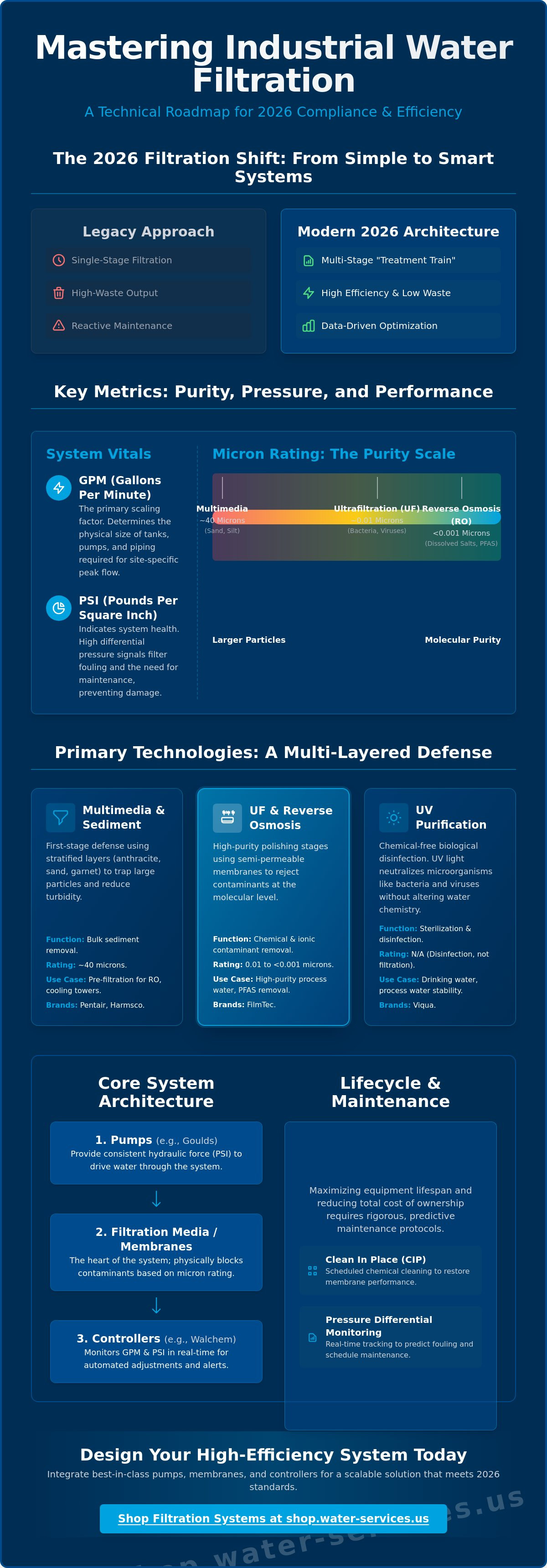
Industrial water filtration systems represent a multi-stage engineering process designed to remove physical solids, dissolved chemicals, and biological contaminants from high-volume water supplies. In 2026, the industry has transitioned away from simple, single-stage filtration toward high-efficiency, low-waste architectures. This shift is driven by stricter environmental mandates and the rising cost of raw water intake. Modern industrial water filtration systems are no longer judged solely on their ability to clean water; they're evaluated on their recovery rates and energy consumption per gallon treated.
A comprehensive Industrial water treatment overview reveals that objectives vary significantly based on the application. Process water requires specific mineral profiles to protect sensitive machinery, while wastewater treatment focuses on meeting discharge limits for pollutants like PFAS and heavy metals. Drinking water systems for industrial campuses must prioritize sterilization. To achieve these diverse goals, engineers utilize a "treatment train" approach. This sequence typically starts with pre-treatment to remove large debris, followed by primary filtration for suspended solids, and concludes with high-purity polishing stages like reverse osmosis or UV sterilization.
The Core Components of an Industrial Setup
The technical integrity of the system depends on the synergy between its parts. Filtration media and semi-permeable membranes act as the heart of the operation, physically blocking contaminants based on size or charge. However, these components cannot function without consistent hydraulic force. Goulds Water Technology Pumps provide the necessary head pressure to push water through dense media and membranes at scale. These pumps work in tandem with automated control systems and flow sensors to monitor performance in real-time, allowing for immediate adjustments to chemical dosing or backwash cycles.
Key Performance Metrics: GPM, PSI, and Micron Ratings
Precision in water management requires a mastery of three metrics. Gallons Per Minute (GPM) serves as the scaling factor; it determines the physical size of tanks and pump capacity. Micron ratings define the smallest particle size a filter captures, ranging from 40 microns in sand filters to 0.01 microns in ultrafiltration. Finally, pressure (PSI) indicates system health. High differential pressure signals fouling, while maintaining optimal PSI levels extends membrane life and prevents pump failure. Tracking these data points allows for predictive maintenance, reducing the total cost of ownership for industrial water filtration systems.
Primary Technologies: From Multimedia to Reverse Osmosis
Selecting the right technology for industrial water filtration systems involves a technical trade-off between energy expenditure and target water quality. While multimedia systems require minimal power, they can't achieve the molecular-level purity of membrane-based solutions. Modern 2026 designs favor modularity. It's an approach that allows facilities to scale capacity by adding skids rather than replacing entire monolithic plants. This flexibility is vital for industries facing fluctuating production volumes or evolving discharge regulations.
Filtration efficiency is tethered to pump performance. Competitors often overlook this link, but maintaining a consistent flux across the media is impossible without precise hydraulic control. A well-engineered system balances flow and head pressure to minimize energy waste and prevent media channeling. For biological threats, Viqua UV Water Purification Systems provide essential sterilization without the need for chemical additives. It's a reliable way to ensure process water remains stable and non-corrosive.
Multimedia and Sediment Filtration
Multimedia tanks use stratified layers of anthracite, sand, and garnet for depth filtration. This arrangement traps larger particles throughout the bed rather than just on the surface, which extends the time between backwash cycles. Heavy-duty Pentair and Harmsco filter housings are industry standards for removing heavy sediment loads before water reaches more sensitive downstream equipment. These setups are common in cooling tower loops and as pre-filtration for reverse osmosis skids where turbidity must be strictly controlled.
Membrane Technologies: Ultrafiltration (UF) and RO
Ultrafiltration acts as a physical barrier against pathogens and macromolecules. It operates at lower pressures than reverse osmosis, making it a cost-effective choice for surface water treatment. For high-purity requirements like boiler feed or desalination, reverse osmosis is necessary within industrial water filtration systems to remove total dissolved solids (TDS). High-performance FilmTec and Hydranautics membranes are the standard for these high-volume operations. For detailed technical specifications on pressure and flow rates, consult our Commercial Reverse Osmosis Water Filtration System Guide.
If you're building a new treatment train, you can browse our full inventory of filtration hardware to find the right match for your flow requirements.
Modular and Mobile Systems for Remote Industrial Sites
Remote industrial operations in mining or military sectors face unique logistical hurdles that traditional industrial water filtration systems cannot address. Fixed infrastructure is often impractical due to the temporary nature of the project or the extreme geography of the site. This has led to the rise of ruggedized, mobile treatment units designed for rapid deployment and high-mobility. These systems must withstand harsh environments while delivering the same water quality as a permanent facility. For a deeper look at site-specific engineering and compliance, see our guide on Mining Wastewater Treatment Solutions.
Engineering for these environments requires a focus on vibration resistance and structural integrity. Components must be secured to prevent damage during transport over unpaved terrain. Success depends on the technical synchronization of pumps, sensors, and housings within a reinforced frame. It's not enough to have high-quality membranes; the entire architecture must be hardened against the rigors of relocation and varied influent water chemistry.
Containerized RO and UF Plants
Containerized plants utilize standard shipping containers to house complete reverse osmosis (RO) or ultrafiltration (UF) setups. This "plug-and-play" approach reduces on-site construction time from months to days. Each unit arrives pre-plumbed and pre-wired, requiring only raw water intake and power connections. Within the container, integrated climate control protects sensitive membranes from temperature extremes. Advanced Walchem controllers manage the automation, ensuring the system operates within optimal parameters without constant manual oversight. If production needs grow, these units allow for easy scalability by daisy-chaining multiple containers together to increase GPH capacity.
Rental vs. Purchase: Tactical Water Management
Deciding between purchasing a permanent mobile unit or opting for a tactical rental depends on project duration and capital allocation. Short-term exploration sites or emergency response scenarios often favor rental units to avoid the high upfront costs of ownership. Conversely, long-term remote installations benefit from the lower total cost of ownership provided by a purchased system. Global support logistics are critical here. Whether renting or buying industrial water filtration systems, you must ensure your provider can ship replacement filters and parts to remote coordinates. Reliability in the field is the only metric that matters when downtime costs thousands of dollars per hour.
Selecting the Right System: A 2026 Decision Framework
Selecting industrial water filtration systems is a technical exercise in risk management and process optimization. You can't rely on guesswork when operational uptime and regulatory compliance are at stake. A systematic framework ensures the chosen hardware matches the specific contaminant profile and hydraulic demands of your site. Success requires a data-driven approach that accounts for both influent quality and effluent requirements.
First, conduct a comprehensive water chemistry analysis. This must include Total Dissolved Solids (TDS), pH levels, and turbidity. Second, determine your daily volume requirements and peak flow demands in GPM. These numbers dictate the size of your pumps and the diameter of your filter housings. Third, identify your discharge or product-water compliance standards. As of 2026, industrial facilities must test for 40 different PFAS compounds quarterly using EPA Method 1633. Fourth, evaluate energy availability and physical footprint constraints. Finally, select your technology stack, such as a combination of Multimedia, RO, and UV stages to create a complete treatment train.
Contaminant-Specific Selection
Mining operations often focus on heavy metal removal, while food processing requires the elimination of organic matter. Each application demands a different chemical approach. Using antiscalants and chemicals is vital to prevent membrane fouling in high-TDS environments. This extends the service life of your RO membranes and maintains consistent flux rates. For a detailed look at evolving discharge limits and "Best Available Technology" standards, refer to our analysis of Wastewater Treatment Technologies for 2026 compliance.
Engineering for Reliability and Redundancy
Continuous 24/7 industrial operations require "N+1" redundancy. This means having an extra filtration skid or pump ready to take over during maintenance or unexpected failure. Integrating robust electric power controls ensures system safety and allows for automated failover. Personnel safety is equally important during system operation. Ensure your team uses appropriate PPE when handling concentrated chemicals or performing Clean In Place (CIP) procedures. Reliable systems don't just clean water; they protect the people and the equipment involved in the process.
If you need help configuring your setup, you can contact our engineering team to select the right components for your facility.
Lifecycle Management and Maintenance of Filtration Hardware
Efficient lifecycle management separates high-performing industrial water filtration systems from those plagued by frequent, costly downtime. It's not enough to install high-quality hardware; you must monitor the hydraulic health of the entire treatment train. Neglecting maintenance doesn't just ruin filters. It puts excessive strain on your pumps and compromises the chemical integrity of your process water. A proactive approach focuses on data-driven intervals rather than reactive repairs.
Routine membrane cleaning, known as Clean In Place (CIP), is mandatory for maintaining optimal flux rates. If you wait for a total flow failure before initiating a CIP cycle, you've likely already caused irreversible scaling or fouling. Monitoring pressure differentials across each filtration stage is the most reliable way to track system health. Using Signet flow sensors and Ashcroft gauges provides the technical precision needed for real-time monitoring. These instruments allow operators to detect a 10% to 15% increase in differential pressure, which is the industry standard signal for required maintenance.
Consumable management is the next pillar of system longevity. You must establish a schedule for replacing sediment filters, carbon media, and UV lamps before they reach the end of their rated service life. For example, Viqua UV lamps typically require replacement every 9,000 hours to ensure biological sterilization remains effective. Integrating these hardware components with reliable pumps ensures that the hydraulic load remains balanced, preventing premature wear on impellers and seals.
Preventative Maintenance Schedules
Daily sensor calibration ensures your data remains accurate for automated decision-making. While sensors handle the minute-to-minute tracking, quarterly pump inspections are necessary to check for leaks or vibration issues in your Goulds units. Advanced Walchem controllers simplify this process by automating the dosing of antiscalants and chemicals, which significantly reduces the frequency of manual membrane cleaning. Every facility should maintain a "critical spare parts" list. This inventory must include replacement O-rings, solenoids, filter cartridges, and at least one set of backup membranes to ensure immediate recovery during a failure event.
The Water Services Advantage
Water Services, Inc. operates with the industrial reliability you need for complex projects. From our base in Provo, Utah, we provide global shipping of Quality Water Equipment you can trust and rely on to remote sites in Africa, South America, and across the globe. Our team specializes in custom engineering for modular, containerized solutions that meet specific site requirements. We don't just sell parts; we provide the technical architecture for sustainable water management. Consult with our engineers for a custom filtration design to optimize your 2026 operations.
Optimizing Your Water Infrastructure for 2026 and Beyond
Effective water management is no longer just about hardware; it's about the technical synchronization of every component in the treatment train. We've examined how modular architectures and precise sensor monitoring prevent fouling and ensure compliance with 2026 PFAS regulations. Mastering industrial water filtration systems requires a commitment to both high-quality membranes and the hydraulic power of reliable pumps. These elements must work in tandem to reduce your total cost of ownership and maintain operational uptime.
Water Services, Inc. has provided specialized solutions to the global mining and military sectors since 1994. We operate as a direct distributor for industry leaders like Goulds, Viqua, and FilmTec, while offering custom containerized engineering for remote deployments. Our team understands the rigors of industrial environments and the necessity of stable, high-performance equipment that can be shipped worldwide from our Utah headquarters.
Browse Industrial Pumps and Treatment Hardware at Water Services, Inc.
You'll find that with the right engineering partner, maintaining a reliable and scalable water supply is a manageable objective. It's time to secure the technical integrity of your facility's water treatment process.
Frequently Asked Questions
What is the difference between commercial and industrial water filtration systems?
Industrial systems are engineered for higher volumes and harsher contaminant profiles compared to commercial setups. While commercial systems often serve hospitality or office environments, industrial water filtration systems handle 24/7 heavy-duty operation in manufacturing, mining, and power generation. These units utilize higher PSI ratings and larger GPH capacities to manage the rigorous demands of process water and wastewater discharge compliance.
How do I calculate the flow rate (GPM) needed for my facility?
Calculate your peak instantaneous demand by totaling the GPM requirements of all equipment operating simultaneously. You must also account for storage tank refill rates and the water volume required for filter backwash cycles. This total ensures your pumps and media tanks maintain consistent pressure during high-load periods without starving downstream industrial processes or causing system cavitation.
What contaminants do multimedia filters typically remove?
Multimedia filters remove suspended solids, silt, and turbidity down to approximately 10 to 20 microns. They utilize stratified layers of anthracite, sand, and garnet to trap debris throughout the entire bed depth rather than just on the surface. This depth filtration makes them an essential pre-treatment stage for cooling towers and membrane-based systems where high turbidity would cause rapid fouling.
When should I choose ultrafiltration over reverse osmosis?
Choose ultrafiltration if your primary goal is removing pathogens, viruses, and macromolecules without stripping dissolved minerals. Reverse osmosis is required only when you must reduce Total Dissolved Solids (TDS) or desalinate the water supply. Ultrafiltration operates at much lower pressures than RO, which significantly reduces the energy consumption and operational costs for your facility's treatment train.
How often do industrial RO membranes need to be replaced?
Industrial RO membranes typically last between 3 to 5 years depending on the feed water chemistry and the consistency of maintenance. Regular Clean In Place (CIP) procedures and the correct dosing of antiscalants can extend this service life toward the higher end of the range. You should monitor salt rejection rates and pressure differentials to determine the exact technical replacement point for your elements.
Can industrial filtration systems be customized for high-salinity water?
Yes, industrial water filtration systems can be engineered with seawater-grade RO membranes and corrosion-resistant alloys for high-salinity applications. These specialized setups utilize Hydranautics or FilmTec elements designed to handle osmotic pressures that often exceed 800 PSI. We integrate high-pressure centrifugal pumps and stainless steel housings to ensure durability in these aggressive chemical environments.
What are the power requirements for a containerized RO plant?
Power requirements depend on the GPD capacity but usually require 460V three-phase electrical service for the high-pressure pumps and internal climate control systems. Smaller mobile units may operate on 230V single-phase power. Each containerized plant includes integrated Walchem controllers and electrical distribution panels to manage the power load for sterilization, pumping, and automated monitoring hardware.
Is mobile water treatment rental a viable long-term solution?
Mobile rentals are a tactical choice for temporary projects, emergency response, or seasonal capacity spikes. While they offer rapid deployment without high upfront capital, the cumulative rental fees usually exceed the cost of purchasing a system within 18 to 24 months. For permanent industrial sites, owning the equipment provides a significantly lower total cost of ownership and better long-term logistical control.
0 comentarios