

In heavy industry, a filter housing is a critical pressure vessel rather than just a container. Its reliability depends on material chemistry and the precision of the surrounding control valves. You understand that a single industrial water filter housing failure under high pressure or unexpected chemical corrosion doesn't just damage equipment. It halts production and compromises site safety. These preventable failures often stem from selecting vessels that don't meet the specific hygienic or pressure demands of modern 2026 operations.
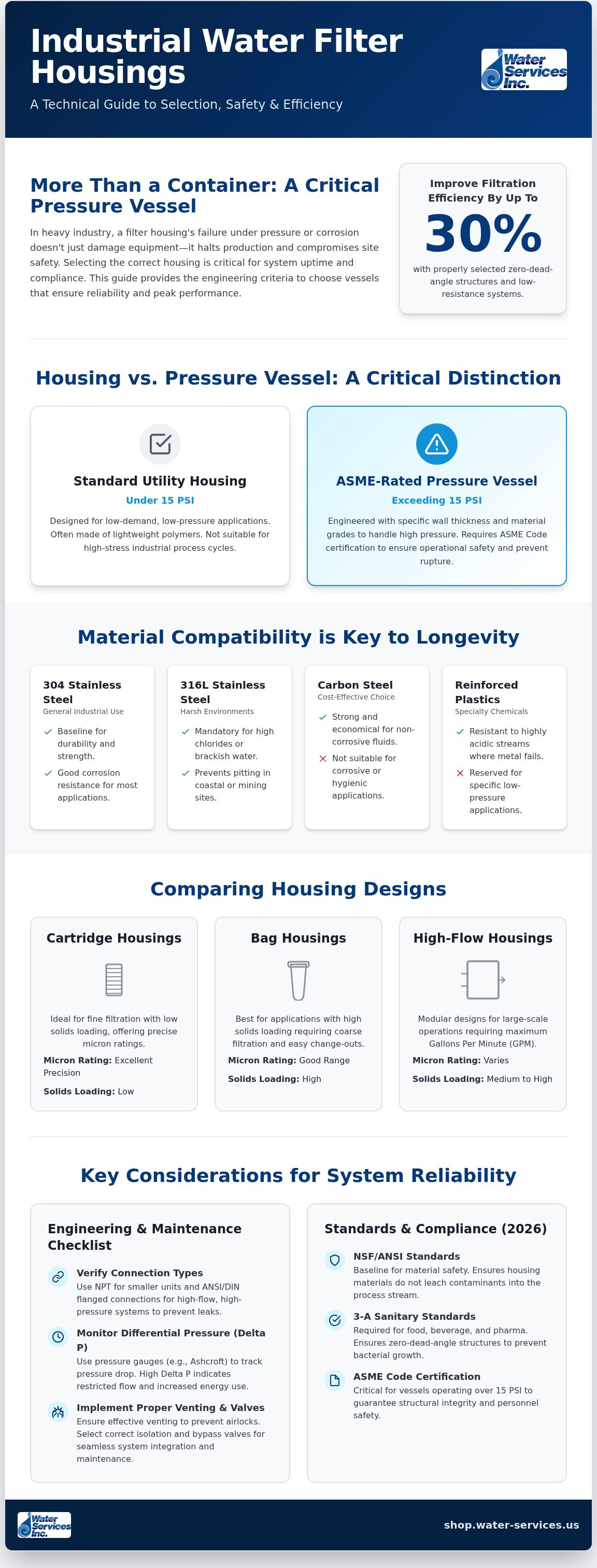
This guide provides the technical specifications and engineering criteria necessary to select housings that ensure maximum system uptime and strict compliance with ISO and FDA standards. We'll examine high-flow modular designs, material compatibility for harsh environments, and the integration of precision components like Pentair housings, Ashcroft gauges, and Signet sensors to extend equipment lifespan. By focusing on zero-dead-angle structures and low-resistance systems, you can reduce maintenance frequency and improve filtration efficiency by up to 30%. This guide provides the data points required for a stable and efficient procurement process.
Key Takeaways
- Distinguish between standard utility housings and industrial-grade high-flow vessels to ensure process safety under extreme operational pressures.
- Evaluate material compatibility between 304 and 316L stainless steel to prevent chemical corrosion and extend the lifespan of your filtration infrastructure.
- Determine the ideal industrial water filter housing configuration by comparing cartridge, bag, and high-flow designs for specific micron ratings and solids loading.
- Implement effective maintenance protocols using Ashcroft pressure gauges and proper venting to monitor differential pressure and prevent system downtime.
- Optimize procurement by selecting the correct isolation and bypass valves that work in tandem with Pentair or Harmsco vessels for seamless system integration.
Understanding the Role of Industrial Water Filter Housings in Process Safety
An industrial water filter housing serves as more than a simple container for filter media. It's a precision-engineered pressure vessel designed to maintain structural integrity under high flow rates and fluctuating hydraulic loads. While residential 'slim' housings are often made of lightweight polymers for low-demand use—and you can learn more about Absolute Water Filtration for these home-scale applications—industrial vessels utilize heavy-gauge stainless steel or reinforced carbon steel to handle the rigors of 24/7 process cycles. These units are built to manage the specific stresses of large-scale operations, ensuring that the internal filtration media remains seated and effective despite high differential pressures.
Selecting the correct vessel requires a foundational knowledge of various water filtration methods. Whether a system utilizes mechanical sieving or advanced adsorption, the housing acts as the primary safety barrier. Failure of a housing can lead to catastrophic downstream consequences. Unfiltered debris or housing fragments can destroy the precision internal components of Goulds Water Technology Pumps, leading to expensive repairs and unscheduled system downtime. In applications like mining process water, oilfield injection, and municipal pre-filtration, this level of reliability is non-negotiable for maintaining site safety and production quotas.
Housing vs. Pressure Vessel: Knowing the Difference
The distinction between a standard housing and a certified pressure vessel often depends on operating pressure. When a housing operates at high pressures, typically exceeding 15 PSI, it may require ASME Code certification to ensure safety. Engineering teams calculate wall thickness and material grade based on these specific PSI ratings. Choosing an unrated housing for a high-pressure loop creates a significant safety hazard. A rupture in a pressurized industrial line can cause severe equipment damage and pose a direct threat to onsite personnel. Proper engineering ensures the vessel can withstand both steady-state pressure and sudden surges.
Industrial Standards and Compliance in 2026
Compliance in 2026 demands adherence to strict global benchmarks for material safety and structural design. NSF/ANSI standards are the baseline for ensuring that housing materials don't leach contaminants into the process stream. For pharmaceutical or food and beverage sectors, 3-A Sanitary Standards are required to ensure zero-dead-angle structures that prevent bacterial colonization. In the mining industry, environmental compliance for wastewater discharge is critical. Housings must be robust enough to handle corrosive mine water while ensuring the treated effluent meets local regulatory limits for discharge or reuse.
Key Engineering Specifications for High-Performance Filter Housings
Engineering an industrial water filter housing requires balancing structural rigidity with chemical inertness. For most industrial applications, 304 stainless steel provides a baseline for durability. However, 316L stainless steel is mandatory for environments involving high chloride concentrations or brackish water, common in coastal military sites or South American mining projects. While carbon steel offers a cost-effective alternative for non-corrosive fluids, reinforced plastics are reserved for specific low-pressure, highly acidic streams where metals would fail rapidly. The choice of material directly impacts the vessel's ability to withstand long-term exposure to harsh process fluids without pitting or structural thinning.
System integration depends on the selection of connection types. NPT threaded connections are standard for smaller, modular units. In contrast, flanged connections (ANSI or DIN) are required for high-flow systems to ensure a leak-proof seal under vibration and thermal expansion. You must calculate the Gallons Per Minute (GPM) requirements accurately to prevent an excessive pressure drop, known as Delta P. A high Delta P indicates restricted flow, which forces pumps to work harder and increases energy consumption. You can evaluate our inventory of heavy-duty filtration components to find vessels rated for your specific flow requirements.
Temperature ratings are equally critical in process engineering. Standard housings may be rated for ambient temperatures, but specialty vessels are required for high-temperature process fluids exceeding 140°F. Using a housing beyond its rated temperature can lead to gasket failure or material warping, compromising the entire filtration loop. Engineering teams must verify that both the vessel and its internal components can maintain their physical properties at the maximum expected operating temperature of the system.
Chemical Compatibility and Corrosion Resistance
The vessel material is only one part of the equation. O-rings and gaskets must also resist the chemical profile of the process water. Viton is the standard for high-temperature and hydrocarbon resistance, while EPDM excels in polar solvents and steam. Buna-N remains a reliable choice for general oil and water service. Passivation is a mandatory chemical treatment process that removes surface iron to ensure the long-term corrosion resistance of stainless steel housings in 2026.
Sizing for Efficiency: Beyond 20-Inch Standards
Multi-round housings allow operators to manage high flow rates within a compact footprint. These vessels hold multiple filter elements, significantly increasing total surface area. While a standard 20-inch housing might suffice for pilot plants, large-scale industrial loops benefit from oversized vessels. Oversizing reduces the frequency of cartridge change-outs, which lowers labor costs and minimizes system downtime. This strategic approach to sizing converts a higher initial capital expenditure into significantly lower operational expenses (OPEX) over the equipment's lifespan.
Comparing Housing Designs: Cartridge, Bag, and High-Flow Systems
Selecting the correct industrial water filter housing configuration depends on the target micron rating and the total suspended solids (TSS) in the influent. Cartridge housings are the standard for high-purity applications, providing fine filtration from 0.1 to 20 microns. These vessels are essential for protecting sensitive downstream equipment like Reverse Osmosis Membranes from particulate fouling. Conversely, bag housings serve as the industrial workhorse for high-solids loading. They handle bulk sediment removal effectively before the water reaches finer polishing stages. For large-scale operations requiring massive GPM throughput, high-flow systems utilize specialized vessels with larger diameter elements to maintain flow rates while reducing the total number of required filter elements.
High-flow systems often utilize 6-inch or 6.5-inch diameter cartridges, allowing a single vessel to manage flow rates that would typically require dozens of standard 2.5-inch cartridges. This design reduces the footprint of the filtration skid and simplifies the maintenance process. By minimizing the number of seals and connection points, high-flow vessels also reduce the risk of internal bypass, ensuring that all process water passes through the media. This level of efficiency is critical for maintaining the high-purity standards required in modern industrial loops.
When to Choose Bag Filtration over Cartridges
In high-sediment environments like mining wastewater treatment, a cost-per-gallon analysis usually favors bag filtration. Bags offer a higher dirt-holding capacity for coarse particles, which prevents the rapid blinding that would occur with expensive pleated cartridges. In remote field operations, the ease of disposal and replacement makes bag housings a logical choice for logistical simplicity. However, bag housings have inherent limitations. They generally cannot achieve the sub-micron precision required for sterile or ultra-pure water applications. In these scenarios, bags function as pre-filters to extend the life of downstream cartridge stages.
Multi-Cartridge Vessel Engineering
The mechanical design of the closure mechanism impacts both safety and maintenance speed. Swing-bolt closures provide a robust, high-pressure seal that is safer for intense pressure cycles compared to lightweight V-band clamps. Within the vessel, internal support plates and spring assemblies are critical. These components ensure a bypass-free seal by keeping the cartridges firmly seated against the manifold. Operators should focus on optimizing the 'clean' pressure drop, which is the initial Delta P when filters are new. Maintaining a low initial pressure drop ensures maximum element life and prevents premature replacement due to hydraulic stress.
Operational Maintenance and System Integration for Industrial Reliability
Maintaining an industrial water filter housing requires precise instrumentation to avoid system failure. In modular or containerized treatment units, space is limited. Every component must serve a functional purpose. You must install Ashcroft Pressure Gauges on both the inlet and outlet ports. These gauges allow operators to monitor the differential pressure across the filter media in real time. Without accurate readings, you risk element collapse or bypass, which introduces contaminants into the downstream process. Monitoring these metrics is the only way to ensure the long-term reliability of your filtration loop.
Proper plumbing for venting and draining is equally critical. Air trapped within the vessel creates air pockets that reduce the effective filtration surface area. It also causes hydraulic shock during pump start-up, which can damage internal seals. You should install vent valves at the highest point of the housing to ensure safe air evacuation. Similarly, drain ports allow for complete fluid recovery during maintenance. This is essential when you're handling chemicals or mining effluent that must meet environmental discharge regulations. Leaking gaskets are a common source of compliance issues. You'll need to inspect and replace O-rings regularly to maintain a hermetic seal.
Advanced systems integrate housings with Electric Power Controls. This allows for automated bypass loops or emergency shutdowns when pressure limits are exceeded. Integration with a central PLC ensures that the system responds instantly to flow variations or filter blinding. You can browse our catalog of industrial control components to build a fully automated filtration skid that meets 2026 safety standards.
Monitoring Differential Pressure (Delta P)
Differential pressure, or Delta P, is the most critical metric for assessing filtration efficiency. It measures the energy lost as water forces its way through the accumulated debris on the filter media. Automated systems use sensors to trigger alerts when Delta P reaches specific alarm setpoints. Terminal pressure drop is the maximum allowable differential pressure at which a filter element is considered fully loaded and must be replaced to prevent housing damage or media rupture.
Safety Protocols for Housing Service
Safety is paramount when you're servicing high-pressure water loops. Operators must strictly follow Lock-out/Tag-out (LOTO) procedures to isolate the vessel from the main flow. Always wear appropriate Personal Protective Equipment (PPE), including gloves and face shields, especially when changing filters used in chemical treatment or mining applications. Before loosening any swing-bolt closures or clamps, verify the zero-pressure state using the manual vent valve. Opening a pressurized vessel can lead to severe injury or equipment destruction.
Procurement Strategy: Selecting Housings and Essential Control Valves
Selecting an industrial water filter housing is an incomplete engineering task without specifying the peripheral control valves. The valves surrounding your vessel are as critical as the pressure vessel itself. They dictate the efficiency of isolation, bypass loops, and routine maintenance cycles. If you install high-performance Pentair or Harmsco housings without compatible valves, you risk internal bypass or water hammer. These issues can compromise the integrity of the filter media and the safety of the entire pressurized line. A stable procurement strategy focuses on the complete filtration skid rather than individual components in isolation.
System reliability depends on selecting the right ball, check, or gate valves based on the specific hydraulic requirements of your site. In mining or military applications, where systems are often modular or mobile, space is at a premium. You must ensure that the chosen valve configuration allows for easy access and rapid operation. Poorly placed or incorrectly specified valves lead to extended downtime during cartridge or bag change-outs. This directly impacts the system uptime promise that industrial operators require for 24/7 production environments.
Beyond the initial hardware cost, you must calculate the Total Cost of Ownership (TCO). This metric includes the price of the housing, the frequency of replacement gaskets, and the energy costs associated with the system's Delta P. Since 1994, Water Services, Inc. has specialized in designing these integrated systems for demanding environments in Africa and South America. We focus on modular system design that incorporates Goulds Water Technology pumps and precise control hardware to ensure long-term durability and safety compliance.
The Role of Valves in Housing Performance
Isolation and bypass loops require specific valve architectures to maintain flow during maintenance. True Union ball valves are the preferred choice for modular systems because they allow for easy removal and system flexibility without cutting pipe. To prevent backflow damage to delicate filter media or reverse osmosis membranes, you must install reliable check valves. In large-scale industrial plants with massive GPM requirements, butterfly valves provide the necessary isolation with a smaller footprint and lower weight than traditional gate valves. You can browse our extensive inventory of high-performance industrial valves to complete your filtration system.
Final Selection Checklist for 2026
A successful procurement process ends with a rigorous verification of site conditions. You must confirm that the housing's flow rate, pressure, and temperature ratings exceed your maximum operational peaks. Verify chemical compatibility for all wetted parts, including O-rings and gaskets. Finally, account for physical space constraints. Many containerized systems fail to provide sufficient overhead clearance for element removal, turning a simple filter change into a complex mechanical project. Checking these data points ensures you meet 2026 industrial safety standards while reducing long-term maintenance frequency.
Advancing Industrial Reliability Through Engineered Filtration Solutions
Successful 2026 operations depend on the precise selection of an industrial water filter housing that meets both structural and chemical demands. You've identified that the distinction between a standard vessel and a certified pressure vessel is critical for site safety. Integrating high-performance housings with the correct isolation and bypass valves ensures that your system remains operational during routine maintenance. By focusing on total cost of ownership and engineering integrity, you can significantly reduce unscheduled downtime and improve your overall process efficiency.
Water Services, Inc. provides ASME-certified engineering support to assist with these complex technical requirements. We leverage over 30 years of water treatment expertise to provide stable solutions for the most demanding environments. Our team facilitates global shipping for remote industrial sites, ensuring that critical components reach mining and military operations in Africa and South America without delay. We're a dependable partner for professionals who require exact solutions for high-purity water systems.
Shop Industrial Valves and Control Hardware to finalize your engineered filtration skid. We're ready to support your next project with precision and logistical reliability.
Frequently Asked Questions
What is the maximum pressure rating for a standard industrial filter housing?
Standard industrial housings typically feature pressure ratings between 100 and 150 PSI. However, specialized ASME-coded vessels can handle pressures exceeding 300 PSI depending on the closure type and wall thickness. You must verify the rating on the manufacturer's data plate. Always ensure your system's peak surge potential doesn't exceed the vessel's rated capacity to prevent catastrophic structural failure.
How do I know if I need a stainless steel or plastic filter housing?
Select a stainless steel industrial water filter housing for high-pressure or high-temperature environments where structural integrity is paramount. Stainless steel is the standard for 24/7 industrial loops in mining or military applications. Reinforced plastic housings are reserved for low-pressure tasks or specific chemical streams where metal is incompatible. Metal vessels offer superior longevity and resistance to hydraulic shock compared to polymer alternatives.
What are the advantages of multi-cartridge housings for high-flow applications?
Multi-cartridge housings increase the total filtration surface area within a single vessel footprint. This allows the system to manage higher GPM throughput while maintaining a low initial pressure drop. By using multiple elements, you reduce the frequency of change-outs and lower operational labor costs. It's a space-efficient solution for large-scale plants that require high-purity water without the complexity of multiple single-cartridge skids.
How often should I replace the O-rings in my industrial filter housing?
Inspect and replace O-rings during every filter change or at least every six to twelve months. Seals made of Viton, EPDM, or Buna-N degrade over time due to thermal cycling and chemical exposure. A compromised gasket leads to internal bypass or external leaks, which can cause environmental compliance issues. Regular replacement ensures a hermetic seal and maintains the safety of the pressurized vessel.
Can I use a bag filter housing for drinking water treatment?
What is the difference between a 304 and 316L stainless steel housing?
The primary difference is corrosion resistance in harsh environments. 316L stainless steel contains molybdenum, which protects against pitting in chloride-rich or brackish water. 304 stainless steel is a durable and cost-effective choice for general water service with low salinity. For mining waste or coastal operations, 316L is mandatory to prevent material thinning and ensure the long-term reliability of the industrial water filter housing.
What instrumentation is required to monitor a filter housing's performance?
Reliable monitoring requires Ashcroft pressure gauges installed on both the inlet and outlet ports. These gauges allow operators to calculate differential pressure in real time. Additionally, you should integrate Signet flow sensors and Walchem controllers to automate system alerts. This instrumentation package provides the data necessary to prevent element collapse and ensure the system operates within its engineered specifications.
How do I calculate the pressure drop (Delta P) for my housing?
Calculate Delta P by subtracting the outlet pressure reading from the inlet pressure reading. This value represents the total resistance created by the housing and the accumulated debris on the filter media. A rising Delta P indicates that the filters are becoming loaded. When the reading reaches the terminal pressure drop specified by the manufacturer, an immediate filter change is required to maintain flow and protect the pump.
0 comentarios