

Facilities utilizing AI-driven condition monitoring can reduce unplanned downtime by 70% and cut maintenance costs by 25% through rigorous industrial pump vibration analysis. For operators in remote mining or offshore environments, a catastrophic pump failure is not just a repair bill. It is a logistical crisis that halts production for weeks. You understand that interpreting complex FFT spectra and managing tiered asset monitoring requires precise technical expertise rather than guesswork. Relying on reactive repairs leads to excessive emergency costs and shortened asset life cycles.
This technical guide provides the specific framework to master predictive maintenance. You will learn to detect fault patterns like unbalance, misalignment, and bearing wear before they escalate into system failures. By applying these technical fundamentals, you can protect high-value Goulds Water Technology Pumps and optimize industrial water system reliability. We will examine current standards such as ANSI/HI 9.6.4-2022 and ISO 20816 to establish a standardized maintenance protocol. This approach transforms raw vibration data into actionable tasks, ensuring your critical infrastructure operates within established safety zones.
Key Takeaways
- Learn how to transition from reactive repairs to predictive maintenance (PdM) to reduce unplanned downtime in remote mining and industrial environments.
- Master the use of Fast Fourier Transform (FFT) to convert time-domain signals into frequency-domain data for precise fault detection.
- Identify specific vibration signatures for mechanical imbalance and misalignment to prevent catastrophic damage to pump seals and couplings.
- Understand how to implement an effective industrial pump vibration analysis program using piezoelectric accelerometers and integrated Walchem Controllers.
- Leverage engineering expertise to protect high-value Goulds Water Technology Pumps and optimize the performance of mission-critical water treatment systems.
The Fundamentals of Industrial Pump Vibration Analysis
Vibration analysis is the primary diagnostic for rotating equipment health. It functions as the measurement and interpretation of oscillating mechanical movements in pumps to determine structural and operational integrity. Understanding The Fundamentals of Vibration is necessary to treat these oscillations as data points rather than just noise. By analyzing frequency and amplitude, technicians pinpoint the exact source of mechanical stress before a component fails. This process involves capturing raw signals and processing them to reveal the underlying health of the asset.
Modern water infrastructure is moving away from reactive "run-to-fail" strategies toward predictive maintenance (PdM). This shift is driven by the need for higher reliability in demanding environments like mining and offshore sites. Implementing industrial pump vibration analysis provides early fault detection, which significantly extends the Mean Time Between Failures (MTBF). It also improves energy efficiency by ensuring pumps aren't running with excessive friction or internal drag. To support your maintenance strategy with high-quality industrial fluids, you can discover Rida Lubricants and their range of premium products. You don't want to wait for a seal to leak or a motor to seize when the data can warn you weeks in advance.
Preventive vs. Predictive Maintenance Models
Scheduled preventive maintenance often fails to prevent catastrophic damage because it relies on time-based intervals. These intervals are frequently too long for high-stress applications or too frequent for stable systems. Vibration data identifies hidden mechanical degradation, such as subtle bearing wear or shaft fatigue, that visual inspections can't detect. While real-time monitoring involves higher initial hardware costs, its cost-benefit ratio is superior to periodic manual checks. Continuous monitoring eliminates the risk of a failure occurring in the weeks between manual data collection routes.
Standard Metrics: Velocity, Displacement, and Acceleration
Selecting the right metric is critical for accurate diagnostics. Velocity, measured in inches per second (in/s) or millimeters per second (mm/s), is the most common indicator of overall pump health. It tracks the destructive energy of the vibration. Acceleration, expressed in g-force (g), is the preferred metric for high-frequency bearing diagnostics and detecting gear mesh issues. Displacement, measured in mils, remains relevant for low-speed industrial equipment where large physical movements are common. Monitoring these metrics is essential for protecting investments in high-performance Goulds Water Technology Pumps and other critical assets.
Technical Mechanics: Interpreting the Vibration Spectrum
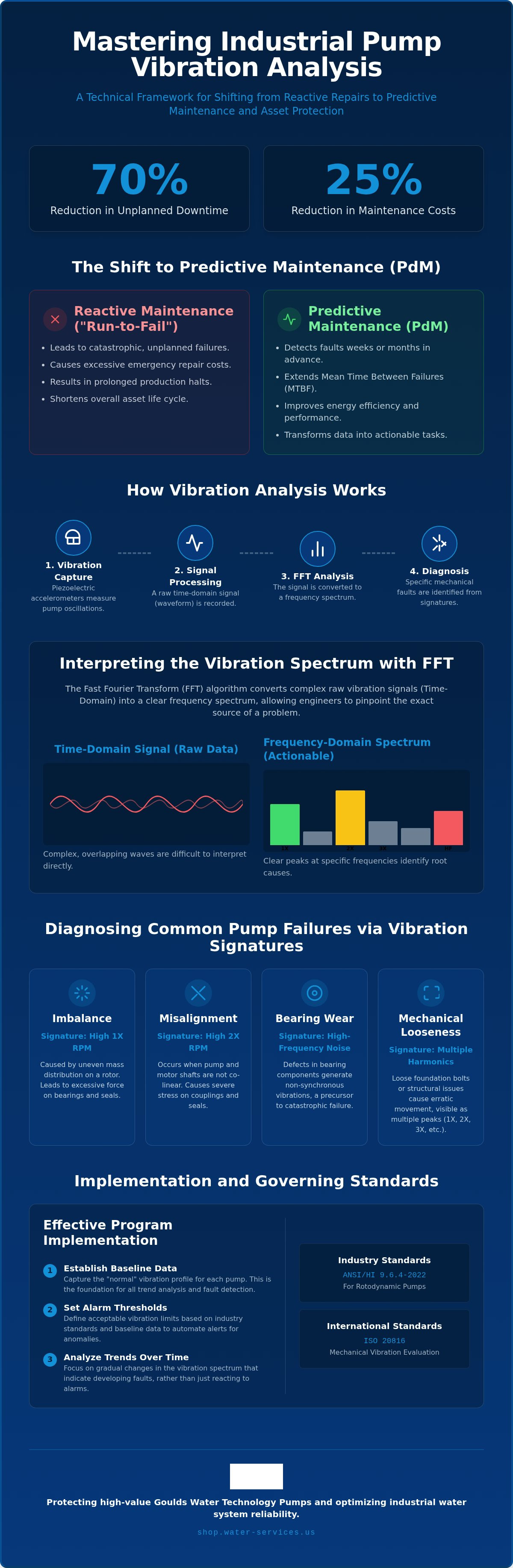
The raw data captured by a vibration sensor is a time-domain signal. It appears as a complex, overlapping wave representing the total movement of the pump. To make this data actionable, we use the Fast Fourier Transform (FFT). This mathematical algorithm decomposes the time-domain signal into its component frequencies. The resulting spectrum allows technicians to see exactly which parts of the pump are vibrating and at what intensity. Industrial pump vibration analysis relies on this spectral clarity to identify specific mechanical faults that remain hidden in raw signals.
Harmonics are peaks that occur at integer multiples of the pump's running speed (RPM). The fundamental frequency is labeled as 1X. If a pump runs at 1,800 RPM, the 1X peak appears at 30 Hz. Subsequent peaks at 2X (60 Hz) or 3X (90 Hz) provide specific clues about the pump's condition. For instance, a dominant 1X peak usually indicates a mechanical imbalance. A strong 2X peak often points toward shaft misalignment or a bent shaft. Distinguishing these harmonics is the first step in diagnosing root causes rather than just treating symptoms.
Establishing baseline data is a technical requirement for any effective program. You must know what "normal" looks like for your specific Goulds pump installation. Factors like pipe strain, foundation stiffness, and fluid viscosity change the vibration profile significantly. Comparing current data against this baseline is the core of Implementing a Predictive Maintenance Program. This comparison reveals subtle trends that standard threshold alarms might miss, such as the gradual emergence of non-synchronous peaks. Non-synchronous peaks don't track with RPM and often indicate bearing defects or electrical interference.
FFT Signal Processing Basics
Industrial sensors capture raw voltage signals that require conditioning before analysis. Signal conditioners amplify and filter these signals to remove electrical noise and interference from adjacent machinery. In a crowded water treatment plant, high-frequency noise from nearby motors can mask critical pump data. Proper filtering ensures the FFT spectrum only displays relevant mechanical information. Integrating these sensors with Walchem controllers allows for automated data logging and real-time alerting based on these processed signals.
Phase Analysis in Pump Diagnostics
Phase analysis measures the relative timing of vibration between two points on the machine. It's a powerful tool for distinguishing between faults that look similar in a standard spectrum. For example, both imbalance and misalignment can cause high 1X peaks. However, their phase signatures differ. Imbalance typically shows a consistent phase shift in the radial direction. Misalignment creates a significant phase difference across the coupling in the axial direction. This distinction is vital for vertical centrifugal pumps where structural resonance can mimic mechanical imbalance, leading to unnecessary and expensive balancing attempts.
Diagnosing Common Pump Failures via Vibration Signatures
Identifying specific mechanical faults requires a systematic approach to reading the spectrum. Mechanical imbalance is the most frequent issue encountered during industrial pump vibration analysis. It manifests as a high-amplitude 1X radial peak in the spectrum. This excessive radial force places extreme stress on pump seals and bearings, often leading to premature leakage and shaft deflection. If the 1X peak exceeds established baseline levels, balancing the impeller is usually the first corrective action required to prevent secondary component damage.
Misalignment presents differently, typically showing strong 2X or 3X axial peaks. In coupled systems, angular or offset misalignment creates a characteristic phase difference across the coupling. Bearing failure, conversely, starts as high-frequency "noise" in the acceleration spectrum. Rolling element wear progresses through four distinct stages; it begins with ultrasonic signals and ends with large, non-synchronous peaks as the geometry of the races and balls degrades. Catching these faults in the early stages allows for planned bearing replacement during scheduled downtime rather than after a catastrophic seizure.
Cavitation is a high-frequency random vibration caused by vapor bubble collapse. It appears as a raised "floor" of noise in the spectrum rather than distinct peaks. This phenomenon occurs when the Net Positive Suction Head (NPSH) is insufficient, leading to rapid material erosion on the impeller surfaces.
Hydraulic Faults: Cavitation and Recirculation
Cavitation creates a signature often described as "marbles in the pump," appearing as high-frequency energy between 500 Hz and 2 kHz. Low-flow recirculation is distinct, producing low-frequency surges and pressure pulsations when the pump operates too far to the left of its Best Efficiency Point (BEP). These hydraulic instabilities cause significant internal damage to Goulds Water Technology Pumps if left unaddressed. Consistent industrial pump vibration analysis prevents the erosion of impellers and volutes caused by these fluid dynamics.
Structural Issues: Resonance and Soft Foot
Soft foot occurs when a pump's mounting feet don't sit flush on the baseplate. You identify this by monitoring phase changes and 1X amplitude shifts while loosening individual mounting bolts. If the vibration drops significantly when a bolt is loosened, soft foot is present and must be shimmed. Mechanical resonance is a more complex structural issue where the machine's natural frequency matches its operating speed. This creates dangerous "critical speeds" that amplify even minor imbalances. Technicians must also distinguish between motor electrical faults, which disappear instantly when power is cut, and mechanical vibrations that coast down with the RPM.
Implementing a Condition-Based Monitoring (CBM) Program
Transitioning from periodic inspections to a formal CBM program requires selecting the correct transducer for your specific asset class. Piezoelectric accelerometers are the industry standard for most industrial pump vibration analysis applications because they capture a wide frequency range and are highly durable. For larger pumps equipped with fluid-film sleeve bearings, proximity probes are necessary to measure actual shaft displacement within the bearing housing. You must decide between continuous online monitoring for critical assets and route-based manual checks for balance-of-plant equipment based on the cost of failure.
Integrating these sensors with Walchem Controllers allows for automated alerts that bridge the gap between data collection and process control. Rather than waiting for a monthly report, these controllers trigger immediate notifications or system shutdowns when vibration levels exceed pre-set limits. Establishing these alarm thresholds should follow ISO 10816 standards, which categorize vibration severity based on machine size and mounting type. Severity Zone A represents newly commissioned machines, while Zone D indicates a high risk of imminent failure that requires immediate intervention.
Hardware Integration in Water Treatment Systems
Mounting technique directly impacts signal integrity and frequency response. Stud mounting is the preferred method for permanent installations because it provides the most accurate transmission of high-frequency signals up to 15 kHz. Magnetic mounts are suitable for route-based data collection but often attenuate frequencies above 5 kHz. In harsh environments like remote mining or offshore sites, sensors require NEMA 4X or IP68 rated stainless steel enclosures to prevent corrosion. You can then connect these vibration transmitters directly to SCADA or PLC systems via 4-20mA or digital protocols to centralize your facility's health metrics.
Data Management and Reporting
Raw data provides no value unless it's converted into actionable maintenance work orders. Historical trending is the primary tool for predicting the Point of Failure (P-F Interval), which is the time between the first detection of a fault and the moment the pump stops functioning. By tracking the rate of vibration increase, you can schedule repairs during planned outages rather than reacting to an emergency. Training plant personnel for basic diagnostic interpretation ensures that minor issues, like a loose mounting bolt or a blocked suction line, are corrected before they cause permanent bearing damage. To optimize your system's reliability, you can browse our selection of industrial controllers and sensors to start building your monitoring infrastructure.
Optimizing Pump Performance with Water Services, Inc.
Protecting high-value Goulds pump investments requires more than just reactive monitoring. It demands a partner with over 30 years of global water infrastructure experience. Water Services, Inc. serves as an authorized distributor of Goulds Water Technology Pumps, selecting specific hardware configurations for high-vibration applications. Our team integrates industrial pump vibration analysis into the commissioning phase to ensure every asset meets API 610 or ISO 10816 standards from day one. This technical oversight extends the asset life of mission-critical mining wastewater treatment solutions where unplanned downtime is not an option. We provide the expertise necessary to interpret complex data and convert it into a sustainable maintenance strategy.
Expert Engineering for Complex Pumping Challenges
System design is the first defense against mechanical failure. We engineer custom industrial water treatment systems specifically to minimize hydraulic turbulence and structural resonance. By sourcing high-durability components from our Water Treatment collection, we eliminate common vibration triggers like pipe strain and cavitation. This precision is vital for containerized and mobile treatment units used in military or remote industrial sectors. These systems operate in demanding environments where structural stability is often compromised by uneven foundations or temporary mounting. Our engineering team ensures that every pump operates within its best efficiency point to reduce internal stress and energy consumption.
Global Support and Maintenance Logistics
Our logistical capabilities ensure that technical support is available regardless of site location. We provide on-site industrial pump vibration analysis and troubleshooting for remote mining and offshore facilities. Proactive replacement part logistics allow for the rapid deployment of bearings, seals, and impellers before a detected fault leads to a catastrophic breakdown. We offer global maintenance contracts that standardize your predictive maintenance protocol across multiple sites. This consistency ensures that every pump in your fleet adheres to the same rigorous health metrics and operational standards. Our technicians provide on-site commissioning to verify that new installations are free from soft foot or misalignment issues before they enter service. Contact Water Services for an Industrial Pump Consultation to secure your infrastructure's reliability and optimize your pumping operations.
Securing Industrial Infrastructure with Predictive Data
Transitioning from reactive maintenance to a data-driven strategy is essential for protecting critical water infrastructure. You've seen how spectral analysis and phase timing differentiate simple imbalance from complex structural resonance. Mastering industrial pump vibration analysis allows your team to identify mechanical degradation before it results in catastrophic failure or expensive unplanned downtime. This technical discipline ensures that every asset operates within its best efficiency point while maintaining compliance with ISO 10816 standards.
Water Services, Inc. provides the engineering expertise and high-performance hardware required to implement these programs. As an authorized Goulds Water Technology distributor with over 30 years of industrial water experience, we offer global technical support and on-site commissioning to secure your facility's long-term reliability. We understand the rigors of remote mining and industrial environments. It's time to transform your maintenance department into a strategic asset. Shop Industrial Pumps and Control Systems to find the exact hardware and monitoring solutions for your application. We look forward to supporting your next infrastructure project.
Frequently Asked Questions
What is a 'normal' vibration level for an industrial centrifugal pump?
Normal vibration levels are defined by the ISO 10816 standard, which categorizes machines based on power and mounting type. For most industrial centrifugal pumps, a velocity below 0.11 inches per second (in/s) indicates a healthy, newly commissioned state. Levels exceeding 0.28 in/s typically trigger a warning, while values above 0.45 in/s require an immediate shutdown to prevent catastrophic failure. You should always establish a baseline for your specific installation to account for local structural resonance.
Can vibration analysis detect cavitation before it damages the impeller?
Yes, industrial pump vibration analysis identifies cavitation by detecting high-frequency random noise in the 500 Hz to 2 kHz range. This appears as a raised noise floor in the FFT spectrum rather than a distinct harmonic peak. By catching these signatures early, you can adjust suction head or flow rates before the vapor bubble collapse causes material erosion on the impeller. This proactive approach is essential for maintaining the reliability of industrial water systems.
What is the difference between a vibration transmitter and a vibration switch?
Mission-critical pumps, such as those in remote mining sites or offshore platforms, require continuous online monitoring to prevent unplanned downtime. For essential assets that don't have a backup, monthly route-based checks are the minimum industry standard. Balance-of-plant equipment can often be monitored quarterly. Frequency should increase if you detect a change in the baseline, as the rate of degradation often accelerates as a component nears its point of failure.
What are the most common causes of high vibration in Goulds pumps?
Mechanical imbalance is the most frequent cause of high vibration in Goulds pumps, typically appearing as a dominant 1X radial peak. Shaft misalignment and soft foot are also common, resulting in elevated axial vibration at 2X or 3X harmonics. Hydraulic instability, such as operating too far from the best efficiency point, creates low-frequency surges. Identifying these specific signatures during industrial pump vibration analysis allows technicians to address the root cause rather than simply replacing damaged seals.
Do I need specialized software to interpret pump vibration data?
Interpreting raw vibration signals requires specialized analytical software capable of performing Fast Fourier Transforms (FFT) and historical trending. While basic transmitters provide a total vibration value, diagnostic software is necessary to isolate specific frequencies associated with bearings, gears, or impellers. Many modern facilities integrate this data directly into their SCADA systems or use dedicated condition monitoring platforms to automate the generation of maintenance work orders based on spectral changes.
Is vibration analysis effective for submersible pumps in wastewater applications?
Vibration analysis is highly effective for submersible pumps, provided you use IP68-rated waterproof accelerometers. These sensors detect internal mechanical issues like bearing wear and seal failure before water enters the motor housing. In wastewater applications, analysis also identifies "ragging" or impeller clogging, which manifests as increased low-frequency vibration and motor amperage. Early detection prevents motor burnout and ensures the reliability of containerized wastewater treatment plants in demanding industrial environments.
Can misalignment be fixed through vibration analysis alone?
Vibration analysis is a diagnostic tool, not a corrective one. It accurately detects the presence and type of misalignment by identifying specific axial peaks and phase shifts, but the physical correction requires laser alignment tools or dial indicators. Once the alignment is adjusted to within manufacturer specifications, you must perform a follow-up vibration check to verify that the fault signature has been eliminated. This ensures the pump operates smoothly without placing excessive stress on the couplings.
0 comentarios