

The global market for flow meters is valued at up to $14.35 billion in 2026, yet many industrial facilities still struggle with sensor failure and inaccurate data. You know that a single faulty reading leads to excessive chemical waste or critical sensor failure when dealing with harsh industrial fluids. It's a frustrating cycle of compatibility issues with existing PLCs and unexpected downtime that compromises your output.
This guide helps you master the technical specifications and selection criteria needed to choose the perfect flow meter for industrial, mining, and water treatment applications. We'll cover how to achieve optimized chemical dosing and meet new regulatory standards, such as the October 2026 water diversion reporting requirements. You'll learn to evaluate hardware like Signet flow sensors and integrate them with Walchem controllers for a seamless monitoring system. We provide a clear technical roadmap to ensure your equipment survives demanding commercial environments while maintaining NIST-traceable accuracy and operational reliability.
Key Takeaways
- Distinguish between paddlewheel sensors for clean liquids and magnetic flow meters for conductive slurries to ensure data accuracy.
- Select body materials and O-rings based on strict chemical compatibility to prevent premature hardware failure.
- Master the technical specifications of Signet 515 and 2537 sensors for superior digital integration with Walchem controllers.
- Follow precise installation protocols for pipe schedule 40 and 80 to maintain GPM tracking and regulatory compliance.
- Link reliable flow monitoring to the optimization of Goulds pumps and reverse osmosis systems for maximum ROI.
Understanding Industrial Flow Meters: The Backbone of Process Control
Industrial flow meters function as the primary sensory organs for modern water treatment infrastructure. They provide the real-time data required to manage Gallons Per Minute (GPM) metrics, which are essential for both process efficiency and legal accountability. For instance, California water diverters exceeding 10 acre-feet per year must comply with updated measurement requirements effective October 2026. Precision tracking ensures your facility stays within these strict legal boundaries while avoiding the penalties associated with inaccurate reporting.
In high-pressure systems, flow data directly dictates the performance of Goulds pumps and the lifespan of reverse osmosis membranes. Monitoring the feed and permeate rates allows operators to detect scaling or fouling before it causes permanent damage. This integration of flow measurement principles into the control logic enables automated pump speed adjustments. These adjustments maintain steady-state operation, reducing the mechanical stress that leads to premature equipment failure and unplanned system downtime.
Accurate data informs every stage of the treatment cycle. When flow rates fluctuate, Walchem controllers utilize meter signals to adjust chemical dosing pumps instantly. This prevents the common problem of chemical over-dosing during low-flow periods, which wastes expensive antiscalants and can compromise discharge compliance. It's a technical necessity for any operator seeking to balance high-volume output with strict environmental standards.
Flow Meters in Mining and Remote Operations
Mining environments present extreme challenges for standard instrumentation. High-sediment wastewater and abrasive slurries quickly erode internal components, causing signal drift. Reliable monitoring in these sectors requires ruggedized housing designed for harsh environmental exposure. For military and emergency response modular units, flow meters must provide immediate data under varying field conditions without frequent recalibration. We integrate Signet hardware into these units to ensure technical integrity in demanding global locations.
In these remote and harsh environments, effective water management is often paired with ecological restoration efforts. For mining operations focused on land reclamation, White Oak Orchard offers resilient oak and chestnut seedlings specifically selected for their ability to thrive in industrial landscapes.
Economic Impact of Precision Flow Measurement
The financial return on investment for high-end sensors is realized through reductions in chemical waste and energy consumption. Over-dosing antiscalants increases costs and risks regulatory discharge violations. Conversely, under-dosing results in rapid membrane degradation. Precise flow data prevents costly membrane damage in commercial reverse osmosis water filtration systems by allowing for optimized chemical injection rates based on actual throughput. Flow accuracy directly dictates the long-term profitability and stability of industrial water management facilities.
Comparing Flow Meter Technologies: Paddlewheel, Magnetic, and Turbine
Selecting the correct technology for flow measurement requires a technical evaluation of fluid properties and hydraulic conditions. While several technologies exist, paddlewheel, magnetic, and turbine meters remain the primary choices for industrial water management. Each method utilizes different physical principles to convert fluid movement into a readable signal, and selecting the wrong type often leads to premature sensor failure or data drift.
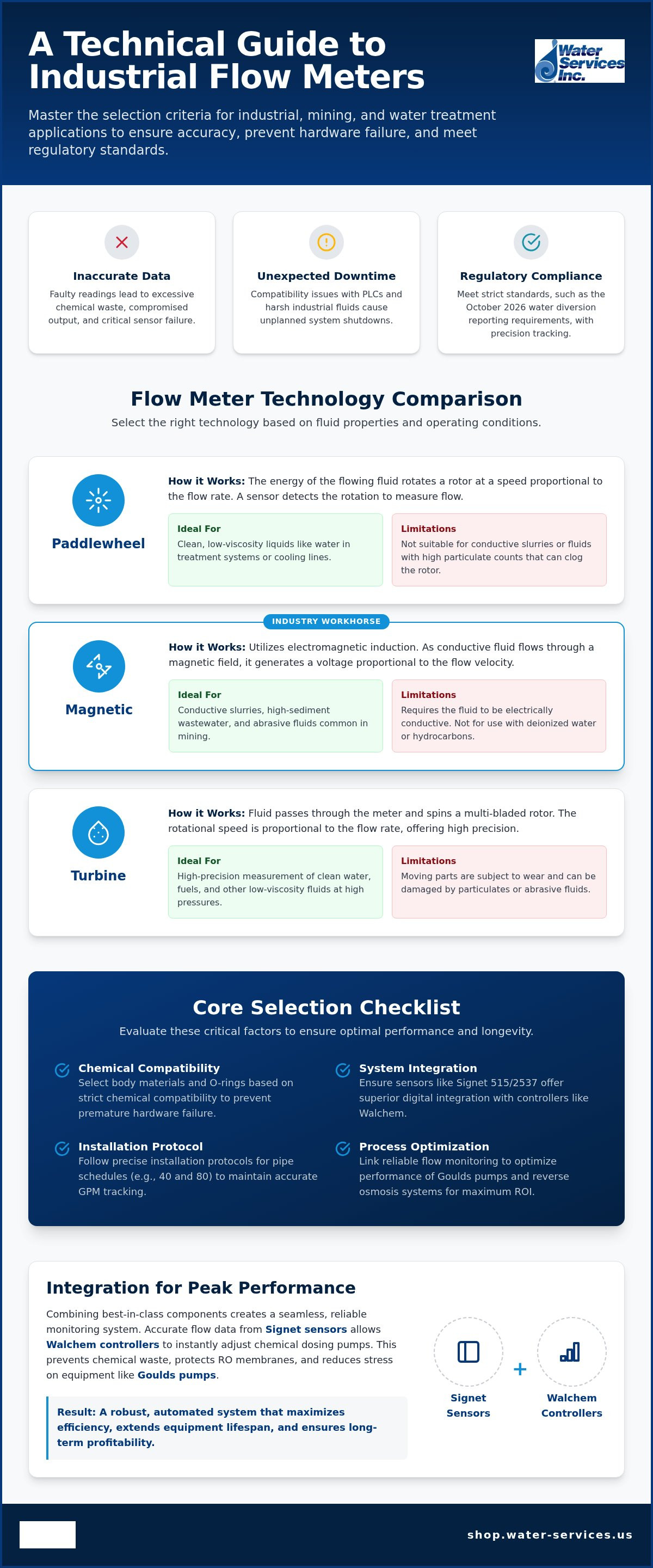
Paddlewheel sensors are the industry standard for clean, low-viscosity liquids. They operate by using the energy of the flowing fluid to rotate a rotor at a speed proportional to the flow rate. These sensors are cost-effective and reliable in standard applications. For more complex fluids, magnetic flow meters, often called magmeters, utilize electromagnetic induction to measure flow. Because they have no moving parts, they are ideal for handling conductive slurries and fluids with high particulate counts that would otherwise clog a mechanical sensor. In 2026, electromagnetic flow meters account for approximately 19% of the global market due to this versatility in harsh environments.
Turbine meters provide high-precision measurement for clean water and fuel applications. These utilize a multi-bladed rotor that spins as fluid passes, offering excellent accuracy at high pressures. For specialized needs, ultrasonic and vortex meters offer advanced solutions. Ultrasonic meters provide non-invasive measurement, while vortex meters, such as the SITRANS FX330, are used for high-temperature applications where they measure flow, pressure, and temperature in a single device. You can view our full range of industrial flow sensors to find the exact match for your pipe schedule.
When to Choose Paddlewheel vs. Magnetic
The decision between paddlewheel and magnetic technologies often rests on fluid conductivity and particulate levels. Paddlewheel sensors require clear fluids to prevent the rotor from seizing. Magmeters require a minimum fluid conductivity, typically measured in microsiemens, to generate a signal. While magmeters have a higher initial cost, their maintenance profile is superior in industrial water filtration systems where debris is common. Wetted paddlewheel sensors are more economical for treated water lines but require periodic inspection of the rotor and O-rings to ensure continued reliability.
Accuracy and Repeatability Standards
Technical specifications often distinguish between full-scale accuracy and reading accuracy. Full-scale accuracy refers to the error margin across the entire range of the meter, while reading accuracy refers to the error at a specific flow rate. Performance is also dictated by Reynolds numbers, a dimensionless value that identifies whether flow is laminar or turbulent. Most meters require a specific length of straight pipe run to ensure a fully developed flow profile for accurate sensing. In chemical dosing, repeatability is often more important than absolute accuracy because it ensures the system delivers a consistent volume of antiscalant over every cycle, maintaining process stability.
Core Selection Criteria: How to Specify Your Flow Meter
Specifying flow meters for industrial environments requires a technical evaluation of hydraulic conditions and chemical variables. You can't simply match the pipe's nominal diameter. You must account for the specific pipe schedule, such as Schedule 40 versus Schedule 80. Schedule 80 piping has thicker walls and a smaller internal diameter (ID) than Schedule 40. Installing a sensor calibrated for one schedule into another results in significant GPM calculation errors because the fluid velocity relative to the cross-sectional area is different. This discrepancy leads to inaccurate dosing and potential regulatory non-compliance.
The selection process also hinges on the required flow range. Every sensor has specific minimum and maximum GPM thresholds where it maintains its rated accuracy. Operating below the minimum threshold results in "no-flow" signals, while exceeding the maximum can cause cavitation or mechanical failure of the rotor. For control system integration, you must choose a signal output that matches your hardware. Common options include 4-20mA analog signals for long-distance transmission, frequency pulses for simple totalizing, or Digital (S3L) protocols for direct integration with Signet and Walchem controllers. These digital options offer superior noise immunity in environments with high electromagnetic interference.
Fluid Dynamics and Installation Requirements
Reliable data depends on proper fluid dynamics at the point of measurement. We follow the "10 and 5" rule, which requires a straight pipe run of at least 10 pipe diameters upstream and 5 pipe diameters downstream from the sensor. This distance is necessary to eliminate turbulence caused by elbows, valves, or pumps. Without these straight runs, the flow profile is distorted, leading to erratic readings. For horizontal installations, mount the sensor at a 45-degree angle. This position prevents air bubbles from interfering with the sensor at the top of the pipe and keeps sediment from burying the sensor at the bottom. In vertical lines, ensure the flow moves upward so the pipe remains completely full during operation.
Material Selection for Industrial Fluids
Chemical compatibility dictates the longevity of your wetted components. Polypropylene is suitable for most water treatment applications, but PVDF is the technical requirement for handling aggressive corrosive chemicals or high-purity water. Seal materials are equally critical. EPDM O-rings are standard for many water processes, while FKM is necessary for systems involving oils or specific acids. For high-pressure or high-temperature applications, stainless steel fittings provide the required mechanical strength. Always cross-reference your sensor materials with the recommendations of your water treatment chemicals distributor to ensure the hardware survives the specific chemistry of your antiscalants and dosing agents.
Top Professional-Grade Flow Meters for 2026
Selecting hardware for 2026 requires balancing technical durability with digital compatibility. The Signet 515 Rotor-X remains a primary choice for standard flow measurement across industrial sectors. It's a non-powered, highly reliable sensor that generates a frequency signal proportional to flow velocity. For facilities requiring advanced process control, the Signet 2537 Paddlewheel offers a digital S3L output or 4-20mA signal directly from the sensor head. This configuration eliminates the need for external transmitters, reducing installation complexity for modular treatment plants and remote skids.
Walchem flow sensors provide the precision required for specialized chemical metering applications. These are technically optimized to work with Walchem controllers for exact antiscalant delivery in reverse osmosis systems. For mining and wastewater operations dealing with abrasive slurries, heavy-duty magmeters provide a solution without moving parts. These electromagnetic flow meters prevent the mechanical wear and clogging associated with traditional paddlewheel designs in high-sediment environments. Choosing the correct model ensures your data remains accurate even under the rigors of 24/7 industrial production.
Spotlight on Signet Flow Sensors
Signet hardware is the industrial standard for water treatment due to its modular design and field-proven reliability. Maintenance is streamlined for operational efficiency. You can replace rotors or sensor electronics by unscrewing the retaining cap. There's no need to cut into the piping or shut down the entire line for extended periods. This logistical advantage is why we utilize these components in our custom modular units for global mining and military projects. You can browse the full range of Signet Flow Sensors and accessories to find the exact fitting for your specific pipe schedule.
Complementary Hardware for a Complete System
A sensor is only as effective as the controller interpreting its data. Integrating flow signals with Walchem Controllers allows for automated system responses based on GPM fluctuations. This integration is critical for maintaining the chemical balance in high-volume treatment plants. For example, flow switches act as safety interlocks to protect Goulds Water Technology Pumps from dry-run conditions that cause immediate mechanical failure. Monitoring pressure alongside flow using Ashcroft Gauges provides a complete diagnostic picture of system health. This multi-point monitoring allows for predictive maintenance of RO membranes and filter media. If you need technical assistance specifying these integrated components, consult with our engineering specialists for a comprehensive project review.
Installation and Integration: Maximizing System Performance
Successful installation begins with the physical seating of the sensor into the pipe fitting. For wetted paddlewheel flow meters, you must verify the pipe is depressurized before beginning. Check the sensor's orientation; most Signet models feature an arrow indicating the required flow direction. Align this arrow parallel to the pipe axis to ensure the rotor catches the fluid velocity correctly. Hand-tighten the retaining nut to seat the O-ring properly. Over-tightening with heavy tools can crack the plastic housing or distort the seal, leading to bypass leaks under high-pressure conditions.
Wiring requires technical precision to prevent signal degradation. Use shielded twisted-pair cables for all frequency and 4-20mA signals. Route these cables away from high-voltage lines and Variable Frequency Drives (VFDs) to avoid electromagnetic interference (EMI). Ground the shield at the controller end only. This practice prevents ground loops that cause erratic GPM readings or "phantom" flow signals. Proper calibration involves entering the correct K-factor into your transmitter. This value represents the number of pulses per unit of volume and varies based on your specific pipe size, schedule, and material.
Connecting to Process Controllers
Integrating sensors into 4-20mA loops allows for real-time remote monitoring and data logging. You should configure flow alarms within your Walchem controller to trigger protective actions. High-flow alarms can signal a pipe burst, while low-flow alarms prevent dry-run damage to your pumping equipment. These automated responses are the foundation of reliable industrial water treatment systems. Precise data integration ensures your chemical dosing remains proportional to actual throughput, maintaining water quality standards without manual intervention.
Troubleshooting Common Flow Issues
Erratic readings often stem from hydraulic issues rather than electronic failure. Air pockets trapped at the top of a horizontal pipe cause the rotor to spin inconsistently. If your GPM values jump unexpectedly, check for cavitation or upstream leaks that might be introducing air into the line. Scale buildup is a significant concern in hard water applications. Minerals can coat the rotor pin, increasing friction and causing the meter to under-read. We recommend a semi-annual inspection of the rotor and O-rings. If the rotor shows visible wear or mechanical "wobble," replace it immediately. Recalibration is only effective if the mechanical components are in peak condition. If signal drift persists after cleaning, verify your transmitter settings against a known NIST-traceable standard to ensure ongoing regulatory compliance.
Securing Long-Term Operational Accuracy
Precise measurement is the foundation of any efficient water treatment system. You've seen how selecting flow meters based on pipe schedule and chemical compatibility prevents the data drift that leads to wasted antiscalants and equipment damage. By integrating Signet sensors with Walchem controllers, you create a responsive environment that protects your Goulds pumps and reverse osmosis membranes from unexpected process fluctuations. Future-proofing your facility requires moving beyond basic volume tracking toward integrated digital monitoring and proactive maintenance.
As an Authorized Signet Distributor, Water Services, Inc. provides the technical integrity required for demanding mining and industrial sites worldwide. We offer expert technical support to ensure your custom modular units meet exact specifications, supported by reliable global shipping for all critical components. Our 30 years of experience in harsh-environment applications ensures your sensors survive the rigors of 24/7 production. We focus on industrial reliability to keep your discharge compliant and your downtime at a minimum.
Shop Industrial Flow Meters at Water Services, Inc.
Frequently Asked Questions
How do I choose the right flow meter for my pipe size?
You must select a sensor fitting that matches your specific pipe diameter and wall thickness schedule, such as Schedule 40 or 80. Every sensor has a defined Gallons Per Minute (GPM) range where it maintains rated accuracy. Choosing a fitting for the wrong schedule results in calculation errors because the internal diameter directly affects fluid velocity measurements.
What is the difference between a flow sensor and a flow transmitter?
A flow sensor is the hardware that physically detects fluid movement and generates a raw signal, such as a frequency pulse. A flow transmitter is the electronic component that interprets this raw signal and converts it into a standardized output, like 4-20mA or digital S3L. Some modern units, like the Signet 2537, integrate both functions into a single sensor head.
Does a flow meter need a specific length of straight pipe?
Most flow meters require a straight pipe run of at least 10 pipe diameters upstream and 5 diameters downstream to ensure a stable flow profile. This "10 and 5" rule prevents turbulence from elbows, valves, or pumps from causing erratic data. Without these straight runs, the sensor cannot accurately calculate the average velocity of the fluid.
Can I use a paddlewheel flow meter for chemicals?
Paddlewheel meters are effective for chemical applications if the wetted materials are compatible with the fluid's chemistry. You should specify PVDF bodies and FKM O-rings for aggressive acids or corrosive antiscalants. Always cross-reference your chemical's safety data sheet with the manufacturer's material compatibility charts to prevent premature housing failure or seal degradation.
How often do industrial flow meters need to be calibrated?
Calibration intervals typically range from six months to two years, depending on the application's criticality and fluid properties. Systems handling abrasive fluids or those required for regulatory discharge compliance often necessitate more frequent verification. Regular calibration ensures the reported data matches the actual volume passing through the line, maintaining process integrity and legal standards.
What happens if there is air in the pipe with my flow meter?
Air in the pipe causes flow meters to provide erratic or falsely high readings because the sensor interprets air bubbles as high-velocity fluid. To prevent this, install the sensor in a vertical line with upward flow or at a 45-degree angle in horizontal lines. These positions ensure the pipe remains full and air pockets pass above the sensor's detection range.
Are Signet flow meters compatible with other brands of controllers?
Signet flow sensors are compatible with most third-party controllers that accept standard frequency or 4-20mA analog signals. While they integrate seamlessly with Walchem controllers via digital S3L protocols, their analog outputs allow them to function as universal inputs for various PLC systems. You must verify the input impedance and power requirements of your controller before final wiring.
What is the best flow meter for high-sediment mining water?
Magnetic flow meters are the technical standard for high-sediment mining water because they feature an unobstructed flow path with no moving parts. This design prevents the mechanical wear and clogging that occurs when abrasive slurries pass through traditional paddlewheel or turbine sensors. They offer superior longevity and lower maintenance costs in harsh, high-solids environments.
0 comentarios