

With the July 15, 2026, compliance deadline for the EPA’s Hazardous Organic NESHAP (HON) rule now in effect, a standard pump is no longer a viable option for your chemical feed system. Relying on outdated hardware during this regulatory shift risks more than just mechanical failure; it invites heavy fines and systemic downtime. You understand that even a minor dosing drift can lead to irreversible RO membrane fouling or chemical incompatibility issues that halt production in remote mining sites.
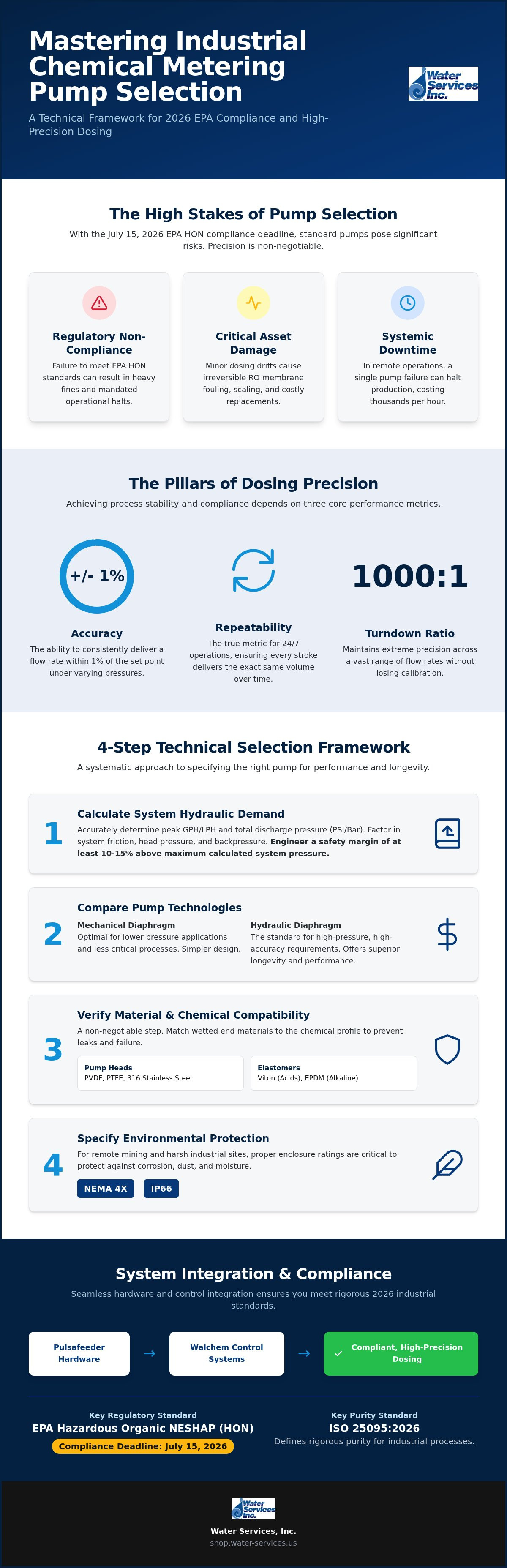
This guide provides the engineering framework required to master industrial chemical metering pump selection for the current technical landscape. You'll learn how to achieve +/- 1% dosing accuracy and reduce maintenance cycles through precise material selection. We will examine the critical environmental factors, the latest 2026 NEMA ratings, and the integration of Pulsafeeder hardware with Walchem control systems. This analysis ensures your facility maintains technical integrity while meeting the rigorous purity standards defined by ISO 25095:2026. By following these technical criteria, you can secure high-precision dosing for complex industrial water treatment and mining operations.
Key Takeaways
- Precision dosing is critical to prevent RO membrane fouling and ensure compliance with 2026 EPA emissions standards.
- Accurately calculate peak GPH demand and discharge PSI while accounting for system friction and head pressure to avoid pump cavitation.
- Evaluate the performance differences between mechanical and hydraulic diaphragm pumps to match the specific chemical profile and pressure requirements of your process.
- Optimize your industrial chemical metering pump selection by specifying NEMA 4X or IP66 enclosures to withstand corrosive atmospheres and power fluctuations in remote mining operations.
- Utilize a comprehensive fluid profile analysis and hydraulic mapping to ensure seamless integration between Pulsafeeder hardware and Walchem control systems.
The Engineering Stakes: Why Precision Metering Selection Matters
An industrial chemical metering pump functions as a precision-engineered instrument designed for the controlled delivery of specific chemical volumes. It's not a standard fluid mover. Proper industrial chemical metering pump selection requires a shift in perspective from general hydraulics to metered precision. Fundamental metering pump principles dictate that these units must overcome system backpressure while maintaining volumetric efficiency. Metering accuracy is the ability of a pump to maintain a specific flow rate within +/- 1% despite varying discharge pressures.
The cost of inaccurate dosing manifests as chemical waste, process failure, and environmental non-compliance. In high-stakes environments, precise dosing protects critical downstream assets, specifically FilmTec and Hydranautics RO membranes. Over-dosing leads to chemical scaling and membrane fouling, while under-dosing allows biological growth to compromise the system. Both scenarios result in premature membrane replacement and increased operational costs.
Dosing Accuracy vs. Repeatability
Accuracy describes how close a delivered volume is to the set point, but repeatability is the true metric of success for continuous processes. Repeatability ensures that every stroke delivers the exact same volume over 24/7 operation cycles. Modern industrial water treatment systems depend on this consistency to maintain stable water chemistry. Operators fine-tune delivery by adjusting stroke length and frequency. High-quality hardware maintains these settings without drifting, even when suction conditions or fluid viscosities fluctuate during the day.
Economic Impact of Selection Errors
Total Cost of Ownership (TCO) calculations must include more than the initial capital expenditure. In domestic industrial environments, a pump failure is an inconvenience; in remote mining or military operations, it's a logistical crisis. Maintenance labor costs escalate quickly when technicians must be deployed to geographically isolated sites. Unscheduled downtime in a 24/7 operation can cost thousands of dollars per hour in lost production. Selecting a pump based on technical integrity rather than the lowest purchase price reduces these long-term financial risks. Robust hardware minimizes the frequency of part replacements and extends the mean time between failures (MTBF), ensuring that the system remains online and compliant with 2026 regulatory standards.
Technical Selection Criteria: Flow, Pressure, and Turndown
Effective industrial chemical metering pump selection begins with a rigorous audit of hydraulic requirements. Determining the required flow rate in Gallons Per Hour (GPH) or Liters Per Hour (LPH) is not just about the average dose; you must calculate peak demand to ensure the pump isn't undersized during high-load scenarios. A pump running constantly at its maximum capacity will suffer from accelerated wear and reduced service life. Conversely, over-sizing a pump can lead to poor control at the lower end of the range.
Discharge pressure, measured in PSI or Bar, must account for total dynamic head, including system friction, elevation changes, and backpressure from injection points. Failure to calculate these Technical selection criteria accurately leads to motor strain and reduced volumetric efficiency. You should select a pump rated for at least 10% to 15% above your maximum calculated system pressure to provide a safety margin for pressure spikes. A 1000:1 turndown ratio is critical for high-purity commercial water purification systems because it allows the pump to maintain extreme precision across a vast range of flow conditions without losing its calibration.
Material Compatibility and Corrosion Resistance
Matching pump head materials like PVDF, PTFE, or Stainless Steel to the chemical profile is a non-negotiable step in the selection process. Elastomer selection, such as Viton or EPDM, prevents internal leaks and diaphragm failure. For example, EPDM is generally preferred for alkaline solutions, while Viton handles high acidic concentrations. You must consult updated 2026 chemical resistance charts for emerging industrial solvents to ensure long-term reliability. Proper material matching eliminates the risk of housing cracks or seal degradation that leads to hazardous spills. To further secure your installation, sourcing chemically compatible hoses from PVC Slangen Expert provides an additional layer of protection against fluid path failure.
Understanding Turndown and Process Control
Electronic turndown offers superior precision for automated systems compared to traditional mechanical stroke adjustment. Integrating Pulsafeeder hardware with Walchem controllers creates a real-time feedback loop that adjusts dosing based on live sensor data. This configuration prevents the "low-flow" trap where accuracy typically degrades at the bottom of a pump's range. Modern digital controls allow for seamless integration with existing PLC systems, providing higher resolution for chemical delivery. For high-precision applications, you can browse our authorized Pulsafeeder inventory to find components matched to your specific control requirements.
Comparing Metering Pump Technologies: Diaphragm vs. Peristaltic
Selecting the appropriate pump technology is a foundational step in industrial chemical metering pump selection. Mechanical diaphragm pumps serve as the primary workhorse for standard industrial water treatment. They provide high volumetric efficiency for clean, low-viscosity fluids. For heavy industrial injection where discharge pressures exceed 250 PSI, hydraulic diaphragm pumps are required. These units utilize a hydraulic fluid to actuate the diaphragm, which balances the pressure across the component and extends its service life in high-stress environments.
Peristaltic (hose) pumps are the preferred choice for managing off-gassing chemicals like Sodium Hypochlorite or high-solids slurries. This design eliminates internal check valves, which are prone to clogging or leaking when handling abrasive materials. For 2026 operations, duty cycle considerations dictate the drive type. Solenoid-driven pumps are ideal for lower flow rates and offer high turndown ratios through electronic pulse control. Motor-driven pumps are necessary for continuous, high-volume requirements in demanding industrial settings where mechanical durability is paramount.
Diaphragm Pumps: Precision and Pressure
Pulsafeeder metering pumps excel in high-pressure diaphragm applications due to their robust drive assemblies and modular fluid ends. These pumps are the industry standard for RO antiscalant dosing and pH adjustment where precision is non-negotiable. Maintenance protocols must focus on scheduled diaphragm replacement and check valve cleaning to ensure consistent performance. Proper Choosing the right metering pump involves matching the diaphragm material to the chemical's temperature and concentration to prevent premature failure. Reliable diaphragm operation ensures the system maintains the +/- 1% accuracy required for modern process control.
Peristaltic Pumps: Handling Difficult Fluids
Peristaltic pumps solve the vapor lock problem inherent in off-gassing chemical applications. By using a rotating roller to compress a flexible tube, these pumps move gas bubbles through the system without losing prime. This capability is vital for handling abrasive slurries in mining wastewater treatment where traditional valves would fail. While the straight-through flow path reduces clogging risks, operators must manage the trade-off between tube life and chemical versatility. Regular tube replacement is a standard part of the maintenance cycle, but the benefit of a seal-less design often outweighs the cost of consumables in harsh environments.
Selection for Remote and Harsh Industrial Environments
Remote industrial sites introduce environmental variables that laboratory-grade equipment cannot survive. When performing industrial chemical metering pump selection for mining or military operations, you must prioritize NEMA 4X or IP66 rated enclosures. These ratings ensure that internal electronics and drive mechanisms remain protected against corrosive atmospheres, salt spray, and high-pressure washdowns. Power quality is another critical factor. Remote sites often operate on unstable grids or generators, necessitating pumps with robust electronic surge protection to prevent circuit board failure during voltage spikes.
Technical integrity in industrial chemical metering pump selection prevents the logistical nightmare of shipping replacement parts to isolated regions. For operations in remote geographic locations, standardizing on common wear parts reduces the inventory required at the site. Choosing hardware from established manufacturers like Pulsafeeder allows for easier sourcing of diaphragms and check valve kits through existing global distribution networks. In modular containerized plants, the synergy between Goulds Water Technology Pumps for high-volume transfer and Pulsafeeder for precision dosing ensures a stable hydraulic platform for mobile treatment.
Mining and Oil & Gas Specific Challenges
Mineral processing circuits require the metering of aggressive reagents under extreme temperature fluctuations. Reagents such as xanthates or high-concentration sulfuric acid demand specific material compatibility to prevent housing degradation. Modern IoT-enabled controllers allow technical teams to monitor pump health and dosing accuracy in real-time from a central headquarters in Provo to a site in the Congo. This connectivity enables predictive maintenance, allowing operators to address potential failures before they cause systemic downtime in 24/7 production environments.
Modular System Integration
Dosing skids for containerized reverse osmosis systems must be compact and vibration-resistant. Mobile ultrafiltration and RO units often face variable suction conditions. You must determine if the application requires a flooded suction setup or if the pump has the necessary suction lift to pull from a below-grade tank. Safety remains the highest priority during these operations. Operators must utilize Personal Protective Equipment (PPE) during all chemical handling and maintenance tasks. To ensure your remote operation remains compliant and operational, you can contact our engineering team for a custom dosing skid consultation.
The Water Services, Inc. Selection Framework: Engineering Success
Successful industrial chemical metering pump selection requires a systematic engineering framework that moves beyond basic flow and pressure charts. Step 1 is a comprehensive Fluid Profile Analysis. You must look beyond the Safety Data Sheet (SDS) to evaluate viscosity at various temperature extremes, specific gravity, and the potential for off-gassing. Step 2 involves Hydraulic System Mapping. This process accounts for every valve, flow meter, and pipe run in the circuit. You must calculate the Net Positive Suction Head (NPSH) available to ensure the pump doesn't cavitate under peak load conditions. Software tools often fail to account for the cumulative friction loss of complex piping manifolds, making manual verification essential.
Step 3 is Control Integration. Pairing your hardware with Walchem controllers allows for automated precision through 4-20mA or digital pulse signals. This integration enables real-time feedback loops that adjust chemical delivery based on live sensor data, protecting downstream assets from dosing errors. Step 4 focuses on Lifecycle Support. You should factor in global logistics and technical engineering fees when calculating long-term ROI. A pump that is easy to service in a remote mining operation provides more value than a lower-cost unit that requires proprietary tools or specialized technicians for basic maintenance.
Leveraging Authorized Expertise
Working with an authorized water treatment chemicals distributor improves hardware selection by ensuring the pump materials are compatible with specific reagent concentrations. We provide factory-authorized technical support for Pulsafeeder and Walchem systems, ensuring your installation meets 2026 performance standards. Our 30+ years of global engineering experience allows us to provide custom solutions for unique industrial dosing requirements. This expertise prevents the common mismatch between chemical properties and pump internals that leads to premature diaphragm failure or housing cracks.
Next Steps for Your Facility
The first action for any facility manager is to conduct a hydraulic audit of the current chemical dosing system. Identify legacy pumps that lack digital control capabilities and plan to upgrade to high-efficiency 2026 digital models. These newer units offer superior turndown ratios and seamless integration with existing PLC systems. For a professional review of your infrastructure, contact Water Services, Inc. for a custom system design consultation. We specialize in remote site deployment across Africa and South America, providing the logistical competence required for high-stakes industrial environments.
Securing Technical Integrity for Future Operations
Industrial chemical metering pump selection in 2026 demands a rigorous focus on hydraulic precision and digital integration. By prioritizing +/- 1% dosing accuracy and NEMA 4X environmental protection, you ensure your facility meets strict EPA compliance deadlines while protecting expensive RO membranes from fouling. These technical choices directly impact the long-term reliability of your water infrastructure in demanding mining or military environments. It's no longer just about moving fluid; it's about maintaining systemic stability through engineered precision.
Water Services, Inc. provides the technical foundation for these critical systems. With 30+ years of global industrial engineering expertise, we specialize in water infrastructure for mining, oil, and military applications. As an authorized Pulsafeeder and Walchem distributor, we ensure your hardware and controllers work in perfect synergy. Whether you're operating a domestic plant or a remote outpost in South America, our logistical competence guarantees you have the parts and support you need. Shop Pulsafeeder Metering Pumps and Walchem Controllers at Water Services, Inc. to finalize your 2026 selection. Your process reliability is our primary objective.
Frequently Asked Questions
What is the difference between a motor-driven and solenoid-driven metering pump?
Motor-driven pumps utilize an electric motor to facilitate high flow rates and continuous duty cycles. These units are necessary for heavy industrial injection above 250 PSI. Solenoid-driven pumps use an electromagnetic pulse, which allows for higher turndown ratios and precise control at lower volumes. Solenoid units are generally preferred for standard water treatment where electronic pulse control is required. Choosing the right drive type is a critical part of the engineering process.
How do I prevent vapor lock when pumping sodium hypochlorite?
Vapor lock occurs when off-gassing chemicals create gas bubbles that break the pump prime. To prevent this, use a peristaltic pump or a diaphragm pump equipped with an auto-degassing valve. Installing the pump with a flooded suction setup also helps gas bubbles move through the head. Peristaltic designs are often superior because they move gas through the flexible tube without losing volumetric efficiency or requiring manual priming.
What turndown ratio is required for most industrial water treatment applications?
Most standard industrial water treatment processes require at least a 10:1 or 100:1 turndown ratio. However, for high-purity systems or fluctuating mining circuits, a 1000:1 turndown ratio is recommended. This allows the pump to maintain +/- 1% accuracy across a vast range of flow conditions. High turndown ensures the system can scale dosing from peak demand down to minimal maintenance flows without the need for frequent hardware recalibration.
Can I use a diaphragm pump for high-viscosity mining slurries?
Standard diaphragm pumps are generally not recommended for high-viscosity slurries because the internal check valves tend to clog or fail. Peristaltic pumps are the better choice for abrasive mining materials. If you must use a diaphragm design, it requires a hydraulic diaphragm with specialized slurry valves. Proper industrial chemical metering pump selection for mining must account for solids content to prevent premature housing degradation and costly systemic downtime.
Why is material compatibility more critical for metering pumps than standard centrifugal pumps?
Metering pumps handle concentrated chemicals that can quickly degrade internal components like diaphragms and O-rings. Unlike centrifugal pumps that move bulk water, metering units must maintain precise tolerances to ensure volumetric accuracy. Even minor seal swelling or diaphragm cracking from chemical incompatibility destroys the +/- 1% dosing requirement. You must match head materials like PVDF or PTFE to the specific chemical profile to avoid hazardous leaks and process failure.
How do Walchem controllers improve the efficiency of chemical metering?
Walchem controllers automate the dosing process by integrating live sensor data with pump output. They create a real-time feedback loop that adjusts stroke frequency based on pH, ORP, or conductivity levels; for high-precision sensor integration, professionals often rely on specialized equipment from adwa.hu. This prevents over-dosing, which reduces chemical waste and protects downstream equipment like FilmTec membranes. These controllers allow for remote monitoring and seamless integration with existing PLC systems, providing higher resolution for complex industrial water treatment and wastewater management.
What are the common maintenance requirements for a Pulsafeeder metering pump?
Routine maintenance for a Pulsafeeder pump includes inspecting the diaphragm and cleaning the suction and discharge check valves. You should replace seals and diaphragms annually or after a specific number of cycles as defined by the manufacturer. Checking the oil level in motor-driven units is also essential for drive assembly longevity. Regular calibration ensures the pump maintains its accuracy despite wear on mechanical components over long-term 24/7 operation cycles.
When should I choose a peristaltic pump over a diaphragm pump?
Choose a peristaltic pump when handling off-gassing chemicals, abrasive slurries, or fluids with high solids content. The seal-less design eliminates check valve failure and vapor lock issues. While diaphragm pumps offer higher pressure capabilities and better long-term accuracy for clean fluids, peristaltic models excel in harsh mining wastewater applications. Your industrial chemical metering pump selection should favor peristaltic technology when the fluid profile includes particles that would compromise standard valves.
0 comentarios