

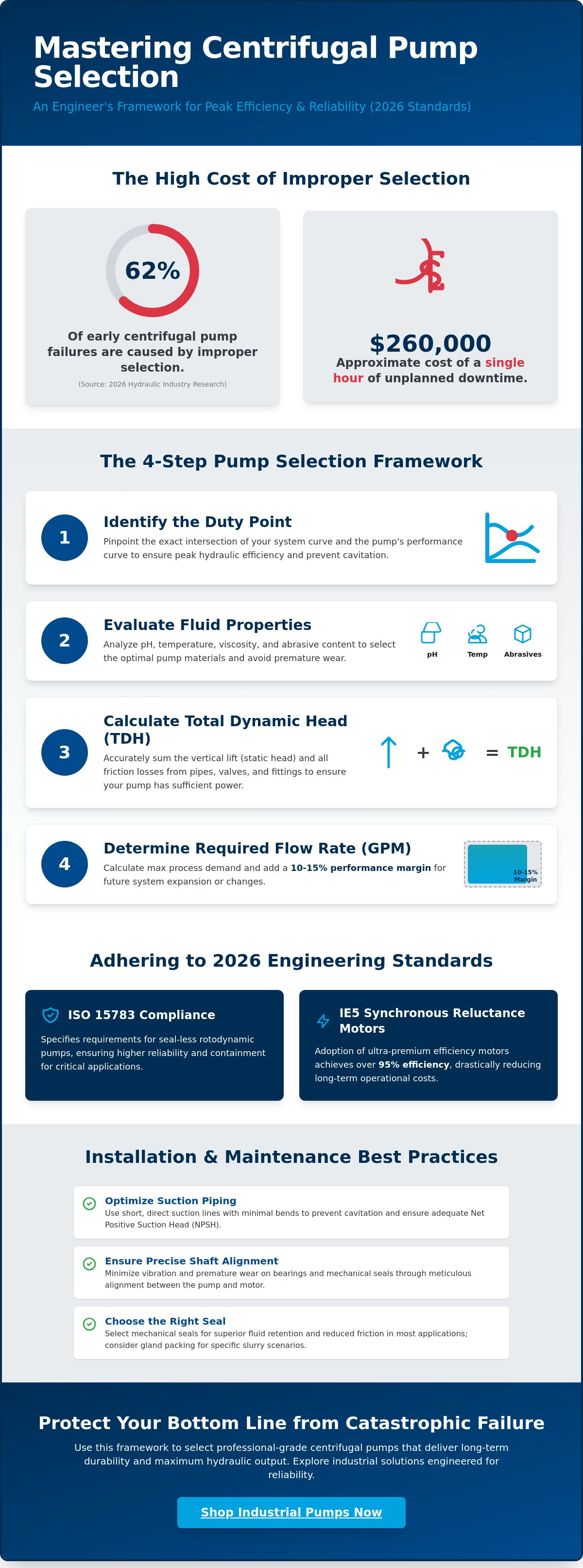
Improper selection leads to 62% of early centrifugal pump failures according to 2026 hydraulic industry research data. For the average industrial manufacturer, a single hour of unplanned downtime now costs approximately $260,000. You understand that hydraulic precision isn't just about moving fluid; it's about protecting your bottom line from catastrophic mechanical failure and excessive energy waste. Selecting the wrong hardware results in cavitation, seal damage, and high operational costs that compound over the equipment's lifecycle.
This guide provides the engineering framework you need to master the selection of industrial centrifugal pumps for demanding environments. You'll learn how to calculate precise duty points while maintaining a 10-15% performance margin for future system expansion. We'll also cover the latest 2026 standards, including ISO 15783 requirements for seal-less pumps and the adoption of IE5 synchronous reluctance motors that achieve over 95% efficiency. From evaluating Goulds Water Technology Pumps to understanding NPSH requirements, this overview of 2026 engineering criteria ensures your next installation delivers long-term durability and maximum hydraulic output.
Key Takeaways
- Identify the precise Duty Point where your system curve meets the performance curve to ensure peak hydraulic efficiency and prevent cavitation.
- Evaluate fluid pH, temperature, and abrasive content to select the optimal housing material, moving beyond the misconception that cast iron is always the most cost-effective choice.
- Discover why Goulds Water Technology centrifugal pumps are engineered for maximum reliability in high-demand industrial fluid transfer environments.
- Calculate Total Dynamic Head (TDH) accurately to ensure your equipment handles system friction and elevation changes without compromising flow rates.
- Apply best practices for suction piping and shaft alignment to minimize vibration and extend the operational life of mechanical seals.
What is a Centrifugal Pump? Industrial Applications and Working Principles
The centrifugal pump serves as the primary workhorse for industrial fluid transfer across global infrastructure. These machines utilize a simple yet effective physical principle to move liquids through complex piping networks. To understand What is a Centrifugal Pump?, an engineer must analyze the energy transfer process. A motor provides rotational kinetic energy to an internal impeller, which then accelerates the fluid outward. This action converts mechanical energy into hydrodynamic energy, creating the pressure required for consistent flow. Selection of professional-grade centrifugal pumps requires a deep understanding of these mechanical fundamentals to ensure long-term system stability.
In heavy industry, these units are essential for high-volume water transfer, agricultural irrigation, and high-pressure booster systems. They are foundational components within industrial water treatment systems, where precise flow control and chemical compatibility are mandatory. Reliability in these environments depends on matching the pump's hydraulic profile to the specific demands of the application. Failure to align the pump's capability with the system's resistance leads to inefficient operation and premature wear.
Key Components: Impellers, Volutes, and Seals
The impeller is the central rotating component. Its vane geometry determines the pump's specific flow and head characteristics. As fluid exits the impeller at high velocity, it enters the volute casing. This curved funnel increases in area, slowing the fluid to convert kinetic energy into static pressure. For leak prevention, engineers choose between mechanical seals and traditional gland packing. Mechanical seals offer superior fluid retention and reduced friction, while packing remains a viable option for specific slurry applications where some leakage is permissible for cooling. Selecting the correct seal type is a critical decision for operational uptime.
Why Centrifugal Design Dominates Industrial Water Services
Centrifugal pumps dominate the market because they handle higher flow rates than positive displacement alternatives. The design's simplicity results in fewer internal wearing parts, which directly translates to lower long-term maintenance costs and reduced downtime. These pumps also provide versatility. They manage varying fluid viscosities and can be configured with open impellers to handle suspended solids without clogging. This adaptability makes them the standard choice for professional operators seeking stable, long-term performance in diverse hydraulic environments. Key advantages include:
- High volume output for large scale transfer.
- Simplified maintenance due to minimal moving parts.
- Broad chemical and solid-handling compatibility.
- Efficient integration with electric power controls for automated operation.
The Selection Framework: Sizing Your Pump for Peak Efficiency
Sizing a pump requires more than matching a basic flow rate. Improper selection leads to 62% of early centrifugal pump failures, a statistic that underscores the need for a precise engineering framework. To ensure operational reliability, engineers must identify the Duty Point. This is the specific intersection where the pump performance curve meets the system resistance curve. If these curves don't align, the pump operates inefficiently, leading to excessive energy waste and mechanical stress that risks the $260,000 hourly cost associated with unplanned downtime.
Total Dynamic Head (TDH) is the most critical metric in this framework. It accounts for the vertical lift plus the friction losses caused by piping, valves, and fittings. Relying on vertical lift alone results in undersized equipment that fails to meet process requirements. Once TDH is established, you must calculate the required Gallons Per Minute (GPM). This flow rate should reflect the maximum process demand while maintaining a 10-15% safety margin for future system expansion. These metrics dictate the required motor horsepower (HP), with industrial models ranging from 1/2 HP for light chemical transfer to 300 HP for high-volume water services.
Understanding Pump Performance Curves
Every pump has a unique performance curve. The Best Efficiency Point (BEP) is the specific location on that curve where the pump operates with the least amount of internal turbulence and vibration. Operating too far to the left or right of this point, known as running off the curve, causes cavitation and rapid seal failure. Net Positive Suction Head (NPSH) is the minimum pressure required at the suction port to prevent the fluid from vaporizing and damaging the impeller. For reliable operation, consult technical specifications for professional-grade centrifugal pumps before finalizing your system design.
Electrical Considerations: Single-Phase vs. Three-Phase Motors
Motor choice depends on site infrastructure and the intended duty cycle. Single-phase motors are suitable for light commercial applications or remote sites where three-phase power is unavailable. Conversely, three-phase motors are the standard for 24/7 heavy industrial operations due to their superior starting torque and higher electrical efficiency. High-horsepower motors require sophisticated electric power controls to manage inrush current and provide essential thermal protection against phase loss or overload conditions. Selecting the correct electrical configuration ensures the motor survives the rigors of demanding commercial environments.
Material Science: Cast Iron vs. Stainless Steel Pumps
Selecting the correct metallurgy for centrifugal pumps is a decision that dictates the equipment's mean time between failures (MTBF). Engineers must assess the operational environment based on three primary variables: pH levels, fluid temperature, and abrasive content. According to 2026 industrial standards, standard room temperature pumps should not transport fluids exceeding 80°C, as this leads to rapid seal degradation. For high-temperature applications over 120°C, specialized alloys and preheating functions are mandatory to maintain structural integrity. Choosing a material based solely on initial purchase price often leads to catastrophic failure in aggressive environments.
The most common misconception in pump procurement is that cast iron is always the most cost-effective choice. While cast iron offers lower upfront capital expenditure, its lifecycle cost in corrosive environments is significantly higher than stainless steel. In chemical transfer or brackish water applications, the rate of internal corrosion in cast iron leads to increased surface roughness, lower hydraulic efficiency, and frequent housing replacements. For complex operations such as mining wastewater treatment solutions, selecting high-chrome iron or specialized stainless alloys is essential to survive the abrasive tailings and acidic runoff typical of the industry.
Cast Iron: The Standard for Clean Water and Irrigation
Cast iron remains the industrial standard for non-corrosive, clean water applications. Its primary advantage lies in its superior vibration dampening properties, which protect internal bearings and seals during high-speed operation. You will find these pumps in HVAC cooling towers, municipal water transfer stations, and large-scale agricultural irrigation systems. However, cast iron is highly susceptible to oxidation and pitting when exposed to acidic fluids or high-salinity water. In these environments, the material's structural stability degrades quickly, leading to wall thinning and eventual pressure boundary failure.
Stainless Steel: Precision for Chemicals and Reverse Osmosis
Stainless steel, specifically 316 and duplex grades, provides the corrosion resistance required for industrial chemical processing and high-purity water production. These materials are non-reactive and withstand the aggressive chloride concentrations found in brackish water. This makes them the mandatory choice for feed pumps in commercial reverse osmosis water filtration systems. Beyond corrosion resistance, stainless steel meets the stringent hygiene requirements of food-grade and pharmaceutical manufacturing. While the initial investment is higher, the extended service life and reduced maintenance requirements provide a superior return on investment in any corrosive or high-purity application.
Top Centrifugal Pumps for 2026: Featured Brands and Models
Selecting the right hardware is the final step in applying the engineering framework discussed in previous sections. For 2026, Goulds Water Technology remains the gold standard for industrial reliability. Their equipment is engineered to withstand the rigors of continuous duty in demanding environments. Whether your process requires high-pressure filtration or high-volume transfer, the Goulds catalog offers specific solutions that align with the duty points calculated during the sizing phase. It's essential to match the pump's mechanical design with the specific hydraulic requirements of your facility to avoid the 62% failure rate associated with improper selection.
The versatility of the Goulds e-SV and 3656/3756 Series allows engineers to address a wide range of operational challenges. These models are categorized by their application: End Suction for standard transfer, Self-Priming for lift applications, and Multi-stage for high-pressure requirements. If your system requires precise pressure maintenance, the e-SV vertical multi-stage pumps offer superior energy efficiency and a small footprint. For those managing large-scale installations, you can browse the full centrifugal pumps collection which includes over 590 models designed for professional use.
Goulds Water Technology: High-Performance Selection
The mechanical integrity of Goulds builds is defined by precision-cast components and robust shaft designs. The 3656 and 3756 Series are the primary choices for general industrial liquid transfer. These models provide performance ranges up to 400 GPM in the S-Group configuration, making them ideal for water circulation and spray systems. Because of their compact footprint and proven durability, Goulds pumps are the preferred choice for containerized treatment plants where space is limited but uptime is non-negotiable. The vertical e-SV series further expands these capabilities, providing high-pressure performance required for boiler feed and reverse osmosis applications.
Self-Priming vs. Standard End-Suction Models
Choosing between self-priming and end-suction configurations depends entirely on your suction conditions. Standard end-suction models are the most efficient choice for flooded suction applications where the fluid source is above the pump inlet. However, for lift stations, dewatering, or applications where the pump is located above the liquid level, self-priming models are required. Goulds self-priming centrifugal pumps feature a specialized casing design that retains fluid after the initial prime to significantly reduce the risk of priming failure during intermittent operation. If you don't account for these suction variables, you risk cavitation and rapid seal degradation.
Ready to upgrade your system? Explore the full range of Goulds Water Technology pumps to find the exact match for your industrial requirements.
Installation, Maintenance, and Procurement Best Practices
Operational longevity for centrifugal pumps begins with a rigid foundation and precise mechanical alignment. Misalignment is a leading cause of premature shaft failure and seal leakage. Engineers should use laser alignment tools to ensure the motor and pump shafts are concentric within manufacturer tolerances. Safety during these procedures is paramount. As of 2026, OSHA has increased penalties for Lockout/Tagout (LOTO) violations to $16,131 per serious violation. Strict adherence to these safety protocols protects your personnel and your capital investment.
Suction piping design remains a critical factor in hydraulic efficiency. You must maintain a straight run of pipe at least five to ten times the pipe diameter before the pump intake to ensure a laminar flow. Installing elbows or valves directly at the suction port creates turbulence that leads to cavitation. This turbulence erodes the impeller and reduces the total dynamic head the system can achieve. Proper piping geometry ensures the pump operates within the performance margin defined in the engineering phase.
Preventative maintenance schedules should focus on vibration analysis and lubrication. Based on 2026 global industrial pump statistics, 85% of common faults are repairable on-site if identified early. Monitor noise levels to ensure they stay below 85dB within a one-meter distance during rated operation. Consistent inspections of mechanical seals and bearings prevent the catastrophic failures that lead to expensive facility downtime.
Common Installation Mistakes to Avoid
One frequent error is using undersized piping which significantly increases friction loss and energy consumption. During maintenance of pumps handling corrosive chemicals or antiscalants, technicians must utilize proper personal protective equipment (PPE) to prevent chemical exposure. Always verify motor rotation with a momentary "bump" test before full system startup. Operating a pump in reverse can unscrew the impeller or cause immediate mechanical damage to internal components.
Maximizing ROI with Technical Support
Leveraging technical support for system integration ensures that your hardware performs as expected within complex containerized plants. Procurement isn't just about the pump; it involves sourcing compatible components like RO membranes and chemicals from the water treatment collection to maintain system integrity. A streamlined procurement strategy relies on fast shipping and technical expertise to minimize site downtime. To secure the hardware required for your 2026 engineering projects, shop the full centrifugal pumps collection now for immediate industrial distribution.
Optimizing Hydraulic Infrastructure for 2026 and Beyond
Precision in sizing and material selection determines the operational success of your fluid transfer systems. Aligning your hardware with calculated duty points and selecting corrosion-resistant alloys ensures your facility avoids the high costs of unplanned downtime. As discussed, the transition to IE5 motor standards and the application of 2026 ISO specifications represent the next level of industrial efficiency. Applying these engineering frameworks today protects your capital investment for years to come.
Water Services, Inc. has provided expert engineering support since 1994, helping professionals navigate complex procurement requirements for centrifugal pumps. As an Authorized Goulds Water Technology Dealer, we provide the technical integrity required for demanding environments. Our logistics network ensures global shipping to remote mining and industrial sites, keeping your operations running regardless of location. We understand the rigors of industrial water service and prioritize the durability of every unit we distribute.
Browse 590+ Industrial Centrifugal Pumps at Water Services, Inc. to find the exact engineering solution for your facility. Our team is ready to assist with your technical specifications and logistics requirements. We look forward to supporting your next project with reliable hardware and specialized expertise.
Frequently Asked Questions
What is the difference between a centrifugal pump and a positive displacement pump?
Centrifugal pumps utilize rotational kinetic energy from an impeller to accelerate fluid and increase pressure. They are the standard for high-volume, low-viscosity applications. Conversely, positive displacement pumps trap a fixed volume of liquid and force it through the discharge pipe. This makes positive displacement models better suited for high-viscosity fluids or precise metering applications where flow must remain constant regardless of system pressure changes.
How do I calculate the Total Dynamic Head (TDH) for my pump system?
Total Dynamic Head is the sum of static head, friction head, and pressure head. Static head is the vertical distance the fluid must travel. Friction head represents the resistance caused by pipe walls, valves, and fittings. Pressure head is the additional pressure required at the end of the system. You must calculate these variables using specific pipe diameters and flow rates to ensure your equipment meets the required duty point without overloading the motor.
Can a centrifugal pump handle solids or slurry in mining applications?
Standard centrifugal pumps with closed impellers will clog or erode quickly when handling solids. However, models configured with open or semi-open impellers can transport slurries and suspended solids effectively. For mining wastewater or tailings, you must select pumps with high-chrome iron or hardened stainless steel components. These materials withstand the abrasive nature of the medium and prevent premature housing failure in demanding industrial environments.
Why is my centrifugal pump vibrating or making a loud gravel-like noise?
Vibration and gravel-like noise are classic symptoms of cavitation. This occurs when the Net Positive Suction Head (NPSH) available is lower than the NPSH required by the pump. Vapor bubbles form at the impeller eye and collapse violently against the metal surfaces. If you don't correct this by increasing suction pressure or reducing fluid temperature, the resulting mechanical stress will destroy the impeller and mechanical seals within a short operational period.
What is the Best Efficiency Point (BEP) on a pump curve and why does it matter?
The Best Efficiency Point is the specific flow rate and head where the pump operates with the highest hydraulic efficiency. At this point, the fluid enters and leaves the impeller with minimal turbulence. Operating at the BEP minimizes radial loads on the shaft and bearings, which significantly extends the equipment's service life. Moving too far to the left or right of this point increases energy consumption and accelerates mechanical wear.
How often should I replace the mechanical seals on an industrial Goulds pump?
Replacement intervals for Goulds Water Technology seals depend on the fluid properties and duty cycle. You should perform a visual inspection for leakage every 3 to 6 months. While some seals last several years in clean water service, those handling abrasives or chemicals may require annual replacement. It's a best practice to replace seals during any major motor overhaul or if leakage exceeds five drops per minute during standard operation.
What are the benefits of using a stainless steel pump for reverse osmosis?
Stainless steel provides the essential corrosion resistance required for high-pressure brackish water and permeate transfer. Standard cast iron pumps will oxidize and contaminate the RO membranes with iron particulates. Using 316 stainless steel or duplex alloys ensures the pump housing survives the aggressive chloride concentrations found in desalination and purification processes. This material choice is mandatory for maintaining the high-purity standards required in pharmaceutical and food-grade water systems.
Do I need a VFD (Variable Frequency Drive) for my centrifugal pump?
You should install a VFD if your process requires varying flow rates throughout the day. Instead of using a throttling valve to restrict flow, which wastes energy and increases heat, a VFD adjusts the motor speed to match the demand. This reduces energy consumption by up to 30% in many industrial applications. VFDs also provide soft-start capabilities that reduce water hammer and mechanical stress on the centrifugal pumps during startup cycles.
0 comentarios