

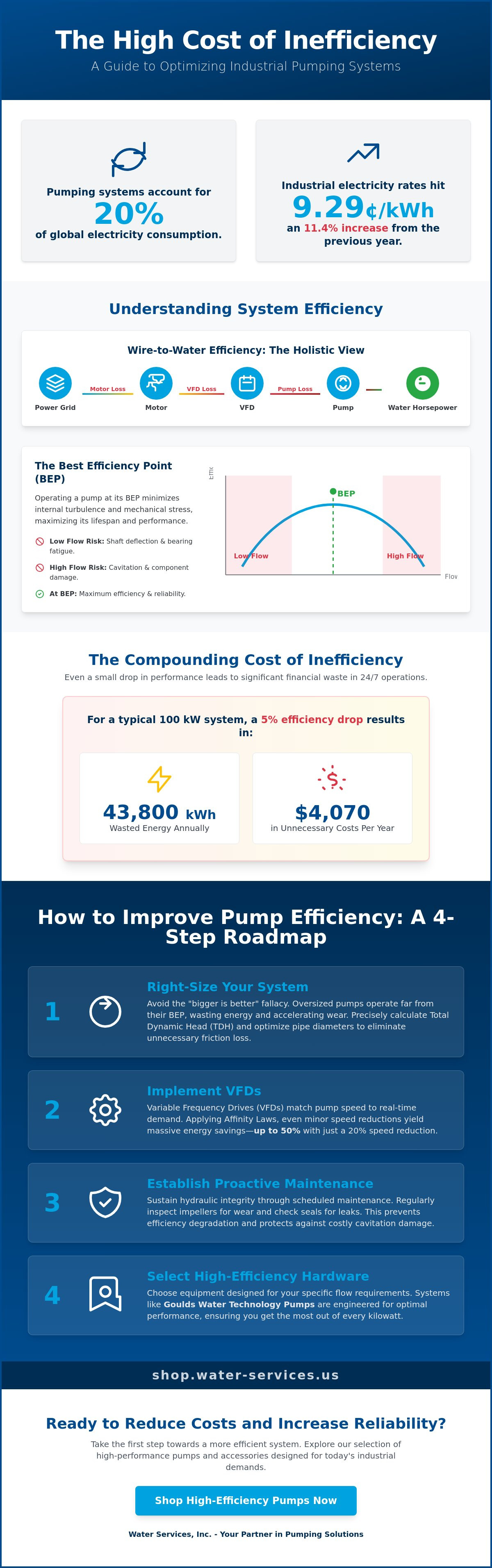
Pumping systems account for up to 20% of global electricity consumption. With industrial electricity rates reaching 9.29¢/kWh in January 2026, an 11.4% increase from the previous year, learning how to improve pump efficiency is now a financial necessity. You've likely dealt with the operational strain of oversized pumps, where high energy bills and frequent maintenance cycles from cavitation disrupt your facility's output. It's a common frustration when inaccurate flow monitoring leads to system imbalances that shorten equipment life and drive up costs.
This guide provides a technical roadmap to optimize your industrial pumping infrastructure for maximum reliability. You'll learn how to reduce energy consumption and lower your Total Cost of Ownership through precise hydraulic sizing and demand control. We will examine the implementation of variable frequency drives, the role of Ashcroft pressure gauges in monitoring stability, and the specific ROI gained from upgrading to high-efficiency Goulds Water Technology systems. By the end of this article, you'll have the data-driven strategies needed to stabilize system pressure and ensure long-term mechanical integrity.
Key Takeaways
- Quantify the wire-to-water efficiency ratio to establish an accurate baseline for energy conversion across your entire pumping system.
- Eliminate performance losses caused by oversized equipment through precise Total Dynamic Head (TDH) calculations and hydraulic optimization.
- Apply the Affinity Laws to understand how to improve pump efficiency, using VFDs to achieve up to 50% energy savings with minor speed reductions.
- Establish proactive maintenance schedules for impellers and seals to sustain hydraulic integrity and prevent costly cavitation damage.
- Optimize your process matching by selecting high-efficiency Goulds Water Technology Pumps designed for specific industrial flow requirements.
What Is Pump Efficiency and Why It Matters in 2026
In industrial engineering, pump efficiency is the ratio of water horsepower to brake horsepower. It measures how effectively a pump converts mechanical energy from the shaft into hydraulic energy in the fluid. While individual component ratings are important, modern facilities focus on wire-to-water efficiency. This holistic metric accounts for losses across the entire power train, including the motor, variable frequency drive, and the pump itself. High pump efficiency ensures that the energy pulled from the electrical grid is utilized for fluid transport rather than being dissipated as heat or vibration. In a water treatment plant, this performance level directly correlates to system reliability; an efficient pump runs cooler and experiences fewer mechanical stresses.
The regulatory environment in 2026 has made energy management a priority. Industrial electricity rates reached 9.29¢/kWh in January 2026, marking an 11.4% increase over the previous year. Additionally, the Section 179D federal tax deduction for energy-efficient improvements is set to expire for projects that don't begin construction by June 30, 2026. These economic pressures mean that understanding how to improve pump efficiency is no longer just a maintenance goal. It's a requirement for maintaining operational margins in a high-cost energy market.
The Economic Impact of Inefficient Pumping
Operating a pump just 5% below its optimal efficiency point creates a compounding financial burden in 24/7 industrial applications. For a system consuming 100 kW, a 5% efficiency drop results in 43,800 kWh of wasted energy annually. At current 2026 rates, this waste represents a significant unallocated cost that provides zero hydraulic benefit. Beyond the utility bill, inefficiency triggers premature component failure. Excess energy that isn't converted into flow is often transformed into heat or radial thrust. This leads to blown seals, bearing fatigue, and unexpected downtime that disrupts production schedules. Minimizing this energy waste is also essential for meeting corporate carbon footprint goals, as pumping systems account for approximately 20% of global industrial energy usage.
Understanding the Best Efficiency Point (BEP)
Every centrifugal pump has a specific performance curve where its efficiency is highest. This is known as the Best Efficiency Point (BEP). Operating a pump too far to the left of the BEP causes low-flow suction recirculation and high radial loads that can deflect the shaft. Conversely, operating too far to the right increases the risk of cavitation as the Net Positive Suction Head Required (NPSHr) exceeds the available head. BEP is the flow rate where internal turbulence is minimized. To maintain this balance, engineers often utilize industrial pumps sized specifically for the system's average demand rather than its peak load. Staying near the BEP ensures the longest possible Mean Time Between Failures (MTBF) for the entire assembly.
Hydraulic Optimization: Sizing and System Design
System design often suffers from a "bigger is better" mentality. Engineers frequently add excessive safety margins to head and flow requirements during the procurement phase. This results in significantly oversized equipment that operates far from its Best Efficiency Point. Calculating Total Dynamic Head (TDH) accurately is the first step in learning how to improve pump efficiency. TDH is the sum of static head, friction head, and velocity head. If these calculations are based on worst-case scenarios that rarely occur, the pump will spend its lifespan wasting energy and incurring unnecessary wear.
Pipe diameter and layout are critical factors in hydraulic load. Smaller pipe diameters increase flow velocity, which exponentially raises friction loss and forces the pump to consume more power. Referencing the Hydraulic Institute's piping efficiency tips can help you identify where turbulence and poor pipe configurations are draining system energy. For facilities with variable demand, the choice between parallel and series configurations is essential. Parallel pumping allows you to bring additional pumps online only when flow requirements increase. Series pumping is reserved for applications requiring extremely high head pressures. Reviewing your current system curve against a Goulds Water Technology Pump performance curve can reveal if your hardware is correctly matched to your process.
The Pitfalls of Oversized Pumps
Throttling a discharge valve to meet a lower demand is an inefficient way to manage flow. It's the mechanical equivalent of driving a car with the gas pedal floored while using the brake to control speed. This practice creates artificial head, shifting the pump's operating point and causing rapid heat buildup. Excessive head also leads to increased vibration and shaft deflection, which destroys bearings and seals. For a broader perspective on how these components fit into a larger facility, consult our guide on industrial water treatment systems.
Impeller Trimming vs. Replacement
Impeller trimming is a permanent, cost-effective solution for pumps that are consistently oversized for their application. By reducing the diameter of the impeller, you lower the head and flow produced by the pump to match the actual system requirements. This modification can significantly reduce energy consumption without the need for a full hardware overhaul. However, if the mismatch between the pump and the system is greater than 25%, a full replacement is usually more efficient. Installing a smaller, right-sized Goulds Water Technology Pump often provides a faster return on investment through drastic energy savings and reduced maintenance costs. If your system pressure remains unstable, integrating accurate Ashcroft pressure gauges can help you determine the exact extent of the mismatch before you commit to hardware changes.
Advanced Control Strategies: VFDs and Automation
Variable Frequency Drives (VFDs) represent the most effective hardware solution for managing fluctuating system demand. While hydraulic sizing addresses the static requirements of a facility, VFDs provide the dynamic flexibility needed to maintain performance without wasting energy. By adjusting the motor's frequency and voltage, a VFD matches the pump's output to real-time process needs. This is a critical component of how to improve pump efficiency because it eliminates the need for energy-draining throttling valves that were discussed in the previous section.
The economic justification for these electric power controls is found in the Affinity Laws. For centrifugal pumps, the power required is proportional to the cube of the shaft speed. This means a 20% reduction in motor speed can lead to a 50% to 60% reduction in power consumption. In an environment where industrial electricity rates have risen by 11.4% in a single year, these savings are substantial. However, implementing VFDs requires an understanding of mechanical limits. Motors running at significantly reduced speeds may suffer from inadequate cooling because the internal fan loses effectiveness. Additionally, every pump has a minimum flow requirement to prevent internal heat buildup and recirculation. Consulting industry resources on improving pump efficiency can help you define these operational boundaries for your specific hardware.
Integrating Smart Controllers and Sensors
Precision control depends on high-quality data loops. Integrating Signet Flow Sensors allows the system to monitor actual flow rates and adjust the VFD output instantaneously. This closed-loop control ensures that the pump only does the work necessary for the current process state. For specialized applications, such as chemical treatment, Walchem controllers manage the timing and volume of metering pumps. This prevents the over-injection of chemicals and reduces the load on secondary treatment stages. Automated valves further enhance this efficiency by redirecting flow based on sensor input, maintaining stabilized system pressure without manual intervention.
Demand-Side Management in Water Treatment
Efficiency isn't just about how the pump runs; it's about when it runs. Buffer tanks are an effective way to level out demand cycles, allowing pumps to operate at a steady, efficient rate rather than frequently cycling on and off. This strategy is particularly useful in industrial water filtration systems, where automated backwashing cycles can be scheduled during off-peak hours or when tank levels are optimal. To ensure these automated systems are functioning correctly, Ashcroft Pressure Gauges provide a reliable visual and electronic reference. They help identify control failures or blockages that could force a pump to work harder than necessary, protecting your ROI on efficiency upgrades.
Maintenance Protocols for Sustained Efficiency
Establishing a rigorous maintenance protocol is the final pillar in learning how to improve pump efficiency. While advanced controls and proper sizing set the foundation, mechanical degradation can quietly erode system performance over time. Mechanical drag caused by improper lubrication or shaft misalignment creates parasitic power losses that often go undetected until a component fails. Internal corrosion and mineral scale buildup increase the surface roughness of the pump casing and impellers; this increased friction forces the motor to draw more current to maintain the same flow rate. Sustaining high efficiency requires a shift from reactive repairs to a data-driven maintenance schedule that monitors specific hydraulic and mechanical metrics.
Routine audits should prioritize the removal of energy-draining obstructions and the restoration of tight mechanical tolerances. By understanding how to improve pump efficiency through routine mechanical audits, operators can extend the mean time between failures (MTBF) and stabilize energy costs. If your system performance has dropped despite stable electrical input, it's time to inspect your replacement wear parts and service kits to restore original factory specifications.
The Efficiency Checklist for 2026
Modern maintenance depends on identifying subtle shifts in operation before they lead to catastrophic failure. Use the following checklist to maintain peak hydraulic performance:
- Monitor Vibration Levels: Use portable or integrated sensors to detect early bearing fatigue or seal failure, which increase mechanical resistance.
- Check Wear Ring Clearances: Excessive clearance allows fluid to leak from the discharge back to the suction side, causing internal recirculation and massive efficiency drops.
- Inspect Filtration Load: Regularly check FilmTec Reverse Osmosis Membranes for fouling; a clogged membrane increases the backpressure on the pump, forcing it to consume more energy to maintain permeate flow.
Cavitation Prevention and Remediation
Cavitation is one of the most destructive forces in industrial pumping. When the local pressure at the impeller eye drops below the vapor pressure of the liquid, vapor bubbles form and then collapse violently against the metal surfaces. This process pits the impeller, destroys hydraulic balance, and significantly reduces the pump's ability to move fluid efficiently. Preventing this requires a strict adherence to Net Positive Suction Head (NPSH) requirements. For high-flow pumps, you must ensure that the available suction pressure remains well above the manufacturer's required minimum. NPSH margin is the buffer between available and required suction pressure. Maintaining a healthy margin prevents the energy waste and mechanical damage associated with suction or discharge cavitation.
Selecting High-Efficiency Hardware with Water Services, Inc.
Technical strategies for how to improve pump efficiency are only as effective as the hardware they support. Selecting equipment that meets the exact hydraulic and chemical requirements of your facility is the final step in optimizing industrial systems. Water Services, Inc. provides high-performance Goulds Water Technology Pumps, which serve as the industry standard for hydraulic efficiency and mechanical reliability. Our approach moves beyond individual component sales to offer modular, containerized reverse osmosis plants and mobile ultrafiltration systems. These pre-engineered solutions ensure that every pump, motor, and controller is factory-matched to the process requirements, eliminating the efficiency gaps often found in field-assembled systems.
Based in Provo, UT, Water Services, Inc. combines domestic industrial reliability with international distribution capabilities. We specialize in complex mining wastewater treatment solutions where pump efficiency is challenged by high solids content and corrosive fluids. Our engineers provide technical consulting to ensure your infrastructure maintains compliance and resource recovery goals while minimizing energy consumption. Whether you are managing a local utility or a global mining operation, our logistical competence ensures you receive the exact hardware needed for your specific environment.
Why Goulds Pumps Lead in Industrial Efficiency
Goulds Water Technology Pumps utilize precision-engineered impellers designed to minimize internal turbulence and maximize energy transfer. These systems are paired with high-efficiency motors that meet or exceed NEMA standards, reducing the total electrical load of your pumping station. For aggressive environments, Goulds offers specialized materials such as duplex stainless steel and hardened alloys to resist the erosion that typically degrades pump performance. Maintaining the original internal geometry of the pump is critical for long-term efficiency; even minor pitting or corrosion can increase power demand by 10% or more. You can browse our full pump collection to compare head-flow curves and technical specifications for your next upgrade.
The Professional Path to System Optimization
Achieving a stabilized system pressure requires a holistic view of the water treatment train. A professional system audit by Water Services engineers identifies bottlenecks where mismatched components are draining power. We integrate Viqua UV systems, RO units, and multimedia filter tanks into a unified flow that maintains consistent hydraulic balance. This integration prevents the "start-stop" cycles that increase wear and energy waste. By pairing Signet flow sensors with Walchem controllers, we create an automated environment that adjusts to demand in real-time. This data-driven approach ensures your facility operates at the lowest possible Total Cost of Ownership (TCO).
Contact Water Services, Inc. for a custom engineered pumping solution today.
Executing Efficiency Upgrades for Industrial Reliability
Mastering how to improve pump efficiency requires a transition from oversized, reactive systems to automated, precision-sized infrastructure. We've established that maintaining operation near the Best Efficiency Point (BEP) and utilizing Variable Frequency Drives can reduce energy consumption by up to 50% under variable loads. These technical adjustments are essential for mitigating the impact of rising 2026 industrial electricity rates and ensuring the long-term integrity of your mechanical components. By integrating precise flow monitoring and proactive maintenance, you can effectively lower your Total Cost of Ownership.
Water Services, Inc. provides the engineering support and specialized hardware needed to execute these upgrades. As an Authorized Goulds Water Technology Distributor with global engineering expertise since 1994, we deliver specialized solutions for demanding mining and military sectors. Our inventory includes the exact controllers, sensors, and high-efficiency pumps required to stabilize system pressure and ensure durability in rigorous environments. You can rely on our technical integrity to provide the stable, high-performance solutions your facility demands.
Shop High-Efficiency Goulds Pumps and Industrial Controls to begin your system optimization today.
Frequently Asked Questions
What is the most effective way to improve pump efficiency?
The most effective way to improve pump efficiency is to ensure the pump is correctly sized for the actual system curve rather than a theoretical peak demand. Oversizing leads to throttling or bypass recirculation, both of which waste energy. By aligning the pump's Best Efficiency Point with the most frequent operating conditions, you minimize internal turbulence and mechanical stress. This foundational step is more critical than any secondary control or maintenance protocol.
How much energy can a Variable Frequency Drive (VFD) actually save?
A Variable Frequency Drive can reduce power consumption by 50% to 60% when motor speed is reduced by just 20%. This is due to the Affinity Laws, which state that power consumption is proportional to the cube of the shaft speed. In typical industrial variable load situations, energy savings between 20% and 40% are common. These savings are achieved by eliminating the friction losses associated with mechanical control methods like throttling valves.
What are the signs that my pump is operating off its Best Efficiency Point (BEP)?
Excessive vibration and audible noise resembling pumping gravel are primary indicators that a pump has drifted from its BEP. Operating too far to the left of the curve causes suction recirculation, while operating too far to the right increases the risk of cavitation. You may also observe high motor temperatures and a disproportionate increase in power draw relative to flow. Monitoring these metrics via Ashcroft pressure gauges and Signet flow sensors provides the data needed to identify these imbalances early.
Can impeller trimming be reversed if system demand increases?
Impeller trimming is a permanent mechanical modification that cannot be reversed. If system demand increases beyond the capacity of the trimmed impeller, the component must be replaced with a full-diameter version. This is why engineers must conduct a thorough analysis of long-term flow requirements before opting for trimming. For systems with highly variable future demand, a VFD is a more flexible alternative for learning how to improve pump efficiency without permanent hardware changes.
How does water temperature affect pump efficiency and NPSH?
Higher water temperatures increase the fluid's vapor pressure, which directly reduces the Net Positive Suction Head Available (NPSHa). As the margin between NPSHa and NPSHr narrows, the risk of cavitation increases, which destroys hydraulic efficiency and damages internal components. While the temperature itself has a negligible effect on the pump's mechanical efficiency, the resulting risk of vapor lock and impeller pitting can lead to severe performance degradation and energy waste.
What is the difference between mechanical efficiency and volumetric efficiency?
Mechanical efficiency measures the power lost to friction in the bearings and seals, while volumetric efficiency quantifies the losses due to internal leakage or recirculation. Volumetric losses typically occur across the wear rings, where fluid escapes from the high-pressure discharge side back to the low-pressure suction side. High volumetric efficiency ensures that the work performed by the impeller actually results in delivered flow. Both metrics are essential components of the overall wire-to-water efficiency of an industrial system.
How often should an industrial pump be audited for efficiency?
Industrial pumps should undergo a comprehensive efficiency audit at least once per year. Systems operating in high-wear environments, such as mining or chemical processing, may require semi-annual inspections to detect early signs of internal erosion or scale buildup. Regular audits allow you to track performance trends and implement proactive maintenance before energy costs spike. Utilizing Walchem controllers and Signet sensors enables continuous monitoring, which can supplement these formal periodic audits with real-time performance data.
Does chemical scaling in pipes significantly impact pump energy consumption?
Chemical scaling significantly increases energy consumption by reducing the effective pipe diameter and increasing surface roughness. This leads to higher friction losses, which raises the Total Dynamic Head (TDH) the pump must overcome to maintain the required flow rate. As the pump works harder against this increased resistance, its power draw rises. Implementing a water treatment strategy with appropriate antiscalants is an essential part of a comprehensive plan for how to improve pump efficiency across the entire infrastructure.
0 comentarios