

Delaying a Clean-In-Place (CIP) cycle until your permeate flow drops by 15% is often a permanent death sentence for your FilmTec or Hydranautics elements. When fouling reaches a critical threshold, the resulting increase in feed pressure doesn't just waste energy; it physically compresses the membrane spacers and makes recovery nearly impossible. You understand the frustration of rising differential pressures and the high replacement costs that follow when a system isn't maintained with precision. It's a heavy logistical burden that affects your entire production schedule and operational bottom line.
This technical guide provides a rigorous SOP on how to clean RO membranes to restore flux and reduce pressure drops effectively. We'll move beyond generic washing to explore the chemical science of targeted cleaning sequences. You'll learn the exact protocols for utilizing low pH and high pH solutions to eliminate mineral scale and organic bio-growth. By following these industrial standards, you can extend the operational life of your existing membrane elements and ensure your reverse osmosis plant operates at peak hydraulic efficiency.
Key Takeaways
- Identify the optimal cleaning window by monitoring for a 10% drop in normalized permeate flow or a 15% increase in differential pressure.
- Discover how to clean RO membranes using a strategic sequence of high pH alkaline cleaners for organics and low pH acid cleaners for mineral scale.
- Execute a professional Clean-In-Place (CIP) procedure that prioritizes low-flow pumping and proper chemical soak times to restore membrane performance.
- Learn the technical protocols for post-cleaning evaluation and the safe neutralization of effluent to maintain site safety and regulatory compliance.
- Reduce future maintenance frequency by optimizing pre-treatment systems and utilizing high-performance antiscalants to prevent scale formation.
Identifying the Need: When to Clean RO Membranes
Successful operation of Reverse osmosis (RO) systems depends on precise maintenance intervals. Operators often ask how to clean RO membranes based on a fixed calendar, but industrial standards require performance-based triggers. Waiting for a visible drop in product water quality is a reactive approach that often leads to irreversible membrane damage. Technical data must drive the decision to initiate a Clean-In-Place (CIP) cycle.
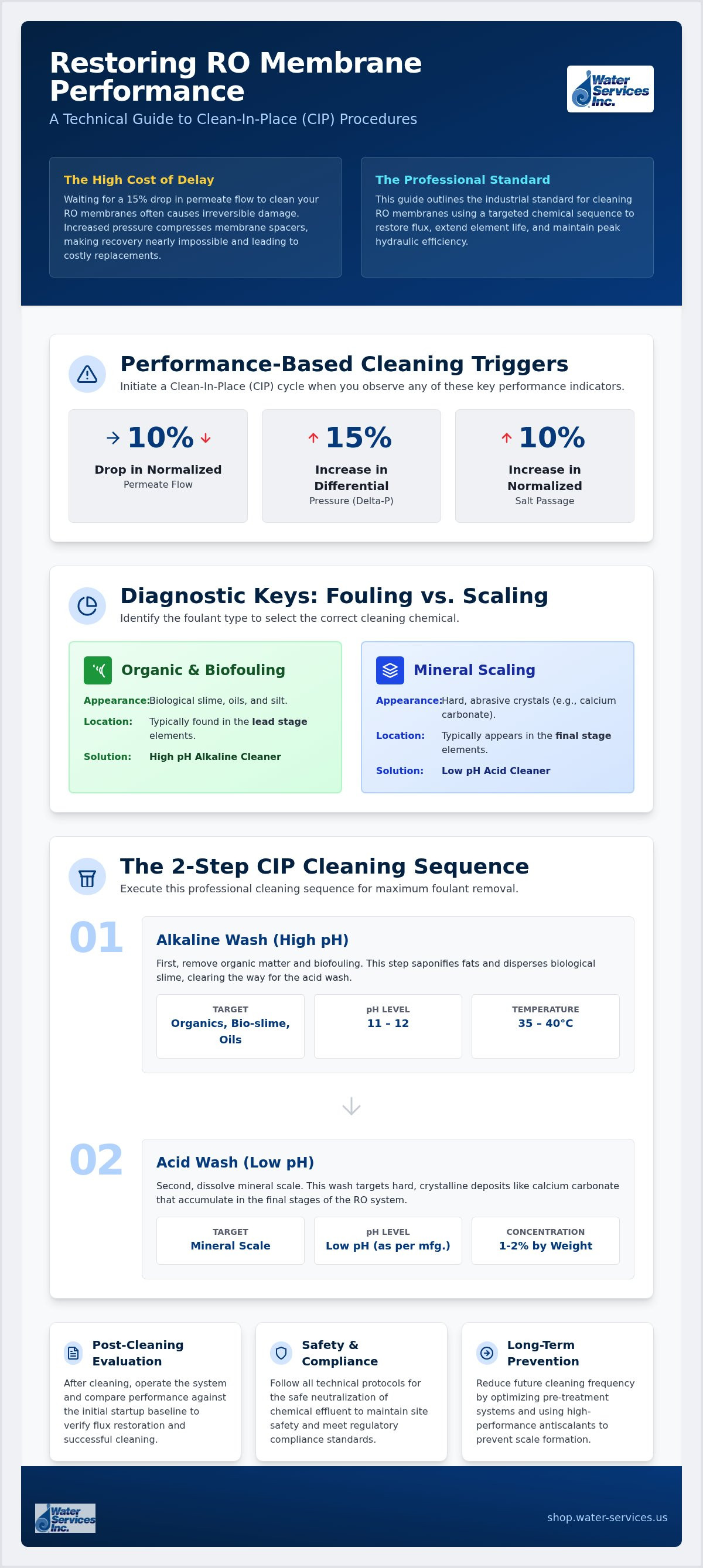
The industry standard for initiating a cleaning cycle is the "10% Rule." You should clean when normalized permeate flow decreases by 10%, or when the feed pressure required to maintain flow increases by 10%. Additionally, a 10% increase in normalized salt passage indicates that fouling is beginning to compromise the membrane barrier. If you wait until performance drops by 20%, the foulants become compacted. This compaction restricts chemical access to the membrane surface, making the cleaning process ineffective and potentially forcing a full element replacement. Visual inspections of the lead and tail elements can confirm these data points, revealing physical debris or slime that baseline metrics suggest.
Key Performance Indicators (KPIs) for Cleaning
Raw data is often misleading due to fluctuations in feed water temperature and salinity. You must calculate normalized permeate flow to compare current performance against the initial startup baseline. For instance, colder water is more viscous and requires higher pressure. Without normalization, you might mistake a seasonal temperature drop for membrane fouling. Monitoring stage-specific pressure drops is equally critical. Utilizing high-accuracy Ashcroft pressure gauges allows operators to pinpoint exactly where the resistance is occurring. An increase in differential pressure (delta-P) across a single stage typically signals the accumulation of solids or biological growth that requires immediate attention.
Fouling vs. Scaling: Diagnostic Differences
Diagnostic accuracy determines the success of the CIP. Biofouling and organic matter typically accumulate in the lead stage elements where nutrient levels are highest. Conversely, mineral scale, such as calcium carbonate, usually appears in the final stage where the brine concentration is most dense. Physical inspection remains a vital tool during maintenance. If an element feels significantly heavier than its dry weight specification, it indicates "dead weight" from deep-seated foulants. This "Weight Test" helps determine if an element is fouled beyond recovery. If the lead elements are slimy, prioritize alkaline cleaners. If the tail elements show hard, abrasive crystals, an acid-based approach is required to restore flux.
Selecting the Right Cleaning Chemicals for RO Membranes
Determining how to clean RO membranes effectively depends entirely on the type of foulant identified during the diagnostic phase. Using an incompatible chemical or an incorrect pH level can permanently damage the thin-film composite structure or cause foulants to set. Most industrial protocols follow a two-step sequence: an alkaline wash to remove organic matter, followed by an acid wash to dissolve mineral scale. Before beginning, you must consult the technical manual from DuPont or your specific membrane manufacturer to confirm the exact pH and temperature tolerances for your elements. FilmTec and Hydranautics membranes generally tolerate a pH range of 1 to 13 during cleaning, but these limits narrow as temperature increases.
Chemical concentration math is vital for system safety. You must calculate the total volume of the CIP circuit, including the cleaning tank, system piping, and the internal volume of the pressure vessels. Most formulated cleaners require a concentration of 1% to 2% by weight. For example, a 500-gallon CIP circuit would require approximately 42 to 84 pounds of chemical. Accuracy here prevents over-concentration, which can delaminate the polyamide layer and destroy the membrane’s salt rejection capabilities.
Alkaline Cleaning (pH 11-12) for Organics
Alkaline cleaners target biological slime, oils, and silt. These high-pH solutions work by saponifying fats and dispersing organic polymers. To maximize efficiency, you should heat the cleaning solution to 35-40°C; higher temperatures significantly improve the solubility of organic foulants. If your feed water contains heavy hydrocarbons or complex oils, adding specialized surfactants to the alkaline mix can help break the bond between the oil and the membrane surface. Always ensure the solution remains within the manufacturer’s temperature-pH envelope to avoid thermal degradation of the element.
Acid Cleaning (pH 2-3) for Mineral Scale
Acid cleaners are designed to dissolve calcium carbonate scale and metal oxides like iron or manganese. Citric acid is a common choice for its chelating properties, though stronger acids like hydrochloric acid are sometimes used for severe scaling. You must monitor the pH closely during this stage. If the pH rises above 3, the acid is being consumed by the scale and you must add more chemical to maintain the cleaning strength. Over-acidification below pH 2 can be aggressive toward the membrane backing materials. For more technical details on selecting compatible solutions, check our guide on Water Treatment Chemicals for integration tips.
Selecting high-purity industrial cleaning chemicals ensures that no additional contaminants are introduced to the system during the CIP process.
The Clean-In-Place (CIP) Procedure: Step-by-Step Execution
Executing an industrial CIP cycle requires a synchronized approach between chemical action and mechanical force. If the hydraulic parameters are incorrect, even the most expensive chemicals will fail to restore flux. Understanding how to clean RO membranes involves mastering the flow rates and contact times necessary to lift foulants without damaging the delicate polyamide layers. This process is not a simple wash; it's a controlled engineering procedure that must be followed with technical precision.
Mechanical Requirements for CIP
Your CIP skid must be robust. Sizing the pump is the first priority. You need high-flow, low-pressure performance to ensure the cleaning solution reaches every part of the membrane surface without exceeding 60 psi. Using Goulds Water Technology Pumps provides the reliability needed for these rigorous recirculation cycles. Additionally, the skid must include a 5 to 10-micron cartridge filter. This prevents dislodged solids from being pumped back into the membrane elements, which would cause secondary fouling. The cleaning tank itself should be constructed from polyethylene or fiberglass reinforced plastic (FRP) to withstand the pH extremes of caustic and acidic solutions.
SOP: The 6-Step Cleaning Sequence
Following a standardized sequence ensures that foulants are removed systematically. This 6-step protocol is the industrial standard for most FilmTec and Hydranautics systems:
- Step 1: Low-pressure flush. Use permeate or deionized water to displace the concentrated brine. This prevents chemical reactions between the feed water and cleaning agents.
- Step 2: Introduction of cleaning solution. Start at a low flow rate to fill the vessels and displace the flush water into a waste drain.
- Step 3: Recirculation. Once the solution is circulating back to the tank, move it through the membranes for 30 to 60 minutes. Monitor the temperature closely.
- Step 4: The Soak. For stubborn organic fouling, turn off the pump and let the elements sit in the solution for 1 to 8 hours. This "rest time" is essential for breaking down complex biofilms.
- Step 5: High-flow flush. Increase the flow rate to the maximum allowed by the manufacturer to physically push out the loosened debris.
- Step 6: Final rinse. Flush the system with permeate until the pH of the effluent matches the pH of the rinse water.
System stabilization is the final act of the CIP. After the final rinse, restart the RO system in "flush to drain" mode for 15 to 30 minutes. This ensures that any residual cleaning chemicals are completely evacuated before you begin producing high-quality permeate for your process again.
Post-Cleaning Evaluation and Safety Protocols
Completing the physical CIP sequence is only part of the process. You must verify the effectiveness of the procedure and manage the hazardous effluent produced. Mastering how to clean RO membranes requires as much focus on the post-cleaning verification as it does on the chemical soak. Compare the post-cleaning normalized permeate flow and salt passage against the original startup data. If the flux hasn't restored to within 10% of the baseline, the fouling may be too severe for recovery or the chemical selection was incorrect.
Managing wastewater is a critical regulatory step. Spent cleaning solutions often have extreme pH levels and high concentrations of dislodged foulants. Under the Clean Water Act and NPDES program, industrial facilities must typically neutralize wastewater to a pH between 6.0 and 9.0 before discharge. Use a neutralization tank to balance the spent acid and alkaline solutions, ensuring the effluent meets local environmental limitations. This prevents damage to municipal sewer systems or local water bodies.
Documentation is the final requirement for a professional maintenance program. Record every cleaning event in the plant log. Include the cleaning date, specific chemicals used, concentration levels, and temperature. Tracking these trends allows you to predict future fouling cycles and adjust pre-treatment antiscalant dosages accordingly. Accurate logs also help determine when elements are nearing their end-of-life, allowing for planned replacement budgeting.
Chemical Handling and PPE
Handling concentrated acids and bases in industrial environments requires strict adherence to safety protocols. Splashes can cause severe chemical burns or permanent eye damage. Operators must wear essential gear, including chemical-resistant gloves, face shields, and aprons from our PPE collection. Ensure that emergency eye-wash stations and safety showers are within immediate reach and fully functional. Acid cleaning cycles can also generate fumes; maintain high-volume ventilation throughout the CIP area to prevent respiratory irritation.
System Re-Commissioning
Before returning the unit to service, you must ensure all residual chemicals are flushed from the system. Divert the permeate to the drain for at least 15 minutes. Monitor the permeate conductivity using calibrated sensors. The water is only safe for your industrial process once the conductivity stabilizes at baseline levels. Refer to our Commercial Reverse Osmosis Selection Guide for baseline performance data to confirm your system is back within spec. Knowing how to clean RO membranes correctly ensures that the product water quality remains consistent and safe for downstream use.
Ensure your facility is prepared for the next maintenance cycle by stocking high-quality industrial water treatment components.
Long-Term Performance: Preventing Membrane Fouling
Reducing the frequency of Clean-In-Place cycles is the most effective strategy for extending the service life of your reverse osmosis system. While mastering how to clean RO membranes is a critical operational skill, high-performance facilities prioritize preventing foulants from reaching the membrane surface. Effective pre-treatment serves as the primary barrier, shielding the thin-film composite from colloidal particles, mineral scale, and oxidizing agents that cause permanent flux loss.
Monitoring the Silt Density Index (SDI) is a mandatory technical requirement for industrial operators. An SDI value exceeding 5.0 indicates a high risk of colloidal fouling, which leads to rapid pressure drops. To mitigate this, utilize high-performance antiscalants. These chemicals interfere with crystal growth, keeping scale-forming minerals in solution so they are safely discharged in the brine stream rather than precipitating on the element surface.
Automation plays a vital role in maintaining hydraulic stability. Implementing automated flushing protocols using Walchem Controllers allows for periodic permeate flushes during standby periods. This process displaces stagnant, high-conductivity brine with high-quality water. It prevents the precipitation of minerals and inhibits the growth of biofilms during system downtime, significantly extending the intervals between manual cleanings.
Advanced Pre-treatment Strategies
High-turbidity feed water requires robust mechanical filtration. Multimedia filter tanks are effective for general suspended solids, but ultrafiltration (UF) systems provide a superior barrier for sub-micron particles and pathogens. Additionally, carbon filtration is necessary for municipal water sources to remove residual chlorine. Even trace levels of chlorine can oxidize the polyamide layer, causing irreversible damage that no cleaning cycle can fix. Read more on Industrial Water Filtration Systems to determine which technology fits your specific water chemistry.
Maintenance Scheduling
Consistency in maintenance prevents emergency production halts. You should establish a predictive maintenance schedule based on the historical fouling rates recorded in your plant logs. Training staff on standardized CIP protocols ensures every cleaning event is performed with technical accuracy. Eventually, even well-maintained FilmTec or Hydranautics membranes reach their end-of-life. This is typically indicated when the system fails to restore flux within 10% of the baseline after a correct cleaning sequence or when salt passage exceeds the design limit by 50%. Planning for these replacements ensures your facility maintains its required permeate output without excessive energy consumption.
Maximizing Industrial Membrane Performance and Longevity
Implementing a technical SOP for Clean-In-Place cycles is the most effective way to protect your facility's capital investment. By strictly adhering to the 10% rule for normalized flow and following a precise chemical sequence, you'll restore hydraulic efficiency and prevent irreversible element compaction. This guide has detailed the essential requirements for how to clean RO membranes using industrial standards that prioritize both flux restoration and operator safety. Consistency in these protocols ensures that your system operates at peak capacity while minimizing unplanned downtime.
Maintaining these high-performance standards requires reliable access to specialized hardware and high-purity treatment chemicals. Water Services, Inc. serves as an authorized distributor of FilmTec and Hydranautics elements, providing the technical support and global logistics necessary for critical mining and remote industrial operations. Shop Industrial RO Membranes and Cleaning Components at Water Services, Inc. to secure the parts and expertise required for your next maintenance cycle. With a proactive strategy and high-quality components, your reverse osmosis plant will continue to deliver stable, high-quality permeate for years to come.
Frequently Asked Questions
How often should I clean my industrial RO membranes?
Industrial cleaning frequency is determined by performance metrics rather than a fixed calendar. You should initiate a Clean-In-Place cycle when normalized permeate flow drops by 10%, or when the differential pressure increases by 15%. Most well-maintained systems require cleaning every three to six months. If your site requires monthly cleaning, you should evaluate your pre-treatment efficiency or antiscalant dosage to prevent premature membrane degradation and high replacement costs.
Can I use bleach (sodium hypochlorite) to clean my RO membrane?
You should never use sodium hypochlorite to clean thin-film composite polyamide membranes. Chlorine causes irreversible oxidation of the membrane surface, leading to a permanent loss of salt rejection. While some older cellulose acetate membranes tolerate chlorine, the FilmTec and Hydranautics elements used in most industrial systems don't. If biological fouling is a concern, use non-oxidizing biocides or high-pH alkaline cleaners specifically formulated for biofilm removal without compromising integrity.
What happens if I mix acid and alkaline cleaners?
Mixing acid and alkaline cleaners in the same tank causes immediate neutralization, rendering the chemicals ineffective for the CIP process. Beyond losing cleaning power, the chemical reaction can precipitate dissolved foulants back onto the membrane surface, making the blockage worse. Always perform a thorough permeate flush between the high-pH and low-pH stages. This ensures that the residual alkaline solution is completely evacuated before the acidic solution enters the pressure vessels.
How do I know if my RO membrane is fouled or scaled?
Determining if a system is fouled or scaled requires monitoring stage-specific pressure drops using Ashcroft gauges. Organic fouling and biofilms typically occur in the lead stage elements where nutrient levels are highest. Mineral scaling, such as calcium carbonate, is usually found in the final stage where the brine concentration is most dense. You can also perform a physical weight test; a significantly heavier tail element suggests mineral scaling that requires an acidic cleaning approach.
What is the maximum temperature for cleaning RO membranes?
Most industrial membranes have a maximum cleaning temperature of 45°C. However, the allowable temperature often decreases as the pH becomes more extreme. For instance, at a pH of 12, many manufacturers recommend staying below 35°C to prevent delamination of the polyamide layer. Always verify the specific temperature-pH limits for your elements. Heating the solution within these technical limits is critical for dissolving stubborn organic foulants and improving flux restoration results.
Why did my permeate flow decrease immediately after cleaning?
An immediate decrease in permeate flow after cleaning often indicates that foulants were loosened but not completely flushed out, causing them to re-settle and compact. If the pH wasn't neutralized correctly, residual chemicals can also cause membrane swelling or secondary precipitation. This highlights the importance of the high-flow flush stage in the SOP. Ensure you're using high-performance Goulds pumps to provide enough velocity to physically evacuate dislodged debris from the feed spacers.
Is it better to clean membranes in-place or off-site?
Clean-In-Place (CIP) is the industrial standard because it minimizes downtime and reduces the risk of physical damage during element handling. Off-site cleaning is typically reserved for elements that have reached a 20% performance drop, where specialized equipment and longer soak times are required. For remote mining or military operations, mastering how to clean RO membranes on-site is essential for maintaining logistical independence and avoiding the high costs of shipping elements.
How much chemical do I need for a 4-inch vs 8-inch membrane system?
Chemical requirements depend on the total volume of the CIP circuit, including the tank and piping. An 8-inch element holds approximately 8 gallons of solution, while a 4-inch element holds about 2 gallons. You must calculate the volume of the entire circuit plus a 20% buffer in the tank to prevent the pump from cavitating. Most formulated chemicals are then added to achieve a 1% to 2% concentration by weight based on that total volume.
0 comentarios