

With the global reverse osmosis market projected to reach $13.47 billion in 2026, the demand for high-efficiency infrastructure has reached a critical peak. This growth makes high pressure pump selection for reverse osmosis systems the most vital engineering decision for your facility's long-term viability. You likely understand that mismatched pump curves and corrosive feed water are the primary causes of premature system failure and inflated energy bills. It's a technical challenge that directly impacts your total cost of ownership and operational uptime.
This 2026 guide provides the engineering nuances required to select the optimal high-pressure pump for industrial applications. We'll help you master the technical criteria needed to reduce expenses and ensure accurate sizing for specific TDS levels. You'll learn how to navigate the latest DOE energy conservation standards and why industry standards like Goulds Water Technology pumps remain the benchmark for industrial reliability. We'll preview the essential steps for balancing energy efficiency against site-specific maintenance capabilities to keep your operations running at peak performance.
Key Takeaways
- Identify how feed water Total Dissolved Solids (TDS) levels dictate minimum osmotic pressure requirements and baseline pump specifications.
- Calculate precise duty points and Net Positive Suction Head (NPSH) requirements to prevent cavitation and ensure long-term mechanical integrity.
- Evaluate the efficiency profiles of multi-stage centrifugal versus positive displacement pumps to align hardware selection with specific flow variables.
- Apply specialized criteria for high pressure pump selection for reverse osmosis systems in demanding mining and desalination environments.
- Minimize total cost of ownership (TCO) by leveraging Goulds Water Technology pumps for maximized uptime in industrial water treatment applications.
Fundamentals of High-Pressure Pumping in Reverse Osmosis
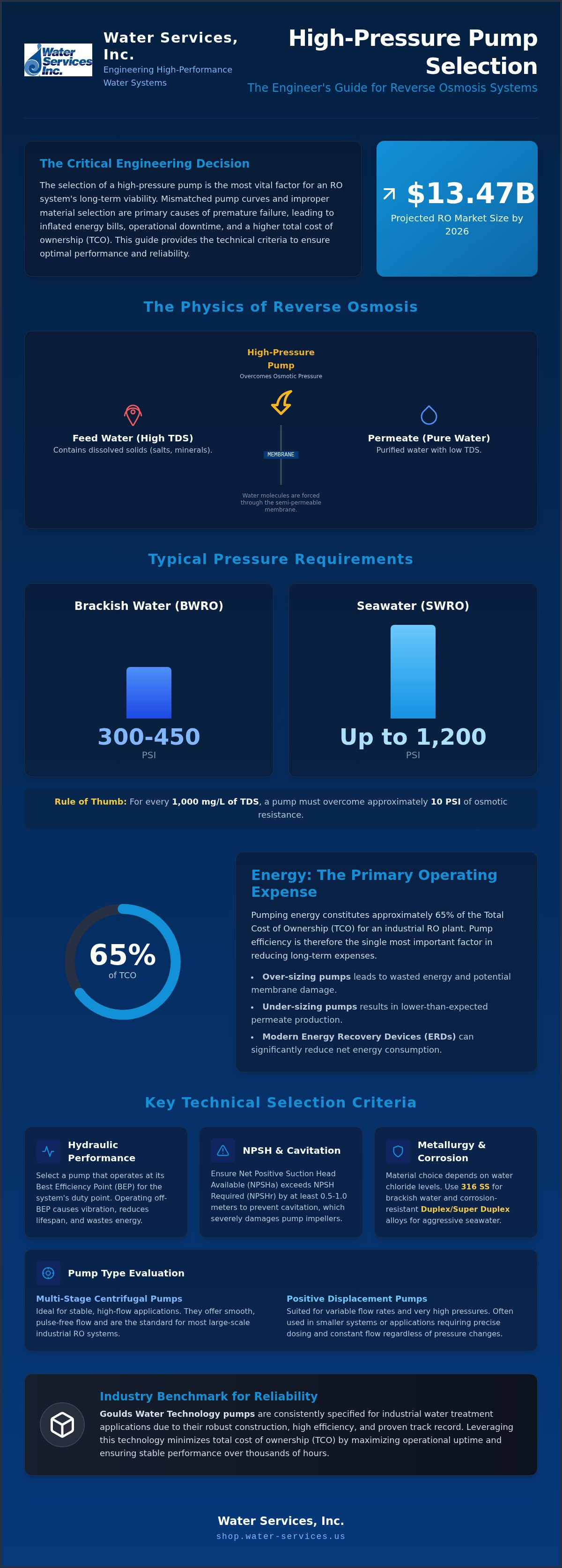
High-pressure pumps generate the mechanical energy needed to reverse the natural flow of solvent through a membrane. Without this external force, the Fundamentals of Reverse Osmosis dictate that water would move from the dilute side to the concentrated side. Precise high pressure pump selection for reverse osmosis systems begins with a calculation of the osmotic pressure of the feed water. This value increases linearly with the Total Dissolved Solids (TDS) concentration. For every 1,000 mg/L of dissolved salts, the pump must overcome approximately 10 psi (0.7 bar) of osmotic resistance before permeate production begins.
The Physics of Osmotic Pressure
Engineers define the Net Driving Pressure (NDP) as the actual force available to push water through the membrane after accounting for osmotic pressure and permeate back-pressure. Temperature is a critical variable in this equation. Cold water increases viscosity, which raises the pressure required to maintain a constant flux rate. In contrast, higher temperatures reduce viscosity but can increase salt passage. Osmotic pressure is the physical force required to stop the natural diffusion of water through a membrane, typically requiring 300 to 450 psi for brackish water (BWRO) and up to 1,200 psi for seawater reverse osmosis (SWRO) systems.
Energy Dynamics in RO Systems
Pumping energy constitutes approximately 65% of the total operating expenses for industrial RO plants. This makes pump efficiency the primary driver of the Total Cost of Ownership (TCO). Modern systems often integrate Energy Recovery Devices (ERDs) to capture hydraulic energy from the high-pressure concentrate stream. These devices work in tandem with industrial pumps to reduce the specific energy consumption, often measured in kWh per cubic meter (kWh/m³) of water produced.
Precision in pump sizing is mandatory. Over-sizing a pump results in excessive energy consumption and potential membrane damage through mechanical compaction. If the pump provides more pressure than the design flux requires, the system experiences higher fouling rates and shortened membrane life. Matching the pump's performance curve to the membrane's recovery requirements ensures the system operates at its most efficient duty point. Reliable hardware, such as Goulds Water Technology pumps, provides the stability needed to maintain these precise parameters over thousands of operational hours.
Technical Selection Criteria: Beyond Flow and Head
Engineering a reliable RO system requires looking past basic flow and head metrics. The duty point, where the pump curve intersects the system resistance curve, must align with the membrane's design flux. If you select a pump that operates too far to the left or right of its Best Efficiency Point (BEP), you risk premature mechanical failure and excessive vibration. High pressure pump selection for reverse osmosis systems also demands a strict analysis of the Net Positive Suction Head (NPSH) to ensure operational stability. Professional system integrators use these metrics to guarantee that the hardware survives the rigors of 24/7 industrial production.
Hydraulic Performance and NPSH
Cavitation occurs when local pressure drops below the vapor pressure of the water. This creates vapor bubbles that implode against the impeller, causing severe pitting. To prevent this, the NPSH available (NPSHa) must exceed the NPSH required (NPSHr) by a safety margin of at least 0.5 to 1.0 meters. Proper suction piping design is essential. You should use straight pipe runs and minimize bends to reduce turbulence before the pump inlet. While the EPA guide to RO systems provides benchmarks for point-of-use efficiency, industrial operators must prioritize these hydraulic safeguards to maintain system uptime. Review our technical specifications for Goulds high-pressure pumps to match your system's specific duty point.
Metallurgy and Chemical Resistance
Selecting the correct metallurgy is a function of the feed water's chloride concentration. For brackish water applications with lower salinity, 316 Stainless Steel is often the standard. However, seawater RO requires Duplex or Super Duplex alloys to resist aggressive pitting and crevice corrosion. Chemical compatibility is equally vital for long-term performance. The dosing of specialized water treatment antiscalants can impact pump seal longevity if the seal materials aren't compatible with the chemical concentrate. Precise material selection prevents the "bleeding" of metals into the permeate stream and protects the structural integrity of the pump casing.
Operational flexibility is the final pillar of technical selection. Modern industrial pumps must be compatible with electric power controls such as Variable Frequency Drives (VFDs). A VFD allows the pump to adjust its speed to match fluctuating feed water temperatures or varying membrane age. This capability prevents the energy waste associated with traditional throttling valves. It also reduces mechanical stress during start-up cycles. By integrating these technical criteria, you ensure the pump remains a reliable asset rather than a maintenance liability.
Centrifugal vs. Positive Displacement Pumps for RO
The core of high pressure pump selection for reverse osmosis systems involves choosing between kinetic and displacement technologies. Multi-stage centrifugal pumps and positive displacement (PD) pumps represent the two primary industrial categories. Centrifugal pumps utilize impellers to increase fluid velocity, converting kinetic energy into pressure. PD pumps move a fixed volume of fluid per revolution. This mechanical distinction dictates how your system responds to pressure fluctuations and determines your long-term energy consumption profile.
Multi-Stage Centrifugal Pumps
Goulds Water Technology Pumps serve as the industry standard for brackish water and industrial process applications. These units offer high-flow capacities and a simplified mechanical design that prioritizes operational uptime. Maintenance typically centers on mechanical seal replacements and bearing inspections. Because they lack the complex valve and piston assemblies of PD pumps, they provide higher reliability in remote sites where specialized labor is limited. Their performance follows a specific pump curve. This allows for operational flexibility when paired with a VFD, though maximum efficiency is restricted to a narrow duty point. They are the preferred choice for fixed plant installations where flow demands remain relatively consistent and maintenance simplicity is a priority.
Positive Displacement and Axial Piston Pumps
Positive displacement pumps, including axial piston designs, excel in high-pressure seawater applications. They maintain a nearly constant flow regardless of discharge pressure. This characteristic makes them highly efficient for seawater RO (SWRO) where pressures often exceed 800 psi. While PD pumps can reach mechanical efficiencies above 90%, they introduce hydraulic challenges. These pumps generate pressure pulsations that can damage downstream membranes and instrumentation. You must install pulsation dampeners and rigid piping supports to prevent vibration-induced fatigue. Lifecycle analysis for PD pumps must account for the higher cost of specialized maintenance for pistons, shoes, and check valves. Despite these requirements, the energy savings in high-TDS environments often justify the technical complexity.
Space constraints in containerized RO systems often favor the compact footprint and high power density of axial piston pumps. These units allow for a smaller skid design without sacrificing the pressure required for high-salinity feed water. Conversely, large-scale fixed plants with high flow requirements generally benefit from the lower maintenance overhead and logistical simplicity of multi-stage centrifugal designs. Your high pressure pump selection for reverse osmosis systems must balance the lower energy footprint of PD technology against the logistical and maintenance advantages of centrifugal systems. Selecting the wrong technology for your feed water chemistry leads to either excessive energy waste or unsustainable maintenance schedules.
Industry-Specific Considerations: Mining, Desalination, and Remote Sites
Environmental conditions often dictate equipment specifications as much as feed water chemistry. In harsh industrial sectors, high pressure pump selection for reverse osmosis systems must account for logistical constraints and physical durability. A pump that performs efficiently in a climate-controlled municipal plant may fail rapidly in a high-vibration mining environment or a remote desert outpost. Reliability in these sectors is defined by the ability to maintain design flux despite fluctuating feed quality and limited access to specialized technical support.
Mining and Heavy Industrial Applications
The wastewater treatment and reuse sector is projected to hold a 41.3% market share in 2026. This growth is driven by the mining industry's shift toward mining wastewater treatment solutions that prioritize resource recovery and Zero Liquid Discharge (ZLD). Pumps in these systems must handle high mineral loads and potential abrasive particulates. While multi-stage centrifugal pumps offer the necessary durability, they require robust pre-filtration using Pentair or Harmsco housings to protect internal impellers. ZLD systems often operate at the upper limits of membrane pressure ratings, requiring pumps that can maintain stability at 1,000 psi or higher without losing hydraulic efficiency.
Mobile and Containerized RO Plants
Mobile water treatment units face unique mechanical stresses during international transport and rapid deployment. Weight and footprint optimization are critical for industrial water filtration systems housed within standard shipping containers. High pressure pump selection for reverse osmosis systems in mobile plants favors hardware with high power density and vibration resistance. Modular designs allow for the integration of Goulds Water Technology pumps, which provide the structural integrity needed for military and emergency response scenarios. These systems must be ready for immediate operation upon arrival at remote global sites in Africa, South America, or the Middle East.
Remote site logistics often prioritize mechanical simplicity over peak theoretical efficiency. In a field environment, the ability to source replacement seals or perform basic maintenance is more valuable than a 2% gain in energy savings. Centrifugal pumps are frequently chosen for these applications because their maintenance requirements are less specialized than those of axial piston pumps. Standardizing on reliable, globally recognized hardware ensures that system uptime remains maximized even when supply chains are strained. For custom engineering support or to source high-performance hardware, you can view our inventory of industrial RO pumps designed for demanding environments.
Optimizing Your RO System with Water Services, Inc.
Successful RO operation depends on the precise synergy between individual components. High pressure pump selection for reverse osmosis systems is a foundational step, but professional integration ensures that the pump, membranes, and controls operate as a unified industrial asset. Water Services, Inc. provides the technical expertise required to transition from a hardware specification to a high-performing water treatment plant. We focus on maximizing system uptime by aligning hydraulic performance with specific site requirements, ensuring your equipment withstands the rigors of demanding commercial environments.
Comprehensive Equipment Integration
The efficiency of an RO system is limited by its weakest component. We prioritize matching high-performance Goulds Water Technology pumps with premium FilmTec or Hydranautics RO membranes. This alignment prevents the mechanical stresses associated with mismatched flux rates and optimizes energy consumption across the plant. To protect these high-pressure assets, we integrate precision flow sensors and pressure gauges that provide real-time data on hydraulic health. These instruments allow operators to monitor Net Positive Suction Head (NPSH) and discharge pressure, enabling immediate adjustments through Walchem controllers. Establishing a strict preventative maintenance schedule, including regular mechanical seal inspections and bearing lubrication, remains essential for maintaining long-term operational stability.
Partnering for Technical Success
Water Services, Inc. provides custom engineering services for unique industrial water challenges in the mining, oil and gas, and military sectors. High pressure pump selection for reverse osmosis systems must account for the logistical realities of the job site. From our headquarters in Provo, Utah, we support global projects across Africa, the Middle East, and South America. We act as a dependable partner that prioritizes technical integrity over flashy presentation, projecting an image of stability and logistical competence. Our expertise in containerized and mobile RO systems ensures that even the most remote sites have access to reliable water purification technology.
Professional buyers require a streamlined path from information gathering to procurement. You can access our curated authority of equipment, including Goulds industrial pumps and Ashcroft pressure gauges, through our online store. We maintain a robust inventory of critical spares and replacement sediment and carbon filters to minimize downtime for mission-critical operations. By combining authorized distribution with specialized management terminology and engineering support, we provide exact solutions for professional users who require industrial reliability. Our commitment to quality and trust ensures your RO system remains a stable component of your facility's infrastructure.
Securing Operational Reliability for 2026 and Beyond
Effective industrial water treatment starts with technical integrity. You've seen how precise high pressure pump selection for reverse osmosis systems minimizes energy waste and protects your membrane assets from mechanical fatigue. By calculating NPSH requirements and selecting metallurgy suited for your specific TDS levels, you ensure the long-term stability of your facility. Whether you're managing a fixed plant or a containerized mobile unit, the decision between centrifugal and positive displacement technology must align with your specific maintenance capabilities and energy goals.
While the engineering focus here is on large-scale infrastructure, the demand for high-purity water extends to the domestic sector as well. For those interested in applying advanced filtration technology at home, you can learn more about Great Water Filters and their range of premium residential reverse osmosis solutions.
Water Services, Inc. operates as a specialized partner to help you navigate these engineering nuances. As an authorized Goulds Water Technology distributor, we provide the industrial hardware and global engineering support needed for complex mining and industrial projects. Our focus remains on high-performance RO component integration that delivers consistent results in the field from our headquarters to your global job site. We're ready to support your next project with the precision and reliability your operations demand.
Shop Industrial High-Pressure Pumps at Water Services, Inc.
Frequently Asked Questions
What is the difference between a booster pump and a high-pressure RO pump?
Booster pumps provide low-pressure feed to the system inlet, typically ranging from 30 to 60 psi, to ensure adequate suction head. In contrast, high-pressure RO pumps generate the 200 to 1,200 psi required to overcome natural osmotic pressure. High-pressure units are specifically engineered with reinforced casings and specialized metallurgy to handle the extreme mechanical loads and hydraulic stresses inherent in the reverse osmosis process.
How do I calculate the required pressure for my brackish water RO system?
You must calculate the sum of the feed water's osmotic pressure, the design permeate back-pressure, and the membrane's specific flux resistance. For brackish water, use a baseline of 10 psi for every 1,000 mg/L of TDS. Add the pressure drop across all membrane stages to determine the total dynamic head required for high pressure pump selection for reverse osmosis systems. This ensures the pump meets the specific design flux of your membrane array.
Why is pump efficiency more critical in seawater RO than in brackish RO?
Seawater systems operate at significantly higher pressures, often exceeding 800 psi, which consumes more energy per cubic meter of water produced. Since pumping energy accounts for approximately 65% of a plant's total operating costs, small efficiency gains result in substantial annual savings. Brackish systems operate at lower pressures, so while efficiency is still important, the total energy footprint is smaller compared to the intensive demands of seawater desalination.
Can I use a standard centrifugal pump for a high-pressure RO application?
Standard centrifugal pumps are generally unsuitable because they lack the multi-stage design and specialized metallurgy required to reach industrial RO pressures. High-pressure applications demand multi-stage centrifugal pumps, such as those from Goulds Water Technology, which utilize multiple impellers to build pressure incrementally. These units feature reinforced structural components designed to withstand the high internal hydraulic forces that would cause a standard pump to fail prematurely.
How does VFD control improve the lifespan of a high-pressure pump?
Variable Frequency Drives (VFDs) eliminate the mechanical shock of across-the-line starts by providing a controlled soft-start ramp-up. They allow the pump to operate at its Best Efficiency Point (BEP) by adjusting motor speed rather than using a restrictive throttle valve. This precise control reduces internal heat buildup and mechanical vibration. These factors directly prevent premature wear on mechanical seals, bearings, and impellers, extending the overall service life of the asset.
What materials are best for high-pressure pumps handling high-salinity water?
Duplex and Super Duplex stainless steel alloys are the industry standard for high-salinity environments like seawater RO. These materials provide superior resistance to pitting and crevice corrosion compared to 316 stainless steel. For brackish water with lower chloride levels, 316L stainless steel is often sufficient. Selecting the correct metallurgy is a vital part of high pressure pump selection for reverse osmosis systems to ensure the pump survives aggressive feed water chemistries.
What are the common causes of high-pressure pump failure in industrial RO?
Cavitation due to insufficient Net Positive Suction Head (NPSH) is the primary cause of mechanical failure in industrial pumping systems. Other frequent issues include chemical corrosion from improper material selection, abrasive wear from inadequate pre-filtration, and mechanical seal failure due to dry running. Operating a pump significantly outside of its design curve also leads to excessive vibration and bearing fatigue, which quickly compromises the structural integrity of the unit.
How often should seals and bearings be replaced in a Goulds industrial pump?
Mechanical seals require inspection monthly and typically need replacement every 8,000 to 12,000 operational hours depending on feed water quality. Bearings in Goulds industrial pumps are engineered for long-term service but must be monitored for changes in vibration and operating temperature. A standard industrial preventative maintenance schedule usually includes bearing replacement every two to three years to ensure maximum system uptime and prevent the costs associated with unplanned outages.
0 comentarios