

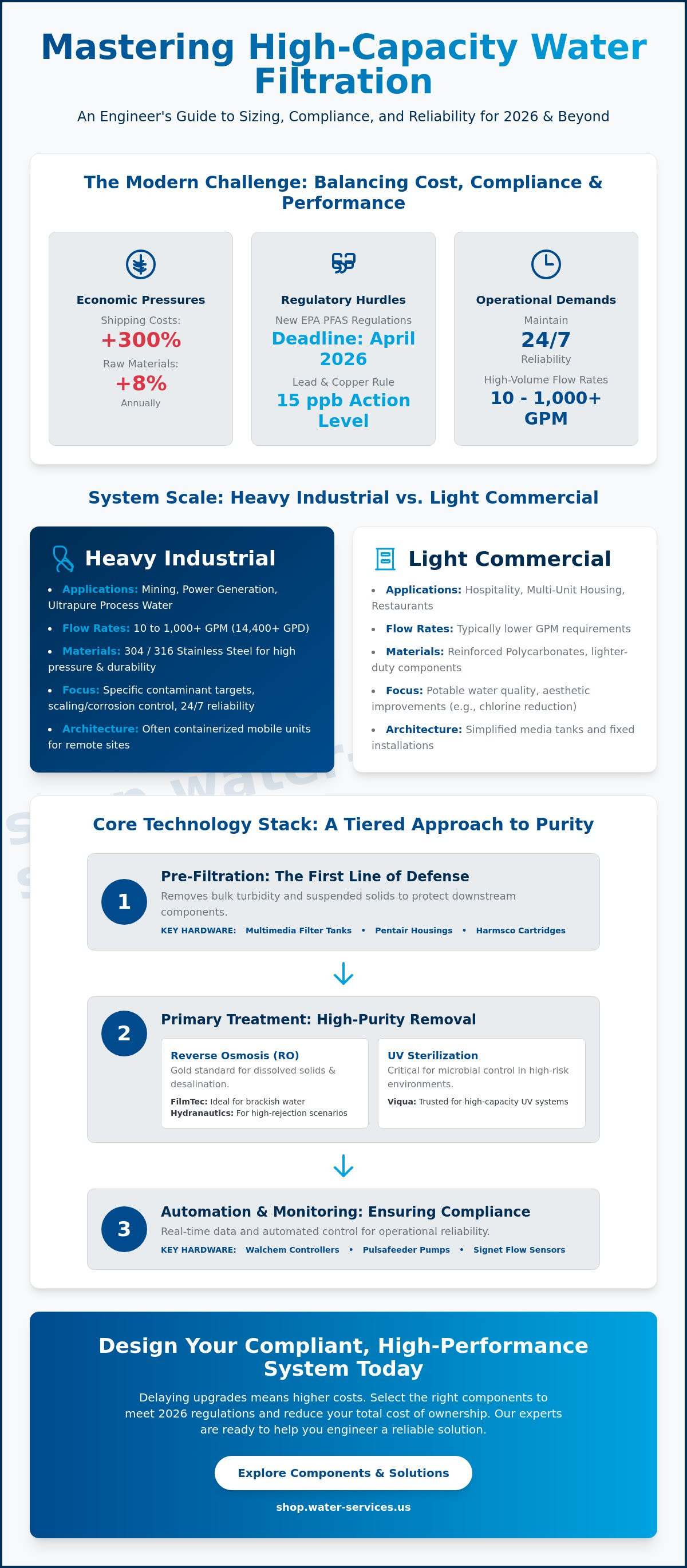
Shipping costs for water filtration components have increased by over 300%, and raw material prices are rising by 8% annually. These economic pressures, combined with the EPA's April 2026 updates to PFAS regulations, mean that delaying infrastructure upgrades will lead to higher capital expenditures. You're likely facing the challenge of maintaining 24/7 operational reliability in remote locations while ensuring your commercial water filtration systems meet the 15 ppb lead action level required by the Lead and Copper Rule Improvements.
Designing a system that balances high-volume flow rates with strict compliance is a modular engineering task. This guide helps you master the technical criteria for sizing and deploying high-capacity systems for industrial, mining, and municipal applications. We'll detail how to integrate Goulds pumps with FilmTec membranes and NSF/ANSI 61 certified components. You'll learn how to achieve specific GPM targets and reduce your total cost of ownership by selecting the right combination of multimedia filter tanks and metering pumps to satisfy site-specific discharge regulations.
Key Takeaways
- Identify the specific engineering requirements for high-capacity applications ranging from 10 to 1,000+ GPM.
- Select appropriate technologies, including FilmTec RO membranes and Viqua UV sterilization, to achieve precise water quality targets.
- Evaluate the CAPEX and OPEX benefits of containerized mobile units versus fixed infrastructure for remote industrial sites.
- Utilize a technical engineering checklist to integrate Goulds pumps and calculate max head for commercial water filtration systems.
- Establish operational reliability through automated Walchem controllers and scheduled membrane cleaning protocols to maximize hardware lifespan.
Defining Commercial Water Filtration Systems: Scale, Scope, and Standards
Commercial water filtration systems are engineered to manage flow rates between 10 and 1,000+ gallons per minute (GPM). These systems utilize heavy-duty components like Pentair filter housings and Harmsco filtration products to withstand continuous high-pressure operation. Standard residential hardware typically fails in these environments due to material fatigue or insufficient surface area. This failure leads to excessive pressure drops and frequent media replacement that halts production. Industrial-grade systems prioritize durability and high-capacity contaminant removal to ensure 24/7 reliability.
The engineering requirements for these systems depend on the specific application and water source. Whether you're treating municipal water or raw intake from a well, the hardware must be sized to handle peak demand without compromising water quality. Precision in component selection is what separates a reliable industrial installation from a system that requires constant emergency maintenance.
Industrial vs. Light Commercial Applications
Light commercial applications, such as hospitality or multi-unit housing, focus on potable water quality and aesthetic improvements like chlorine reduction. These sites usually require lower GPM and utilize simplified media tanks. In contrast, heavy industrial sites like mining or power generation demand specific water quality targets for process water or ultrapure applications. This industrial water treatment overview highlights the necessity of managing scaling and corrosion in these high-stakes environments.
Material durability is a primary differentiator. Light commercial systems often use reinforced polycarbonates for filter housings. Heavy industrial systems require 304 or 316 stainless steel housings to maintain structural integrity under high max head conditions. Mining sites often deploy containerized reverse osmosis plants to provide portable, high-capacity filtration in rugged terrain where fixed infrastructure isn't feasible.
Primary Contaminant Removal Profiles
Industrial systems must handle high levels of suspended solids and turbidity during raw water intake. This requires robust multimedia filter tanks and high-surface-area Harmsco cartridges to protect downstream membranes. For high-risk environments, microbial control is achieved through Viqua UV sterilization or FilmTec reverse osmosis membranes. A true commercial filtration system is defined by its ability to process a minimum of 14,400 gallons per day (GPD) with zero downtime for maintenance during peak flow periods.
In 2026, compliance is driven by the EPA's Lead and Copper Rule Improvements and strict PFAS limits. Meeting these standards requires precise chemical dosing via water treatment antiscalants and Pulsafeeder metering pumps. Automated Walchem controllers and Signet flow sensors provide the real-time data needed to verify that discharge water meets all legal requirements before it leaves the site.
Core Technologies: RO Membranes, UV Sterilization, and Media Filtration
High-performance commercial water filtration systems rely on a tiered approach to contaminant removal. The process begins with sediment and multimedia filtration. These initial stages utilize multimedia filter tanks and Pentair housings to remove bulk turbidity. This protects expensive downstream components from fouling. Without these pre-treatment steps, membrane lifespan decreases significantly. Ashcroft pressure gauges are critical here. They provide the differential pressure readings that signal when a filter change is required. Proper pre-filtration reduces the total cost of ownership by extending the life of high-value consumables.
Reverse Osmosis and Membrane Selection
Reverse Osmosis (RO) remains the gold standard for desalination and dissolved solids removal. FilmTec membranes are often preferred for brackish water applications due to their high flux rates and reliability. Hydranautics membranes excel in high-rejection scenarios, such as seawater desalination or high-purity process water. Selecting between these brands depends on your specific TDS (Total Dissolved Solids) profile and recovery targets. For detailed technical specifications, consult our Commercial Reverse Osmosis Water Filtration System Guide.
Using water treatment antiscalants is essential for system longevity. These chemicals prevent mineral scaling on membrane surfaces. Scaling can reduce efficiency by 25% or more if left untreated. Precise control over these chemical additives requires Pulsafeeder metering pumps and Walchem controllers. These electric power controls ensure the correct dosage is delivered based on real-time flow data from Signet sensors. This level of automation is necessary for 24/7 reliability in industrial environments.
UV Disinfection for Large Scale Operations
Viqua UV sterilization provides non-chemical microbial control. It's an effective solution for facilities that must avoid chemical residuals in their effluent. When integrating UV into commercial water filtration systems, sizing is the most critical factor. Engineers must account for the UV Transmittance (UVT) of the water. Low UVT requires slower flow rates or higher-intensity lamps to ensure complete sterilization. If the water is too turbid, the UV light can't penetrate effectively, which is why sediment pre-filtration is mandatory.
Standard maintenance involves cleaning quartz sleeves and replacing lamps every 9,000 hours of operation. In wastewater treatment, UV serves as a final polishing stage to ensure effluent meets discharge standards. This technology is particularly useful in remote mining or municipal sites where chemical logistics are difficult. Reliable system performance depends on high-quality hardware. You can browse our full range of industrial pumps and filtration components to find the right fit for your facility.
Modular Architecture: Fixed Infrastructure vs. Containerized Mobile Units
Commercial water filtration systems are no longer restricted to concrete and steel facilities. The rise of containerized reverse osmosis plants has changed how remote mining sites and military outposts access clean water. These units arrive pre-plumbed and pre-wired inside standard ISO shipping containers. This modularity bypasses the 12-month timelines typical of traditional site builds. Because shipping costs for filtration components have increased by over 300% since 2024, consolidated modular units offer a significant logistical advantage by reducing the number of individual shipments required for a single project.
Logistics play a decisive role in system selection for global operations. Exporting these systems to regions like Africa and the Middle East requires rigorous pre-commissioning at our Provo, Utah facility. By testing the integration of Goulds pumps and Hydranautics membranes before shipment, we eliminate on-site troubleshooting in areas with limited technical support. For disaster relief or temporary industrial outages, mobile ultrafiltration systems provide a rapid solution. These mobile commercial water filtration systems can be deployed and operational within 48 hours of arrival at a site with existing power and water hookups.
Benefits of Containerized Water Treatment
Containerized systems offer a plug-and-play setup that reduces on-site engineering time by approximately 70%. The enclosed environment provides a climate-controlled space for sensitive electric power controls and Walchem controllers. This protection is vital in desert or high-humidity environments where dust and moisture lead to premature board failure. If site demand increases, operators can simply add another 20-foot or 40-foot module to the existing array. This scalability ensures that GPM targets remain met as industrial operations expand without requiring new building permits.
The Rental vs. Purchase Decision Framework
Choosing between CAPEX (purchase) and OPEX (rental/leasing) depends on project duration and tax strategy. For projects lasting fewer than 24 months, renting a mobile ultrafiltration unit often provides better financial efficiency. Ownership becomes the logical choice for permanent municipal installations or long-term mining contracts exceeding three years. Maintenance responsibilities in leasing contracts typically fall on the provider, which is advantageous in high-wear environments where membrane replacement is frequent. While fixed units require months of civil engineering and construction, mobile units can be fully commissioned on-site in less than 72 hours.
The Engineering Checklist: Sizing, Flow Rates, and Pump Integration
Engineering commercial water filtration systems requires precise calculation of the synergy between pump performance and filtration resistance. You cannot size a system based on flow rate alone. You must determine the Total Dynamic Head (TDH), which includes the static lift, friction loss in the piping, and the maximum allowable pressure drop across the filter media. A common error is sizing a pump for a clean filter. As sediment accumulates, the pressure drop increases. If your pump lacks a sufficient curve, your GPM will drop below operational requirements, potentially halting industrial processes.
Goulds Water Technology Pumps serve as the primary driver for maintaining consistent system pressure in high-demand environments. These centrifugal pumps are engineered to handle the continuous duty cycles required for multi-stage filtration. In a typical configuration, a Goulds pump must provide enough head to push water through pre-filters, RO membranes, and post-treatment stages while still meeting the site's discharge pressure needs. Using Ashcroft pressure gauges at every stage allows you to monitor this gradient in real time.
Matching Pump Performance to Filtration Resistance
Filter fouling directly impacts energy consumption and pump longevity. When a Harmsco filter bank reaches its dirt-holding capacity, the pump must work harder to maintain the target flow rate. This shift on the pump curve can lead to cavitation or motor overheating if the system isn't properly designed. For chemical dosing, the requirements change. You don't use centrifugal pumps for antiscalants. Instead, Pulsafeeder metering pumps provide the precise, low-volume injection needed for membrane protection. Integrating Walchem controllers allows the system to automate pump speeds via VFDs (Variable Frequency Drives) in response to flow changes detected by Signet sensors.
Real-Time Monitoring and System Protection
Monitoring performance is the only way to ensure 24/7 reliability. Signet flow sensors provide the data necessary to calculate recovery rates, while Ashcroft gauges identify exactly which stage is saturated. We recommend setting automated shut-off triggers at specific pressure differentials. For example, if the pressure drop across a FilmTec membrane exceeds 15% of the baseline, the system should trigger a cleaning cycle or shut down to prevent permanent membrane compaction. This proactive approach is a cornerstone of modern wastewater treatment technologies. You can find the specific hardware needed to build these protections in our collection of industrial pressure solutions.
Maintenance and Consumables: Ensuring 24/7 Operational Reliability
Maintenance prevents the high cost of industrial downtime. For remote mining or municipal sites, 24/7 operational reliability depends on having critical spares on-site. Commercial water filtration systems require a structured approach to consumable management. This strategy includes stocking replacement sediment and carbon filters to avoid delays caused by international shipping logistics. Annual maintenance for these commercial systems typically ranges from $500 to $2,000, and failing to adhere to a schedule often leads to expensive hardware failures.
Extending the life of Hydranautics and FilmTec units requires strict Clean-In-Place (CIP) protocols. When normalized flux drops by 10%, you must perform a chemical cleaning. Waiting until the flux drop reaches 20% often results in permanent membrane compaction or irreversible fouling. Handling the acidic and alkaline cleaning chemicals safely requires proper personal protective equipment (PPE). This includes chemical-resistant gloves, aprons, and face shields to ensure operator safety during high-risk maintenance tasks.
Managing Replacement Parts and Media
Establish a predictable schedule for Harmsco and Pentair filter replacement based on the differential pressure data from your Ashcroft gauges. In high-turbidity environments, pre-filters may require replacement every 14 to 30 days to protect downstream membranes. You must also maintain a 90-day inventory of water treatment consumables, including antiscalants and disinfection chemicals. Pulsafeeder metering pumps require periodic seal and diaphragm inspections every six months to prevent dosing failures that can lead to rapid membrane scaling.
Global Support and Technical Commissioning
Professional commissioning is mandatory for industrial RO systems to verify that all Signet flow sensors and Walchem controllers are calibrated to site-specific water chemistry. This process ensures the system operates within its designed recovery parameters from day one. In 2026, remote monitoring capabilities allow our technical team to analyze performance data from containerized plants in real time. This proactive oversight identifies potential issues before they cause a system shutdown.
Water Services, Inc. manages global logistics and technical support from our Provo, Utah hub. We ensure that every commercial water filtration system is fully tested and documented before it leaves our facility. This rigorous pre-shipment testing minimizes on-site troubleshooting in locations where technical support is limited. Our ability to ship worldwide ensures that even the most remote industrial operations have access to the high-quality water equipment they can trust and rely on.
Optimize Your Industrial Water Infrastructure for 2026
Engineering commercial water filtration systems that meet 2026 regulatory mandates requires a synergy between high-capacity hardware and automated monitoring. Success is measured by your ability to maintain specific GPM targets while managing rising operational costs. Integrating Goulds centrifugal pumps with FilmTec RO membranes ensures your facility handles the rigors of heavy industrial use. Proactive maintenance using Walchem controllers and Signet sensors is the only way to guarantee 24/7 uptime in remote locations.
Water Services, Inc. has supported the global mining and military sectors since 1994. Our Provo, Utah-based engineering team provides the technical expertise needed for complex installations. We offer worldwide shipping and technical support to ensure your equipment operates at peak efficiency regardless of location. Whether you require a containerized RO plant or a mobile ultrafiltration unit, we deliver the heavy-duty hardware required for 24/7 reliability. It's our priority to provide the quality water equipment you can trust and rely on.
Request a Custom Engineering Quote for Your Commercial Water System to secure your facility's operational future. Our team is ready to help you deploy a durable and compliant solution.
Frequently Asked Questions
What is the difference between commercial and industrial water filtration?
Scale and durability are the primary differentiators. Commercial systems typically provide potable water for hospitality or multi-unit housing at moderate flow rates. Industrial systems manage process water or wastewater for mining and manufacturing, often requiring flow rates exceeding 1,000 GPM. These industrial setups utilize 316 stainless steel housings and heavy-duty components to withstand continuous high-pressure operation in rugged environments.
How do I calculate the GPM requirement for my commercial facility?
Sum the peak flow demand of all downstream equipment and add a 20% safety margin. This buffer accounts for the increased resistance and pressure drop that occurs as filter media accumulates sediment. Factoring in the backwash requirements of multimedia filter tanks is also essential. Accurate sizing ensures your Goulds pumps maintain the necessary head pressure to meet your facility's operational targets.
Can commercial RO systems be used for mining wastewater treatment?
High-capacity industrial RO units are effective for treating mining wastewater. These systems use Hydranautics or FilmTec membranes to remove heavy metals and dissolved solids from process runoff. Many mining sites deploy these as containerized RO plants to ensure portability and rapid site integration. This technology allows operators to meet strict discharge standards while potentially recycling water for other on-site industrial processes.
What are the maintenance requirements for a containerized RO plant?
Routine maintenance includes monthly pre-filter changes and semi-annual membrane cleaning cycles. You must also inspect Pulsafeeder metering pumps and calibrate Walchem controllers to ensure precise chemical dosing. Regular monitoring of Ashcroft pressure gauges is required to identify filter saturation before it impacts flow. Proper upkeep prevents unscheduled downtime and extends the service life of expensive RO membranes in remote locations.
Is it better to rent or buy a mobile water treatment unit for a 6-month project?
Rental is the better financial choice for any project lasting fewer than 24 months. It allows you to categorize the cost as an operational expense and avoids the large capital outlay of a purchase. Leasing contracts often include provider-led maintenance and technical support, which is beneficial for temporary sites. Ownership is only recommended for permanent municipal or industrial installations with long-term ROI.
What pump brands are best for high-pressure commercial filtration?
Goulds Water Technology Pumps are the industry standard for driving high-pressure commercial water filtration systems. They provide the consistent head pressure needed to overcome the resistance of multi-stage RO and media filtration. For precise chemical injection, Pulsafeeder metering pumps are the preferred choice. These brands ensure the system maintains the required flow rates even as the filter media begins to foul.
How often should I replace RO membranes in an industrial setting?
Industrial RO membranes typically require replacement every 3 to 5 years. This timeframe depends on the quality of your pre-treatment and the consistency of your antiscalant dosing. You should plan for replacement when normalized salt rejection drops or feed pressure requirements increase by 15%. Adhering to regular cleaning protocols and using high-quality sediment pre-filters can help you reach the maximum lifespan.
Do commercial filtration systems require specialized power controls?
Industrial-scale systems require Walchem controllers and Signet flow sensors for automated operation. These components manage pump speeds via VFDs and control chemical dosing based on real-time flow data. Specialized power controls protect the hardware from pressure spikes and dry-run conditions. They also provide the data logging necessary for regulatory compliance and performance monitoring in complex commercial or industrial facilities.
0 comentarios