

A metering pump earns its name through controlled, repeatable delivery: it moves a measured volume of liquid over a specified time. For chemical metering pump selection, size the pump so the maximum expected flow is 85 percent to 90 percent of its total capacity.
Capacity alone does not determine whether a pump will deliver the dose a process needs. The required feed rate also depends on process flow, target dose, chemical concentration, and operating conditions. An oversized or poorly matched pump can make accurate dosing harder to maintain.
This guide explains how to calculate feed flow from dose and process data, how pump types differ, and how terms such as metering, dosing, feed, and injection are used. It also covers how pressure, materials, and control affect selection, so you can assess a pump against your system’s demands.
Key Takeaways
- Assess a metering pump by its ability to deliver a controlled, repeatable volume, then account for operating pressure and pressure protection.
- Calculate required feed flow from process flow, target dose and chemical concentration, correcting for density when the dosing recipe uses mass proportions.
- Compare pump types by their drive and dosing mechanism, then match the choice to the process conditions and control needs.
- Separate pump terminology by function: metering describes controlled delivery, while dosing, feed and injection describe how chemical is applied in a process.
What Makes a Pump a “Metering” Pump?
A metering pump is a positive-displacement pump that delivers a controlled volume over time. Its output depends on swept volume per cycle, cycle frequency, and volumetric efficiency. This supports repeatable dosing, but actual delivery also depends on discharge pressure, suction conditions, and the liquid’s properties.
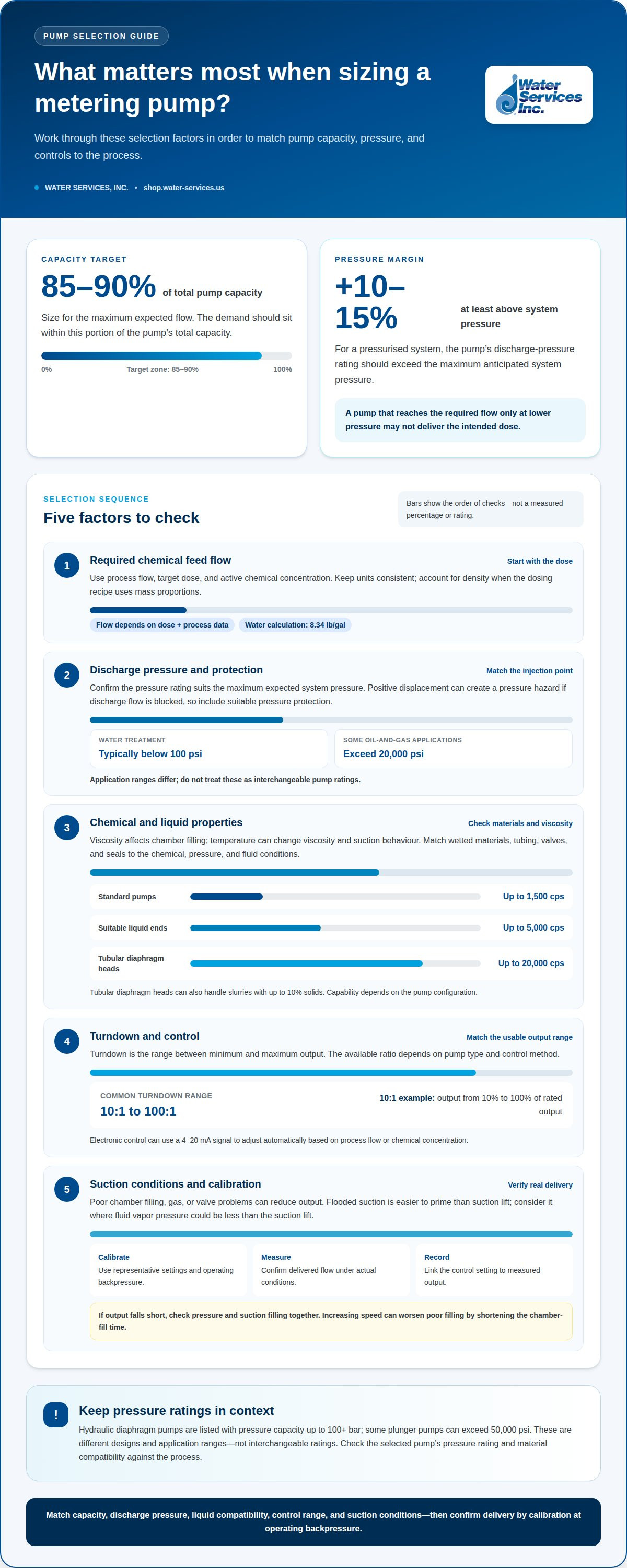
For chemical metering pump selection, size capacity around the maximum expected demand. That flow should be 85 percent to 90 percent of the pump’s total capacity. Then match the discharge-pressure rating to the injection point: for a pressurised system, the pump rating should exceed maximum anticipated system pressure by at least 10-15%. A pump that reaches the required flow only at lower pressure may not deliver the intended dose against process pressure.
Pressure requirements vary by application. Water-treatment metering pumps typically operate below 100 psi, while some oil-and-gas applications require pressures exceeding 20,000 psi. Hydraulic diaphragm pumps are listed with pressure capacity up to 100+ bar; some plunger pumps can exceed 50,000 psi. These are different pump designs and application ranges, not interchangeable ratings. Confirm that the selected pump’s pressure and material compatibility suit the process chemical and operating conditions.
Positive displacement creates a pressure hazard if discharge flow is blocked. Pressure can rise beyond the ratings of the pump and connected components. Include suitable pressure protection in the dosing assembly, such as a correctly selected relief arrangement to prevent an unsafe pressure rise. Also consider suction: flooded-suction installations are easier to prime than suction-lift, top-mounted designs. Use flooded suction where the fluid’s vapor pressure could be less than the suction lift.
At commissioning, calibrate delivery at representative settings and operating backpressure. Record the relationship between the control setting and measured flow to confirm whether the pump delivers the required volume under actual conditions. If output falls short, check discharge pressure and suction filling together. Increasing speed can worsen poor suction filling by shortening the time available to fill the chamber.
There is no single typical price by flow rate and pump type that applies across configurations. Cost depends on capacity, pressure rating, wetted-material compatibility, drive, and controls. Compare complete pump specifications rather than type alone.
Sizing flow rate using dose, process flow, and chemical concentration
Start with process flow, target dose, and the active chemical concentration. These values establish the chemical feed rate; use consistent units before comparing the result with pump capacity. For water, metering calculations use 8.34 lb/gal. A worked example can help verify the required feed rate for a specific dosing application.
Viscosity affects how readily a liquid fills the pumping chamber, while temperature can change viscosity and suction behavior. Chemical concentration changes the volume needed to deliver a given dose. Standard pumps can handle clear liquids up to 1500 cps; suitable liquid ends can extend this to 5,000 cps, and tubular diaphragm heads can handle up to 20,000 cps or slurries with up to 10 percent solids.
For a reciprocating pump, delivered flow depends on swept volume per cycle, cycle frequency, and volumetric efficiency. Flow is often specified in gallons per hour. A peristaltic mechanism displaces liquid differently, so compare its rated operating conditions and calibrated output when assessing capacity. Do not assume a nominal stroke setting alone establishes actual delivery.
Turndown describes the usable range between maximum and minimum output. Ratios commonly range from 10:1 to 100:1, depending on pump type and control method. A 10:1 pump can deliver from 10% to 100% of rated output. Electronic control can also use a 4-20 mA signal for automatic adjustment based on process flow or chemical concentration.
Suction losses matter. Poor chamber filling, gas, or valve problems can reduce delivery, and increasing speed may worsen poor suction filling by shortening the filling interval. Select tubing, valves, seals, and injection accessories for chemical compatibility, pressure, and fluid viscosity, including compatibility with corrosive acids or caustics.
Calibrate at representative stroke settings and operating backpressure. Measure delivered flow, then record the relationship between the control command and output. For equipment options related to this application, explore metering pump products.
Chapter Two - What are the Different Types of Metering Pumps?
Metering pumps use different drive and displacement designs to control liquid delivery. The right mechanism depends on process conditions, chemical compatibility, and the level of control required.
Comparing Metering Pump Types
Pump type identifies how a pump is driven or displaces liquid; the distinction matters because each design controls flow differently. Electronic solenoid-driven and motor-driven injection pumps deliver small measured quantities into process lines. Solenoid units actuate dosing strokes electronically, while motor-driven diaphragm designs use a motor to move the diaphragm. Peristaltic pumps displace liquid through tubing, and gear pumps move it between rotating gears. Compare these options with piston and plunger pumps against process flow, fluid properties, and required accuracy.
Pump Mechanisms
A pump mechanism is the component that draws in and discharges liquid, so it affects how the pump handles the application. A diaphragm flexes to move liquid while separating it from the drive; mechanical diaphragm pumps are listed with a typical pressure range up to 12 bar. A single-acting plunger draws liquid through a suction check valve, then pushes it through a discharge valve on its forward stroke. Piston pumps also use a moving chamber to displace liquid. Bellows pumps use a flexing bellows element to move liquid without a sliding seal at the fluid boundary. Match the mechanism to the chemical and operating conditions.
Leak Detection and Double Diaphragms
Leak detection identifies diaphragm failure, while a double-diaphragm arrangement adds a barrier between the pumped liquid and the drive side. This matters when leakage could affect equipment, process fluid, or personnel. In a monitored design, the space between diaphragms can signal a failure before liquid passes through the second barrier. The detection method and response depend on the pump configuration. Consider this arrangement when evaluating diaphragm pumps for applications where containment is important.
For example, a process requiring small measured additions may favor an electronically controlled diaphragm design, while tubing-based displacement may suit a different liquid-handling setup. Before choosing, compare each pump’s mechanism, maximum operating pressure, liquid compatibility, and control method.
Metering, dosing, feed, and injection pump terminology
These terms describe controlled chemical delivery but emphasize different parts of the process. Understanding the distinction helps match equipment and performance requirements to the application.
Dosing Terminology and Industry Standards
Metering describes controlled measurement of flow; dosing is adding a target amount, feed is supplying chemical to a process, and injection is introducing it into a line or vessel. The terms often overlap, so define the required rate and function in a specification. API 675 and NSF/ANSI 61 are standards to consider when selecting a chemical dosing pump. Chemical feed accuracy may be expressed as a percentage of dose rate, such as within ±2%.
Chemical Compatibility and Material Selection
Chemical compatibility means the wetted materials can handle the liquid without unacceptable degradation. Material mismatch can affect containment and operation. Match pump-head, valve, seal, and tubing materials to the chemical, especially for corrosive acids or caustics. Viscosity matters too: a liquid that resists flow can affect chamber filling and delivered output. Select components for the actual fluid and operating conditions.
For a multi-head dosing system, measure each head separately. Calculate each head’s volumetric fraction by dividing its flow by total system flow. A shared motor speed does not guarantee equal delivery or preserve mixture proportions if one head has a filling or valve problem. Verify each stream independently during calibration.
Incorrect dosing can result from a blocked valve, poor filling, or changing liquid properties. These faults can reduce output even while the drive continues cycling. Inspect the suction path and valves, then compare measured delivery with the control setting. For viscous or solids-bearing chemicals, account for flow resistance and clogging risk when selecting equipment.
In agriculture, metering pumps help control the concentration and amount of chemicals delivered. Accurate proportional dosing matters when application rates need to track water flow or crop-treatment requirements.
Compare brands by rated flow, pressure capability, control method, chemical compatibility, and calibration needs. A brand name alone does not establish suitability; match documented pump performance to the process and the liquid being handled.
Water Services, Inc.: Goulds Water Technology Pumps
Water Services, Inc. offers Goulds Water Technology Pumps and Pulsafeeder Metering Pumps for water-system and chemical-feed applications. Once your flow calculation and process conditions point to a pump decision, these product categories are a practical next step for evaluating equipment against your required duty.
Water Services, Inc. also offers Water Treatment Antiscalants and Chemicals, Hydranautics RO Membranes, and Viqua UV Water Purification Systems. These products relate to treatment processes where chemical feed, membrane systems, or UV purification form part of the wider system requirements. Match equipment to the process, chemical, and treatment objectives established during sizing.
For help identifying relevant Water Services, Inc. products for your application, contact Water Services, Inc.
Put Your Pump Decision Into Practice
Turn process requirements into a clear equipment specification before making a purchase decision. Include the chemical, intended operating conditions, and control needs so the equipment can be assessed against the actual application. This makes chemical metering pump selection part of a wider system decision, rather than an isolated choice based only on pump type.
Water Services, Inc. offers Goulds Water Technology Pumps, Viqua UV Water Purification Systems, and FilmTec Reverse Osmosis Membranes. These products serve different roles in water systems, from pumping to purification and membrane treatment. Consider how the pump fits the broader treatment setup when planning equipment for your facility.
For a practical next step, explore pump options from Water Services, Inc. and identify the equipment category relevant to your process. A well-defined application gives you a stronger basis for moving from sizing calculations to a suitable system choice.
Frequently Asked Questions
What information is needed to size a chemical metering pump?
Gather the process flow, target chemical dose, product concentration, and operating conditions. Record the chemical’s density, viscosity, temperature, and compatibility requirements, along with the suction arrangement and injection-point pressure. For example, a dosing recipe expressed by mass needs density information to convert the target into a liquid volume. Include normal and maximum process demand so the equipment can accommodate operating changes.
How do you calculate required metering pump flow rate and pressure?
Calculate feed flow from process flow and target dose, then adjust for the concentration of the supplied chemical. Keep units consistent, and apply a density correction if the recipe uses mass proportions. For pressure, account for the injection-point pressure and losses through the discharge line and fittings. The required rating must support delivery against system operating pressure, not just open-discharge output.
Which metering pump types are best for different chemicals and applications?
No single design suits every chemical or process. Solenoid and motor-driven diaphragm pumps suit controlled chemical addition, while plunger or piston designs provide reciprocating displacement. Peristaltic pumps move liquid through tubing, and gear pumps use rotating gears. Compare the fluid’s viscosity and solids content with each design’s operating limits, then consider the required flow control, pressure, and containment.
What accuracy, turndown ratio, and control features should a dosing pump have?
Choose accuracy and turndown based on how much process demand varies and how tightly the dose must track it. A fixed-rate process may use manual adjustment, while changing flow or concentration can benefit from signal-based control. Specify the operating range, not just maximum output. Calibration under representative process conditions helps establish how settings correspond to delivered chemical volume.
Which safety standards and regulations apply to chemical dosing pumps in the United States?
API 675 and NSF/ANSI 61 are standards to consider during pump selection, but they don’t replace facility-specific regulatory duties. According to OSHA, 29 CFR 1910.119 mechanical-integrity requirements apply where metered chemicals meet the process safety management threshold. The U.S. Environmental Protection Agency includes chemical feed and metering systems in Risk Management Program requirements for facilities handling hazardous chemicals above threshold quantities.
What common mistakes and failure risks should be considered when selecting a chemical metering pump?
Common risks include choosing materials that do not suit the chemical, overlooking poor suction filling, and failing to protect a positive-displacement assembly against blocked discharge. Gas, clogged lines, or faulty valves can also reduce delivery. During troubleshooting, compare discharge pressure with drive load. Together, these readings help distinguish hydraulic or mechanical loading from other causes of low flow.
0 comentarios