

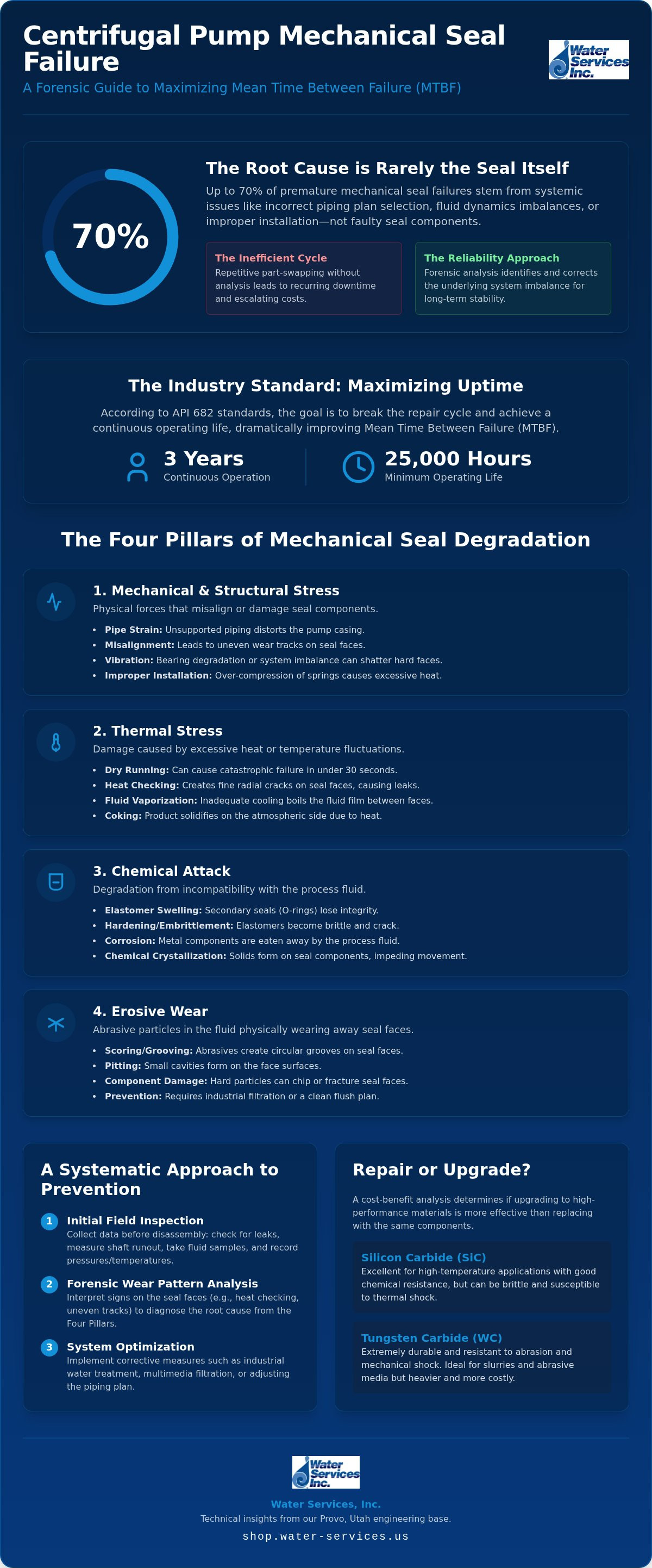
Up to 70% of premature mechanical seal failures in process plants stem from incorrect piping plan selection rather than the seal components. When a critical asset stops, the high cost of unscheduled downtime creates immediate pressure on maintenance teams. Conducting a precise centrifugal pump mechanical seal failure analysis is the only way to break the cycle of repetitive repairs. It's not enough to replace the hardware. You must identify the systemic imbalances in fluid dynamics or installation that caused the breach.
You're likely frustrated with the complexity of identifying root causes in harsh industrial environments where heat and vibration mask the evidence. This 2026 field guide provides the forensic criteria needed to interpret seal wear patterns and optimize your pumping systems. We'll leverage technical insights from our Provo, Utah engineering base to help you improve your Mean Time Between Failure (MTBF). You'll gain actionable prevention strategies, updates on API 682 standards, and diagnostic data to ensure your Goulds Water Technology pumps remain stable and efficient.
Key Takeaways
- Break the cycle of repetitive part-swapping by identifying seal failure as a symptom of broader systemic imbalances in fluid dynamics and installation.
- Execute a technical centrifugal pump mechanical seal failure analysis to distinguish between mechanical forces like vibration and thermal stresses such as heat checking.
- Master forensic mapping techniques to interpret seal face wear patterns, allowing for precise diagnostics of misalignment or improper cooling.
- Extend Mean Time Between Failure (MTBF) by integrating protective measures like industrial water treatment systems and multimedia filtration to remove damaging fines.
- Apply a 2026 cost-benefit framework to determine when to repair or upgrade to high-performance materials like Silicon Carbide or Tungsten Carbide.
Fundamentals of Mechanical Seal Failure Analysis
A centrifugal pump mechanical seal failure analysis is a systematic forensic investigation of seal components. It's designed to identify the specific root cause of leakage or malfunction rather than simply documenting the damage. Effective analysis requires a deep understanding of the Fundamentals of Mechanical Seals and their interaction with the pump's hydraulic environment. By 2026 standards, industrial reliability protocols prioritize Mean Time Between Failure (MTBF) over simple repair speed. The goal is a continuous three year or 25,000 hour operating life as outlined by API 682 standards.
The high cost of part-swapping without analysis is a common industrial pitfall. Research indicates that 60% to 70% of premature mechanical seal failures result from poor selection of the piping plan or system imbalances. Simply replacing a damaged seal with a new one often leads to repetitive failures if the underlying pressure surges or fluid contaminants aren't addressed. Technicians must collect initial data including suction and discharge pressures, fluid temperature, and vibration levels before disassembly. This data provides the context necessary to interpret the physical wear patterns found on the seal faces later.
Defining the Primary Failure Modes
Technicians must distinguish between nuisance leaking and catastrophic failure. A slow leak often suggests gradual wear or minor elastomer degradation, while a catastrophic failure points to sudden events like dry running or massive pressure spikes. The seal support system is critical for maintaining the operating environment. If the flush plan fails to provide adequate cooling or lubrication, the seal faces will overheat. Common environmental factors that trigger these failures include temperature spikes that cause fluid vaporization at the faces and abrasive content that scores the sealing surfaces.
Initial Field Inspection Protocol
Before removing the seal, perform a visual inspection of the pump exterior and seal gland. Look for signs of "coking" or chemical crystallization that indicate long term, minor leakage. Check the shaft for runout and axial play. Excessive movement stresses the seal faces and prevents them from maintaining a consistent fluid film. It's also vital to collect fluid samples. Changes in chemical concentration or increased particulate loading can quickly degrade secondary sealing elements. Using precision instruments like Ashcroft pressure gauges to verify system conditions ensures that the Goulds Water Technology pumps in your facility are operating within their designed parameters.
The Four Pillars of Mechanical Seal Degradation
Identifying why a seal failed requires looking beyond the damaged faces. A structured Mechanical Seal Failure Analysis categorizes degradation into four primary pillars: mechanical forces, thermal stress, chemical attack, and erosive wear. Each category leaves distinct signatures on the hardware. In industrial environments, these stressors rarely act in isolation. Mechanical vibration often creates heat, which then accelerates chemical degradation of the elastomers. Understanding these interactions is vital for any centrifugal pump mechanical seal failure analysis intended to produce long-term reliability.
Mechanical and Structural Stressors
Mechanical failure often begins with pipe strain. If the suction or discharge piping isn't properly supported, it exerts massive forces on the pump casing. This distorts the seal chamber and forces the faces out of alignment. Misalignment leads to uneven wear tracks and increased power consumption. Improper impeller clearance adjustments also play a role. If the shaft is positioned too far axially, the seal springs may be over-compressed, leading to excessive face heat and premature wear. Vibration analysis is a critical diagnostic tool here. Detecting bearing degradation early prevents the shaft oscillations that would otherwise shatter hard seal faces. Precision installation of Goulds Water Technology pumps minimizes these structural risks from the start.
Thermal and Chemical Vulnerabilities
Thermal stress is a leading cause of catastrophic failure. Dry running is the most severe example. Even 30 seconds of operation without fluid can permanently damage silicon carbide faces through heat checking. This phenomenon creates radial cracks that allow fluid to bypass the sealing interface. Chemical attack is equally destructive but often more subtle. Material incompatibility leads to the swelling or hardening of O-rings, which prevents the seal from "tracking" shaft movement. In mining wastewater applications, technicians must select elastomers that resist aggressive industrial water treatment solutions and antiscalants. Crystallization also occurs when process fluids dry on the atmospheric side of the seal. The resulting abrasive solids score the faces during startup.
Erosive wear is frequently caused by poor industrial water filtration. When particulates enter the seal chamber, they act as a grinding compound between the rotating and stationary faces. This scoring quickly ruins the lapped finish required for a liquid-tight seal. High-purity environments require consistent monitoring of particulate loading to protect these precision components.
Forensic Mapping: Reading Seal Face Wear Patterns
Forensic mapping is the core of a professional centrifugal pump mechanical seal failure analysis. The seal faces act as a diagnostic record, documenting every hydraulic and mechanical event that occurred during the run cycle. A centered, uniform wear path indicates a stable operating environment and proper installation. Any deviation from this pattern provides the specific data points needed to prevent repetitive failures. Reading these patterns accurately allows maintenance teams to transition from reactive repairs to predictive optimization.
Heavy one-sided wear is a definitive sign of shaft misalignment or a bent shaft. If the wear track is wider on one side of the stationary face, the seal is struggling to track the orbital movement of the shaft. Heat checking appears as fine radial cracks emanating from the center of the seal face. These cracks signal insufficient cooling or vaporization of the fluid film between the faces. Chipping and fracturing on the outer edges of hard faces like tungsten carbide suggest hydraulic shock or the presence of hard solids. These impact marks differ from the smooth, continuous scoring seen in abrasive wear.
Interpreting Face Topography
Examining the track width reveals pressure and deflection issues. A narrow wear track suggests high internal pressure is distorting the faces, while a wide wear track indicates low pressure or excessive shaft deflection. Pitting on carbon faces is a tell-tale sign of chemical leaching, where the binder is dissolved by aggressive process fluids. To meet 2026 precision standards, technicians use monochromatic light and optical flats to measure face flatness. This process identifies high spots or "waviness" that are invisible to the naked eye but cause immediate leakage upon startup. For advanced forensic analysis of surface degradation, Electron Optics Instruments, LLC provides high-resolution imaging solutions that allow reliability engineers to detect microscopic material fatigue and stress fractures.
Secondary sealing elements provide critical clues regarding the chemical environment. Puffing and swelling of O-rings diagnose material incompatibility with the process fluid or temperature-induced degradation. Solids in mining wastewater treatment frequently cause spring clogging and "hang-up." This stalls the seal's axial movement, preventing the faces from maintaining contact as they wear. Technicians should also inspect the seal gland for erosion. Metal loss on the interior surface identifies high-velocity abrasive bypass, indicating that the flush plan isn't effectively protecting the primary sealing interface.
Systemic Prevention: Optimizing the Pumping Environment
A successful centrifugal pump mechanical seal failure analysis often reveals that the seal didn't fail due to design flaws, but because of a hostile operating environment. Prevention requires a systemic approach to fluid conditioning and hydraulic stability. High-purity applications rely on industrial water treatment systems to remove dissolved solids that would otherwise crystallize on seal faces. Implementing strainers and multimedia filters is equally critical. These components capture fines and abrasive particulates before they can enter the seal chamber and score the lapped surfaces.
Temperature regulation is another pillar of systemic prevention. Proper API Flush Plans, such as Plan 11 for recirculation or Plan 32 for external flush, ensure that heat generated at the seal faces is efficiently dissipated. When dealing with hard water or process fluids prone to mineral deposition, utilizing specific water treatment chemicals prevents scale buildup. This scale often clogs the small orifices in flush lines or restricts the movement of seal springs, leading to eventual hang-up.
Filtration and Fluid Conditioning
Fluid chemistry significantly impacts seal longevity. For instance, RO permeate is often hungry water. It's aggressive and can leach binders from carbon seal faces or corrode standard stainless steel hardware if the pH isn't properly balanced. In mining and dredging sectors, cyclone separators are essential. They use centrifugal force to remove heavy solids from the flush stream, protecting the seal even in high-slurry environments. Monitoring pH levels ensures that the passive oxide layer on stainless steel components remains intact, preventing localized pitting.
Operational Best Practices
Mechanical integrity depends on how a pump is started and monitored. Soft-start procedures reduce the hydraulic shock that can shatter brittle silicon carbide or ceramic seal faces during initial torque. Operators must be trained to recognize the high-pitched squeal that signals a dry-running seal, allowing for immediate shutdown before catastrophic damage occurs. Integrating smart electric power controls provides a final layer of protection. These systems monitor pump load and can trigger an automatic stop if they detect the erratic power signatures of cavitation or dry running.
Optimize your industrial pumping reliability by integrating advanced water treatment and filtration hardware into your maintenance strategy.
Industrial Solutions: Replacing and Upgrading Seals
The final stage of a centrifugal pump mechanical seal failure analysis is the decision between component repair and total replacement. In 2026, industrial cost-benefit frameworks prioritize total cost of ownership over initial part pricing. Repairing a seal by relapping faces is viable only if the primary ring maintains at least 90% of its original thickness and shows no signs of deep thermal fracturing. If the analysis reveals structural compromises in the seal gland or severe pitting on the faces, a full replacement is the only path to achieving the 25,000-hour MTBF benchmark. Swapping individual components without verifying the integrity of the entire assembly often leads to premature infant mortality of the new seal. When replacement is necessary, Carbide Kings provides essential guidance on recycling your spent tungsten and carbide components.
Selecting the correct face materials is essential for preventing the degradation modes identified in forensic mapping. For abrasive slurries in mining, hard-on-hard face combinations like Tungsten Carbide against Silicon Carbide provide the necessary impact and erosion resistance. Carbon faces are suitable for clean water, but they're vulnerable to chemical leaching in high-purity RO applications. Secondary seal selection is equally critical. While Viton is a standard choice, high-temperature or aggressive chemical environments may require EPDM or Kalrez to prevent elastomer swelling. Technicians must always utilize the appropriate PPE when handling seals exposed to hazardous process fluids during the changeout process.
Standardizing on Goulds Water Technology Pumps offers a significant advantage in reliability. These units feature oversized seal chambers that improve heat dissipation and provide easier access for maintenance. This standardized geometry allows for the seamless integration of advanced seal support systems and helps ensure that the fluid film remains stable under varying load conditions. It's a design choice that directly addresses the mechanical stresses often found in high-demand industrial sectors.
The Water Services Advantage
Water Services, Inc. provides more than just hardware; we offer specialized engineering support for complex centrifugal pump mechanical seal failure analysis. Our team assists in selecting the optimal seal configurations for modular treatment plants and mobile ultrafiltration units. We provide direct access to high-quality replacement parts and precision Ashcroft pressure gauges to ensure your systems operate within their mechanical limits. A structured approach to hardware selection, backed by technical data, is the most effective way to eliminate repetitive pump failures.
Ensure your facility maintains peak operational efficiency. Contact our engineering team for a comprehensive system audit and pump analysis to optimize your industrial pumping infrastructure.
Advancing Industrial Pump Reliability through Forensic Precision
Effective maintenance in 2026 requires moving beyond simple component replacement. By applying a rigorous centrifugal pump mechanical seal failure analysis, you identify the hydraulic and chemical stressors that compromise your assets. Mastering forensic mapping and optimizing the pumping environment through advanced filtration allows your facility to achieve the three year MTBF benchmark. It's the difference between reactive part swapping and proactive system engineering.
Water Services, Inc. supports these objectives with global engineering expertise and specialized solutions for the mining, oil, and military sectors. As an authorized Goulds Water Technology distributor, we provide the high performance hardware and technical data necessary to stabilize your most demanding applications. Our Provo, Utah based team is ready to help you implement these diagnostic protocols and reduce high costs associated with unscheduled downtime. You're now equipped to turn seal failure into a clear roadmap for systemic optimization and long term performance.
Shop Industrial Pumps and Replacement Seals to upgrade your system's durability and ensure operational continuity.
Frequently Asked Questions
What are the most common signs of mechanical seal failure in centrifugal pumps?
Visible leakage at the pump gland is the most immediate indicator of seal distress. You might also notice a high-pitched squeal or grinding noise during operation. These symptoms suggest the fluid film between the faces has been compromised. EPA regulations in 2026 require weekly visual inspections for dripping seals in many industrial settings. Ignoring these signs leads to catastrophic bearing failure or permanent damage to the pump shaft.
How can I tell if a seal failed due to heat or chemical attack?
You can distinguish these failure modes by examining the hardware and elastomers. Heat damage manifests as radial cracks on the seal faces, known as heat checking, or hardening of the O-rings. Chemical attack typically causes the secondary seals to swell, soften, or disintegrate. If the faces show pitting where the carbon binder has dissolved, chemical incompatibility is the likely root cause. Accurate centrifugal pump mechanical seal failure analysis requires this physical distinction.
Why does my mechanical seal keep leaking shortly after replacement?
Repetitive failures usually indicate that the underlying system issue wasn't addressed during the repair. Common causes include excessive shaft runout, pipe strain, or an improper API flush plan that fails to cool the new seal faces. If you don't verify the pump's mechanical alignment and fluid cleanliness, the new seal will fail just as the previous one did. Swapping parts without a root cause investigation is an ineffective maintenance strategy.
What is 'heat checking' on a mechanical seal face?
Heat checking refers to the presence of fine, radial cracks that spread from the center of the seal face. This occurs when the faces experience extreme thermal stress or a sudden lack of lubrication. The friction generates intense heat, causing the material to expand and then crack when cooled by the process fluid. These cracks create a direct leak path. It's a definitive sign that your seal support system isn't providing adequate cooling.
Is it possible to repair a mechanical seal, or must it always be replaced?
It's possible to repair a mechanical seal by relapping the faces, but only if they haven't been structurally compromised. If the primary ring maintains at least 90% of its original thickness and lacks deep thermal cracks, a repair is cost-effective. However, if the seal gland is eroded or the elastomers have undergone chemical degradation, a full replacement is mandatory. In mission-critical sectors like mining or military operations, replacing the entire assembly is often the safer choice.
How do I choose the right seal face materials for mining wastewater?
Mining wastewater contains high concentrations of abrasives and aggressive antiscalants. You should prioritize hard-on-hard face combinations, such as Tungsten Carbide against Silicon Carbide, to resist erosion. For secondary seals, selecting elastomers like Kalrez ensures resistance to chemical attack. Standardizing on Goulds Water Technology pumps allows for larger seal chambers that improve solids handling. This material selection is a vital part of a comprehensive centrifugal pump mechanical seal failure analysis.
What role does pump alignment play in seal longevity?
Proper pump alignment ensures that the seal faces remain parallel and maintain a consistent fluid film. Even minor misalignment forces the seal to track the orbital movement of the shaft, leading to uneven wear and increased heat generation. This mechanical stress quickly fatigues the bellows or O-rings and can lead to face chipping. Using precision tools and Ashcroft pressure gauges to monitor system stability helps ensure the pump operates within its designed mechanical limits.
0 comentarios