

By the close of 2026, the traditional evaporation pond will be an obsolete centerpiece for any serious wastewater strategy. Operators are currently navigating the August 25, 2026, deadline for updated mining effluent regulations while managing the skyrocketing costs of legacy infrastructure. Effective brine management in mining operations is no longer just about disposal; it's a technical requirement for maintaining your social license to operate. You've likely seen how high-sulfate scaling and frequent pump failures can halt production and drive up maintenance budgets.
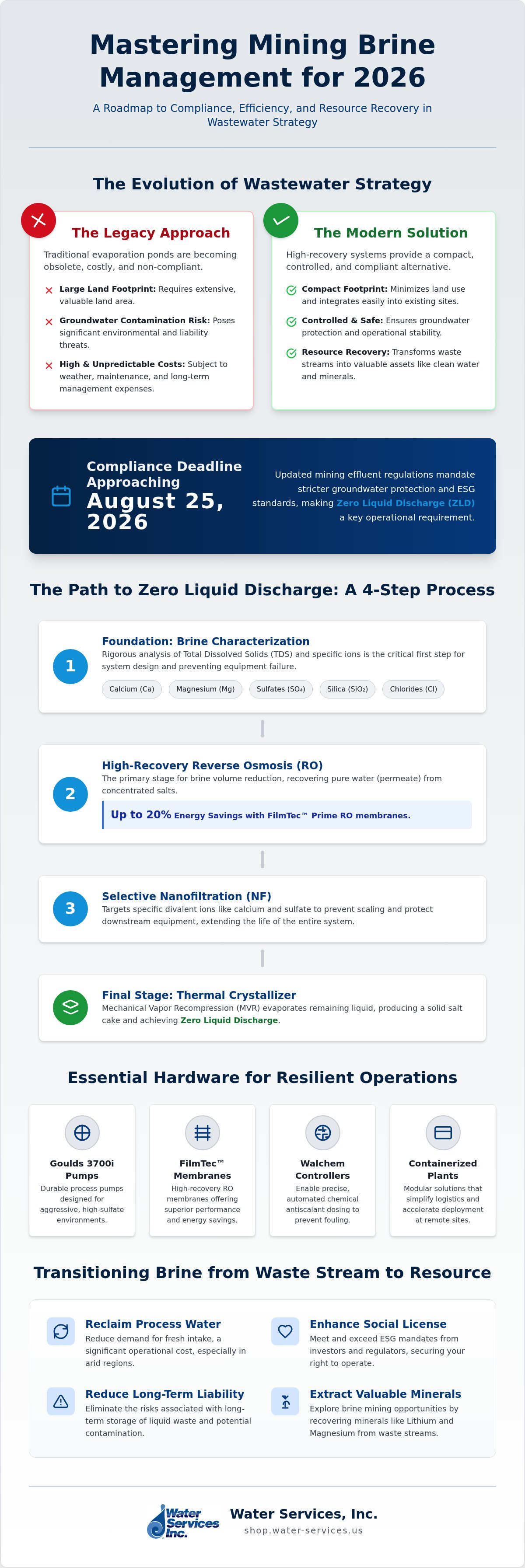
This guide delivers a clear roadmap to mastering 2026 engineering and compliance standards. You'll learn how to integrate high-recovery reverse osmosis and Zero Liquid Discharge (ZLD) systems to minimize waste volumes. We'll cover specific hardware requirements, including the use of Goulds 3700i process pumps and FilmTec Prime RO membranes that offer up to 20% energy savings. From modular containerized plants to precise chemical antiscalant dosing using Walchem controllers, this overview outlines the hardware and strategies needed to ensure your site meets modern groundwater protection mandates.
Key Takeaways
- Transition from legacy evaporation ponds to high-recovery mechanical treatment to align with 2026 ESG and groundwater protection mandates.
- Optimize brine management in mining operations by integrating high-recovery reverse osmosis and selective nanofiltration to achieve maximum liquid waste reduction.
- Reduce equipment downtime in aggressive high-sulfate environments through precision chemical dosing and the selection of durable Goulds process pumps.
- Simplify remote site logistics using modular containerized reverse osmosis plants that minimize on-site civil engineering and deployment timelines.
- Implement resource recovery protocols to reclaim process water and explore the potential for extracting valuable minerals like lithium and magnesium from concentrated streams.
The Evolution of Brine Management in 2026 Mining Operations
Brine management in mining operations encompasses the containment, treatment, and disposal of high-salinity byproduct streams. These streams are generated during pit dewatering, heap leaching, and mineral processing. In 2026, the industry is moving away from traditional solar evaporation ponds. These ponds require large land footprints and present significant groundwater contamination risks. High-recovery mechanical treatment systems provide a compact, controlled alternative. They utilize specialized FilmTec and Hydranautics RO membranes to separate pure water from concentrated salts.
The financial impact of brine management is substantial. High disposal costs for liquid waste can compromise the economic viability of a project. Conversely, the implementation of brine mining and recovery protocols turns a waste stream into a resource. Recovering process water reduces the demand for fresh intake, which is often a significant cost in arid regions. This transition from disposal to recovery is a core engineering objective for modern operations. Sites that successfully integrate ZLD protocols often see a reduction in long-term liability and an increase in operational efficiency.
2026 Regulatory Landscape and ESG Mandates
2026 groundwater protection standards mandate strict effluent limits for mining operations. The August 25, 2026, deadline for updated mining effluent regulations in Canada is a primary example of this tightening oversight. Regulators now focus on the long-term stability of tailings and brine storage. The outdated "dilution is the solution" approach is no longer compliant. ESG mandates from global investors prioritize water stewardship and the reduction of environmental footprints. Adopting Zero Liquid Discharge (ZLD) protocols is often the only way to secure a social license to operate in sensitive ecological zones.
Characterizing Brine Chemistry for Treatment Selection
Treatment selection depends on a rigorous analysis of Total Dissolved Solids (TDS) and specific ion concentrations. Brine characterization is the foundation of system design. Accurate data allows for the selection of specific antiscalants and the calibration of Walchem controllers for automated chemical dosing. Analyzing the Langelier Saturation Index (LSI) is necessary for high-salinity streams. Common scaling precursors in mining environments include:
- Calcium and Magnesium: Primary contributors to carbonate and sulfate scaling.
- Sulfates: Highly aggressive in high-pressure environments, requiring specialized Goulds Water Technology pumps with corrosion-resistant internals.
- Silica: Known for forming hard, glass-like scales that are difficult to remove chemically.
- Chlorides: High concentrations increase the osmotic pressure, requiring high-pressure membrane housings.
Identifying these challenges early prevents rapid membrane fouling and unplanned downtime. Precision monitoring using Signet flow sensors and Ashcroft pressure gauges ensures the treatment train matches the specific chemical profile of the site.
Advanced Membrane and Thermal Technologies for Brine Concentration
Integrating advanced membrane and thermal stages is the industry standard for effective brine management in mining operations. High-recovery Reverse Osmosis (RO) typically serves as the primary stage for volume reduction. It concentrates the brine stream while recovering a high percentage of the water as high-quality permeate. Nanofiltration often follows as a selective pretreatment method. It targets specific divalent ions like calcium and sulfate. This selective removal prevents the premature scaling of downstream thermal equipment and extends the operational life of the entire treatment train.
The synergy between membrane and thermal stages is critical for cost management. Membrane stages handle the bulk of the water volume at a lower energy cost per cubic meter. This reduces the total hydraulic load on the thermal crystallizer. Mechanical Vapor Recompression (MVR) then takes the concentrated reject and evaporates the remaining liquid. The final product is a solid salt cake. This integrated approach ensures that the most energy-intensive processes are reserved for the smallest possible volume of waste.
Selecting High-Pressure RO Membranes
Engineers must choose membranes based on osmotic pressure and fouling potential. FilmTec RO Membranes, specifically the Prime RO series, are engineered for high-salinity applications. These units offer up to 20% reduced energy consumption and up to 60% improved permeate quality compared to legacy generations. For environments with high organic fouling risks, Hydranautics RO Membranes provide specialized spacers and surface chemistries that maintain flux rates under aggressive conditions. Operating limits for these membranes often reach 1,200 psi in concentrated brine circuits. You can browse our technical specifications for RO membranes to find the exact pressure ratings for your specific brine profile.
Zero Liquid Discharge (ZLD) Implementation
Zero Liquid Discharge (ZLD) represents the final engineering path from liquid brine to solid waste. The process moves concentrated reject through thermal evaporation and eventually into a crystallizer. Current ZLD system costs range from $2.50 to $4.00 per cubic meter of treated water. While thermal stages are energy-intensive, modular pretreatment skids reduce the overall footprint and capital expenditure. These containerized designs allow for rapid deployment in remote regions where traditional civil construction is impractical. Precision monitoring using Walchem controllers and Signet flow sensors ensures that the transition from liquid to solid remains within compliance parameters.
Operational Resilience: Managing Scaling and Fouling in High-Sulfate Brines
Mining brines are uniquely aggressive. High concentrations of sulfates, calcium, and silica create a high-risk environment for membrane-based systems. In many jurisdictions, brine management in mining operations must account for gypsum (calcium sulfate) levels that far exceed standard saturation points. When water is recovered through RO stages, these minerals concentrate further, leading to rapid precipitation. This scale formation doesn't just reduce permeate flow; it can cause irreversible mechanical damage to membrane spacers and high-pressure pump internals.
Operational resilience depends on stabilizing this chemistry before it reaches a critical state. pH adjustment is a primary tool for managing carbonate-based scaling. Lowering the pH increases the solubility of certain ions, allowing the system to operate at higher recovery rates without immediate fouling. However, sulfate scaling requires a different approach. Threshold inhibitors and dispersants are necessary to delay crystal formation. Precision in these chemical additions is the difference between continuous operation and weekly system shutdowns for intensive cleaning.
Antiscalants and Chemical Integration
Selecting the correct antiscalant requires a detailed brine analysis that accounts for the Langelier Saturation Index (LSI) and Stiff-Davis Stability Index (S&DSI). Specialized mining antiscalants are formulated to handle the high ionic strength of these streams. Using Pulsafeeder Metering Pumps allows for the precise delivery of these chemicals into the feed stream. These pumps ensure consistent dosing even as influent water quality fluctuates. Accurate chemical integration maximizes RO recovery rates and protects the significant capital investment in membrane hardware.
Automated Process Control
Automation is essential for maintaining system health in remote or high-throughput environments. Integrating Walchem Controllers provides a centralized platform for real-time monitoring and data logging. These controllers can be programmed to adjust chemical dosing based on input from Signet Flow Sensors, which track recovery efficiency across the treatment train. When sensors detect a rise in differential pressure or a drop in salt rejection, the system can automatically initiate a Clean-in-Place (CIP) cycle. This proactive automation prevents hard scale from bonding to the membrane surface, extending the interval between manual maintenance interventions and reducing overall downtime.
Monitoring Ashcroft pressure gauges at each stage further identifies specific areas of fouling. By tracking the pressure drop across individual vessels, operators can pinpoint whether fouling is biological, organic, or mineral-based. This data-driven approach ensures that brine management in mining operations remains both compliant and cost-effective throughout the 2026 production cycle.
Engineering Modular and Containerized Brine Treatment for Remote Sites
Modular containerized plants are the 2026 engineering standard for remote brine management in mining operations. These systems integrate full treatment trains, including filtration, RO, and control logic, into standard ISO shipping containers. This design minimizes the requirement for extensive on-site civil engineering. Instead of constructing permanent concrete structures, operators utilize skid-mounted units that require only a level pad and utility connections. This approach significantly reduces commissioning timelines. It's an ideal solution for remote regions in Africa and South America where local logistical support is often limited.
Scalability is a primary advantage of the modular design. As mine production increases or brine chemistry shifts, additional treatment blocks can be added to the circuit. This flexibility avoids the capital risk of overbuilding initial capacity. These systems are designed for rapid transport and can be relocated as specific pits are dewatered or closed. The use of standardized components ensures that maintenance and parts replacement remain efficient across global sites.
Pumping and Fluid Movement in Brine Circuits
Handling aggressive brine requires specific pump configurations and materials. Goulds Water Technology Pumps are the preferred choice for these corrosive environments. High-pressure RO stages typically utilize multi-stage centrifugal pumps to maintain consistent flux and permeate quality. Positive displacement pumps are often reserved for lower-flow, high-pressure chemical dosing or deep-well injection applications. Material selection is critical for system longevity. Engineers specify 316L stainless steel, Duplex, or Super Duplex alloys to resist chloride-induced pitting. These materials ensure that brine management in mining operations remains reliable under continuous 24/7 duty cycles.
System Health and Pressure Monitoring
Maintaining system health in remote operations depends on robust instrumentation and safety protocols. Utilizing Ashcroft Pressure Gauges allows operators to monitor performance across the entire treatment skid. These gauges identify pressure surges that could rupture membrane housings or damage high-pressure piping. Protecting the system from water hammer is a priority during automated startup and shutdown sequences. Operator safety is also a regulatory requirement. Ensuring the availability of Personal Protective Equipment (PPE) is mandatory during chemical handling and high-pressure maintenance tasks. Explore our industrial pumps and modular components to optimize your remote site infrastructure.
Transitioning Brine from Waste Stream to Resource Opportunity
Brine management in mining operations is shifting from a compliance liability to a strategic resource opportunity. The global market for Zero Liquid Discharge (ZLD) systems is projected to reach $9.15 billion in 2026, reflecting a massive industry move toward total water and mineral recovery. Modern operations no longer view concentrated reject as waste. Instead, they treat it as a source of critical minerals. Direct Lithium Extraction (DLE) technologies are a primary driver of this change, with the DLE market projected to reach $1.4 billion by the end of 2026. Recovering lithium, magnesium, and potash from brine streams can offset the operational costs of wastewater treatment and generate new revenue streams.
Water Services, Inc. provides the industrial infrastructure necessary to bridge the gap between disposal and recovery. High-recovery systems utilizing FilmTec and Hydranautics RO membranes produce a permeate stream suitable for reuse in process circuits. This reduces the site’s fresh water intake requirements, which is a critical metric for ESG reporting. Our engineering support includes the integration of Goulds Water Technology pumps and Walchem controllers to manage the high-pressure, high-salinity environments required for mineral concentration. By concentrating the brine to near-saturation, we prepare the stream for final crystallization or mineral harvesting.
The Circular Economy in Mining
Adopting a circular economy model allows mines to operate in water-stressed regions without depleting local aquifers. High-recovery systems can reclaim up to 90% of process water, significantly reducing the environmental footprint of the operation. These systems are particularly effective in arid mining districts in South America and Africa where water rights are expensive and strictly regulated. You can read more about the technical integration of these systems in our sibling article on The Role of Zero Liquid Discharge (ZLD) in Mining. This transition ensures long-term site viability and strengthens the social license to operate.
Next Steps for Site Managers
Transitioning to a resource-recovery model starts with a comprehensive brine audit. Managers must characterize the specific ion concentrations of their waste streams to determine the feasibility of mineral extraction. We recommend the following steps for site evaluation:
- Feasibility Study: Analyze TDS levels and specific mineral potential (Lithium, Magnesium, Potash) to calculate the ROI of recovery hardware.
- Pilot Testing: Utilize mobile or rental ultrafiltration and RO units to verify recovery rates under actual site conditions before committing to full-scale capital expenditure.
- Modular Design Consultation: Work with engineering partners to develop containerized plants that can be scaled as production volumes increase.
Whether you're looking to purchase a permanent plant or evaluate rental options for mobile treatment, selecting durable hardware is essential. Precision monitoring with Signet flow sensors and Ashcroft pressure gauges ensures that your recovery circuit operates within optimal parameters, maximizing both water and mineral yields.
Optimizing Brine Recovery for 2026 and Beyond
Mastering brine management in mining operations requires a transition from passive disposal to active resource recovery. By integrating high-recovery FilmTec membranes with precision Walchem control logic, operators can meet strict 2026 groundwater protection mandates while reducing operational overhead. Modular containerized systems provide the necessary flexibility for remote locations. These designs allow for rapid deployment and scalable capacity as production needs evolve without the requirement for permanent civil infrastructure.
Water Services, Inc. is an authorized distributor of Goulds, Viqua, and FilmTec hardware. We specialize in custom containerized systems engineered and built at our headquarters in Provo, Utah. Our team maintains extensive global deployment expertise in harsh environments, including remote sites across Africa and South America. We provide the durable equipment and technical support needed to maintain compliance and operational integrity in the most demanding industrial conditions. Reliable water management is the foundation of a sustainable and profitable mining operation.
Consult with our engineers for custom mining brine solutions to secure your site’s operational future.
Frequently Asked Questions
What are the main challenges of brine management in mining operations?
The primary challenges include high concentrations of scaling ions like calcium and sulfate, which cause rapid equipment fouling and downtime. Brine management in mining operations also faces logistical hurdles in remote areas and rising costs for evaporation pond maintenance. Compliance with 2026 ESG benchmarks requires operators to minimize liquid discharge and protect local groundwater sources from contamination.
How does Zero Liquid Discharge (ZLD) work for mining brine?
ZLD systems create a closed-loop process where all liquid waste is converted into high-quality reclaimed water and solid solids. This typically involves a high-recovery RO stage to reduce volume, followed by thermal evaporation using Mechanical Vapor Recompression (MVR) and a final crystallization step. The resulting solid salt cake is then safely disposed of or processed further for mineral recovery.
Can RO membranes handle high-salinity mining brine?
Specialized RO membranes are engineered specifically to handle the high osmotic pressure of concentrated mining streams. Models such as the FilmTec Prime RO series provide up to 60% improved permeate quality while operating at pressures reaching 1,200 psi. These membranes are essential for the first stage of volume reduction in any modern brine treatment circuit.
What is the most cost-effective way to manage brine at a remote mine?
Modular containerized plants offer the highest cost-efficiency for remote operations by minimizing on-site civil engineering and construction timelines. These skid-mounted systems are pre-assembled and tested before shipping, which reduces the risk of installation delays. Their scalability allows managers to add capacity only when production volumes require it, preserving capital.
How do antiscalants improve the efficiency of brine treatment?
Antiscalants function as threshold inhibitors that prevent minerals from bonding to membrane surfaces and pump internals. By stabilizing the chemistry of aggressive high-sulfate brines, these chemicals allow systems to reach higher recovery percentages without causing irreversible fouling. This protection extends the service life of expensive hardware and reduces the frequency of Clean-in-Place cycles.
Is modular brine treatment better than permanent infrastructure for mining?
Modular systems are generally superior for modern mining due to their flexibility and lower logistical footprint. Unlike permanent concrete infrastructure, containerized units can be relocated or sold once a specific project reaches its end of life. They allow for a much faster response to changing regulatory requirements or shifts in brine chemistry.
What regulations govern mining brine disposal in 2026?
In 2026, disposal is governed by strict groundwater protection mandates and updated effluent regulations, such as the Canadian Metal and Diamond Mining Effluent Regulations. Operators must also navigate regional requirements, like the $500 per wellbore permit fee for brine injection in Texas. ESG reporting standards now often require proof of water stewardship and minimized environmental impact.
Can minerals like lithium be recovered from mining brine waste?
Mineral recovery is a growing trend, with Direct Lithium Extraction (DLE) becoming a viable method for harvesting lithium from brine waste. Other minerals like magnesium and potash can also be extracted depending on the chemical profile of the stream. This approach transforms brine management in mining operations from a disposal cost into a potential revenue-generating resource.
0 comentarios