

By August 25, 2026, the era of treating mine wastewater as a disposable byproduct ends permanently. As global mandates tighten, the traditional reliance on massive evaporation ponds is no longer a viable strategy for operational resilience. You likely already feel the pressure of skyrocketing maintenance costs and the frustration of frequent pump failures caused by aggressive high-salinity scaling. It's a logistical burden that threatens both your bottom line and your license to operate.
This technical guide helps you master the transition to high-recovery brine management in mining operations by focusing on precision engineering and hardware durability. You'll learn how to navigate the August 2026 regulatory deadlines while optimizing your site for maximum water reclamation. We provide a detailed look at hardware selection, including the use of Goulds Water Technology pumps for corrosive circuits and FilmTec RO membranes for energy-efficient recovery. From modular ZLD system design to automated chemical dosing with Walchem controllers, this guide delivers the specifications needed to secure your facility's future in a 9.15 billion dollar global market.
Key Takeaways
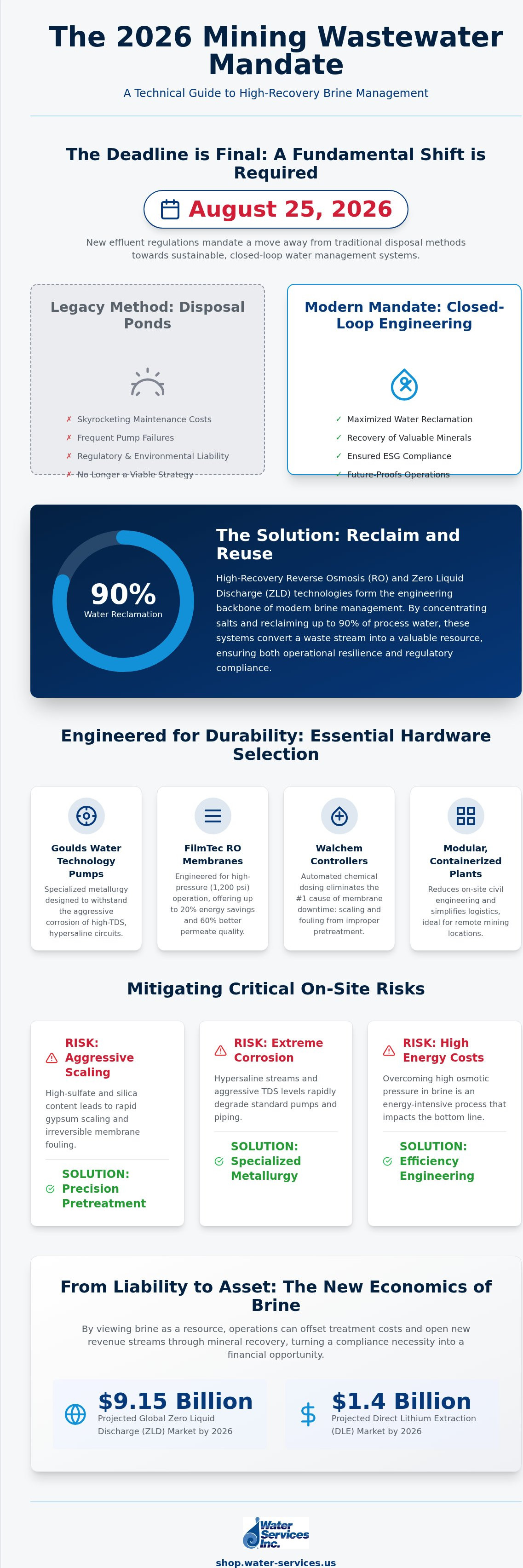
- Navigate the August 25, 2026, effluent deadline by transitioning from legacy disposal ponds to closed-loop engineering models.
- Optimize brine management in mining operations using high-recovery Reverse Osmosis and Zero Liquid Discharge (ZLD) technologies to reclaim up to 90% of process water.
- Select durable hardware like Goulds Water Technology pumps and FilmTec membranes to withstand the aggressive scaling and corrosion of hypersaline streams.
- Implement precision chemical pretreatment and automated dosing to protect system integrity and eliminate the #1 cause of membrane-related downtime.
- Leverage modular, containerized treatment plants to reduce on-site civil engineering requirements and simplify logistics at remote mining locations.
The Evolution of Brine Management in 2026 Mining Operations
The industrial approach to wastewater is undergoing a fundamental shift. Brine management in mining operations has transitioned from a passive disposal task to a critical, closed-loop engineering requirement. Legacy methods, specifically solar evaporation ponds, are collapsing under the weight of 2026 ESG mandates and land-use restrictions. Modern operations now treat brine as a concentrated resource stream rather than a liability. This evolution is driven by the need for water security and the recovery of valuable minerals, a process detailed in this Brine mining overview.
Regulatory Landscape and ESG Compliance
The primary catalyst for this shift is the August 25, 2026, deadline for updated mining effluent regulations. These mandates focus heavily on groundwater protection and zero-discharge standards. For operators, compliance directly impacts the social license to operate and corporate sustainability reporting (CSR). The global market for Zero Liquid Discharge (ZLD) systems is projected to reach $9.15 billion by the end of 2026, reflecting the scale of this transition. Proactive investment in water treatment hardware is now a more cost-effective strategy than facing regulatory fines or site-wide downtime.
Characterizing Mining Brine Chemistry
Engineering a successful system requires a deep understanding of complex brine profiles. Mining effluent often contains high concentrations of sulfates, calcium, and silica, which create severe scaling risks. Standard industrial wastewater solutions often fail because they aren't designed for these aggressive TDS (Total Dissolved Solids) levels. Site-specific pilot testing is the only reliable way to ensure 2026 system designs can handle these variables. Without precise data on brine chemistry, hardware selection becomes a gamble that leads to premature equipment failure.
- High-sulfate streams lead to rapid gypsum scaling on membrane surfaces.
- Silica concentrations often exceed saturation limits, causing irreversible fouling.
- Aggressive TDS levels require specialized metallurgy to prevent corrosion in high-pressure circuits.
The transition from risk mitigation to proactive reclamation also opens new revenue streams. Technologies like Direct Lithium Extraction (DLE), which is projected to reach a $1.4 billion market by the end of 2026, exemplify this trend. By viewing brine as an asset, mining operations can offset treatment costs through the sale of recovered salts and minerals. This dual-purpose engineering approach ensures that compliance doesn't just meet a legal requirement but also contributes to the mine's overall economic productivity. Effective brine management in mining operations relies on matching the treatment technology to the specific chemical fingerprint of the site to ensure long-term mechanical integrity.
Advanced Membrane and Thermal Technologies for Brine Concentration
High-Recovery Reverse Osmosis (RO) serves as the primary engineering backbone for brine volume reduction. By concentrating salts before thermal stages, RO reduces the overall energy footprint and physical scale of the treatment circuit. Modern brine management in mining operations relies on these high-pressure membrane systems to reclaim up to 90% of process water for reuse in milling and processing. Selective Nanofiltration is also emerging as a critical tool for mineral asset recovery, allowing operators to isolate specific ions like lithium or magnesium from complex waste streams before final disposal.
Selecting High-Pressure RO Membranes
Systems must withstand operating pressures reaching 1,200 psi to overcome the high osmotic pressure inherent in hypersaline streams. FilmTec Reverse Osmosis Membranes, specifically the Prime RO series, are engineered for these environments, offering up to 20% energy savings and 60% improved permeate quality. Membrane flux rates are a critical metric; higher flux allows for a smaller total system footprint, which is essential for remote mine sites with limited space. For environments with high organic fouling risks, Hydranautics RO Membranes provide specialized resistance. Integrating energy recovery devices (ERDs) further optimizes these circuits by capturing hydraulic energy from the high-pressure concentrate stream to pre-pressurize the feed water.
Zero Liquid Discharge (ZLD) vs. Minimal Liquid Discharge (MLD)
Engineering the transition from liquid waste to solid residue requires balancing CAPEX with environmental mandates. Minimal Liquid Discharge (MLD) focuses on using high-recovery mechanical RO to reduce brine volume by up to 95%, leaving a small concentrate stream for secondary management. Zero Liquid Discharge (ZLD) goes further by employing thermal evaporators and crystallizers to eliminate liquid waste entirely, producing a dry salt cake. While ZLD is the benchmark for 2026 groundwater protection, it involves treatment costs ranging from $2.50 to $4.00 per cubic meter. Operators often utilize MLD as a cost-effective precursor to ZLD to minimize the size and energy requirements of expensive thermal hardware. This hybrid approach ensures brine management in mining operations remains economically viable while meeting strict August 2026 discharge standards.
For sites requiring high-reliability hardware, selecting engineered treatment solutions ensures your membrane stack is matched to your specific brine chemistry and recovery targets.
Operational Resilience: Hardware Selection for Harsh Mine Sites
Mechanical integrity is the bottleneck of effective brine management in mining operations. While process chemistry defines the treatment path, hardware durability determines the uptime. Pump failure remains the leading cause of system downtime, often resulting from the aggressive nature of hypersaline fluids that exceed the design limits of standard industrial equipment. Achieving operational resilience requires a shift from general-purpose hardware to specialized components that can withstand high-TDS (Total Dissolved Solids) environments without catastrophic corrosion or erosion.
Pumping and Fluid Movement in Brine Circuits
Selecting Goulds Water Technology Pumps is a standard engineering choice for managing these aggressive streams. In brine circuits, standard 316L stainless steel often lacks the pitting resistance needed for high-chloride concentrations; instead, hardware must utilize Duplex or Super Duplex alloys. The Goulds 3700i series, for instance, is built for the high-temperature and corrosive demands of mining wastewater. Engineers must also account for the increased density of brine, which significantly alters Net Positive Suction Head (NPSH) requirements compared to fresh water. Using mechanical seals with silicon carbide or tungsten carbide faces is essential to prevent leaks when handling abrasive particulates common in mine effluent.
System Health and Pressure Monitoring
Real-time data prevents minor scaling events from becoming site-wide failures. Utilizing Ashcroft Pressure Gauges allows operators to track transmembrane pressure (TMP) with precision. A sudden spike in differential pressure across a membrane stack is a definitive early warning sign of calcium sulfate or silica scaling. To maintain an accurate recovery rate, integrating Signet Flow Sensors ensures that the ratio of permeate to concentrate stays within the engineered design limits. These sensors provide the granular data necessary for 24/7 remote monitoring, allowing for proactive adjustments to chemical dosing or flow rates before hardware is compromised.
High-availability mining circuits don't rely on single-point success. Redundancy, specifically an N+1 pump configuration, ensures that brine management in mining operations continues during scheduled maintenance or unexpected seal failures. By matching metallurgy to brine chemistry and backing it with precise instrumentation, operators can secure the mechanical reliability required to meet 2026 compliance standards.
Mitigating Scaling and Fouling in High-Salinity Streams
Chemical pretreatment serves as the primary defense for high-recovery membrane systems. In brine management in mining operations, scaling from calcium sulfate and silica represents the most significant threat to membrane longevity and system flux. Effective mitigation requires a transition from manual chemical additions to a data-driven approach. Monitoring the Langelier Saturation Index (LSI) in real-time provides the necessary metrics to adjust chemical feeds before mineral precipitation occurs on membrane surfaces.
Antiscalants and Chemical Integration
Mining brines possess unique chemical fingerprints that require site-specific antiscalant formulations. Standard off-the-shelf chemicals often fail to prevent complex silica scaling in hypersaline environments. Utilizing Walchem Controllers allows for automated, sensor-based dosing that reacts to fluctuations in feed water chemistry. These controllers integrate with precision metering pumps to ensure the exact required concentration of antiscalant is maintained. This level of precision reduces chemical waste and prevents the "over-dosing" that can lead to secondary fouling. Implementing automated Clean-in-Place (CIP) protocols further protects the stack by removing minor deposits before they undergo irreversible compaction.
Managing Biological and Organic Fouling
While mineral scaling is a primary concern, biological and organic fouling can rapidly degrade high-value RO membranes. Biofilm growth creates a physical barrier that increases feed pressure and reduces permeate quality. Integrating Viqua UV Water Purification Systems into the pretreatment circuit provides a non-chemical method for neutralizing bacteria and pathogens. This step is particularly critical for mines utilizing recycled process water or tailing pond supernatant as feed. To manage suspended solids and turbidity, operators should also incorporate multimedia filter tanks and high-efficiency sediment filters. This multi-stage approach ensures that the water reaching the high-pressure RO stage is free of the particulates that lead to mechanical abrasion and fouling.
Maintaining the chemical balance of your system is essential for meeting 2026 effluent standards. You can secure your operation's efficiency by selecting the correct water treatment chemicals and dosing hardware for your specific site chemistry.
Modular Logistics: Engineering Brine Treatment for Remote Sites
Infrastructure development at remote mine sites often faces significant hurdles, including limited skilled labor and high mobilization costs. Containerized reverse osmosis plants solve these logistical challenges by providing factory-tested, pre-engineered solutions that arrive ready for commissioning. This modular approach reduces on-site civil engineering requirements and slashes deployment timelines compared to traditional stick-built facilities. For operators, this means brine management in mining operations can be established or upgraded months faster, ensuring compliance with the August 25, 2026, effluent standards.
Containerized vs. Stick-Built Infrastructure
Deployment speed is a critical factor for remote African or South American sites where local construction materials are often scarce. Modular systems allow for standardized parts across a global mining fleet, which simplifies technical support and inventory management. When high-durability components like Goulds Water Technology Pumps and Walchem controllers are integrated into a controlled container environment, they're better protected from the extreme dust and temperature fluctuations of harsh environments. These units are also inherently scalable; operators can add modular stages as mine production increases or brine chemistry evolves over the life of the mine.
Short-life mine sites benefit specifically from the ease of decommissioning modular hardware. Once a site reaches its end-of-life, containerized plants are easily disconnected and relocated to new projects, preserving the initial capital investment. This flexibility is impossible with permanent concrete-and-steel infrastructure, making modularity the preferred engineering choice for modern, agile mining fleets.
Transitioning Brine to a Resource Opportunity
Effective brine management in mining operations now incorporates the principles of a circular economy. High-recovery modular systems allow for the reclamation of up to 90% of process water, which significantly reduces fresh water intake costs and the operational reliance on local aquifers. Beyond water recovery, concentrated brine streams are increasingly viewed as feedstock for mineral extraction. With the Direct Lithium Extraction (DLE) market projected to reach $1.4 billion by the end of 2026, the ability to isolate lithium, magnesium, or potash from concentrated waste transforms a disposal liability into a secondary revenue stream.
Implementing these advanced recovery stages within a modular framework allows mines to adapt to changing mineral prices without overhauling their entire water circuit. By selecting modular water treatment plants, engineers can ensure their facilities remain both environmentally compliant and economically productive in an increasingly regulated global market.
Securing Operational Resilience Through Advanced Brine Engineering
The August 25, 2026, regulatory deadline represents a fundamental shift from passive waste disposal to precise resource recovery. You've seen how integrating high-pressure RO with durable components like Goulds Water Technology pumps and FilmTec membranes prevents the scaling and corrosion that often plague standard industrial systems. Modular, containerized plants provide the logistical flexibility required for remote sites; this ensures that brine management in mining operations remains efficient and compliant throughout the entire mine lifecycle.
We provide global deployment expertise across complex sites in Africa and South America. As an authorized distributor for Goulds and FilmTec, we specialize in the engineering of modular, containerized industrial RO plants designed to meet the most stringent 2026 mandates. Contact our engineering team for a custom mining brine management solution to optimize your water recovery rates and protect your mechanical integrity. Your facility is ready to successfully navigate the transition to a circular water economy with hardware built for industrial reliability.
Frequently Asked Questions
What are the main 2026 regulatory changes for mining brine discharge?
The primary change is the August 25, 2026, deadline for updated mining effluent regulations. These mandates focus on groundwater protection and stricter limits on liquid waste discharge. Operators must transition from legacy evaporation ponds to high-recovery mechanical systems to maintain their social license. Failure to comply can result in significant regulatory fines and site-wide downtime. Effective brine management in mining operations now requires a closed-loop engineering approach to meet these 2026 ESG standards.
How does high-recovery RO differ from standard reverse osmosis?
High-recovery systems operate at significantly higher pressures, often reaching 1,200 psi, compared to standard industrial RO. These systems use specialized membranes, such as the FilmTec Prime series, to overcome high osmotic pressure in hypersaline streams. While standard RO might achieve 50% to 75% recovery, high-recovery configurations can reclaim up to 90% of process water. This maximizes water reuse and minimizes the volume of concentrate requiring secondary thermal treatment or crystallization.
What is the typical lifespan of an RO membrane in a mining environment?
RO membrane lifespan in mining typically ranges from 1 to 3 years, depending heavily on the efficacy of pretreatment and cleaning protocols. High concentrations of silica and sulfates can cause irreversible fouling if not managed correctly. Using specialized antiscalants and automated Clean-in-Place (CIP) systems helps extend this duration. Monitoring transmembrane pressure with Ashcroft gauges ensures you identify scaling early. Regular maintenance and proper chemical dosing are essential to prevent premature replacement costs.
Can Zero Liquid Discharge systems be implemented at remote mine sites?
Yes, Zero Liquid Discharge (ZLD) systems are now frequently implemented at remote sites through modular, containerized engineering. These factory-tested units arrive ready for commissioning, which bypasses the need for complex on-site civil engineering and specialized local labor. By combining high-pressure RO with compact thermal evaporators, remote operators can eliminate liquid waste entirely. This approach is particularly effective for sites with limited land for ponds or those facing strict groundwater protection mandates.
What metallurgy is required for pumps handling high-TDS mining brine?
Pumps handling hypersaline mine water require Duplex or Super Duplex stainless steel to prevent pitting and stress corrosion cracking. Standard 316L stainless steel often fails in high-chloride environments common in brine circuits. Hardware like Goulds Water Technology pumps utilizes these high-performance alloys to ensure mechanical integrity under continuous operation. Selecting the correct metallurgy, combined with silicon carbide mechanical seals, is the most effective way to reduce pump-related downtime in harsh mining wastewater applications.
How do antiscalants prevent RO membrane fouling in high-sulfate water?
Antiscalants function by interfering with the crystal growth of minerals like calcium sulfate and gypsum. These chemicals delay the precipitation process, keeping the minerals in a dissolved state as they pass through the RO membrane. Precision dosing is critical; using Walchem controllers ensures the chemical concentration matches the real-time feed water chemistry. This prevents the formation of hard scale on the membrane surface, which maintains system flux and reduces the frequency of intensive chemical cleanings.
What are the benefits of modular, containerized brine treatment plants?
Modular plants offer significantly faster deployment timelines and reduced on-site construction costs. These systems are inherently scalable, allowing operators to add extra units as mine production or brine volume increases. Because they're housed in standardized containers, they're easier to decommission and relocate once a mine reaches its end-of-life. This flexibility protects capital investment while ensuring the brine management in mining operations can adapt to changing site requirements without major infrastructure overhauls.
How can I recover valuable minerals like Lithium from my brine stream?
Mineral recovery is achieved through selective separation technologies like Direct Lithium Extraction (DLE) or specialized nanofiltration. These processes isolate specific ions such as lithium, magnesium, or potash from the concentrated brine stream after the primary RO stage. With the DLE market projected to reach $1.4 billion by the end of 2026, many operators are turning waste streams into revenue opportunities. This circular economy model offsets the cost of brine treatment by producing high-value industrial minerals.
0 comentarios