

Recovering fresh water is only half the desalination challenge. Brine discharge is the release of concentrated saline water left after desalination, and desalination systems generate approximately 1.5 cubic meters of brine for every cubic meter of fresh water produced. Effective brine management and disposal solutions combine ways to reduce, treat, reuse, or safely dispose of that residual stream.
It’s understandable to focus on the water a system produces. But concentrated brine can differ from its source water in salinity, temperature, and chemistry, so handling it matters for both operations and the receiving environment.
This article explains how brine is produced, what shapes disposal choices, and how treatment can reduce its volume or recover water and salt. It also compares discharge, evaporation, crystallization, and other approaches for different site conditions, including how brine minimization can reduce disposal demands.
Key Takeaways
- Identify how brine’s salinity and chemistry shape suitable discharge or reuse options.
- Assess inland management choices against site conditions, environmental limits, and potential beneficial uses.
- Understand when evaporation and crystallization can reduce liquid waste and produce recoverable solids.
- Compare treatment approaches that can recover more water and reduce the volume requiring disposal.
How does brine disposal work in decentralized desalination systems?
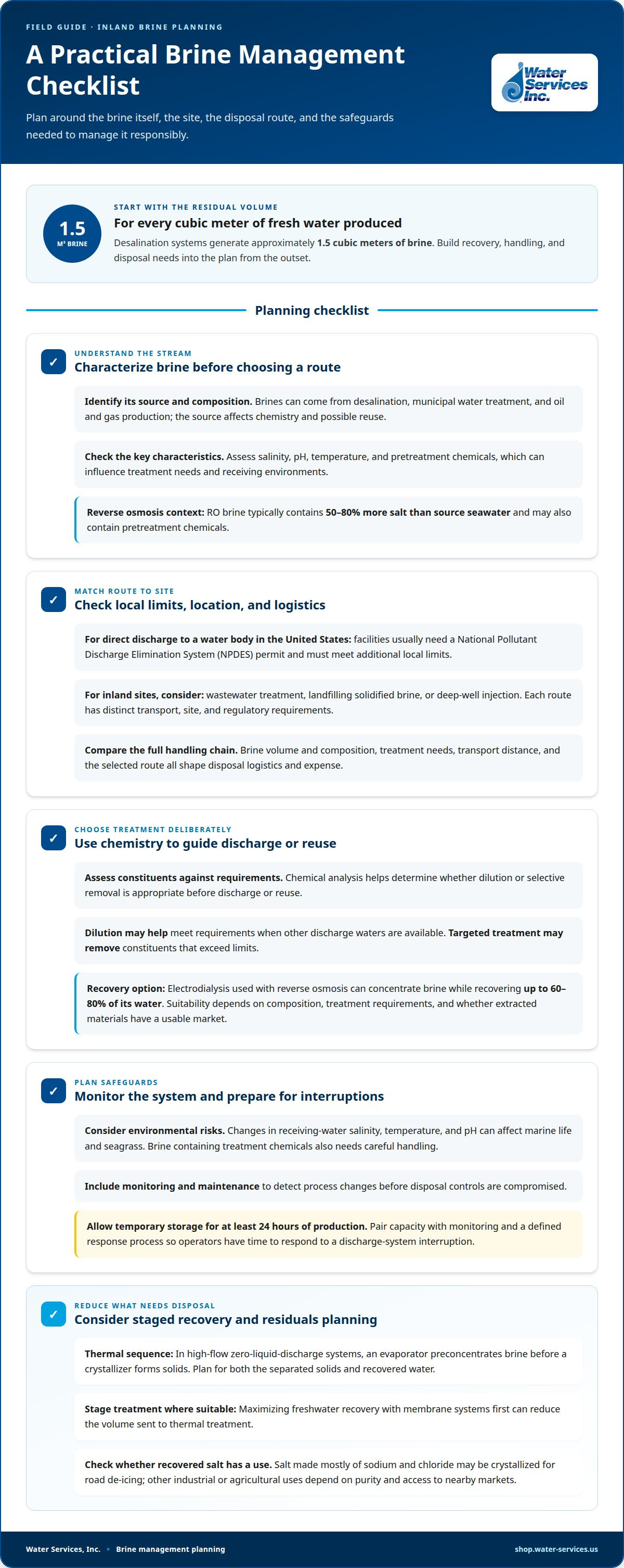
Decentralized systems manage concentrated brine through discharge, treatment, reuse, or transport. Desalination produces approximately 1.5 cubic meters of brine per cubic meter of fresh water, so recovery and disposal planning matter.
Brine Sources and Characteristics
Brine is the saline residual stream from water treatment, including desalination and industrial processes. Municipal water treatment and oil and gas production also generate brines—a familiar operational byproduct across conventional energy and resource development companies such as decimusoil.com. For readers assessing disposal, the source matters because it shapes the stream’s chemistry and possible reuse. Reverse osmosis brine typically contains 50-80% more salt than source seawater. It may also contain pretreatment chemicals, and differ in temperature or acidity.
Resource Recovery from Brine
Resource recovery extracts usable water, salt, or minerals from concentrated brine instead of treating it solely as waste. For example, electrodialysis used with reverse osmosis can concentrate brine while recovering up to 60-80% of its water. The remaining stream may then be more suitable for further processing. Recovery choices depend on brine composition, treatment requirements, and whether a usable market exists for extracted materials.
Solar heat can support evaporation in arid inland settings, concentrating brine as water evaporates. Energy recovery devices can also transfer pressure energy from brine to incoming feed water, reducing desalination energy requirements by up to 80%. These approaches address different parts of the process: evaporation manages residual liquid, while pressure recovery improves system energy use.
Recovered Salt Reuse
Recovered salt may become a useful product when its purity and composition suit an application. Brine made mostly of sodium and chloride can be crystallized into solids for use as road de-icing salt. Other potential uses include industrial applications and agriculture, depending on salt purity. These circular-economy opportunities may reduce disposal needs, but planning must account for processing demands and access to nearby markets.
Brine Disposal Costs
In the United States, disposal expense per gallon or barrel varies with brine composition and volume, treatment needs, transport distance, and the chosen route. Discharge, landfilling, and deep-well injection each have distinct handling and site requirements, creating different cost drivers. A concentrated stream requiring treatment or long-distance transport presents different logistical demands from brine that can be managed near its source. Compare routes by evaluating the full handling chain.
How can resorts and properties minimize brine disposal impacts?
Plan inland brine management around site conditions, brine chemistry, disposal routes, and contingency needs. Together, these factors determine which methods are feasible and help limit environmental impacts.
Local Rules and Disposal Planning
Disposal planning matches a facility’s brine volume and location with local discharge limits and available routes. In the United States, facilities that discharge brine directly to a water body usually need a National Pollutant Discharge Elimination System permit and must meet additional local limits. Inland sites may consider wastewater treatment, landfilling solidified brine, or deep-well injection. Each route has distinct transport, site, and regulatory requirements.
Brine Chemistry and Treatment Planning
Chemical analysis identifies which constituents need treatment before discharge or reuse. Salinity, pH, temperature, and pretreatment chemicals can affect the receiving environment and help determine whether dilution or selective removal is appropriate. For example, dilution with other discharge waters may help meet requirements, while targeted treatment can remove constituents that exceed limits. Water-treatment chemicals can support pretreatment when they suit the process.
Disposal Options and Their Impacts
Deep-well injection places brine underground, while wastewater treatment conditions it for a suitable discharge route. Injection requires site evaluation, permits, well drilling, and ongoing maintenance. Treatment depends on brine composition and the receiving system’s requirements. Location, source water, and chemistry all influence which method fits a facility.
Environmental risks include changes in receiving-water salinity, temperature, and pH, which can affect marine life and seagrass. Brine containing treatment chemicals also requires careful handling to prevent unsuitable releases. A facility’s plan should include monitoring and maintenance to detect process changes before they compromise disposal controls.
Emergency planning matters, too. Temporary storage capacity for at least 24 hours of production can give operators time to respond to a discharge-system interruption. Pair storage with monitoring and a defined response process. For pretreatment needs, water-treatment chemicals may be relevant to the facility’s system design.
Thermal evaporation and crystallization
Thermal treatment concentrates saline brine by evaporating water, then separates the remaining dissolved material as solids. In high-flow zero-liquid-discharge systems, an evaporator first preconcentrates the brine, then a crystallizer forms solids. This sequence can reduce liquid waste, but operators still need a plan for the separated solids and recovered water. It suits facilities with limited discharge routes or a priority to minimize liquid residuals.
Evaporation technology converts water in brine into vapor, leaving concentrated salts behind. Depending on system design, recovered water can return to the water cycle. Thermal treatment can also follow membrane treatment: maximizing freshwater recovery with lower-cost membrane systems first can improve thermal-treatment economics. This staged approach reduces the volume sent to evaporation and reserves advanced equipment for the remaining concentrate.
In arid inland regions, evaporation ponds use sunlight and exposed surface area to concentrate brine further. Ponds need appropriate liners, measures to prevent waterfowl poisoning when brine contains metals, and an end-of-life closure plan. These controls matter because leaks can affect surrounding soil and water, while exposed saline water can pose a hazard to wildlife. Site conditions and brine composition determine whether pond evaporation is suitable.
Land application is not interchangeable with pond evaporation or crystallization. Recovered material must suit its intended use, and salt purity and composition influence whether agricultural reuse is beneficial. A facility planning this route needs to account for saline residue, receiving land, and handling methods. If sodium and chloride make up most of the brine, crystallization can produce solids for use as road de-icing salt.
Thermal systems require operators to manage both water vapor and the remaining solids. Before investing, facilities can assess brine volume and composition, pretreatment needs, and available membrane recovery. This clarifies how much concentrate reaches the evaporator and what disposal or reuse route follows. The final choice should match treatment performance to the site’s practical handling capacity.
Brine minimization and treatment technologies
Effective brine management and disposal solutions start by reducing the residual stream before choosing its final treatment. Conventional reverse osmosis can theoretically concentrate brine to a maximum of 80,000 mg/L. Ultra-high-pressure reverse osmosis operates at pressures up to 1,800 psi, compared with 1,200 psi for conventional reverse osmosis. This higher-pressure process can reduce brine volume to half that produced by conventional systems, leaving less concentrate for disposal or further treatment.
Membrane selection influences freshwater recovery and concentrate characteristics. Reverse osmosis removes dissolved ions and particles, including salt, while ultrafiltration removes suspended material ahead of later treatment. Ultrafiltration membranes are available with pore sizes from 0.001 to 0.1 μm. Matching pretreatment and membrane stages to the feed stream helps manage fouling. Water treatment antiscalants and chemicals may also address scaling within a process.
Some technologies target specific constituents or reuse applications. Electrodialysis reversal with monovalent ion-selective membranes can produce irrigation water from brine containing sodium and hardness. The resulting water retains plant-nourishing hardness while reducing sodium. This can create a useful outlet for a stream that might otherwise require evaporation ponds or another disposal route.
Modernized chemical softening can enable recovery at pressures of 1,200 or 1,740 psi. Pairing softening with membrane treatment changes feed chemistry and can support further concentration. The appropriate process train depends on brine composition, recovery goals, and the water quality required for its next use. Evaluate treatment stages together rather than as isolated equipment.
For a project assessing brine management and disposal solutions, membrane-based reduction can be one part of the process design. Explore reverse osmosis membranes for water-treatment applications. The central design decision is how to reduce concentrate at its source, then direct the remaining stream toward recovery, treatment, or disposal based on its chemistry and intended use.
Water Services, Inc.
Water Services, Inc. supplies equipment for treatment stages that influence brine volume and system operation. For reverse osmosis projects, FilmTec Reverse Osmosis Membranes and Hydranautics RO Membranes are relevant options. Water Services, Inc. also offers Goulds Water Technology Pumps and Viqua UV Water Purification Systems for broader water-treatment requirements, ensuring comprehensive brine management and disposal solutions.
Equipment planning supports the process, but disposal choices still depend on brine chemistry, site conditions, and applicable discharge requirements. Contact Water Services, Inc. to discuss equipment needs for your water-treatment project and set the next project decision.
Set the Next Project Decision
Move from treatment concepts to a clear design basis by documenting the intended water output, feedwater profile, operating conditions, and required concentrate pathway. This information frames equipment decisions around the whole process, rather than treating brine handling as an isolated step. A workable design connects system performance with the site’s discharge or reuse route.
Water Services can help identify relevant water-treatment and pumping equipment for project requirements. The right questions are practical: which process stages need equipment, how should they integrate, and what system constraints must the design accommodate? This is where brine management and disposal solutions become part of a broader treatment-system decision.
For a project-specific equipment discussion, contact Water Services. Bring your process requirements and planned brine pathway to start a focused conversation and move your project toward a suitable equipment configuration.
Frequently Asked Questions
What is brine discharge?
Brine discharge is the controlled release of concentrated saline residual water from a treatment process. It may leave a desalination facility through an outfall or enter another authorized disposal route. A coastal plant and an inland facility, for example, face different receiving environments. The discharge method determines which handling controls and monitoring considerations apply.
Is it necessary to treat before disposal of brine?
Not every brine stream needs the same treatment before disposal. The required approach depends on its composition and the receiving route’s limits. A stream containing constituents above applicable limits may need selective removal; dilution with another suitable discharge water may also help meet requirements. Match treatment planning to the brine chemistry and destination rather than assuming one process fits every facility.
What are the main brine disposal methods for small-scale desalination?
Small systems may use permitted surface-water discharge, connection to wastewater treatment, evaporation ponds, or transport to an appropriate disposal facility. Deep-well injection is another option where site conditions and permits support it. A coastal property may evaluate discharge, while an inland site may have fewer receiving-water options. Brine volume, composition, geography, and available infrastructure shape the practical choice.
What environmental regulations apply to brine disposal from small systems?
In the United States, facilities that discharge brine directly to a body of water usually need to comply with a National Pollutant Discharge Elimination System (NPDES) permit and additional local discharge limits. Requirements depend on the discharge location and brine characteristics. A small system is not automatically exempt because of its capacity; the discharge route and applicable limits remain central to compliance planning.
What is brine management?
Brine management coordinates the handling of residual saline water from generation through treatment, reuse, transport, or disposal. For a small facility, it links operating decisions with the final waste route. Reducing the brine stream upstream, for example, can change storage and transport needs downstream. A complete plan also accounts for process monitoring and responses to interruptions in the normal disposal pathway.
What is brine reuse?
Brine reuse means recovering water or usable materials from the residual stream, or applying brine in a suitable secondary use. Treatment may recover water, while crystallization can separate salt for a potential application. Reuse value depends on the recovered material’s purity, processing requirements, and access to a suitable use or market. Reuse is different from simply diluting or discharging brine.
0 comentarios