

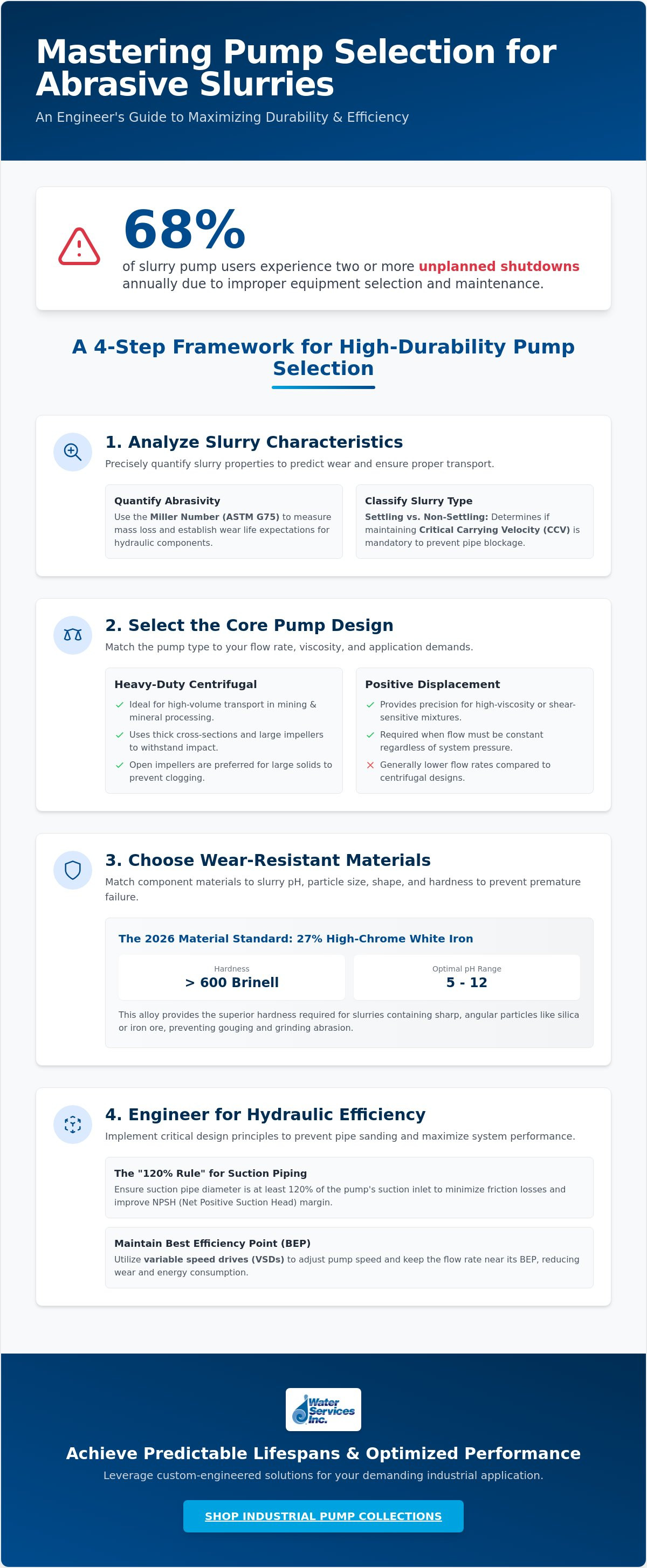
A 2026 survey indicates that 68% of slurry pump users experienced two or more unplanned shutdowns this year due to improper equipment selection and maintenance protocols. You likely recognize the operational strain caused by frequent impeller erosion and the high cost of replacement wear parts. Selecting the best pumps for abrasive slurries requires a precise balance between hydraulic efficiency and sacrificial material management to avoid seal failures and environmental compliance issues. It's a technical challenge where the wrong specification leads to immediate downtime and an inflated total cost of ownership.
This engineering guide provides the specific criteria required to master high-durability pump selection for demanding industrial environments. You'll learn why High-Chrome White Iron with a hardness exceeding 600 Brinell remains the 2026 material standard for slurries with a pH between 5 and 12. We also detail the "120% Rule" for suction piping design and how to utilize variable speed drives to maintain flow rates near the Best Efficiency Point. This overview ensures you can achieve predictable equipment lifespans and optimized performance across your mineral processing or industrial applications.
Key Takeaways
- Quantify slurry abrasivity using the Miller Number to establish precise wear life expectations for critical hydraulic components.
- Select the best pumps for abrasive slurries by analyzing the performance trade-offs between heavy-duty centrifugal models and positive displacement designs for high-viscosity applications.
- Optimize material selection by matching 27% high-chrome white iron alloys or elastomer liners to specific particle characteristics and fluid pH levels.
- Implement a selection framework that prioritizes Critical Carrying Velocity (CCV) and accurate head loss calculations to prevent pipe sanding and hydraulic inefficiency.
- Leverage custom-engineered solutions and global logistical capabilities for efficient equipment deployment in remote mining and wastewater treatment environments.
Understanding Abrasive Slurries: Wear Mechanisms and Classifications
An abrasive slurry is a mixture of insoluble solids, such as sand, grit, or mineral tailings, suspended within a carrier fluid. Identifying the specific characteristics of these solids is the first step in selecting the best pumps for abrasive slurries. Engineers must evaluate particle concentration, which can reach up to 70% by weight in heavy industrial applications. A standard Slurry pump is designed to handle these high solid concentrations by utilizing sacrificial wear parts and robust internal clearances.
To quantify abrasivity, the industry relies on the Miller Number, governed by ASTM G75-15(2021). This metric measures the relative abrasivity of a slurry by determining the mass loss of a standard metal wear block. A higher Miller Number indicates a more aggressive slurry, requiring harder materials like 27% high-chrome white iron. Ignoring this data makes predicting the lifespan of an impeller or liner impossible. Detailed technical specifications for high-durability hardware are available through professional industrial pump collections.
Mechanical wear often works in tandem with chemical degradation. Erosion removes the protective oxide layer from metal surfaces, exposing fresh material to corrosive agents in the carrier fluid. This synergy accelerates the thinning of pump casings. Particle size, shape, and hardness are critical variables; sharp, angular particles cause significantly more damage than rounded grains of the same material. Harder particles, such as silica or iron ore, require specific metallurgical choices to avoid premature failure.
Settling vs. Non-Settling Slurries
Slurries are classified by how solids behave during transport. Non-settling (homogeneous) slurries consist of very fine particles that remain in suspension, behaving like a high-viscosity fluid. Settling (heterogeneous) slurries contain larger particles that fall out of the carrier fluid if velocity drops. Maintaining a velocity above the Critical Carrying Velocity (CCV) is mandatory to prevent pipe blockage. High viscosity in non-settling mixtures often requires derating centrifugal pump performance curves to account for increased friction.
The Three Types of Abrasive Wear
Industrial slurry management involves three distinct wear mechanisms. Gouging abrasion occurs when large particles strike wetted parts under high pressure, creating deep grooves. Grinding abrasion, or high-stress abrasion, happens when particles are crushed between moving components, such as the impeller and suction liner. Erosion abrasion is a low-stress mechanism where a high-velocity fluid stream wears down surfaces over time. Understanding these modes allows engineers to select the best pumps for abrasive slurries based on the specific mechanical stresses of their application.
Core Pump Designs for Abrasive Handling: Centrifugal vs. Positive Displacement
Selecting the best pumps for abrasive slurries requires an evaluation of the required flow rate versus the physical properties of the fluid. Centrifugal designs are the primary choice for high-volume transport in mining and mineral processing. Conversely, positive displacement (PD) pumps provide necessary precision for shear-sensitive or extremely viscous mixtures. According to this Beginners Guide to slurry pumps, the choice often hinges on the concentration of solids and the total dynamic head required by the system.
Heavy-Duty Centrifugal Slurry Pumps
Centrifugal slurry pumps utilize large diameter impellers and thick cross-sections to withstand continuous abrasive impact. These units often feature adjustable wear plates to maintain hydraulic efficiency as the impeller erodes. Open impellers are typically preferred for large solids to prevent clogging, while closed impellers offer higher efficiency for finer slurries. In grit-heavy wastewater applications, Goulds Water Technology Pumps demonstrate reliability through reinforced casings and high-chrome internal components. These designs minimize the frequency of unplanned shutdowns in municipal and industrial treatment plants.
Positive Displacement: Diaphragm and Peristaltic Options
Air-operated double diaphragm (AODD) pumps are effective for abrasive chemicals and sludge where flow rates are moderate. These pumps handle solids up to the size of the ball valve ports without significant internal damage. Peristaltic or hose pumps are unique because they isolate the slurry from all pump internals except the hose. This design reduces maintenance when handling highly abrasive or shear-sensitive fluids. PD pumps do face limitations in large-scale operations. Flow rate constraints and pulsation issues often necessitate the use of dampeners or multiple units in parallel to meet industrial demands.
Configuration also impacts long-term reliability. Horizontal pumps are the industry standard for ease of maintenance and accessibility. Vertical configurations, or cantilever sump pumps, are utilized when space is limited or when the pump must be submerged to maintain suction. For complex installations, you can explore the full range of industrial slurry solutions to find the exact configuration for your specific sump depth and flow requirements.
Material Science in Slurry Pumping: Hard Metals and Elastomer Liners
The longevity of the best pumps for abrasive slurries depends on the metallurgical or elastomeric composition of the wetted parts. In 2026, high-chrome white iron (27% Cr) remains the industry standard for handling sharp, large-particle abrasion. This alloy provides a hardness exceeding 600 Brinell, which is essential for slurries with a pH between 5 and 12. Ni-Hard alloys offer an alternative for specific abrasive conditions, though they generally lack the impact resistance of high-chrome options. Engineers must match the material hardness to the Miller Number of the slurry to ensure predictable wear rates.
Selecting the Right Liner for the Particle
Selecting between metal and rubber liners requires an analysis of particle size and shape. A common engineering rule of thumb suggests using elastomer liners for particles smaller than 1/4 inch (6.35 mm). Natural rubber excels at resisting fine, round particles by absorbing the kinetic energy of the impact. However, elastomer performance degrades at temperatures exceeding 80°C. For particles larger than 1/4 inch, hard metal alloys are required to prevent the tearing and gouging that would destroy a rubber liner. Chemical compatibility also dictates material choice; acidic slurries with a pH below 2 often require specialized stainless steels or ceramic coatings to prevent accelerated corrosion.
Ceramic inserts provide the ultimate defense in critical wear zones, such as the throat bush or the suction liner. These materials resist high-velocity erosion better than any metallic alloy. While ceramic components increase the initial capital expenditure, they significantly reduce the Total Cost of Ownership (TCO). This reduction is achieved by extending the interval between major overhauls and decreasing the frequency of unplanned downtime. Balancing initial material cost with replacement frequency is the only way to optimize a slurry system's budget over a 10 year operational lifecycle.
Seal Technology: Mechanical vs. Expeller vs. Gland Packing
Seal selection is as critical as the liner material for maintaining operational uptime. Expeller seals, also known as dynamic seals, are preferred for remote mining sites because they operate without external flush water. This reduces infrastructure costs and eliminates the risk of product dilution. Mechanical seals represent a high-tech solution for applications requiring strict environmental containment. They prevent leaks that lead to compliance issues. Gland packing remains a traditional, low-cost option. It requires a constant supply of clean flush water and frequent manual adjustment, making it the most maintenance-intensive choice for modern industrial facilities. Professionals seeking reliable sealing and fluid movement hardware can find compatible options in the industrial pump selection.
Selection Framework: Sizing, Velocity, and NPSH for Slurries
Engineering the best pumps for abrasive slurries requires a multi-step framework that goes beyond simple flow and head calculations. The presence of solids fundamentally alters fluid dynamics, requiring specific adjustments to ensure system longevity. Engineers must follow a structured selection process to avoid the 300% increase in abrasive wear that occurs when a pump is oversized and operated far from its Best Efficiency Point (BEP). This process begins with determining the Critical Carrying Velocity (CCV) to keep solids in suspension without causing excessive pipe erosion.
- Step 1: Establish the CCV based on particle size and concentration to prevent pipe sanding.
- Step 2: Calculate Total Dynamic Head (TDH) including the higher friction losses inherent in slurry transport.
- Step 3: Apply derating factors to standard water performance curves based on the concentration of solids by volume (Cv).
- Step 4: Verify Net Positive Suction Head (NPSH) margins, accounting for the vapor pressure of the carrier fluid and site altitude.
- Step 5: Select a motor with sufficient horsepower and a safety margin of at least 15% to handle high startup torque from settled solids.
The Impact of Solids on Hydraulic Performance
Solids reduce the effective head and efficiency of a centrifugal pump because they do not participate in the pressure energy transfer within the impeller. This necessitates a derating process where standard water curves are adjusted for the specific slurry reality. As the concentration of solids by volume (Cv) increases, the pump's hydraulic efficiency and total head decrease proportionally due to the energy consumed by particle acceleration and increased internal friction. Failing to account for this drop leads to underperforming systems and premature motor failure.
NPSH and Cavitation in Slurry Systems
Slurry pumps are exceptionally susceptible to cavitation damage because collapsing vapor bubbles accelerate the erosion of already stressed metal surfaces. Proper suction piping design is the primary defense against this. Implementing the "120% Rule," where suction piping is at least one size larger than the pump's suction flange, minimizes friction and turbulence. Utilizing Ashcroft Pressure Gauges allows operators to monitor suction and discharge pressures in real-time to identify cavitation indicators. You can ensure your system operates within safe hydraulic limits by selecting the right instrumentation from our industrial pump and control collections.
Implementing Industrial Slurry Solutions with Water Services, Inc.
Successfully integrating the best pumps for abrasive slurries into a complex industrial process requires a comprehensive systems-engineering approach. Rather than treating the pump as an isolated component, it must be viewed as a critical link within the entire treatment train. Water Services, Inc. provides the technical expertise to design and implement mining wastewater treatment solutions that focus on engineering compliance and resource recovery. This ensures that the hydraulic performance established in the selection phase is maintained across the entire operational lifecycle, from the initial suction point to the final discharge or filtration stage.
Modular Slurry Management Systems
Modularity has become a standard requirement for 2026 industrial operations, particularly for temporary dredging projects or emergency wastewater needs. We design and assemble mobile, containerized treatment plants that feature pre-integrated Goulds Water Technology Pumps. These units arrive at the job site fully piped, wired, and tested. This pre-engineered approach significantly reduces on-site installation time and total engineering costs. When these pumps are integrated into larger Reverse Osmosis (RO) or ultrafiltration trains, the abrasive handling section acts as a primary defense, protecting sensitive downstream membranes from solid-related fouling and mechanical damage.
Procurement and Global Support
Industrial reliability depends on a stable supply chain and expert technical support. Our global logistical capabilities are designed for remote site deployment, supporting operations in specialized markets across Africa and South America. We understand the rigors of international transport and the necessity of getting high-durability hardware to remote locations efficiently. Professionals can access our full range of equipment and technical data through the Water Services Online Store, which serves as a centralized hub for procurement and specification gathering.
To minimize the risk of unplanned shutdowns, we maintain an extensive inventory of critical replacement parts, such as impellers, suction liners, and seals. Our services extend beyond direct sales to include technical consulting for the optimization of existing abrasive handling infrastructure. We conduct performance audits to identify hydraulic bottlenecks and recommend material upgrades that align with the specific Miller Number of your slurry. This commitment to technical integrity ensures that your selection of the best pumps for abrasive slurries results in a lower total cost of ownership and optimized flow rates for settling solids.
Optimizing Slurry Infrastructure for 2026 and Beyond
Predictable slurry management depends on the rigorous application of technical metrics like the Miller Number and ASTM G75-15 standards. You've learned that balancing hydraulic efficiency with sacrificial material management is the only way to minimize unplanned shutdowns. Implementing engineering best practices, such as the 120% rule for suction piping and precise Critical Carrying Velocity calculations, prevents the costly error of pump oversizing. Selecting the best pumps for abrasive slurries requires a commitment to these fundamentals to ensure a sustainable total cost of ownership and reliable fluid transport.
Water Services, Inc. serves as a dependable partner with global project experience across the mining and oil and gas sectors. As an authorized Goulds Water Technology distributor, we provide the technical integrity and logistical competence required for demanding industrial environments. Our Provo-based engineering and technical support team is available to assist with custom hardware specifications and modular system integration. Browse Heavy-Duty Goulds Slurry Pumps at Water Services, Inc. to find the exact hardware for your specific abrasive application. You can secure a stable and efficient operational future with the right equipment and engineering expertise.
Frequently Asked Questions
What is the most durable pump material for sand-laden slurries?
High-chrome white iron with a 27% chromium content is the most durable material for sand-laden slurries. This alloy provides a hardness rating exceeding 600 Brinell, which is necessary to resist the sharp, angular nature of silica sand. For finer particles, natural rubber liners offer superior resilience by absorbing impact energy. Selecting the best pumps for abrasive slurries requires matching these specific materials to the Miller Number of your application.
How do I calculate the critical carrying velocity for my slurry pipe?
Critical carrying velocity (CCV) is calculated by considering the particle size, solid concentration, and pipe diameter. Engineers often use the Durand equation to establish the minimum speed required to keep solids suspended in the carrier fluid. If the velocity drops below this threshold, solids will settle and cause pipe sanding or blockages. Maintaining a velocity slightly above the CCV ensures consistent hydraulic transport without causing excessive pipe wall erosion.
Can I use a standard centrifugal pump for abrasive slurries?
Standard centrifugal pumps aren't suitable for abrasive slurries and will experience rapid failure of the impeller and casing. These units lack the thick cross-sections and sacrificial wear parts required to withstand continuous solid impact. A dedicated slurry pump features reinforced housings and specialized metallurgy designed specifically for high-solids concentrations. Using standard water pumps in these environments leads to frequent unplanned shutdowns and high maintenance costs.
What is the difference between a slurry pump and a dredge pump?
The primary difference lies in the particle size handling and the specific application. Slurry pumps are typically used in mineral processing plants to transport mixtures with high solid concentrations. Dredge pumps are designed for excavation and must handle much larger solids, such as rocks and debris, often found on the seafloor or riverbeds. While both are heavy-duty, dredge pumps prioritize large internal clearances over the high hydraulic efficiency found in process slurry units. If your project involves offshore or riverbed work, you can learn more about BTR Marine Services LLC to find the appropriate vessels for your dredging fleet.
How often should I replace the impeller in an abrasive slurry application?
Impeller replacement frequency doesn't just depend on the material but how close the pump operates to its Best Efficiency Point. According to 2026 industry benchmarks, a properly selected pump should achieve a minimum of 8,000 hours of operation before requiring major wear part replacement. Operating a pump far from its design point can accelerate wear by as much as 300%. Regular monitoring of discharge pressure helps identify when internal clearances have widened.
Why does my slurry pump keep losing suction capability?
Loss of suction capability is frequently caused by cavitation or air entrainment within the slurry mixture. If the Net Positive Suction Head (NPSH) available isn't higher than the required amount, vapor bubbles form and collapse, damaging the impeller. Additionally, froth or air bubbles in the slurry can create air-binding in the pump volute. Ensuring the suction piping follows the 120% rule and minimizing turbulence helps maintain a stable prime and consistent performance.
Are vertical or horizontal pumps better for abrasive sumps?
Vertical cantilever pumps are generally better for abrasive sumps where space is limited and the pump must be submerged. These designs eliminate the need for submerged bearings or seals, which are common failure points in abrasive environments. Horizontal pumps are preferred for high-volume process applications because they offer easier maintenance access and higher pressure capabilities. It's often a choice based on the sump depth and the required discharge head for the installation.
What are the benefits of using a rubber-lined pump over a metal-lined one?
Rubber-lined pumps are superior for handling fine, round particles smaller than 1/4 inch. The elastomer material deforms under impact, absorbing the kinetic energy of the particles rather than eroding like hard metal. This makes them one of the best pumps for abrasive slurries involving fine tailings or chemicals. However, rubber liners are limited by temperature and aren't suitable for slurries exceeding 80°C or containing large, sharp-edged solids that could tear the lining.
0 comentarios