

Standard chlorination achieves virtually zero practical inactivation of Cryptosporidium oocysts at typical industrial concentrations, yet UV systems deliver 99.99% inactivation in seconds at a nominal dose of 22 to 40 mJ/cm2. For operators managing remote mining or oil and gas facilities, the logistical burden of transporting and storing hazardous chemicals is a constant risk. Understanding the benefits of UV treatment over chlorination is now a requirement for maintaining compliance with 2026 EPA Stage 2 Disinfection Byproducts rules. You've likely dealt with the rising costs of hazmat infrastructure and the strict OSHA Process Safety Management standards that govern chlorine gas storage.
This guide provides a professional comparison of physical sterilization versus chemical dosing to help you implement a safety-first disinfection strategy. We'll show you how shifting to UV technology reduces regulatory paperwork regarding hazardous materials and lowers long-term logistical overhead. This analysis covers the 30-year lifecycle Net Present Value of these systems, the impact of 2026 EPA Risk Management Program deadlines, and why Viqua UV systems are the industrial standard for high-flow, chemical-free pathogen control. You'll gain a clear understanding of the ROI for UV reactors and how to optimize your treatment train for maximum reliability.
Key Takeaways
- Learn how UV sterilization eliminates OSHA Process Safety Management (PSM) risks and EPA Risk Management Program (RMP) thresholds associated with chlorine gas storage.
- Evaluate the logistical benefits of UV treatment over chlorination, specifically the removal of hazardous material transport and recurring chemical procurement for remote sites.
- Compare the physical footprint and contact time requirements between 10-second UV reactor exposure and 45-minute chlorine contact basins.
- Identify critical pre-treatment parameters, including UV Transmittance (UVT) and turbidity limits, to ensure validated disinfection performance.
- Understand how modular Viqua UV Water Purification Systems integrate into containerized water treatment plants for scalable industrial deployment.
Industrial Disinfection Evolution: UV vs. Chlorination
Industrial water treatment is undergoing a fundamental shift. Traditional chemical dosing is being replaced by physical barriers to meet 2026 "Green Disinfection" ESG mandates. These mandates require facilities to reduce their hazardous chemical footprint and eliminate secondary pollution. One of the primary benefits of UV treatment over chlorination is its status as a physical process. UV systems utilize ultraviolet germicidal irradiation at a wavelength of 254nm to neutralize microorganisms. Unlike chlorination, which relies on chemical oxidation, UV is a point-of-entry solution that adds nothing to the water stream. UV adds no chemicals.
Understanding Physical vs. Chemical Disinfection
UV light works by penetrating the cell walls of pathogens and disrupting their DNA. This process prevents replication, effectively making the organism harmless without altering the water's pH, conductivity, or chemical composition. In contrast, chlorine is a reactive additive. It oxidizes organic matter but often leaves behind residual tastes and odors. For sensitive industrial processes, such as food and beverage production or high-purity manufacturing, maintaining the original water chemistry is essential. Physical treatment ensures that downstream equipment, like RO membranes, isn't exposed to oxidative damage from residual chlorine.
Pathogen Targets: Where Chlorine Falls Short
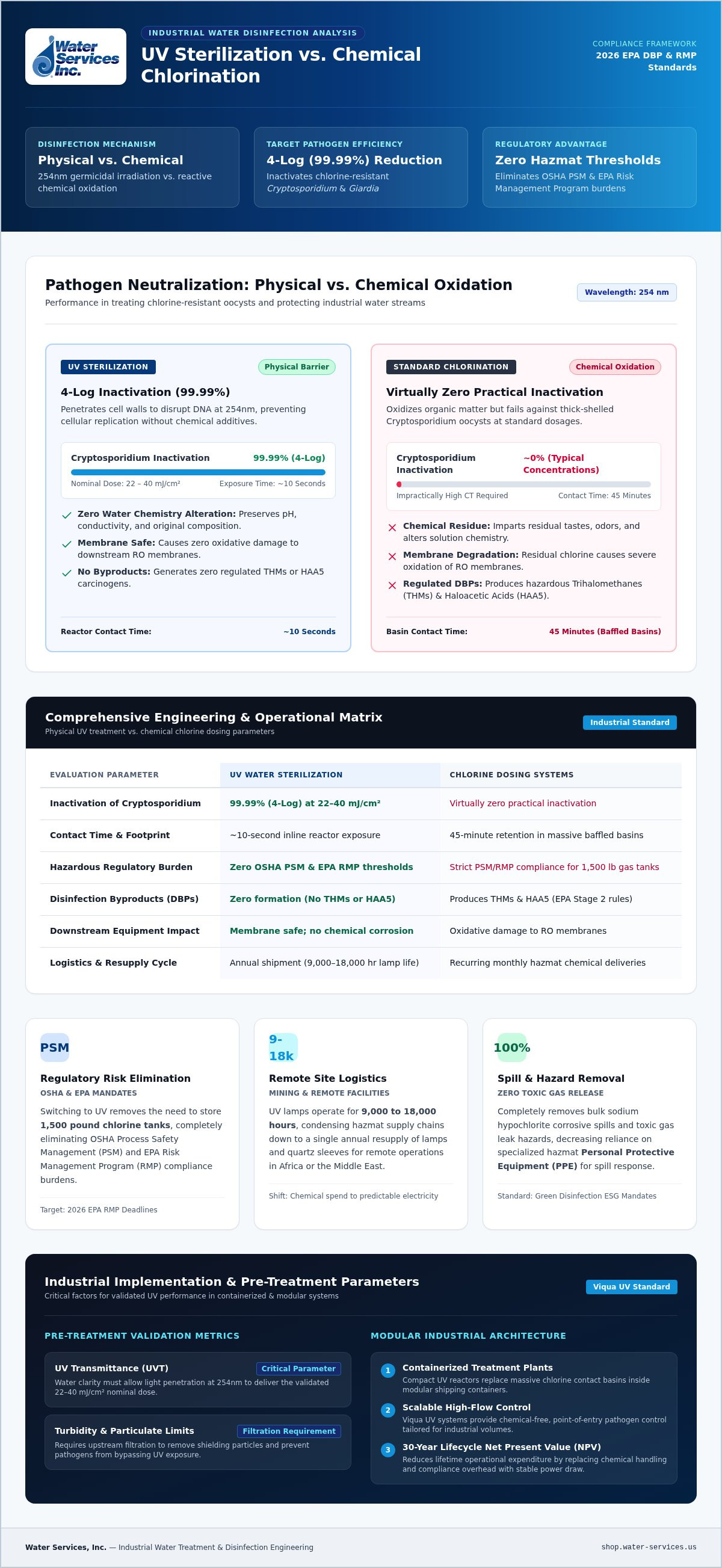
Standard chlorination is often ineffective against specific, resilient pathogens. Cryptosporidium and Giardia possess thick outer shells that resist chemical oxidation at standard contact times. To achieve 3-log (99.9%) inactivation of Cryptosporidium using chlorine, an impractically high concentration-time (CT) value is required. Chlorine requires time. UV systems solve this by delivering a lethal dose of radiation that bypasses these physical defenses. UV is the 2026 industrial standard for inactivating chlorine-resistant cysts because it achieves 4-log reduction in seconds.
Industrial compliance relies heavily on "log reduction" metrics. A 4-log reduction means 99.99% of pathogens are neutralized. Achieving this with UV requires far less space and infrastructure than the massive baffled contact tanks needed for chlorine. The benefits of UV treatment over chlorination become clear when evaluating the efficiency of a physical barrier versus a chemical reaction that depends on temperature, pH, and contact time.
Operational Safety and Logistical Advantages of UV
Chlorine gas and bulk sodium hypochlorite require specialized containment and rigorous transport protocols. One of the key benefits of UV treatment over chlorination is the total elimination of on-site chemical inventory. This shift removes the risk of toxic gas release or corrosive liquid spills. Facilities no longer need to manage 1,500 pound chlorine tanks that trigger OSHA Process Safety Management (PSM) standards. Instead, a compact UV reactor provides equivalent or superior disinfection in a fraction of the space. It's a cleaner approach to industrial safety.
Eliminating the Hazardous Chemical Supply Chain
For remote mining and military operations in regions like Africa or the Middle East, logistical reliability is paramount. Monthly chemical deliveries are prone to supply chain disruptions and high freight costs. UV lamps typically require replacement only once every 9,000 to 18,000 hours. This reduces the logistical footprint to a single annual shipment of lamps and quartz sleeves. Reducing chemical handling also decreases the reliance on specialized PPE required for emergency spill response. The operational cost shifts from recurring chemical purchases to predictable electricity consumption.
Reducing Regulatory and Compliance Overhead
Chemical disinfection often produces harmful Disinfection Byproducts (DBPs), such as Trihalomethanes (THMs) and Haloacetic Acids (HAA5). These are strictly regulated under EPA Surface Water Treatment Rules. UV treatment is a physical process that doesn't create these carcinogens. This simplifies reporting and eliminates the need for complex DBP monitoring programs. Modern systems utilize Walchem Controllers to automate dosage monitoring and provide real-time data logging for compliance audits. Automated controls ensure the system maintains the required UV dose without manual titration or chemical testing.
The benefits of UV treatment over chlorination extend to the physical plant design. A UV reactor is an inline component that installs directly into existing piping. It eliminates the need for large, baffled contact tanks that require 15 to 45 minutes of hydraulic retention time. For engineers designing space-constrained systems, integrating Viqua UV Water Purification Systems provides a compact, high-efficiency alternative to traditional chemical basins. This setup streamlines the entire treatment train.
UV vs. Chlorination: Industrial Comparison Matrix
Industrial operators must weigh the technical trade-offs between physical and chemical systems. One of the clearest benefits of UV treatment over chlorination is the reduction in contact time. While chlorine requires 15 to 45 minutes of hydraulic retention in massive baffled tanks, UV achieves complete inactivation in 1 to 10 seconds. This disparity dictates the entire facility layout. Physical footprint and byproduct management are the primary drivers of this comparison. Decision-makers must also consider the long-term implications of chemical disinfection and byproduct risks, which can lead to strict regulatory oversight and expensive mitigation strategies.
The Contact Time (CT) Factor in Industrial Scaling
Instantaneous disinfection enables the use of compact, modular systems. This is especially critical for mobile or containerized units where space is at a premium. Unlike chlorination, which relies on stagnant retention basins, inline UV reactors maintain high flow rates with minimal head loss. This efficiency directly impacts the selection of Goulds Water Technology Pumps. High-performance pumps operate more reliably when the disinfection stage doesn't introduce massive hydraulic resistance or require large-volume storage. In high-flow process water applications, the ability to treat water in a single pass without a 30-minute delay improves overall system throughput.
Total Cost of Ownership (TCO) Analysis
A comprehensive TCO evaluation reveals that the initial capital expenditure for UV hardware is often offset by the elimination of civil engineering costs. Building large concrete contact tanks for chlorination is a significant CAPEX burden that is often overlooked. When analyzing long-term operational expenditure, the benefits of UV treatment over chlorination become even more pronounced. Recurring costs for Viqua UV systems are limited to electricity and annual lamp replacements. These systems often feature energy-adaptive technology that dims lamps during low-flow periods, further reducing utility costs.
Conversely, chlorination involves the escalating price of bulk chemicals, safety equipment maintenance, and the recurring costs of environmental compliance audits. While chlorine provides a residual effect that protects downstream piping from biofilm, this benefit is frequently outweighed by the complexity of managing chemical supply chains in remote environments. Over a 30-year lifecycle, UV offers a predictable cost structure that avoids the volatility of chemical markets.
- Contact Time: UV (1-10 seconds) vs. Chlorine (15-45 minutes).
- Footprint: UV (Compact inline reactor) vs. Chlorine (Extensive baffled infrastructure).
- Byproduct Formation: UV (Zero regulated DBPs) vs. Chlorine (High levels of THMs and HAAs).
- Residual Effect: UV (None) vs. Chlorine (Present).
Implementation Constraints: When UV Requires Pre-Treatment
UV disinfection is a precision process. Its effectiveness depends entirely on the ability of UVC light to reach the target pathogen's DNA. While one of the major benefits of UV treatment over chlorination is the lack of chemical additives, UV systems are more sensitive to feed water quality. High levels of suspended solids or dissolved minerals can interfere with the light path. This makes a well-designed pre-treatment train essential for industrial reliability. You can explore the latest equipment configurations in our Industrial Water Filtration Systems guide. Proper filtration ensures the system meets its validated dose.
The Role of UVT and Turbidity
UV Transmissivity (UVT) measures the percentage of light that passes through a water sample. For most industrial applications, a UVT of 95% or higher is the target for maximum efficiency. If the water is cloudy or has high turbidity, the light is scattered or absorbed before it can neutralize microbes. This leads to disinfection failure regardless of lamp intensity. Total Suspended Solids (TSS) directly impede UV efficacy by providing physical cover for pathogens, a phenomenon known as shadowing. Pre-treatment must reduce turbidity to below 1.0 NTU to prevent these blind spots in the sterilization chamber.
Synergy with Reverse Osmosis and Multi-Media Filters
Commercial Reverse Osmosis Systems serve as the ideal pre-treatment stage for UV reactors. RO membranes remove the dissolved solids and minerals that cause quartz sleeve scaling. By integrating UV downstream of Multimedia Filter Tanks, you ensure that large particulates are removed before they reach the sterilization chamber. This synergy also works in reverse. Installing UV upstream of FilmTec or Hydranautics membranes helps prevent biofouling on the membrane surface, extending the life of these expensive components. It's a dual-barrier approach that protects both the disinfection process and the filtration hardware.
Hardness and mineral content also dictate maintenance intervals. Calcium and magnesium can bake onto the quartz sleeve, creating a physical barrier that blocks UVC light. Regular maintenance and the use of antiscalants are required to keep the sleeve clear. Without clear quartz, the benefits of UV treatment over chlorination are lost to fouling. Industrial operators must monitor these parameters to ensure continuous compliance and performance. To optimize your treatment train, browse our selection of industrial water treatment components.
Selecting Industrial UV Solutions: The Viqua Standard
Industrial water treatment requires hardware that can withstand harsh environments while maintaining precise disinfection dosages. Viqua UV Water Purification Systems are the primary choice for high-flow applications, supporting operational flow rates from 10 gpm to 290 gpm per reactor. These systems utilize high-efficiency amalgam lamps that operate for up to 18,000 hours before replacement is required. This technical longevity is one of the distinct benefits of UV treatment over chlorination, where chemical inventory must be replenished monthly. Viqua reactors use 316L stainless steel chambers to ensure durability in corrosive industrial settings.
Scalability for Mining and Remote Sites
Mining operations often face fluctuating flow rates and unstable power grids. Viqua systems utilize ruggedized ballast designs that protect against voltage swings common in remote African or South American sites. To handle high-flow mining wastewater, engineers deploy parallel UV reactor configurations. This modularity allows for maintenance on one unit while the others remain operational, preventing total system downtime. These reactors are critical components in Mobile Water Treatment Units designed for rapid deployment in emergency military or temporary industrial settings. Modular scaling ensures that the disinfection barrier grows with the facility's needs.
Maintenance and Long-Term Reliability
Continuous disinfection is ensured through integrated UV sensors and diagnostic controls. These sensors monitor lamp intensity in real-time, triggering automated alerts when output falls below validated thresholds. While standard low-pressure lamps require replacement at 9,000 hours, the Viqua Pro series amalgam lamps provide a two-year service life. To maintain peak performance, quartz sleeves must remain free of mineral scale. Operators can use manual or automatic wipers to clean sleeves without shutting down the water flow. For specialized cleaning solutions, consult a Water Treatment Chemicals Distributor to find compatible antiscalants and citric acid cleaners that prevent quartz fouling.
Selecting the right hardware ensures the logistical benefits of UV treatment over chlorination are fully realized. By prioritizing industrial-grade sensors and modular designs, facilities reduce compliance risks associated with chemical handling. Real-time monitoring and automated fail-safes provide a level of reliability that manual chemical titration cannot match. This technical approach secures the water supply while lowering the overall logistical overhead for the facility.
Optimizing Your Industrial Disinfection Strategy for 2026
The transition from chemical-based disinfection to physical sterilization is a strategic move for industrial operators. By eliminating the safety risks and regulatory burdens of chlorine gas and bulk bleach, facilities can focus on operational efficiency. The benefits of UV treatment over chlorination include a smaller physical footprint, zero disinfection byproducts, and significantly reduced logistical overhead for remote sites. These systems offer a predictable ROI through lower maintenance cycles and simplified compliance reporting.
Water Services, Inc. has provided global deployment expertise for specialized water systems since 1994. As an authorized distributor for Viqua, Goulds, and FilmTec, we specialize in designing modular and containerized industrial systems for the most demanding environments. We provide the technical integrity required for mining, military, and oil and gas sectors. Browse Professional Viqua UV Systems and Industrial Water Treatment Components to secure your facility's future. Investing in reliable UV technology is a decisive step toward a safer and more efficient operation; it's the standard for modern industrial water security.
Frequently Asked Questions
Does UV treatment provide a residual disinfectant like chlorine?
UV treatment doesn't provide a residual disinfectant. It's a physical process that occurs strictly within the reactor chamber. Unlike chlorine, which remains in the water to protect distribution piping, UV only neutralizes pathogens at the point of exposure. If your facility uses long pipe networks or open storage tanks, you might require a secondary residual barrier or localized point-of-use UV systems to prevent biofilm growth downstream.
What is the minimum UV Transmissivity (UVT) required for industrial disinfection?
Industrial systems typically require a minimum UV Transmissivity of 75% to 85% for standard operation. However, a UVT of 95% or higher is the target for maximum efficiency and reduced power consumption. When water clarity drops, the light is absorbed by organic matter before it reaches the pathogens. This is one of the key implementation constraints when evaluating the benefits of UV treatment over chlorination in turbid water environments.
Can UV treatment kill Cryptosporidium and Giardia?
Yes, UV is highly effective against Cryptosporidium and Giardia. These specific pathogens are resistant to standard chemical oxidation because of their thick outer shells. While chlorine requires hours of contact time at high concentrations, UV inactivates 99.99% of these cysts in seconds at a nominal dose of 22 mJ/cm2. This makes UV the 2026 industrial standard for managing chlorine-resistant organisms in surface water supplies.
How often do industrial UV lamps need to be replaced?
Industrial-grade UV lamps require replacement based on their rated service life. Standard low-pressure lamps are rated for 9,000 hours, which is approximately one year of continuous operation. High-efficiency amalgam lamps, such as those found in Viqua Pro series systems, are rated for 18,000 hours or two years. Using integrated sensors and Walchem controllers allows operators to track lamp intensity and receive automated alerts before the disinfection barrier reaches its end of life.
Does UV treatment change the taste or pH of industrial process water?
UV treatment doesn't alter the taste, odor, or pH of industrial process water. Because it's a physical process using light radiation, no chemical additives are introduced to the stream. This is a significant advantage for food, beverage, and high-purity manufacturing sectors where water chemistry must remain consistent. Unlike chlorination, which can lower pH and leave behind a distinct chemical taste, UV maintains the original profile of the treated water.
Is UV more expensive than chlorination for large-scale mining sites?
While the initial capital cost for UV hardware is often higher than simple chemical dosing pumps, the total lifecycle cost for mining sites is usually lower. UV eliminates the recurring expense of hazardous material transport, specialized safety training, and chemical storage scrubbers. When you factor in the reduced regulatory burden and lower logistical overhead for remote operations, the long-term benefits of UV treatment over chlorination provide a superior return on investment.
What pre-treatment is required before a Viqua UV system?
Effective UV disinfection requires a multi-stage pre-treatment train to protect the quartz sleeves and ensure light penetration. Standard requirements include sediment filtration down to 5 microns to prevent shadowing of pathogens. Additionally, feed water must have iron levels below 0.3 mg/L and hardness below 7 gpg to prevent mineral scaling. Integrating multimedia filter tanks and water softeners upstream of the Viqua UV system ensures the reactor maintains its validated disinfection dose.
Can UV be used for wastewater disinfection before environmental discharge?
Yes, UV is increasingly used for wastewater disinfection before environmental discharge. It's preferred for facilities discharging effluent into sensitive aquatic ecosystems because it doesn't leave toxic chemical residuals. Using UV avoids the need for secondary dechlorination stages, such as sodium bisulfite dosing, which simplifies the treatment process. This approach helps industrial sites meet strict 2026 discharge permits while protecting local waterways from secondary chemical pollution.
0 comentarios