

Did you know that arsenic-bearing concentrates can trigger smelter penalties that reduce your concentrate value by as much as $150 per tonne? For mining operators, managing arsenic isn't just a regulatory hurdle; it's a direct threat to the bottom line. You're likely dealing with the pressure of strict international discharge limits and the frequent failure of systems in remote, high-TDS environments. Mastering arsenic removal from mine water requires a shift from simple chemical dosing to integrated, high-efficiency remediation strategies.
This 2026 industrial guide provides the technical framework to achieve sub-ppb discharge levels while maintaining operational uptime. You'll learn how to select specific equipment, including FilmTec or Hydranautics RO membranes and Pulsafeeder metering pumps, to handle complex influent chemistry. We'll analyze the critical role of pre-oxidation, the selection of high-rejection filtration media, and the implementation of scalable architectures that reduce long-term consumable costs.
Key Takeaways
- Identify the critical chemical differences between Arsenic(III) and Arsenic(V) and implement pre-oxidation to ensure high-efficiency remediation.
- Optimize bulk arsenic reduction through precise chemical precipitation and the deployment of multimedia filter tanks for effective solids capture.
- Evaluate high-rejection FilmTec and Hydranautics RO membranes for arsenic removal from mine water to consistently achieve sub-10 ppb discharge targets.
- Develop site-specific system designs by calculating hydraulic loading rates that account for extreme seasonal runoff variations in remote environments.
- Assess the logistical advantages of containerized RO plants and mobile ultrafiltration systems for rapid, scalable deployment across diverse global mining climates.
Understanding Arsenic Speciation in Mine-Influenced Water
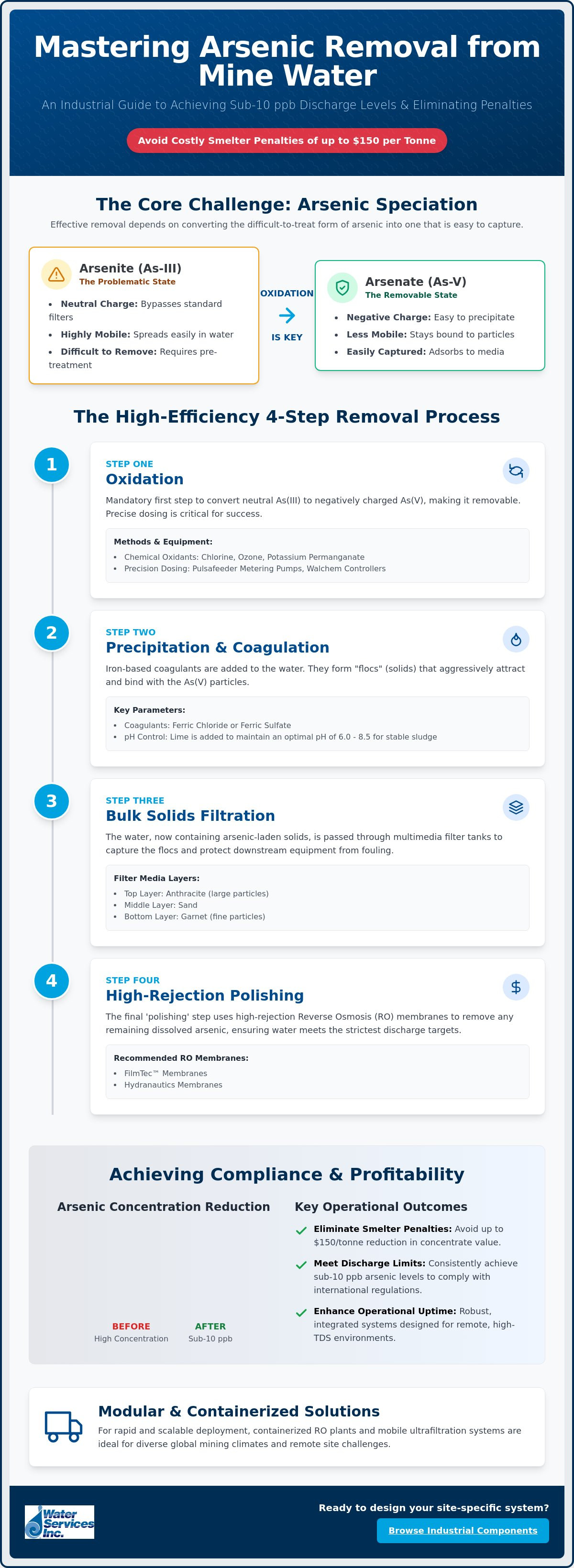
Effective arsenic removal from mine water begins with a precise understanding of speciation. Arsenic exists primarily in two inorganic forms: arsenite [As(III)] and arsenate [As(V)]. In anaerobic environments like deep underground shafts or tailing ponds, As(III) is the dominant species. Once exposed to oxygen or chemical oxidants, it converts to As(V). This shift is critical because As(III) is significantly more mobile and harder to sequester than As(V). Managing these chemical states is the difference between meeting strict discharge limits and facing regulatory penalties.
Oxidation is the mandatory first step for any high-efficiency remediation system. Trivalent arsenic lacks the ionic charge necessary for standard precipitation or adsorption. Proper management involves monitoring the Redox potential (Eh) and pH levels. For example, Arsenic contamination of groundwater often involves complex interactions with iron and sulfur minerals. When mine runoff is acidic, iron and aluminum salts can naturally assist in trapping arsenic; however, high-pH environments require aggressive chemical intervention to force the conversion to a removable state.
You must also identify co-contaminants like selenium, antimony, and iron. While iron often acts as a beneficial scavenger through coprecipitation, selenium competes for the same adsorption sites on media. This competition reduces the overall efficiency of your water treatment hardware. Accurate bench-scale testing is necessary to determine the impact of these interfering ions on your specific site chemistry.
The Challenge of Arsenite (As-III) Removal
Neutral-charged arsenite remains stable at pH levels below 9.0. It bypasses most multimedia filters and standard membranes without pre-treatment. To address this, operators use chemical oxidation via chlorine, ozone, or potassium permanganate. Under 2026 industrial protocols, complete pre-oxidation of trivalent arsenic to its pentavalent state is required to ensure effluent concentrations remain below the 10 µg/L threshold. Precise dosing is achieved through Walchem controllers and Pulsafeeder metering pumps to maintain the required stoichiometric ratios.
Arsenate (As-V) and Adsorption Mechanics
Once oxidized, arsenate carries a negative charge. This allows it to bond with positively charged metal hydroxides. In acidic mine drainage, iron and aluminum salts create effective flocs that trap As(V) through coprecipitation. Optimizing contact time within the reactor tank is essential for success. Brief contact leads to arsenic breakthrough; sufficient residence time allows for maximum adsorption efficiency before the water reaches the final arsenic removal from mine water filtration stage.
Pretreatment Strategies: Chemical Precipitation and Coagulation
Achieving bulk arsenic removal from mine water typically relies on iron-based precipitation. This process is the most cost-effective method for handling the high flow rates and high-volume solids characteristic of mining lagoons. By adding ferric chloride or ferric sulfate, you create ferric hydroxide flocs that aggressively adsorb pentavalent arsenic. For this to work, the water must be fully oxidized, as discussed in the previous section. According to the Society for Mining, Metallurgy & Exploration regarding arsenic control technologies in mining, maintaining a precise pH range is vital for sludge stability. Lime is often paired with ferric salts to reach an optimal pH of 6.0 to 8.5, ensuring the arsenic remains bound within the mineral matrix and doesn't leach back into the environment during storage.
Managing the resulting sludge requires a robust filtration stage. Multimedia filter tanks are used to capture precipitated solids that don't settle in primary clarifiers. These tanks use layers of anthracite, sand, and garnet to trap fine flocs, protecting downstream equipment from fouling. To maintain system health, operators monitor differential pressure using Ashcroft pressure gauges and adjust backwash cycles accordingly. This prevents solids breakthrough in remote lagoons where manual oversight is limited. For sites requiring precise chemical management, you can browse industrial dosing components to ensure long-term system reliability.
Precision Dosing with Pulsafeeder Systems
Inconsistent chemical delivery is a primary cause of treatment failure in complex mining environments. Integrating Pulsafeeder metering pumps ensures that coagulants and pH adjusters are delivered at exact stoichiometric ratios. When these pumps are paired with Walchem controllers and Signet flow sensors, the system can perform real-time proportional dosing. This automation accounts for fluctuations in seasonal runoff volumes, reducing chemical waste and preventing the over-dosing of expensive consumables.
Flocculation and Sedimentation Hardware
Successful solids separation depends on selecting the right coagulants for your specific mine water mineralogy. Once flocs are formed, clarifiers and thickeners perform the heavy lifting of primary separation. Maintaining consistent throughput during this stage requires high-efficiency Goulds Water Technology pumps designed for abrasive slurries. These pumps move the thickened sludge to dewatering units or storage ponds, ensuring the integrated arsenic removal from mine water strategy remains scalable and operational despite extreme climate conditions.
Membrane Filtration vs. Traditional Adsorption Media
Polishing effluent to meet sub-10 ppb targets requires a choice between membrane separation and specialized adsorption media. While pretreatment stages handle bulk solids, the final arsenic removal from mine water stage addresses dissolved species. Reverse Osmosis (RO) stands as the most reliable technology for achieving ultra-low concentrations. It provides a physical barrier that rejects up to 99% of dissolved arsenic when operating under optimal flux and pressure. However, the high-sulfate content found in many mining environments can lead to rapid gypsum scaling, necessitating the use of specialized antiscalants and frequent cleaning cycles to maintain performance.
Total Cost of Ownership (TCO) is the primary metric for selecting between these technologies. Adsorption media, such as Granular Ferric Oxide (GFO), offers lower initial capital expenditure but carries high operational costs due to media exhaustion and disposal requirements. In contrast, membrane systems involve higher upfront investment in high-pressure pumps and housings but offer scalable throughput with lower consumable waste. For remote sites with limited logistical access, reducing the frequency of media replacement often justifies the shift toward membrane-based architectures.
High-Rejection RO with FilmTec and Hydranautics
Deploying FilmTec Reverse Osmosis membranes allows operators to reach stringent environmental discharge limits with high reliability. These membranes are engineered for high rejection of inorganic ions, making them ideal for complex mine runoff. For applications involving high-TDS mine water, Hydranautics RO membranes provide specialized spacers that minimize pressure drop and improve cleaning efficiency. Maintaining precise membrane flux rates is essential in mining water reuse to balance permeate quality with the energy requirements of high-pressure feed systems.
Adsorption Media and Ion Exchange
Granular Ferric Oxide (GFO) and activated alumina remain viable for low-flow, high-concentration runoff where the footprint for a full RO plant is unavailable. GFO typically outperforms alumina in neutral pH ranges and doesn't require the same level of pH adjustment. Ion exchange (IX) resins offer a targeted solution for specific ionic loads but face challenges in mining contexts due to resin fouling from organics or competing ions like sulfates. Selecting the right media depends on the specific breakthrough curves observed during bench-scale testing. When media reaches capacity, it must be replaced or regenerated, creating a logistical requirement for waste management that membrane systems largely avoid through continuous brine rejection.
Designing a Site-Specific Arsenic Removal System
Designing a high-performance system for arsenic removal from mine water requires a shift from generic templates to site-specific engineering. Bench-scale testing serves as the foundation for this process. By analyzing the unique ionic balance of your influent water, you can determine the precise stoichiometric requirements for chemical dosing. You must also calculate hydraulic loading rates that account for seasonal runoff variations. In many mining environments, spring snowmelt or tropical rain events can double the influent volume, potentially overwhelming undersized systems and leading to regulatory bypass incidents.
Reliable fluid movement is the backbone of any treatment architecture. Integrating Goulds Water Technology Pumps ensures that the system can handle the high-head requirements and abrasive solids typical of mine runoff. These pumps are engineered for durability in demanding industrial conditions, reducing the risk of mechanical failure. Because handling arsenic-laden sludge and concentrated oxidants presents significant health risks, equipping personnel with the correct personal protective equipment (PPE) is a non-negotiable safety requirement for every site.
Pilot Testing and Data Validation
Pilot testing validates the optimal oxidation-precipitation-filtration sequence before you commit to full-scale capital expenditure. This stage allows you to assess the impact of temperature on arsenic removal kinetics. Cold water environments often slow down chemical reactions, requiring longer residence times in reactor tanks to achieve the same effluent quality. You'll use this data to validate that the treated water consistently meets local regulatory benchmarks under all operating conditions. This empirical approach eliminates guesswork and ensures the final system is both compliant and cost-effective.
System Redundancy and Maintenance
Operational uptime is critical in remote mining locations where technical support is hours or days away. Planning for redundancy involves more than just having spare parts; it requires an integrated monitoring strategy. Use Ashcroft pressure gauges and Signet flow sensors to track system health in real time. These instruments provide early warning signs of membrane fouling or pump wear. Training on-site staff for routine membrane cleaning and chemical handling is equally vital. Well-trained operators can perform preventative maintenance that extends the life of your equipment and prevents costly emergency shutdowns. For reliable performance in extreme environments, shop industrial water treatment equipment designed for the rigors of the mining industry.
Modular and Containerized Solutions for Global Mining
Deploying a permanent treatment facility in remote mining regions often presents prohibitive civil engineering costs and logistical delays. Containerized Reverse Osmosis Plants and modular treatment skids offer a "plug-and-play" alternative that streamlines arsenic removal from mine water. By shifting the assembly and testing phases to a controlled factory environment, operators ensure that every component, from high-pressure pump manifolds to chemical dosing stations, meets exact specifications before arriving on site. This approach reduces the need for specialized on-site labor and minimizes the environmental footprint of the treatment infrastructure.
Engineering these units for extreme climates is a core requirement for global mining operations. Systems destined for the high-altitude Andes require de-rated electrical components and specialized insulation to account for lower atmospheric pressure and freezing temperatures. Conversely, units operating in African heat require industrial-grade HVAC systems to protect sensitive electronics and prevent chemical degradation within storage tanks. Standardized shipping container dimensions allow for seamless international transport via rail, sea, and heavy-duty truck, ensuring rapid commissioning even in the most isolated geographies.
Water Services, Inc. Engineering Capabilities
We specialize in the custom design of containerized systems tailored to the specific ionic profile and climatic conditions of your site. Our engineering team integrates advanced electric power controls to enable autonomous operation, which is essential for remote sites with limited technical staff. These systems include real-time data logging and remote monitoring capabilities to track arsenic rejection rates and membrane health. In high-altitude remediation projects, our modular designs have successfully maintained discharge compliance while operating under fluctuating hydraulic loads and extreme thermal cycles.
Rental vs. Purchase for Temporary Operations
Choosing between capital purchase and mobile treatment rentals depends on the project lifecycle. Short-term remediation needs, such as pit dewatering or emergency spill response, are best served by mobile ultrafiltration or RO rentals. These units provide immediate arsenic removal from mine water without the lead times associated with permanent construction. For permanent installations, long-term leasing options provide a way to manage capital intensity while ensuring access to the latest treatment technologies. For a broader perspective on regulatory adherence and resource recovery, read our guide on Mining Wastewater Treatment Solutions.
Optimizing Industrial Compliance and Operational Efficiency
Mastering arsenic removal from mine water in 2026 requires an integrated approach that balances chemical speciation with advanced mechanical filtration. Success depends on complete pre-oxidation of arsenite and the precise dosing of coagulants to stabilize sludges before they reach the final polishing stage. By transitioning to high-rejection FilmTec or Hydranautics membranes, your operation can achieve the sub-ppb effluent targets required by modern environmental standards while minimizing the logistical burden and high consumable costs of traditional media replacement.
Efficiency in remote mining environments is best achieved through modular, containerized architectures that reduce civil engineering costs and deployment timelines. Water Services, Inc. brings over 30 years of global industrial water experience to every project, specializing in robust, factory-tested solutions for the most demanding climates. As an authorized distributor for Goulds Water Technology, FilmTec, and Viqua, we provide the technical expertise and hardware required to maintain operational uptime and strict regulatory standing.
Consult with our Engineers for a Custom Arsenic Removal System today to secure your site's future. Reliable, high-efficiency remediation is within reach.
Frequently Asked Questions
What is the most effective technology for arsenic removal in mining?
An integrated system using chemical oxidation followed by high-rejection reverse osmosis is the most effective for achieving sub-ppb levels. While adsorption media works for low-flow sites, membranes provide a more scalable and reliable physical barrier. This combination ensures consistent arsenic removal from mine water even when influent concentrations fluctuate due to seasonal runoff or varying ore grades.
How do you convert Arsenic(III) to Arsenic(V) for easier removal?
You convert Arsenic(III) to Arsenic(V) by adding chemical oxidants such as chlorine, ozone, or potassium permanganate. This step is mandatory because trivalent arsenic is neutrally charged and resists standard precipitation. Once oxidized to pentavalent arsenic, the contaminant carries a negative charge, allowing it to bond with iron-based coagulants or be rejected by RO membranes.
Can reverse osmosis remove arsenic from high-TDS mine water?
Reverse osmosis effectively removes arsenic from high-TDS environments when paired with specialized high-rejection membranes. Products from FilmTec and Hydranautics are engineered to handle high osmotic pressures. To maintain performance, you must use industrial antiscalants to prevent gypsum and sulfate scaling, which is a common failure point in concentrated mine runoff.
What are the EPA discharge limits for arsenic in mine effluent for 2026?
EPA discharge limits for mining operations are governed by 40 CFR Parts 436 and 440, though specific numerical requirements are often determined at the state level via NPDES permits. Most modern mining operations target the WHO provisional guideline of 0.01 mg/L (10 µg/L) to ensure global compliance. Meeting these strict 2026 standards requires high-efficiency treatment architectures.
How does iron concentration affect the arsenic removal process?
Iron acts as a natural scavenger that improves removal efficiency through coprecipitation. When iron is present in sufficient concentrations, it forms ferric hydroxide flocs that adsorb dissolved arsenate. If your mine water is iron-deficient, you must supplement it with ferric chloride or ferric sulfate to facilitate bulk solids separation during the pretreatment stage.
What is the typical lifespan of RO membranes in a mining environment?
RO membranes in mining typically last between 2 and 5 years. This lifespan depends heavily on the quality of your pretreatment and the frequency of Clean-In-Place (CIP) cycles. Using multimedia filter tanks and high-quality sediment filters protects the membranes from abrasive solids, while industrial antiscalants prevent the irreversible scaling that often plagues remote arsenic removal from mine water systems.
Is it better to rent or buy a mobile arsenic treatment system?
Rental is the superior choice for short-term remediation tasks like emergency pit dewatering or temporary site stabilization. It allows for rapid deployment without large capital expenditures. For active, long-term mining operations, purchasing a containerized plant or entering a long-term lease provides better cost-per-gallon efficiency and allows for deeper integration with site power and control systems.
What safety precautions are required for handling arsenic-laden sludge?
Handling arsenic-laden sludge requires strict adherence to industrial safety protocols and the use of specialized PPE. Personnel must use chemical-resistant suits, gloves, and respiratory protection to prevent dermal contact or inhalation of dried particulates. Because this sludge contains concentrated toxins, it must be stabilized through pH adjustment and disposed of in accordance with hazardous waste regulations.
0 comentarios