

What if a material rated “excellent” on a chemical compatibility chart still fails in your dosing application? A chemical compatibility chart for metering pumps can narrow your options, but its rating is not final approval. Concentration, temperature, exposure, and the specific wetted components all affect whether a material is suitable.
Charts can be difficult to interpret on their own. Manufacturers may use different test conditions and rating scales, and a mismatch in the pump head, diaphragm, seals, gaskets, or check valves can lead to leakage, premature wear, or dosing interruptions.
This guide explains how to compare common materials, including PVC, polypropylene, PVDF, PTFE, stainless steel, and elastomers, and build a shortlist for further evaluation. You’ll learn what to record from the chemical’s Safety Data Sheet and current pump documentation, including concentration, operating temperature, and the materials in the specific pump configuration. Then you can connect compatibility screening to the wider metering pump selection process, including dosing requirements and Pulsafeeder options for water-treatment applications.
Key Takeaways
- Use a chemical compatibility chart for metering pumps to screen candidate materials, not to approve a complete pump configuration.
- Record the chemical’s exact concentration, operating temperature, pressure, and exposure conditions before interpreting a chart rating.
- Check every wetted component, including the pump head, diaphragm, seals, gaskets, and check valves.
- Compare ratings with current manufacturer documentation and record the source and conditions behind each rating.
- Use compatibility findings as one part of pump selection, alongside capacity, pressure, controls, and installation requirements.
What a Chemical Compatibility Chart for Metering Pumps Can, and Cannot, Tell You
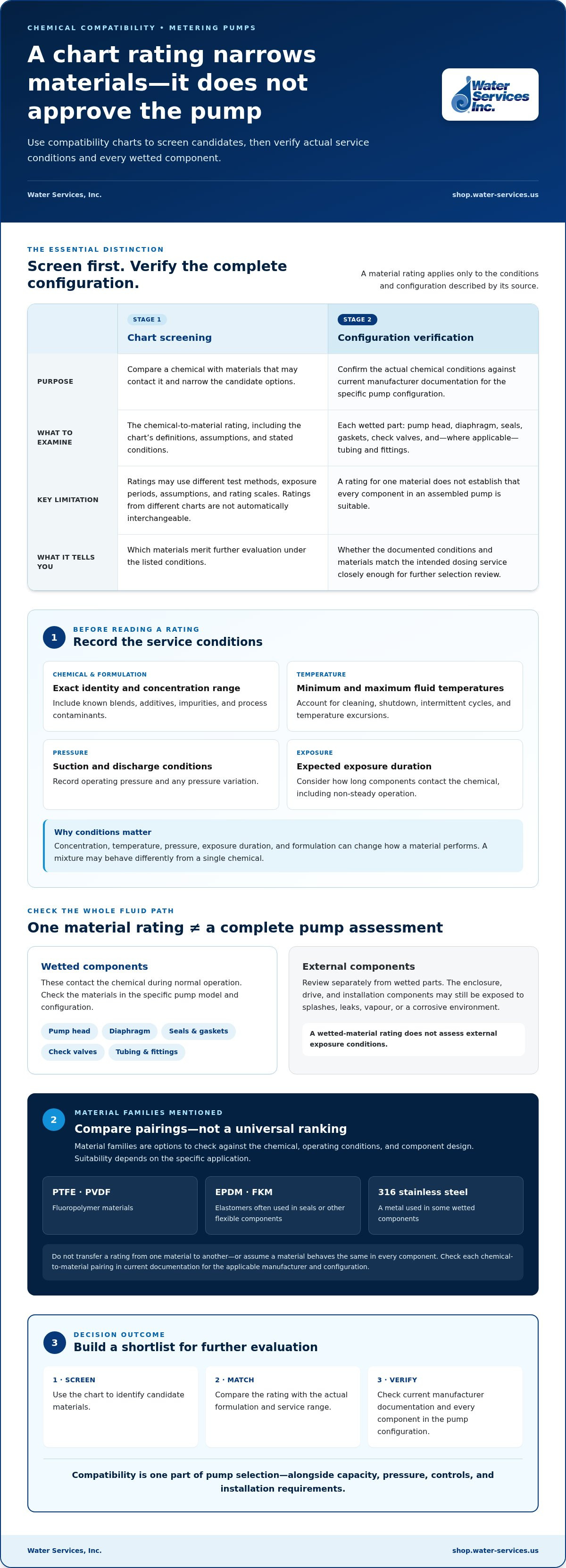
A chemical compatibility chart for metering pumps is a starting point for comparing a fluid with materials that may contact it. It helps screen potential options, but each rating applies only to the conditions and configuration described by its source. It does not approve every pump made with a listed material.
A chemical compatibility chart is a screening aid for identifying materials to evaluate, not final approval of a pump for a specific dosing duty. Use it to narrow the options, then compare the actual chemical conditions and pump configuration with current manufacturer documentation. The fundamental principles of chemical resistance also explain why a material’s response depends on both the material and its exposure.
Which metering pump components does compatibility apply to?
Compatibility applies first to wetted parts, the components that contact the chemical as it moves through the pump during normal operation. These typically include liquid-end surfaces and, depending on the design, the diaphragm, valve components, seals, tubing, and fittings. Materials can differ by model and configuration, so a chart entry for one material does not establish that every component in the assembled pump is suitable.
Review external components separately from wetted parts. The enclosure, drive, and installation components may not contact the dosing fluid during normal operation, but splashes, leaks, vapour, or a corrosive environment can expose them to the chemical. A wetted-material rating does not assess those external conditions. To compare metering and process pump options, consider pump categories alongside the chemical screening results.
Why a chart rating is not a universal guarantee
Ratings for the same chemical and material pairing can differ because charts may use different test methods, assumptions, exposure periods, or rating scales. Labels such as “good” or “excellent” are meaningful only alongside the manufacturer’s definitions and stated conditions. Do not treat a rating from one chart as interchangeable with a rating from another.
Operating conditions matter. Higher concentration or temperature can change how a material performs, and exposure duration affects how long it remains in contact with the chemical. Mixtures can also behave differently from a single chemical, so a rating for one ingredient may not represent the actual dosing fluid.
Avoid calling a material universally safe or incompatible without verified conditions. Treat the chart result as a candidate for further review, then confirm that it matches the formulation, operating range, and specific wetted components in the pump configuration. This helps prevent an initial material screen from being mistaken for complete equipment selection.
How Chemical Properties and Operating Conditions Affect Pump Material Compatibility
A chemical name alone is not enough to identify a suitable pump material. Formulation and service conditions matter: two solutions with the same primary chemical may behave differently if their concentrations, additives, contaminants, or temperatures differ. Pressure and exposure duration also affect component performance. A material that appears suitable under one set of conditions may not be suitable under another.
Before interpreting a compatibility rating, record the exact chemical identity, concentration range, additives or contaminants, minimum and maximum fluid temperatures, pressure conditions, and expected exposure duration. Include cleaning cycles and intermittent operation, not just steady-state dosing. These details allow a meaningful comparison with manufacturer documentation and help frame the full chemical metering pump selection guide for your application.
Which operating details should you record before checking a chart?
Start with the product formulation and concentration range, noting known blends, impurities, or process contaminants. Record the lowest and highest fluid temperatures, including changes during cleaning, shutdown, or intermittent cycles. Then note suction and discharge conditions, such as operating pressure and any pressure variation. These details inform both material screening and review of the pump configuration.
Update the recorded conditions if the process changes. A revised dilution, new cleaning method, or temperature excursion can make an earlier chart comparison less relevant. Compare the actual service range with the conditions behind the rating instead of relying on a chemical name or nominal operating point.
How material families differ in chemical service
PTFE and PVDF are fluoropolymer materials; EPDM and FKM are elastomers often used in seals or other flexible components; and 316 stainless steel is a metal used in some wetted components. These are material families to compare, not a universal ranking. Suitability depends on the specific chemical, conditions, and component design.
Check each chemical-to-material pairing in the current chart for the applicable pump manufacturer and configuration. Do not transfer a rating for a polymer to an elastomer or assume a material performs the same in every component. Manufacturer documentation should clarify the rating scale and any limits. For water-treatment applications, compare the chemical formulation with water-treatment chemical options as part of the process-specific assessment.
How to Read a Metering Pump Chemical Compatibility Chart
A compatibility chart is useful when its entries can be matched to the right material, chemical conditions, and source. Use it to organize candidate pairings, not to infer a rating from a chemical name alone. The sample matrix below is a documentation template, not a set of compatibility recommendations. Complete its fields using current manufacturer documentation for the specific pump configuration.
Sample screening matrix. No compatibility ratings are supplied here.
| Chemical | Concentration | Temperature | Material and component | Rating | Source and limitations |
|---|---|---|---|---|---|
| Sodium hypochlorite | Enter actual range | Enter actual range | Specify exact material and wetted part | Enter manufacturer rating | Record manufacturer, document, and stated conditions |
| Sulfuric acid | Enter actual range | Enter actual range | Specify exact material and wetted part | Enter manufacturer rating | Record manufacturer, document, and stated conditions |
| Antiscalant formulation | Enter actual formulation and range | Enter actual range | Specify exact material and wetted part | Enter manufacturer rating | Record product identity and supporting documentation |
What do compatibility symbols and ratings mean?
Symbols and labels such as suitable, conditional, and unsuitable are not standardized across all chart publishers. Read the chart’s legend and record its definitions accurately. Include any conditions attached to a rating, such as concentration or temperature limits, rather than copying the symbol by itself.
If an entry is blank, unclear, or missing conditions, flag it for technical review. Do not turn missing information into an assumed rating. Record the original manufacturer chart or documentation as the source, including the document version when available.
How to compare chemicals and wetted materials in a table
For a practical comparison, use one row per chemical and a separate entry for each material and wetted component being assessed. Keep the chemical identity and concentration range beside the rating. Record the applicable temperature, exact material grade or formulation, source, and any stated limitations. If the chart does not cover the process conditions, flag the pairing instead of extrapolating.
Water-treatment products, including antiscalants, can vary by formulation. Start with the actual product information and use the water-treatment chemicals collection to identify relevant chemical categories. Then compare each candidate with the pump manufacturer’s chart and configuration documentation. A general material name or a rating from another pump series is not a substitute for that match.
A Practical Compatibility Check Before Selecting a Metering Pump
Use a documented review to move from chemical identification to a material shortlist. A chemical compatibility chart for metering pumps helps screen candidate materials, but it does not replace checking the actual operating range or selecting a pump for its dosing duty. Keep compatibility findings and hydraulic requirements as related but separate parts of the decision.
Five checks to complete before material approval
- Identify the chemical. Record its exact composition, product formulation, process concentration range, and known additives or contaminants. A trade or generic chemical name alone may not describe the fluid being dosed.
- Define the exposure conditions. Document minimum and maximum concentration and temperature, including startup, shutdown, cleaning, and intermittent cycles. Chart ratings are useful only when their stated conditions cover the actual service range.
- Review the relevant chart. Use current manufacturer documentation and its rating legend. Note stated limitations, and do not transfer a rating from another manufacturer or pump series.
- Verify the configuration. Match each rating to the specific wetted materials in the pump documentation, including the liquid end and applicable valves, diaphragm, seals, tubing, and fittings.
- Flag unresolved details. Record missing conditions, unclear ratings, or process variations for engineering review. Do not treat an unqualified entry as approval.
For broader context when evaluating water-treatment formulations, consult this water-treatment chemicals distributor guide. The product identity and operating range remain essential inputs to the material review.
When compatibility is only one part of the decision
A suitable wetted-material combination does not establish that a pump will meet the process duty. Separately compare the required dosing rate and operating pressure with the pump configuration, then consider flow accuracy and control requirements. Fluid viscosity, suspended solids, temperature variation, and duty cycle may also affect equipment selection or operation.
Keep these checks distinct: compatibility screens whether wetted materials are candidates for the fluid, while hydraulic and control review assesses whether the pump can perform the dosing task. Once both reviews are documented, use industrial pump options to move from material screening to equipment selection.
Match Compatibility Findings to Metering Pump Selection and Operation
A verified material rating narrows the liquid-end options, but it does not complete pump selection. Apply the rating to the exact pump configuration, then assess whether that configuration meets the dosing duty and installation requirements. Keep the chart and manufacturer documentation with the selection record so the decision can be reviewed during commissioning, inspection, and maintenance.
What to verify in the selected pump configuration
Compare the materials in your compatibility assessment with the actual wetted parts in the selected pump. Confirm the liquid-end components, including the diaphragm, valves, seals, and any tubing or fittings, against current manufacturer documentation. Check that the documented chemical concentration, operating temperature, and pressure conditions cover the intended service.
Compatibility is one selection gate, not a substitute for hydraulic review. Confirm required capacity, operating pressure, flow-control needs, and installation conditions separately. A material rating does not establish dosing accuracy or show that the pump can deliver the required flow under the process conditions.
How to maintain a documented compatibility decision
Keep the applicable compatibility chart, pump configuration details, and operating conditions with the equipment records. During operation, monitor for leaks, visible deterioration, or changes in dosing performance. These checks may reveal a developing issue, but normal operation or the absence of visible damage does not prove that a material is compatible.
Record inspection findings and dosing deviations in the maintenance history. Reassess the material decision if the chemical formulation, concentration, or process temperature changes. Before replacing wetted parts or changing service conditions, review current manufacturer documentation again. A replacement part made from a different material can change the compatibility assessment, even if it fits the same pump.
Use a chemical compatibility chart for metering pumps to support a documented, configuration-specific decision, then connect that decision to how the equipment is operated and maintained. To compare pump categories, review metering pump options alongside your recorded process requirements.
Turn Compatibility Screening Into a Confident Pump Selection
A chemical compatibility chart for metering pumps helps identify materials for further evaluation, but a rating applies only when its conditions match the actual chemical and pump configuration. Record the concentration and temperature range, verify every wetted component against current manufacturer documentation, and keep unresolved details visible for engineering review.
Then assess the full dosing duty. Capacity, pressure, control, and installation requirements are separate selection checks. Monitoring for leaks, deterioration, or dosing changes supports operation, but it does not replace compatibility verification.
Water Services, Inc. supplies Pulsafeeder metering pumps, water-treatment chemicals, and industrial water-treatment equipment for process-specific applications. Review metering pump options and take the next step with your documented process requirements.
Frequently Asked Questions
What is a chemical compatibility chart for metering pumps?
A chemical compatibility chart for metering pumps is a screening reference that compares chemicals with materials used in pump components. It helps identify material pairings for further evaluation, but it does not approve a particular pump. Ratings depend on the source’s test conditions and definitions. Before selecting a configuration, compare the chemical formulation, concentration, temperature, and exact wetted components with current manufacturer documentation.
How do I use a chemical compatibility chart for a metering pump?
Start by recording the chemical’s identity, concentration range, and minimum and maximum operating temperatures. Find those conditions in the chart, then compare the rating for each wetted material in the pump configuration, including seals, valves, and the diaphragm where applicable. Check the chart’s legend and limitations. If the conditions or materials do not match, treat the result as unresolved and review the relevant manufacturer documentation.
Which pump materials are resistant to chemicals?
Materials commonly compared for chemical service include PTFE, PVDF, PVC, polypropylene, 316 stainless steel, and elastomers such as EPDM and FKM. None is universally resistant to every chemical or operating condition. The appropriate candidate depends on the exact formulation, concentration, temperature, exposure, and component design. Use the applicable manufacturer chart to check each chemical-to-material pairing rather than relying on a general material ranking.
Can one metering pump handle different chemicals?
One pump may be used for different chemicals only if its wetted materials and operating configuration are suitable for each fluid and the changeover procedure is appropriate. Check compatibility separately for every chemical, including mixtures and residues that may remain between dosing runs. Review manufacturer instructions for flushing, cleaning, and service conditions. Do not assume that a pump suitable for one chemical is suitable for another.
Does temperature affect chemical compatibility with pump materials?
Yes. A material’s performance can change as fluid temperature changes, so a rating at one temperature may not apply at another. Compare the chart conditions with the full operating range, including changes during startup, shutdown, cleaning, or intermittent cycles. If the chart does not cover those temperatures, do not extrapolate its rating. Use current manufacturer documentation to assess the specific material and pump configuration.
What should I do if a compatibility chart gives a conditional rating?
Read the chart legend and identify the conditions attached to the rating. A conditional result may depend on concentration, temperature, exposure duration, or other stated limits. Compare those conditions with the actual process range and record any gaps. If the application falls outside the chart’s stated limits, or the meaning is unclear, treat the pairing as unresolved and seek technical review using the relevant manufacturer documentation.
Is a chemical compatibility chart enough to select a metering pump?
No. A chart helps screen wetted materials, but complete pump selection also requires checking the required dosing capacity, operating pressure, flow control, and installation conditions. Review the actual pump configuration and confirm that its documented materials match the compatibility assessment. Consider relevant fluid properties and operating changes as well. Treat the chart as one input to process-specific selection, not approval of the complete pump.
0 comentarios