

If your industrial water filter cartridges are blinding before their rated service life, you aren't just losing consumables; you're bleeding operational efficiency through unplanned downtime and pressure-drop energy losses. It's a common frustration to manage frequent replacement cycles and the constant risk of chemical incompatibility that compromises your effluent quality. You need a filtration strategy that moves beyond guesswork and into precise technical specification to protect your system longevity.
This 2026 guide helps you master the technical nuances of industrial filtration to select the exact cartridge for your specific process requirements. With the EPA maintaining PFOA and PFOS limits at 4 parts per trillion and the global industrial filtration market reaching 42.46 billion dollars this year, the pressure for compliance and cost control is high. We will examine how to leverage high-flow architectures and non-woven media, which now holds a 44.7% market share, to stabilize your operations. You will learn to evaluate specifications from trusted manufacturers like Harmsco and Pentair to ensure consistent performance and simplified procurement of high-performance consumables.
Key Takeaways
- Protect high-value downstream assets like FilmTec RO membranes and Viqua UV systems by distinguishing between standard commercial filters and heavy-duty industrial requirements.
- Master the technical relationship between absolute micron ratings and Delta P to specify industrial water filter cartridges that optimize flow dynamics and energy efficiency.
- Compare the performance characteristics of pleated surface filters versus spun-poly depth media to match your specific sediment and chemical adsorption needs.
- Identify high-performance hardware from industry leaders like Harmsco and Pentair for large-scale sediment removal and VOC reduction.
- Implement rigorous differential pressure monitoring and housing sanitization protocols to extend service life and prevent bypass or media failure.
Why Industrial Water Filter Cartridges are Critical for Process Integrity
Industrial process integrity depends on the mechanical reliability of every single component within a fluid system. While light commercial filters often focus on basic sediment reduction for low-pressure use, heavy-duty industrial water filter cartridges serve as the primary defensive barrier for high-value equipment. These components must withstand continuous flow, high differential pressures, and chemical exposure without compromising structural integrity. Selecting the wrong media leads to more than just poor effluent quality. It causes catastrophic fouling of downstream systems and results in significant operational downtime.
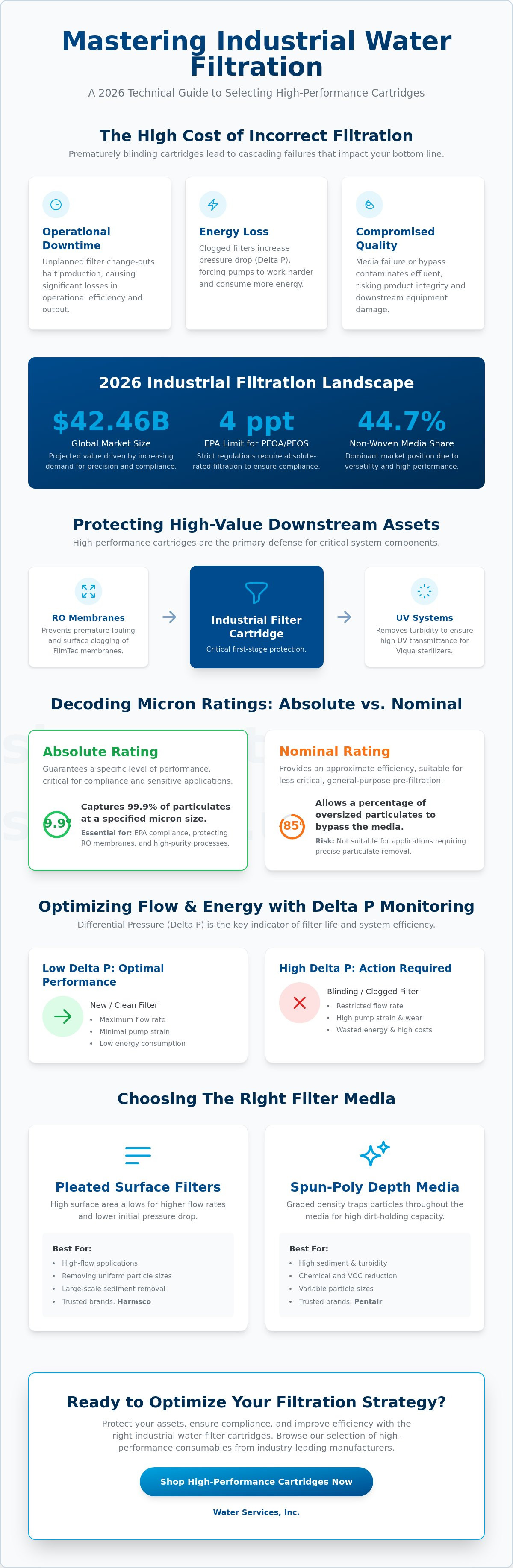
Precision industrial applications cannot rely on nominal filtration ratings. Nominal filters provide an approximate efficiency, often allowing a percentage of oversized particulates to bypass the media. In contrast, absolute-rated cartridges ensure that 99.9% of particulates at a specific micron size are captured. This distinction is vital when managing mining wastewater treatment solutions or sensitive chemical manufacturing. Utilizing advanced water filtration methods like adsorption and sieving allows operators to meet the 2026 EPA regulations for PFAS. These rules require keeping PFOA and PFOS levels at or below 4 parts per trillion. With the global industrial filtration market projected to reach 42.46 billion USD in 2026, the demand for this specialized precision is increasing.
Protecting Downstream Infrastructure
The primary role of a pre-filter is to shield expensive hardware from damage. In commercial reverse osmosis water filtration systems, high-quality sediment cartridges prevent the premature fouling of FilmTec or Hydranautics membranes. Without this protection, particulates clog the membrane surface, increasing energy consumption and reducing permeate flow. Similarly, Viqua UV sterilization systems require high water transmittance to function. Cartridges must remove turbidity to ensure UV light reaches every pathogen. Effective filtration also reduces mechanical wear on Goulds Water Technology pumps by eliminating abrasive particulates that erode impellers and seals.
Meeting Industry-Specific Standards
Operational environments dictate the necessary filtration hardware. Remote military deployments and mobile ultrafiltration units require ruggedized housings and high-capacity pleated cartridges that handle variable feed water quality. In the mining sector, managing high-turbidity wastewater is a daily challenge. Operators must use robust water treatment strategies to ensure compliance with local discharge permits. Global industrial manufacturing sites also face diverse standards. They must maintain consistent process water quality across different geographic locations to ensure product uniformity. High-performance cartridges from brands like Harmsco and Pentair provide the reliability needed to meet these international specifications while controlling long-term consumable costs.
Decoding Technical Specifications: Micron Ratings and Flow Dynamics
Selection of industrial water filter cartridges is a technical exercise in balancing particle retention with system energy costs. Engineering teams must look beyond simple size dimensions to evaluate how media architecture interacts with fluid velocity. Performance is measured by the ability to maintain a specific effluent quality while minimizing the "Delta P," or differential pressure. If you ignore these dynamics, you'll face high operational costs from premature blinding and excessive pump strain.
Material compatibility is equally vital. Standard polypropylene media works for many applications, but aggressive process fluids or high-temperature environments require specialized polymers like Polyethersulfone (PES) or PTFE. Elastomers used in O-rings and gaskets, such as EPDM, Viton, or Buna-N, must also be compatible with the chemical profile of the feed water. Failure to match these materials leads to seal degradation and untreated fluid bypass. You can monitor system performance and pressure trends using precision monitoring hardware to ensure your cartridges operate within their design parameters.
Absolute vs. Nominal Micron Ratings
The distinction between absolute and nominal ratings is a frequent point of confusion in procurement. A 5-micron nominal filter is only an estimate of efficiency. It might allow up to 20-micron particles through if the pore size distribution is inconsistent. In contrast, an absolute-rated pleated cartridge provides a 99.9% retention efficiency at the specified micron level. This level of precision is non-negotiable for critical process steps where downstream contamination is unacceptable. Pore size distribution also impacts contaminant holding capacity; a narrower distribution often results in a more predictable service life.
Calculating Flow Rates and Vessel Sizing
Flow rate requirements dictate the total surface area needed for your application. Engineers use flux rates, measured in gallons per minute (GPM) per 10-inch equivalent, to determine the appropriate number of cartridges. Sizing the housing too small leads to a high initial pressure drop, which shortens the effective life of the media. For high-volume applications, consulting a guide on industrial water filtration systems helps in selecting multi-cartridge configurations. These setups distribute the load across multiple elements, reducing the velocity through the media and maximizing total throughput before a change-out is required.
Comparing Filter Media: From Sediment Removal to Chemical Adsorption
Selecting the correct media for industrial water filter cartridges involves matching the capture mechanism to the specific contaminant profile. In 2026, the non-woven segment dominates the market with a 44.7% share, largely due to the versatility of these materials in both depth and surface applications. While depth filtration handles variable particle size distributions, surface filtration provides the high surface area necessary for high-flow industrial processes. Choosing the wrong architecture leads to rapid blinding or untreated bypass, both of which compromise downstream equipment.
Specialty media options extend beyond basic sediment removal. KDF and ion-exchange cartridges are critical for targeted heavy metal removal in mining wastewater and remote military sites. These environments often face contaminants that standard mechanical filters cannot address. For high-purity requirements, membrane-grade cartridges provide an absolute barrier for sub-micron sterile filtration. This level of protection is essential for shielding FilmTec RO membranes from ultra-fine particulates that cause irreversible fouling and high replacement costs.
Mechanical Sediment Removal
Mechanical filtration relies on either depth or surface capture. String-wound cartridges are effective for high-viscosity fluids because their diamond-pattern wind provides a high dirt-holding capacity. Melt-blown filters offer a more consistent pore structure for precise sediment control. For high-flow, low-pressure drop applications, pleated polyester cartridges from manufacturers like Harmsco are the industry standard. These designs utilize multi-gradient density media to extend service life; larger particles are trapped on the outer layers while finer solids are captured in the core, preventing premature surface blinding.
Adsorption and Chemical Treatment
Chemical adsorption is the primary method for removing dissolved organics and chlorine. High-capacity carbon blocks are preferred for industrial dechlorination where high contact time is required in a compact footprint. Granular Activated Carbon (GAC) serves high-flow organic reduction needs but requires careful monitoring to prevent carbon fines from entering the process stream. With the 2026 EPA regulations enforcing a 4 parts per trillion limit for PFOA and PFOS, specialized carbon media has become a requirement for environmental compliance. Integrating these advanced cartridges with water treatment chemicals distributors allows for a comprehensive, multi-barrier approach to complex feed water challenges. This ensures that your system meets both process integrity and regulatory standards simultaneously.
Top-Performing Cartridges for 2026 Industrial Applications
Selecting industrial water filter cartridges requires identifying hardware that matches the specific mechanical and chemical demands of your facility. Leading manufacturers such as Pentair, Harmsco, and 3M have established the 2026 benchmarks for reliability and throughput. These brands provide the necessary technical integrity for demanding environments like power generation and petrochemical processing. High-performance filtration is about more than just particle capture; it's about ensuring the longevity of downstream assets like Hydranautics RO membranes and Viqua UV lamps.
Harmsco High-Flow Pleated Cartridges remain the industry standard for large-scale sediment removal. Their architecture allows for high-velocity fluid processing without the excessive pressure drop typical of lower-grade alternatives. For facilities requiring mineral-free process water, high-purity RO membranes from FilmTec and Hydranautics provide the necessary rejection rates. Specialty cartridges also play a critical role in niche applications, including oil/water separation and ruggedized units for military deployments. These specialized filters ensure that mobile ultrafiltration systems remain operational in high-turbidity environments.
Standout Products from Our Collection
The Harmsco Hurricane Series is engineered for extreme flow rates and features a design that supports reusable applications in specific industrial contexts. For commercial pretreatment, Pentek Big Blue Cartridges offer reliable 10-inch and 20-inch solutions that fit standard large-diameter housings. These are often paired with Viqua replacement sleeves and filters to maintain the UV transmittance required for effective sterilization. You can explore the full Water Filter Cartridges collection to find the specific SKUs required for your system configuration.
Selecting by Housing Compatibility
Industrial housings require exact cartridge end-cap configurations to prevent bypass. High-pressure environments typically utilize 222 or 226 O-ring designs to ensure a positive, leak-proof seal within the vessel. It's also necessary to cross-reference cartridge lengths, which range from standard 10-inch and 20-inch units to 30-inch and 40-inch elements for multi-round vessels. Using Ashcroft pressure gauges to monitor the differential across these housings is the most effective way to determine when a change-out is required. If you need to upgrade your current filtration hardware, you should browse our high-performance industrial consumables to ensure your system remains within spec.
Maintenance and Lifecycle Management for Maximum Efficiency
Operational efficiency in high-volume systems depends on a shift from reactive to predictive maintenance. Monitoring the differential pressure (Delta P) across your industrial water filter cartridges is the most reliable way to prevent media rupture or bypass. A standard protocol involves recording the pressure drop at the start of a clean cycle and establishing a terminal pressure setpoint, typically between 15 and 25 PSID. If you wait for the flow to stop entirely, you're already risking downstream damage. Exceeding these limits risks 'bursting' the media, which sends accumulated contaminants directly into your FilmTec membranes or Viqua UV systems.
Sanitization is a critical step during every change-out. Each time you open a Pentair housing, you must inspect the internal seals and sanitize the vessel to prevent biofilm accumulation. This is especially vital in food and beverage applications, which represent 47.0% of the filtration market in 2026. For spent cartridges, the current industry trend shows a significant increase in the use of recyclable non-woven and activated carbon media. Facilities should coordinate with local waste management to ensure compliance with environmental standards for industrial consumables, particularly when handling media used for PFAS or heavy metal removal.
Monitoring and Troubleshooting
Precision instrumentation identifies 'blinded' filters before they trigger a system shutdown. Ashcroft pressure gauges provide the visual data needed for manual checks, but modern facilities often integrate Signet flow sensors and Walchem controllers for automated tracking. By connecting these sensors to electric power controls, operators receive real-time alerts when flow rates deviate from the baseline. This monitoring also helps detect 'channeling' in carbon blocks. Channeling occurs when water carves a path through the media, rendering the adsorption process ineffective even if the pressure drop remains low.
Operational Best Practices
Standardizing hardware across multiple sites is the most effective way to reduce inventory complexity and cost. Whether you're managing remote mining operations or mobile military units, keeping a consistent stock of 10-inch and 20-inch replacements ensures that critical spares are always available. All personnel performing maintenance must be trained in the use of personal protective equipment (PPE) to handle potentially contaminated media safely. Scheduled maintenance based on throughput data is always more cost-effective than reactive repairs. It's the only way to ensure consistent effluent quality and maximize the service life of every cartridge in your inventory.
Optimizing Your Filtration Infrastructure for 2026 and Beyond
Maintaining process integrity requires a disciplined approach to media selection and lifecycle management. By distinguishing between absolute and nominal ratings and implementing a rigorous differential pressure monitoring protocol, you can significantly reduce unplanned downtime and protect high-value assets. Utilizing high-performance industrial water filter cartridges ensures your system meets the stringent 2026 environmental standards while controlling total operational costs. The transition from reactive maintenance to technical specification is the most effective way to stabilize your effluent quality and ensure predictable throughput.
We're an authorized distributor for Harmsco, Pentair, and Viqua, providing the technical engineering support required for complex filtration arrays. Our expertise in global industrial and military logistics ensures that critical consumables reach your facility on schedule. We're ready to assist you in refining your procurement strategy to maximize system longevity and process reliability. Shop our full collection of high-performance Industrial Water Filter Cartridges to secure your facility's operational future with hardware you can trust.
Frequently Asked Questions
How do I determine the correct micron rating for my industrial process?
Base your selection on the smallest particle size that must be removed to protect downstream equipment or meet final product specifications. If you're protecting a Viqua UV system, you must meet specific transmittance and turbidity requirements to ensure sterilization. Absolute-rated cartridges are necessary for these critical process steps. Nominal filters are generally sufficient for primary sediment reduction where 100% retention isn't required for every particle size.
What is the difference between a pleated and a depth (melt-blown) filter?
Pleated designs provide significantly more surface area, which is ideal for high-flow rates and lower initial pressure drops. This architecture allows for longer service life in clean fluids. Melt-blown depth filters utilize a tortuous path to capture a wide range of particle sizes throughout the media thickness. This makes depth filters a better choice for feed water with high turbidity or varying particle size distributions.
Can I wash and reuse industrial water filter cartridges?
Most melt-blown and carbon cartridges are single-use consumables that require disposal after blinding. However, specific pleated polyester filters from Harmsco are designed to be washed and returned to service in certain sediment-only applications. You should never attempt to clean a filter if the process involves hazardous chemicals, sterile requirements, or if the media shows signs of structural degradation or permanent staining.
How often should I change my industrial carbon block filter?
Replacement should occur when the differential pressure reaches the terminal setpoint or when effluent testing shows chemical breakthrough. For industrial dechlorination, monitoring chlorine levels after the filter is the only reliable way to ensure the carbon hasn't reached its adsorption limit. While a 15 to 20 PSID drop often indicates physical blinding, the adsorption capacity might be exhausted well before you see a significant pressure change.
Are all 20-inch cartridges compatible with any 20-inch housing?
No, physical length is only one factor in housing compatibility. You must also match the cartridge diameter, such as standard 2.5-inch versus 4.5-inch Big Blue sizes, and the specific end-cap configuration. High-pressure industrial housings often require 222 or 226 O-ring connections to ensure a positive seal. Using a double-open-end (DOE) cartridge in a housing designed for O-ring seals will result in untreated fluid bypass.
What happens if I don't change the filter cartridge at the recommended pressure drop?
Neglecting change-outs leads to media failure and untreated fluid bypass. High differential pressure can cause the cartridge to collapse or the media to tear. This sends a concentrated slug of sediment into your FilmTec RO membranes or Goulds pumps. These failures result in expensive hardware repairs and unplanned facility downtime that far exceeds the cost of routine industrial water filter cartridges replacement.
Do I need a specific cartridge for high-temperature industrial fluids?
Standard polypropylene media typically has a maximum operating temperature of 140°F and will fail in hotter processes. You must select industrial water filter cartridges made from specialized materials like PES, nylon, or stainless steel for high-temperature applications. Ensure the elastomers, such as Viton or EPDM O-rings, are also rated for the specific temperature and chemical profile to prevent seal failure and leaching.
How do I protect my RO membrane from chlorine damage using cartridges?
Install high-capacity carbon block cartridges upstream of the RO unit to adsorb free chlorine. Free chlorine causes rapid oxidation of the polyamide layer in FilmTec or Hydranautics membranes. This damage is irreversible and results in a total loss of salt rejection capabilities. Using a dedicated carbon stage is the most reliable mechanical method to ensure your reverse osmosis system remains within its design parameters.
0 comentarios